"Motion skill" means three different things depending on who searches it. Since 8 October 2026, Claude has a built-in feature called Claude Motion, and a lot of people looking for a "motion skill" want that. Developers in Claude Code usually want a skill that makes their interface animate well. And a third group wants Claude to produce motion graphics videos.
We read the source of every skill in this guide on 14 November 2026: the SKILL.md, its reference files and its README. Star counts and last-update dates come from GitHub that day. Where a skill is in the HostedMCP catalog, the checks score is ours.
Three things called a motion skill
| You want | What to use | Where it runs | Output |
|---|---|---|---|
| An animated explainer of a report, chart or plan | Claude Motion (built in) | claude.ai, Team and Enterprise | MP4 |
| Interface animation that feels right: hovers, modals, page transitions | UI motion skills: design-motion-principles, LottieFiles motion-design, a Motion library skill | Claude Code, Codex, Cursor | Code in your app |
| Motion graphics or video made in code | Remotion skills, OpenMotion, open-artifacts claude-motion | Claude Code, Codex, Cursor, locally | MP4 or GIF rendered on your machine |
The first one is a product feature, not a skill. The other two are folders of instructions you install into an agent.

Claude Motion, the built-in one
Anthropic announced Claude Motion together with Claude Dashboards on 8 October 2026. Both are in beta. The same day, Docs, Slides and Design left beta.
What it does, in Anthropic's own words: Claude "builds an animation from your prompt, and it plays like a short video." It "writes code that animates your text, charts, shapes, and images", and it "doesn't use a video generation model, so there's no generated footage and no AI-generated people."
That last point sets expectations. Motion is for explaining things: a quarterly report turned into an all-hands clip, a chart from a board deck that builds itself, a product walkthrough for onboarding. Those are the examples Anthropic gives. It will not make a cinematic scene with people in it.
How to use it:
- Type
/motionin the message box, or ask in plain words, for example "Animate how our pricing plans compare for the sales kickoff." - Change the result in the editor or ask Claude to change it. Because the animation is code, any word, number or timing can be edited.
- Download it as an MP4 file. Animations also open in Adobe, Descript, HeyGen, Higgsfield, invideo, Luma AI and Runway, with Canva and Captions listed as coming soon.
Who gets it: Team and Enterprise plans, in beta. Dashboards and Motion are off by default; an admin turns them on under Organization settings › Artifacts. Sharing outside your organization works only if the admin allows it. Anthropic's announcement does not state a length limit.
If you are on a Pro or Max plan, Motion is not available in this beta. The closest you can get locally is the community skill described in the video section below.
Skills for UI and interaction motion
This is the "UI UX interaction motion" part of the search. These skills do not render anything themselves. They change what Claude Code writes when it adds a transition, so the result is faster, more consistent and accessible.
design-motion-principles
kylezantos/design-motion-principles, MIT, 1,562 stars, last pushed 30 May 2026.
The skill distils the published work of three motion designers, Emil Kowalski, Jakub Krehel and Jhey Tompkins, and weighs them by context. It has two modes: Create, which builds components with motion, and Audit, which reviews motion that already exists and writes a report.
Two rules from its SKILL.md stood out. The first is a frequency gate, applied before any animation is added:
| How often users trigger it | Recommendation |
|---|---|
| Rarely, monthly | Expressive motion is fine |
| Occasionally, daily | Subtle and fast |
| Constantly, hundreds of times a day | No animation, or an instant change |
| From the keyboard | Never animate |
The second is duration by context: under 300 ms for productivity interfaces, with 180 ms as the ideal; 200 to 500 ms for production polish; and whatever serves the effect in playful or children's apps. The skill tells the agent not to cap durations blindly, but to check which context it is in first. Every animation must also handle prefers-reduced-motion, with no exceptions.
We installed it with the skills CLI 1.8.1:
npx skills add kylezantos/design-motion-principles --agent claude-code
It put 15 files, 212 KB in total, into .claude/skills/design-motion-principles/: the SKILL.md, two workflows (create.md, audit.md) and twelve references, including one per designer, an accessibility guide and an HTML report template. There are no scripts in it, so it cannot run anything on its own. The CLI also wrote a skills-lock.json at the project root.
Use it when you want a second opinion on motion, or when you ask Claude for "a modal that opens nicely" and want it to pick a sensible duration instead of a guess.
LottieFiles motion-design
LottieFiles/motion-design-skill, MIT, 3,020 stars, last pushed 18 May 2026. It is in our catalog as lottiefiles/motion-design.
Where design-motion-principles is about restraint, this one is about character. It asks three questions before any technical choice (what the viewer should feel, what the micro-story is, and how to make it believable) and splits motion into primary, secondary and ambient layers.
Its most useful table is the motion personality. You pick one per project and apply it everywhere:
| Personality | Duration | Easing | Overshoot |
|---|---|---|---|
| Playful | 150–300 ms | ease-out-back | 10–20% |
| Premium | 350–600 ms | cubic-bezier(0.4,0,0.2,1) | 0% |
| Corporate | 200–400 ms | cubic-bezier(0.2,0,0,1) | 0–3% |
| Energetic | 100–250 ms | ease-out-expo | 15–30% |
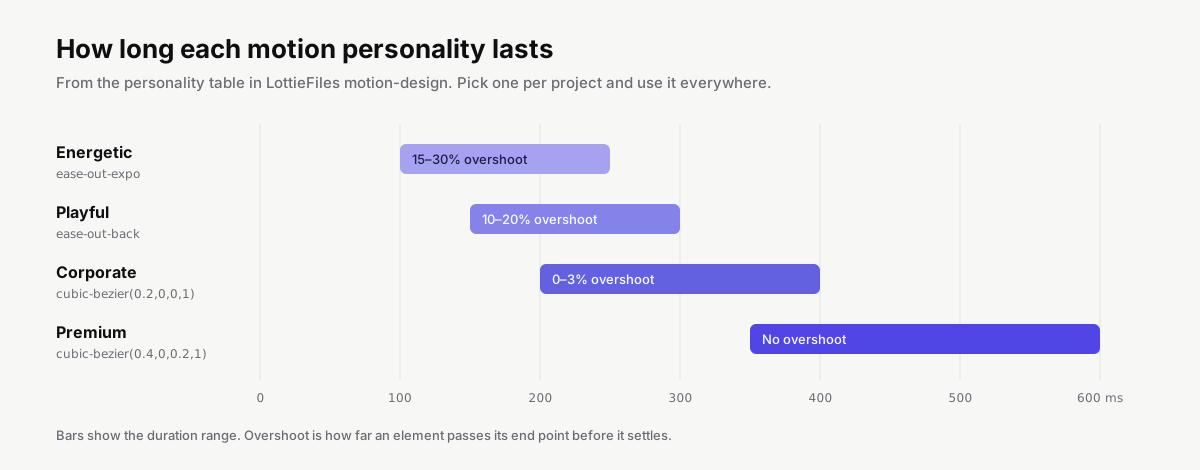
The default is Corporate for interfaces and Playful for illustrations. It then has you fix three constants for the brand: one signature easing curve for most animations, three durations, and one entrance pattern. If your product has no motion system yet, this skill is a fast way to get one written down.
npx skills add LottieFiles/motion-design-skill
Skills for the Motion library
Motion, the React and JavaScript animation library formerly called Framer Motion, has its own skills. These teach Claude the library's API rather than design judgement.
The most listed one, motion from jezweb/claude-skills, still appears on several skill registries. When we checked on 14 November 2026, it was no longer in that repository. If a registry hands you that command, it will fail or install a stale copy.
The live alternative is motion in secondsky/claude-skills (MIT, 248 stars, pushed 31 October 2026). Its SKILL.md is long, 516 lines, and covers installation, AnimatePresence exit animations, layout animation, scroll and gestures, with a troubleshooting section that starts with the most common bug: exit animations that do not run. One detail worth knowing from it: motion is the current package name, and framer-motion is a deprecated alias that still publishes the same code. The skill keeps framer-motion as a workaround for Cloudflare Workers builds. It ships as a Claude Code plugin:
/plugin marketplace add secondsky/claude-skills
/plugin install motion@claude-skills
Skills for motion graphics and video
Remotion's official skills
Remotion turns React components into video, and its team publishes agent skills at remotion-dev/skills (6,974 stars, pushed 11 November 2026). There are 13 of them, including remotion-create, remotion-captions, remotion-interactivity and remotion-docs, with remotion-best-practices acting as the router that sends the agent to the right one. That router skill carries a version number, 4.0.543, tied to the Remotion release.
npx skills add remotion-dev/skills
The README also offers gh skill install remotion-dev/skills for GitHub CLI users.
This is the right pick when the video is part of a product: release clips, personalised videos, captions on recorded talks. You get React code you can keep, not a one-off export. Many registries list copies of remotion-best-practices under other owners; install from remotion-dev so you get updates.
OpenMotion
nexu-io/openmotion, Apache-2.0, 9,862 stars, pushed the day we checked. It is the largest motion project in our catalog, and its openmotion-director skill passed our checks with a score of 100 (see it here).
The director skill plans and builds original motion videos: it forms a creative judgement, turns it into an action script, tests the riskiest part first, then builds and reviews the whole film. Sibling skills recreate a reference video as an editable project, adapt templates and swap brand assets. Note that the SKILL.md is written in Chinese. Claude handles that fine, but you will want a translator if you plan to edit the skill.
open-artifacts claude-motion
JimLiu/open-artifacts, formerly baoyu-design, 6,424 stars. It repackages the artifact types from claude.ai, Motion included, as local skills for Claude Code, Cursor and Codex. Its claude-motion skill writes a film as code, scene by scene, plays it in a local player and exports MP4 or GIF. The README gives 10 to 30 seconds as the default length and 15 minutes as the maximum. A companion skill, motion-director, adds narration, a voice and timing to the words.
Two cautions. The project says it is not affiliated with Anthropic. And while the maintainer's code is MIT, the repository says it grants no license to the Anthropic material inside it, so read the license note before you use it at work.
npx skills add JimLiu/open-artifacts --skill claude-motion --agent claude-code
Side by side
| Skill | Makes | Stars | License | Last push | Scripts |
|---|---|---|---|---|---|
| design-motion-principles | UI motion code and audits | 1,562 | MIT | 30 May 2026 | None |
| LottieFiles motion-design | Motion system and UI animation | 3,020 | MIT | 18 May 2026 | None |
| secondsky motion | Motion library code | 248 | MIT | 31 Oct 2026 | Two setup scripts: install, bundle optimizer |
| Remotion skills | Videos as React code | 6,974 | Not stated | 11 Nov 2026 | Runs Remotion and Node commands |
| OpenMotion director | Motion graphics films | 9,862 | Apache-2.0 | 14 Nov 2026 | None in the skill folder |
| open-artifacts claude-motion | Code-made films, MP4 or GIF | 6,424 | MIT plus unlicensed Anthropic material | 13 Nov 2026 | Local player and export |
Stars and dates from GitHub on 14 November 2026. "Not stated" means the repository has no license file GitHub recognises.
Which one to install
- You build a SaaS dashboard and want calmer transitions. design-motion-principles, in Audit mode first, on the screens people use most.
- Your product has no motion style yet. LottieFiles motion-design, then ask Claude to write the three brand constants into your design tokens.
- You use the Motion library and Claude keeps writing old
framer-motionpatterns. secondsky'smotion. - Marketing needs a 30-second explainer of last quarter. Claude Motion if you are on Team or Enterprise; open-artifacts claude-motion if you are not.
- You ship videos as part of the product. Remotion's skills.
- You make long-form motion graphics. OpenMotion.
UI and video skills do not conflict, so a design-engineering team can install one of each. Two UI skills at once is less useful: they give the agent two sets of duration rules, and it has to pick.
How to install, and where files go
The skills CLI works for all of the skills above. The plain command installs into the current project:
npx skills add <owner/repo>
Add -g to install for every project, --skill <name> to take one skill from a repository that has many, and --agent claude-code to install for Claude Code only.
For Claude Code the files land in .claude/skills/<name>/. Commit that folder and skills-lock.json if your team should share the skill. Claude Code reads each skill's description and loads the full skill when a request matches it, so you do not need to name it in every prompt. Our guide to installing Claude skills covers the plugin and manual routes too.
Before you install
The skills CLI ends every install with a line worth taking literally: "Review skills before use; they run with full agent permissions." A skill is instructions the agent follows, and some come with scripts it can run.
What we found when we read these:
- design-motion-principles and LottieFiles motion-design are text and references only. Low risk.
- secondsky's
motionadds two shell scripts:init-motion.shinstalls the package and sets up the project, andoptimize-bundle.shrewrites components to the smaller LazyMotion build. Both are short and readable; read them before letting the agent run them. - Video skills run commands by design: Node, npm, Remotion and often ffmpeg. That is normal for the job, but check what each one is allowed to run and do not approve broad shell access without looking.
- Registries copy skills. The same name can point to an old fork, a renamed repo or, like jezweb's
motion, to nothing. Install from the original repository.
HostedMCP runs automated checks on every indexable skill in its catalog: whether the repository is reachable, the license, recent activity, the scripts in the folder (download-and-run, remote code, credential access) and hidden instructions in the SKILL.md. Each skill page links to its full report.