
An open-source headless CMS that allows AI agents to write drafts and manage content through an MCP server.
Also known as seirai-dev/areca-cms, @areca-cms/skills
- Stars
- 6
- Tools
- —
- Downloads, 30 days
- 1,683
- Latest version
- —
- Last commit
- Nov 13, 2026
- License
- MIT
What is Areca CMS MCP?
Areca CMS is an open-source headless CMS that allows AI agents to write drafts and manage content through an MCP server.
Summary generated from the project's README
About Areca CMS MCP server
Areca CMS is an open-source headless content management system designed specifically for agencies managing multiple client websites from a single installation. It provides a structured workflow where editors create drafts, owners mark content as ready, and a Go live command freezes approved content into a snapshot for deployment. This ensures that websites remain fast and static because visitors interact with snapshots rather than the live CMS.
Developers and agencies can connect AI clients like Claude, ChatGPT, or Cursor to their sites using a dedicated MCP server URL. This allows AI agents to write drafts using the same permissions as the connected user. The system includes specialized agent skills to help coding agents wire up new sites. Setup typically involves running the application via Docker Compose with PostgreSQL, Redis, and S3-compatible storage.
What you can do with it
- 1Automated content draftingAn AI agent can write new content drafts directly into the CMS using the MCP server connection.
- 2Safe content deploymentAgencies can manage a publishing pipeline that moves content from draft to live status with built-in safety checks.
- 3Multi-client managementAn agency administrator can oversee various clients, each with their own specific sites, owners, and editors, from one dashboard.
Written from the project's README. Every use case is checked against a quote from it.
How to install Areca CMS MCP
Formats verified 10 Nov 2026Add to CursorAdd to GooseInstall Areca CMS MCP in Claude Code
$ claude mcp add areca-cms -- npx -y @areca-cms/skillsInstall Areca CMS MCP in Cursor
~/.cursor/mcp.json
{
  "mcpServers": {
    "areca-cms": {
      "command": "npx",
      "args": [
        "-y",
        "@areca-cms/skills"
      ]
    }
  }
}Install Areca CMS MCP in VS Code
.vscode/mcp.json
{
  "servers": {
    "areca-cms": {
      "type": "stdio",
      "command": "npx",
      "args": [
        "-y",
        "@areca-cms/skills"
      ]
    }
  }
}Install Areca CMS MCP in VS Code CLI
$ code --add-mcp '{"name":"areca-cms","type":"stdio","command":"npx","args":["-y","@areca-cms/skills"]}'Install Areca CMS MCP in Claude Desktop
claude_desktop_config.json
{
  "mcpServers": {
    "areca-cms": {
      "command": "npx",
      "args": [
        "-y",
        "@areca-cms/skills"
      ]
    }
  }
}Install Areca CMS MCP in Codex
$ codex mcp add areca-cms -- npx -y @areca-cms/skillsInstall Areca CMS MCP in Codex config.toml
~/.codex/config.toml
[mcp_servers.areca-cms]
command = "npx"
args = ["-y", "@areca-cms/skills"]
Install Areca CMS MCP in Gemini CLI
$ gemini mcp add -s user areca-cms npx -- -y @areca-cms/skillsInstall Areca CMS MCP in Gemini settings.json
~/.gemini/settings.json
{
  "mcpServers": {
    "areca-cms": {
      "command": "npx",
      "args": [
        "-y",
        "@areca-cms/skills"
      ]
    }
  }
}Automated checks
Ran Nov 12, 2026Full report →Passed our automated checks. That is not a security audit: read the code and give the server the narrowest access it needs. How checks work

- Source repository linked and reachablePass
- Open source license (OSI)Pass
- Commit or release in the last yearPass
- Package name not close to a popular packagePass
- Remote endpoint uses HTTPSNot checked
- Destructive tools are labelledNot checked
- No hidden instructions to the modelPass
- No critical advisory in the package or its dependenciesNot checked
README
View on GitHubAreca CMS
The open-source CMS for agencies that run many client websites.
Clients write and approve their own content. Your sites stay fast, static and fully yours.
Website · Documentation · Live demo · Quick start




Why Areca CMS
Most headless CMSs are built for one company with one website. Agencies have the opposite problem: dozens of clients, each with a site or two, each with people who should only see their own content.
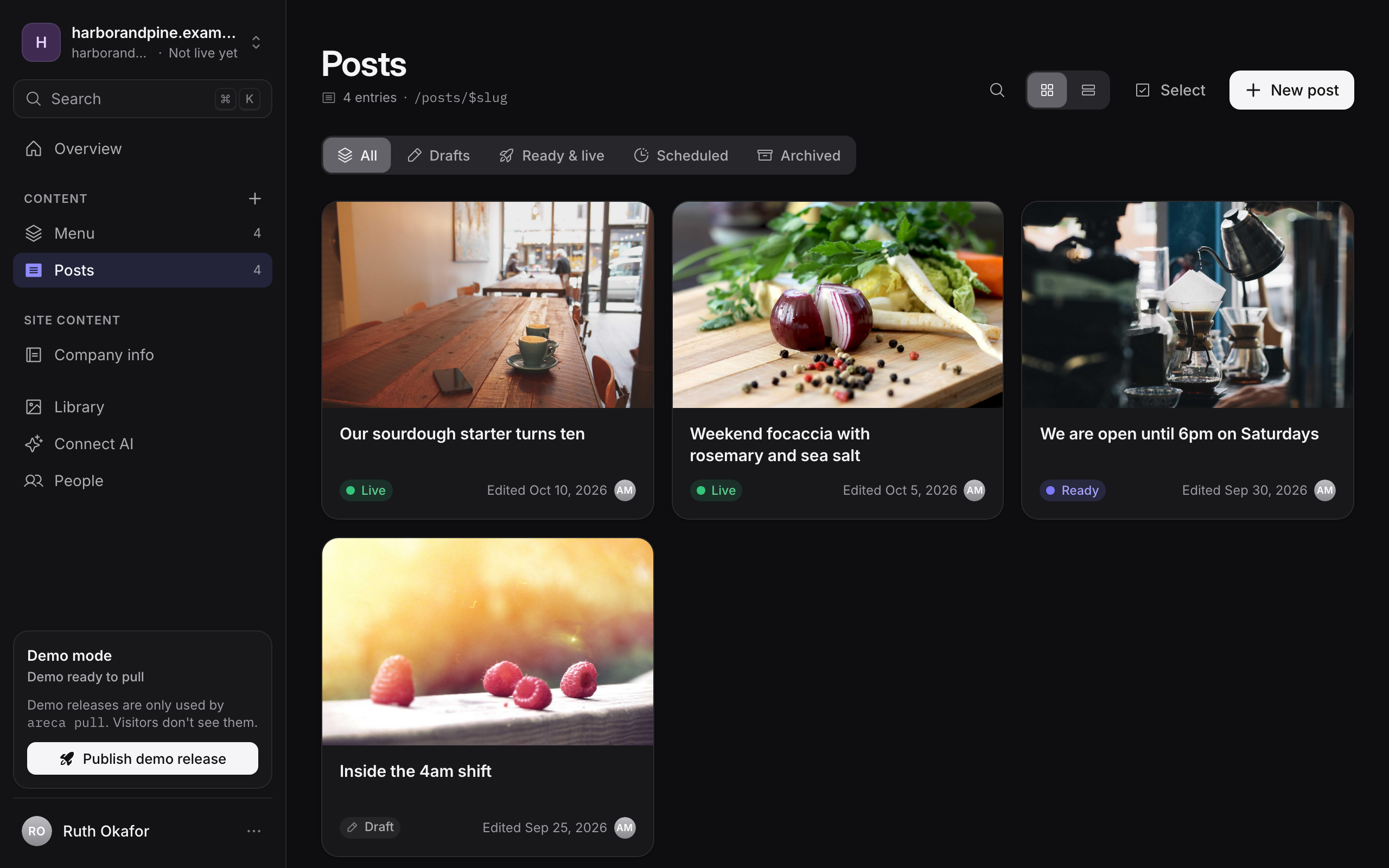
Areca CMS is built around that. One installation holds all your clients. Each client gets its own sites, owners and editors, and your agency admins see everything. Editors write drafts, owners mark them ready, and Go live freezes the approved content into a snapshot and deploys the site. The website pulls that snapshot while it builds, so visitors get static pages and never touch the CMS.
- Built for agencies. Clients, sites and roles per client (owner, editor), an agency dashboard across all of them, and your own branding on the CMS.
- Visual editor. Edit next to a live preview of the real site, and click any part of the page to jump to its field.
- A safe publishing flow. Draft → ready → live, with scheduling, release history, rollback and health checks. A failed deploy never replaces the live site.
- Made for AI. Every site has an MCP server, so Claude, ChatGPT, Cursor and other AI apps can write drafts with the same permissions as the person who connected them. Agent skills teach coding agents to wire up a new site.
- SEO and AI answers. Search, social and structured-data fields on every entry, with optional AI suggestions through OpenRouter.
- Multilingual content, rich text with code blocks, a media library, and site-wide content such as company info.
- Deploys where you do. Built-in adapters for Dokploy and Cloudflare (Pages and Workers), and a throwaway development environment per site.
- Typed from schema to page. Define content in
areca.config.ts, and@areca-cms/site-sdkgenerates types for every collection. - Secure by default. Two-factor authentication, Google and Microsoft sign-in, step-up checks for sensitive actions, and a tested permissions matrix.
Quick start
1. Run the CMS
You need Docker with Compose v2. This starts the CMS with PostgreSQL, Redis, S3-compatible storage and a test inbox:
git clone https://github.com/seirai-dev/areca-cms.git
cd areca-cms/docker
cp .env.example .env    # then set the secrets, see the comments in the file
docker compose up -d --wait
Open http://localhost:3000/setup and create the first admin. The setup token is printed in docker compose logs cms. The Docker quick start explains each setting, and Production covers a public install.
2. Connect a website
Create a client and a site in the CMS and copy the site token. Then, in your website project:
pnpm add @areca-cms/site-sdk
pnpm exec areca init
Describe your content in areca.config.ts, push it with areca manifest push, and pull the content during your build with areca pull. The guide walks through a full site, from the first collection to the first release.
Using an AI coding agent? Run npx @areca-cms/skills, then ask it to /areca-quickstart.
How publishing works
Draft ─► Mark as ready ─► Go live ─► Content snapshot ─► Website build pulls it ─► Deploy ─► Health check ─► Live
Editing a draft never changes the live site. Only approved versions go into a release, and a release only counts as live after the health check confirms the website serves it. If a deploy fails, the previous version stays live, and any earlier release can be rolled back. Previews of drafts are fetched from the CMS on demand. Concepts explains the model in more detail.
What's in this repository
| Path | What it is |
|---|---|
apps/cms |
The CMS: editor, API, MCP server, publishing worker and scheduler |
packages/site-sdk |
@areca-cms/site-sdk: the SDK and areca CLI that connect a website |
packages/skills and skills |
@areca-cms/skills: agent skills for the SDK, the MCP server, visual editing and the quickstart |
examples/demo-site |
Northbound Coffee, a complete example website built with the SDK |
apps/docs |
The documentation site, docs.arecacms.com |
apps/landing |
The website, arecacms.com, and its product video |
docker |
Docker Compose for self-hosting, and backup and recovery tools |
docs |
Notes for contributors: architecture, design decisions, permissions |
The CMS is a TanStack Start app on PostgreSQL with Drizzle, Redis and S3-compatible storage. The interface is available in English, Dutch and Turkish.
Contributing
Contributions are welcome, from typo fixes to new features. CONTRIBUTING.md explains how to set up the workspace, run the tests and get a change merged. For bigger changes, please open an issue first.
Found a security problem? Please report it privately, as described in SECURITY.md.
Releases
The CMS is published as a Docker image, ghcr.io/seirai-dev/areca-cms, tagged vX.Y.Z, vX.Y and latest. The GitHub releases list what changed in each version, and Upgrades explains how to move between them. The npm packages have their own changelogs: site-sdk and skills.
Support the project
Areca CMS is free and MIT licensed. If it saves your agency time, you can sponsor its development on GitHub. A star on this repository helps too.
License
MIT © 2026 Emir Kaan Özver and Areca CMS contributors
Areca CMS MCP questions
How do I add Areca CMS MCP to Claude Code?
Run claude mcp add areca-cms -- npx -y @areca-cms/skills in your terminal. Add --scope user to make it available in every project.
How do I add Areca CMS MCP to Cursor?
Open ~/.cursor/mcp.json and add the server under mcpServers, using the Cursor config shown in the install section above.
How can AI agents use Areca CMS?
Every site has an MCP server, allowing Claude, ChatGPT, Cursor, and other AI apps to write drafts using the same permissions as the connected user.
What happens if a website deployment fails?
A failed deployment will never replace the live site; the previous version remains active.
How do I get started with the CMS using Docker?
You can run the CMS by cloning the repository, configuring the .env file, and using docker compose up.