
Solves sparse linear systems, estimates single entries, and ranks graph nodes via local push and PageRank algorithms.
Also known as ruvnet/sublinear-time-solver, goalie
- Stars
- 94
- Tools
- 14
- Downloads, 30 days
- —
- Latest version
- —
- Last commit
- Nov 11, 2026
- License
- MIT
What is Sublinear Time Solver MCP?
Sublinear Time Solver solves sparse linear systems, estimates single entries, and ranks graph nodes via local push and PageRank algorithms. It exposes 14 tools, such as solve, estimateEntry, analyzeMatrix.
Summary generated from the project's README
About Sublinear Time Solver MCP server
Developers working with large-scale graphs and sparse matrices can use this tool to perform mathematical computations without processing every single variable. It provides specialized algorithms to solve systems of equations, estimate specific values, and rank nodes within a network. By focusing on local neighborhoods rather than the entire dataset, it achieves high efficiency for specific queries.
Users can integrate this into their workflow via a command line interface, a JavaScript API, or a Rust crate. When used as an MCP server, it connects to clients like Claude Code or Codex through standard input and output. It requires a coordinate format (COO) matrix and a vector for linear system tasks. The server includes specific tools for full solves, single entry estimation, and PageRank calculations, allowing for different levels of precision and computational cost depending on the user's needs.
What you can do with it
- 1Solve sparse linear systemsAn AI client can find the solution to a system of equations using the solve tool.
- 2Perform local graph updatesA user can identify the most important nodes in a specific neighborhood of a graph.
Written from the project's README. Every use case is checked against a quote from it.
How to install Sublinear Time Solver MCP
Formats verified 10 Nov 2026Add to CursorAdd to GooseInstall Sublinear Time Solver MCP in Claude Code
$ claude mcp add sublinear-time-solver -- npx -y goalieInstall Sublinear Time Solver MCP in Cursor
~/.cursor/mcp.json
{
  "mcpServers": {
    "sublinear-time-solver": {
      "command": "npx",
      "args": [
        "-y",
        "goalie"
      ]
    }
  }
}Install Sublinear Time Solver MCP in VS Code
.vscode/mcp.json
{
  "servers": {
    "sublinear-time-solver": {
      "type": "stdio",
      "command": "npx",
      "args": [
        "-y",
        "goalie"
      ]
    }
  }
}Install Sublinear Time Solver MCP in VS Code CLI
$ code --add-mcp '{"name":"sublinear-time-solver","type":"stdio","command":"npx","args":["-y","goalie"]}'Install Sublinear Time Solver MCP in Claude Desktop
claude_desktop_config.json
{
  "mcpServers": {
    "sublinear-time-solver": {
      "command": "npx",
      "args": [
        "-y",
        "goalie"
      ]
    }
  }
}Install Sublinear Time Solver MCP in Codex
$ codex mcp add sublinear-time-solver -- npx -y goalieInstall Sublinear Time Solver MCP in Codex config.toml
~/.codex/config.toml
[mcp_servers.sublinear-time-solver]
command = "npx"
args = ["-y", "goalie"]
Install Sublinear Time Solver MCP in Gemini CLI
$ gemini mcp add -s user sublinear-time-solver npx -- -y goalieInstall Sublinear Time Solver MCP in Gemini settings.json
~/.gemini/settings.json
{
  "mcpServers": {
    "sublinear-time-solver": {
      "command": "npx",
      "args": [
        "-y",
        "goalie"
      ]
    }
  }
}Sublinear Time Solver MCP tools 14
Detected from the READMEsolveestimateEntryanalyzeMatrixpageRankverifySparseSolutioncoherenceScoreclosureIndicessolveOnChangeSublinearcontrastiveSolveOnChangeSublinearestimateComplexityClassgenerateTestVectorsaveVectorToFile
| solve | — | |
| estimateEntry | — | |
| analyzeMatrix | — | |
| pageRank | — | |
| verifySparseSolution | — | |
| coherenceScore | — | |
| closureIndices | — | |
| solveOnChangeSublinear | — | |
| contrastiveSolveOnChangeSublinear | — | |
| estimateComplexityClass | — | |
| generateTestVector | — | |
| saveVectorToFile | — |
Show all 14 toolsShow fewer tools
solveTrueSublinearanalyzeTrueSublinearMatrix
| solveTrueSublinear | — | |
| analyzeTrueSublinearMatrix | — |
Automated checks
Ran Nov 12, 2026Full report →Passed our automated checks. That is not a security audit: read the code and give the server the narrowest access it needs. How checks work

- Source repository linked and reachablePass
- Open source license (OSI)Pass
- Commit or release in the last yearPass
- Package name not close to a popular packagePass
- Remote endpoint uses HTTPSNot checked
- Destructive tools are labelledPass
- No hidden instructions to the modelPass
- No critical advisory in the package or its dependenciesNot checked
README
View on GitHubSublinear Time Solver: sparse linear solvers, PageRank and local push for JavaScript, MCP and Rust




Solve systems of equations, estimate individual values, and rank nodes in a graph. Use the command line, the JavaScript API, the Rust crate, or an MCP client.
The idea is simple. If a problem has many variables but each one depends on only a few others, the solver can sometimes answer a question by visiting a small neighborhood. Think of a sensor network where one reading changes and you want to check nearby readings first.
Quick start · How it works · MCP · Library · Benchmarks · Upgrading from 1.7
| Package | Use it for | Runtime deps | Clean install |
|---|---|---|---|
@ruvnet/sublinear-core |
Embedding solvers and PageRank in a library or app | 0 | 1 package, 220 kB |
sublinear-time-solver |
MCP server, CLI, and the 1.x SublinearSolver class |
4 | 99 packages, 31 MB (1.7.2: 220 packages, 123 MB) |
sublinear |
Rust solvers with a complexity-typed API | — | cargo add sublinear |
Quick start
With Node.js and npm, paste this into a terminal in a scratch directory. The matrix uses coordinate format (COO), which lists the value, row, and column of each nonzero entry.
cat > matrix.json <<'JSON'
{
  "rows": 2, "cols": 2, "format": "coo",
  "values": [4, -1, -1, 4],
  "rowIndices": [0, 0, 1, 1],
  "colIndices": [0, 1, 0, 1]
}
JSON
printf '%s\n' '[3,3]' > vector.json
npx -y sublinear-time-solver solve --matrix matrix.json --vector vector.json \
  --method forward-push --output solution.json
cat solution.json
The two values in solution should be close to [1, 1], and metadata.converged should be true. Run npx -y sublinear-time-solver --help to see commands for inspecting matrices, generating test inputs, and running PageRank.
How it works
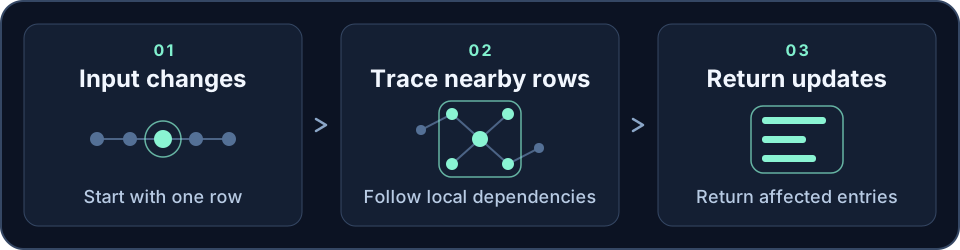
A sparse matrix stores only the relationships that exist. A local solve starts with the row you care about, follows nearby dependencies, and returns a value or a small set of updates. The cost depends on how large that neighborhood gets and how much accuracy you need. A full solve returns every value, so its output grows with the size of the system.
| If you need | Start with |
|---|---|
| Every value in a system of equations | CLI or MCP solve |
| An estimate for one entry | MCP estimateEntry |
| A small set of updates after a local change | The Rust event driven example on the development branch |
| An importance score for each node in a graph | CLI pagerank or MCP pageRank |
The local path works best when rows have few neighbors, the diagonal terms dominate, and the change stays local. Inspect your matrix with analyze and check the residual when you need to know how closely a solution satisfies the equations.
Use it with an MCP client
Add this to your client's MCP server configuration. It starts the server over standard input and output.
{
  "mcpServers": {
    "sublinear-solver": {
      "command": "npx",
      "args": ["-y", "sublinear-time-solver", "serve"]
    }
  }
}
With Claude Code: claude mcp add sublinear -- npx -y sublinear-time-solver serve. With Codex, add [mcp_servers.sublinear] with command = "npx" and args = ["-y", "sublinear-time-solver", "serve"] to ~/.codex/config.toml. All diagnostics go to stderr, so stdout carries only JSON-RPC.
Try asking your client to list the solver tools, then pass the COO matrix and vector from the quick start to solve. Clients can also inspect complexity metadata before choosing a tool. The MCP server source has the tool schemas, and ADR 001 explains the complexity budget.
Use it in code
The zero-dependency core is the fastest way to embed the math:
npm install @ruvnet/sublinear-core
import { solve, graphFromEdges, pageRank, personalizedPageRank, forwardPush, topK } from '@ruvnet/sublinear-core';

// A x = b. COO input; duplicate entries are summed. The residual is recomputed from x.
const { x, residual, converged } = solve(
  { rows: 2, cols: 2, rowIndices: [0, 0, 1, 1], colIndices: [0, 1, 0, 1], values: [4, -1, -1, 4] },
  [3, 3],
);

// PageRank and personalized PageRank on string ids
const g = graphFromEdges([['a', 'b'], ['b', 'c', 2], ['c', 'a'], ['a', 'c']]);
topK(pageRank(g).scores, 3, g);
personalizedPageRank(g, 'a', { damping: 0.85 });

// Local top-k: the work depends on epsilon, not on the graph size
topK(forwardPush(g, 'a', { epsilon: 1e-6 }).scores, 10, g);
solve(A, b, { method })accepts COO, dense rows, or aCsrMatrix(csrFromCoo,csrFromDense).- The default
'auto'uses conjugate gradient for symmetric matrices with a positive diagonal and Gauss-Seidel otherwise. 'jacobi'and'neumann'are also available. The two have identical iterates.- Jacobi, Neumann and Gauss-Seidel need diagonal dominance. Conjugate gradient needs a symmetric positive definite matrix.
- The default
pageRank/personalizedPageRank: scores sum to 1.dampingis the probability of following an edge, so a restart probability α meansdamping = 1 − α.forwardPush(g, seeds, { epsilon })/backwardPush(g, target): local personalized PageRank. Forward push does at most 1/((1 − damping)·epsilon) pushes, whatever the graph size.estimateEntry(A, b, i, { walks }): estimates one entry of x by random walks and returns a standard error. After a one-time check per matrix, the cost does not depend on n.
The core package README has the full API. sublinear-time-solver/core exposes the same functions plus the 1.x SublinearSolver class, without loading the MCP server. For Rust, run cargo add sublinear and see the crate documentation.
Use it from agentdb, claude-flow or ruvector
Make @ruvnet/sublinear-core an optional dependency and keep your own fallback (try { core = await import('@ruvnet/sublinear-core') } catch {}).
- claude-flow: replace
simplePersonalizedPageRankwithpersonalizedPageRank(graphFromEdges(edges), seed, { damping: 1 - restart })andtopK(scores, k, graph). claude-flow'sdampingis the restart probability. - agentdb:
SparsificationServicecan usepersonalizedPageRank(graphFromAdjacency(edges), source, { damping: 1 - alpha }), orforwardPushfor large graphs. - ruvector: rank similarity or code graphs with
pageRank, or smooth signals over them by solving(I + L) x = ywithsolve.
Runnable versions are in packages/sublinear-core/examples/.
Performance
Rust crate
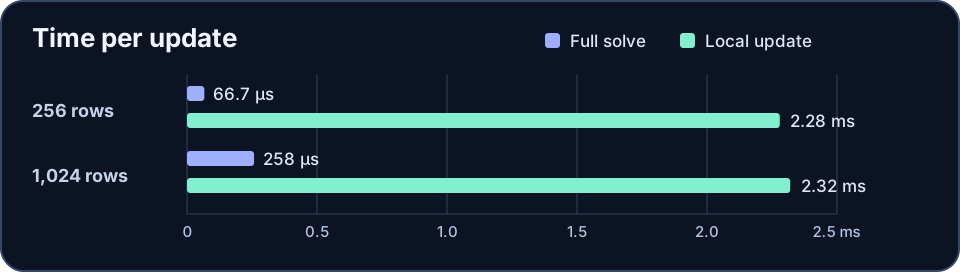
On this benchmark, quadrupling the number of rows took the full solve from 66.7 µs to 258 µs and the local update from 2.28 ms to 2.32 ms. The full solve was faster at both sizes. The local update grew more slowly because the changed neighborhood stayed small. See the benchmark setup and results.
JavaScript core
Setup.
- Harness:
packages/sublinear-core/bench/bench.mjs. Reproduce withnpm run bench. AddLEGACY=<dir>to time sublinear-time-solver 1.7.2, andGRAPH_TRANSFORMER=<dir>to time@ruvector/graph-transformer. - Inputs: generated from fixed seeds. Linear systems are random sparse strictly diagonally dominant matrices with about 9 non-zeros per row.
- Machine: Node v22.23.2 on an AMD Ryzen 9 9950X, single-threaded. The machine was shared (load average about 30), so treat the numbers as indicative.
- Timing: best of 3 runs, except single runs at n = 1,000,000.
Linear solves: accuracy against dense Gaussian elimination (n = 1,000, tolerance 1e-12).
| Method | Time | Iterations | Relative residual | Max error vs dense |
|---|---|---|---|---|
| Dense Gaussian elimination (reference) | 108.7 ms | — | — | — |
core gauss-seidel |
0.95 ms | 13 | 7.0e-13 | 4.0e-13 |
core jacobi |
2.04 ms | 20 | 2.5e-13 | 7.9e-14 |
core neumann |
0.70 ms | 20 | 2.5e-13 | 7.9e-14 |
1.7.2 SublinearSolver neumann |
50.8 ms | 23 | 5.0e-1 | 1.3e-1 |
The 1.7.2 Neumann solver returned a wrong answer here because its series used the wrong sign. That is fixed in 1.8.0.
Linear solves: scaling (tolerance 1e-10).
| n | nnz | Build CSR | Gauss-Seidel | Jacobi | 1.7.2 Neumann |
|---|---|---|---|---|---|
| 10,000 | 90 k | 8.8 ms | 2.3 ms (11 iterations) | 1.5 ms (16 iterations) | 4,402 ms |
| 100,000 | 900 k | 70 ms | 32 ms | 43 ms | — |
| 1,000,000 | 9.0 M | 951 ms | 474 ms | 314 ms | — |
Full-vector solves cost time linear in nnz per iteration; they are not sublinear.
Personalized PageRank head to head.
- Graphs: unweighted, about 10 out-edges per node, no dangling nodes, so every implementation's conventions agree. Restart probability 0.15.
- Error: max absolute error against a power iteration run to 1e-14.
- Timing: core times exclude the one-time graph build. That build took 5.3 ms, 393 ms and 3.4 s at the three sizes.
pprScoresconverts its adjacency-list input on every call, and that conversion is included in its time.
| n (edges) | core personalizedPageRank to 1e-9 |
core, fixed 20 iterations | @ruvector/graph-transformer pprScores (native, 20 iterations) |
core forwardPush eps 1e-4 |
core forwardPush eps 1e-7 |
1.7.2 computePageRank |
|---|---|---|---|---|---|---|
| 1 k (10 k) | 0.34 ms, err 4e-12 | 0.21 ms, err 2.4e-10 | 0.52 ms, err 2.4e-10 | 0.08 ms, err 8.8e-3 | 1.4 ms, err 1.0e-5 | 3,439 ms, err 0.82, scores sum to 0.54 |
| 100 k (1.0 M) | 46 ms, err 2e-13 | 33 ms, err 9.3e-11 | 85 ms, err 9.3e-11 | 0.20 ms, err 1.6e-3 | 187 ms, err 1.2e-4 | — |
| 1 M (10 M) | 1,502 ms, err 2e-13 | 783 ms, err 3.6e-10 | 1,506 ms, err 3.6e-10 | 0.16 ms, err 5.0e-4 | 331 ms, err 2.3e-4 | — |
Where each tool fits.
- Many queries on one graph: core power iteration reuses a prebuilt CSR graph. Here it matched
pprScoresexactly at equal iterations and was 1.9 to 2.6 times faster per query. - One query on a fresh graph:
pprScoresis faster. It needs no separate build step, and the core's graph build costs about as much as 4 to 25 fixed-iteration queries. - Large graphs, top-k only:
forwardPushtouches only the neighbourhood of the seed. It answered in under 0.4 ms at every size, with per-node error nearepsilon × degree. The top-ranked nodes stay accurate; small scores do not. - Every score needed precisely: run power iteration. A small
epsilonmakes push slower than power iteration.
Global PageRank on skewed graphs with dangling nodes (tolerance 1e-9).
| Graph | Build | pageRank |
personalizedPageRank |
Map-of-arrays PPR baseline (same iterations) | forwardPush top-10 overlap |
|---|---|---|---|---|---|
| n = 100 k, m = 1 M | 141 ms | 53 ms (18 iterations) | 35 ms (22 iterations) | 3,475 ms (same scores to 3e-18) | 8/10 at eps 1e-4 (0.27 ms), 9/10 at eps 1e-6 (10.6 ms) |
| n = 1 M, m = 10 M | 3.1 s | 562 ms (18 iterations) | 1.6 s (23 iterations) | — | 10/10 at eps 1e-4 (0.32 ms), 9/10 at eps 1e-6 (42 ms) |
Single-entry estimates. estimateEntry with 2,000 walks took 0.70 ms, 0.65 ms and 0.05 ms at n = 1 k, 100 k and 1 M. The walk-step count stayed at about 3,540 throughout. These times exclude the one-time O(nnz) validation of each matrix.
What "sublinear" means here
The name refers to algorithms whose cost is bounded by the query, not by the problem size. That includes single-entry random-walk estimates, local forward and backward push, and the Rust crate's closure-restricted solve_on_change_sublinear. The benchmarks above show that property directly.
Computing the full solution vector, or full PageRank, is linear in nnz per iteration. No algorithm can produce all n entries in less than n time.
The solveTrueSublinear MCP tool, a Johnson-Lindenstrauss projection solver, returns an approximation. In a 100×100 diagonally dominant test its relative residual was about 6%. The tool now reports a verified_relative_residual with every answer. Use solve when you need an accurate vector.
MCP tools
Core:
solve: verified iterative solveestimateEntryanalyzeMatrixpageRankverifySparseSolutioncoherenceScoreclosureIndicessolveOnChangeSublinearcontrastiveSolveOnChangeSublinearestimateComplexityClassgenerateTestVectorsaveVectorToFile: basename-only, confined to a state directory
Approximate:
solveTrueSublinearanalyzeTrueSublinearMatrix
Experimental research tools: temporal-lead calculators, psycho-symbolic reasoning, domain management, consciousness and emergence simulations, and the nanosecond scheduler. They ship for compatibility and exploration. Their outputs are simulations, not validated scientific measurements.
Every matrix argument is validated before a handler runs:
- indices must be in-range integers. This blocks property-key injection such as a
"__proto__"index. - values must be finite.
- dimension, non-zero and dense-allocation limits apply (
MATRIX_LIMITS).
Upgrading from 1.7
1.8.0 is a drop-in upgrade. The old exports and subpaths still work. The behaviour changes:
- Neumann solves are now correct. They return the solution of A x = b to the requested residual. 1.7.x could return vectors with large errors.
- Non-convergence is reported, not thrown.
SublinearSolver.solvereturnsconverged: falseinstead of throwing, andresidualis always the true ‖A x − b‖₂ of the returned vector. - Push methods.
forward-push,backward-pushandbidirectionaluse Gauss-Seidel for full linear solves, and the result'smethodfield says so. Their 1.7.x implementations reported convergence at several percent error. For local PageRank push, useforwardPush/backwardPush. random-walkreturns a Monte Carlo solution instead of throwing.computePageRankscores sum to 1: dangling-node mass is redistributed, andpersonalizedvectors are normalized.- Output streams. Nothing is written to stdout on import or during solves, and the MCP server routes all logs to stderr. Set
SUBLINEAR_DEBUG=1for solver diagnostics on stderr. - MCP
solvealways uses the verified solvers. The projection solver is still available assolveTrueSublinear.
More resources
Changelog and upgrade notes · Security policy · Issue tracker · License
The repository also includes temporal lead solving, a nanosecond scheduler, and experimental reasoning and consciousness exploration modules.
Sublinear Time Solver MCP questions
How do I add Sublinear Time Solver MCP to Claude Code?
Run claude mcp add sublinear-time-solver -- npx -y goalie in your terminal. Add --scope user to make it available in every project.
How do I add Sublinear Time Solver MCP to Cursor?
Open ~/.cursor/mcp.json and add the server under mcpServers, using the Cursor config shown in the install section above.
What tools does Sublinear Time Solver MCP provide?
It exposes 14 tools, including solve, estimateEntry, analyzeMatrix, pageRank, verifySparseSolution.
How do I add the sublinear solver to an MCP client?
Configure your client to run npx with the solver's serve subcommand, which starts an MCP server over standard input and output.
Can I estimate a single entry of the solution instead of solving everything?
Yes, estimateEntry estimates one entry of x by random walks and returns a standard error without cost depending on n.
What input format does the solver accept for matrices?
It accepts coordinate format (COO), dense rows, or a CsrMatrix, and duplicate COO entries are summed.
Is there a zero-dependency core package?
Yes, @ruvnet/sublinear-core has no runtime dependencies and can be imported directly in JavaScript.