
Clew MCP server
Commit Oct 15, 2026Performs lineage-based impact analysis and remediation for workflow runs to identify affected tasks and safe directories to delete.
Also known as QuietFlare/clew
- Stars
- 5
- Tools
- —
- Downloads, 30 days
- —
- Latest version
- —
- Last commit
- Oct 15, 2026
- License
- AGPL-3.0
What is Clew MCP?
Clew performs lineage-based impact analysis and remediation for workflow runs to identify affected tasks and safe directories to delete.
Summary generated from the project's README
About Clew MCP server
Data engineers and workflow operators use Clew to perform lineage-based impact analysis and remediation for complex computational pipelines. By reading records from engines like Nextflow, Snakemake, Cromwell, Horus, DNAnexus, and Latch, the tool identifies which tasks are affected when an input or container is found to be defective. It also helps manage storage by identifying work directories that are safe to delete without breaking downstream dependencies.
Users can run Clew locally via pip, through Docker, or within GitHub Codespaces. The system operates by extracting engine records into a graph format, allowing users to ask questions about impact, drift between runs, or reclamation opportunities. It is designed for high-stakes environments where decisions must be defensible; every verdict is tied to versioned rules and can be sealed into an evidence bundle for offline verification by auditors. The tool provides a read-only MCP server to allow AI agents to answer questions about these sealed bundles with full citations.
What you can do with it
- 1Analyze container defectsDetermine which specific tasks in a workflow were reached by a defective container to decide if they need to be re-run or quarantined.
- 2Reclaim disk spaceIdentify and delete redundant work directories to free up storage based on proven graph lineage.
- 3Detect workflow driftCompare two different workflow runs to find exactly where their outputs began to differ and why.
- 4Audit workflow decisionsProvide an AI agent or auditor with a read-only interface to query sealed evidence bundles for verified results.
Written from the project's README. Every use case is checked against a quote from it.
Automated checks
Ran Nov 15, 2026Full report →Not verified yet. A server needs a score of 80, no serious finding, and enough data for us to check. How checks work · What to fix for more points

- Source repository linked and reachablequietflare/clew is public and reachablegithub.com/quietflare/clew ↗Pass
- Package names this repository as its sourceNot checked
- Build provenance (Sigstore attestation)Not checked
- Open source license (OSI)AGPL-3.0spdx.org/licenses/AGPL-3.0.html ↗Pass
- Commit or release in the last yearLast commit or release 2026-10-15github.com/quietflare/clew ↗Pass
- OpenSSF ScorecardNot checked
- Package name not close to a popular packageNot checked
- No critical advisory in the package or its dependenciesNot checked
- No hidden instructions to the model0 tool descriptions and the README read; no override phrases, credential paths or hidden charactersPass
- Destructive tools are labelledNot checked
- Remote endpoint answers the MCP handshakeNot checked
README
View on GitHubClew




Clew turns the lineage your workflow engine already writes into decisions you can defend. When an input or container goes bad, it says what to do about each output it reached. When the disk fills up, it names the work directories that are safe to delete and shows why. When an incident report arrives as a sentence, it turns the sentence into a question the run can answer, or holds it for a person. Any of these decisions can be sealed as evidence that an auditor checks offline.
It reads the record from Nextflow, Snakemake, Cromwell, Horus, DNAnexus and Latch, and changes nothing in your pipeline. No model touches a verdict: where a model is used, it proposes, versioned rules decide, and the record says which model was asked. The examples are from genomics because that is where it was first used. The graph underneath is tasks that read and write files, whatever the field.
A clew is the ball of thread Ariadne gave Theseus. You follow it back out.
Try it in five minutes
In a Codespace. Clew, Nextflow and two recorded nf-core/demo runs are in place when the terminal prints "Clew is installed". Say the seqtk container turned out to have a defect, and ask what it reached:

clew impact --runs examples/demo-run/.lineage --run trimmed --trigger container:seqtk \
    --work-root examples/demo-run/work --results examples/demo-run/results-trimmed
Three tasks get a verdict, five are untouched, and the policy version that decided is printed at the top. docs/try.md carries on from there: drift between the two runs, reclaim, sealing the answer as evidence, and the page.
In Docker. The page, the commands and the same two runs, in one image:
docker run -p 8770:8770 ghcr.io/quietflare/clew
Open the link it prints. Browse on the page uploads a run from your
machine, or mount a launch folder with -v /path/to/launch:/runs/mine.
From a checkout, docker build -t clew . gives the same image.
On your own machine. Python 3.9 or later, no dependencies:
pip install clew-lineage
docs/try.md fetches the two recorded runs and takes it from there.
The flow
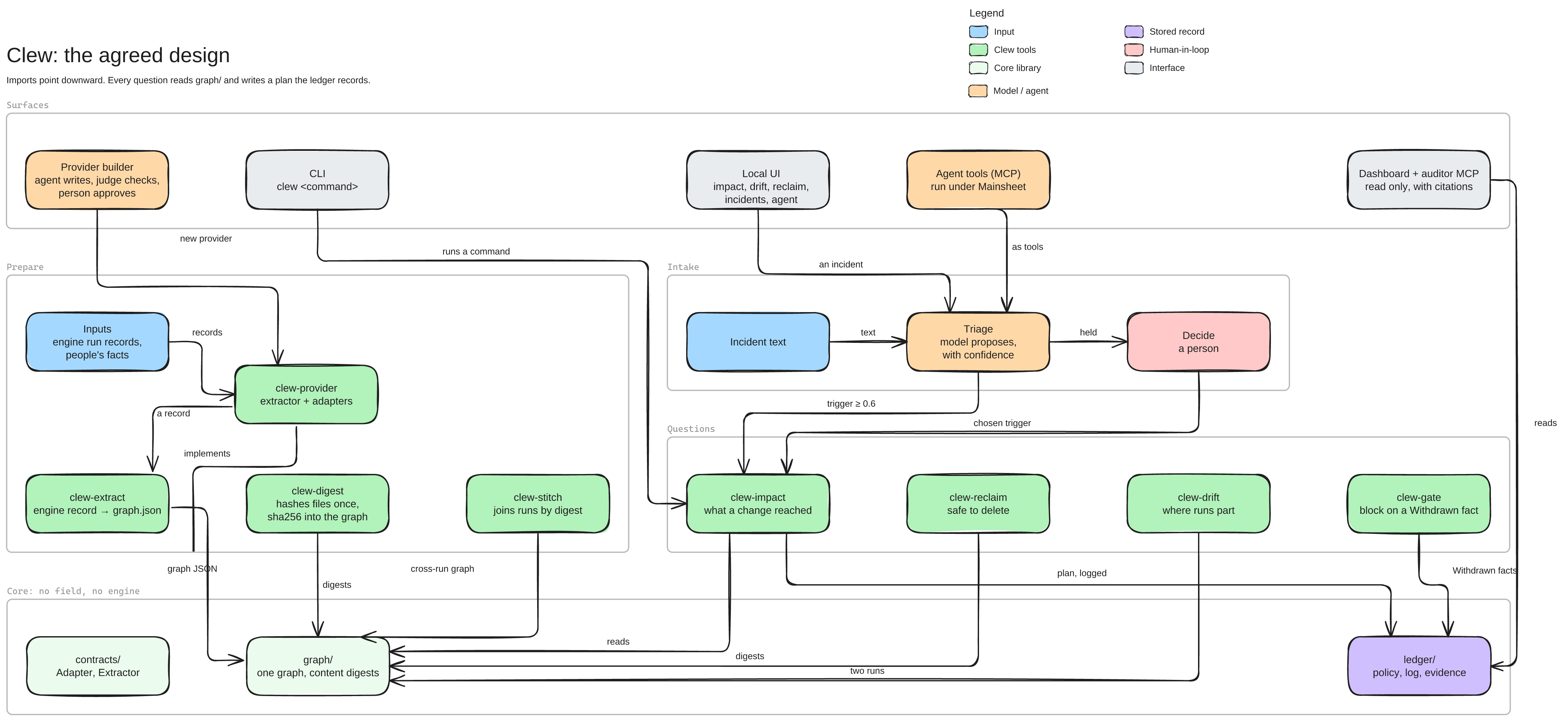
Six steps, one command each. Every step reads what the one before wrote and leaves a file the next one reads, so any step can be rerun or checked on its own.
engine record --> graph.json --> plan.json --> bundle/ --> auditor
   extract         ask            seal         share
                   triage, decide
1. Extract
Point Clew at where the workflow was launched. The engine's own record
becomes graph.json: every task, every file it read and wrote, and the
content digests the engine recorded.
clew extract nextflow --store .lineage --run <run> --json-out graph.json
clew extract alone lists every engine installed. clew digest fills in
digests an engine did not record. clew stitch joins runs that consumed
each other's outputs. Sources says what each engine
records and what that limits.
2. Ask
clew impact  --graph graph.json --container gatk4 --json plan.json
clew reclaim --graph graph.json --work-root work/ --results results/
clew drift   --before a.json --after b.json
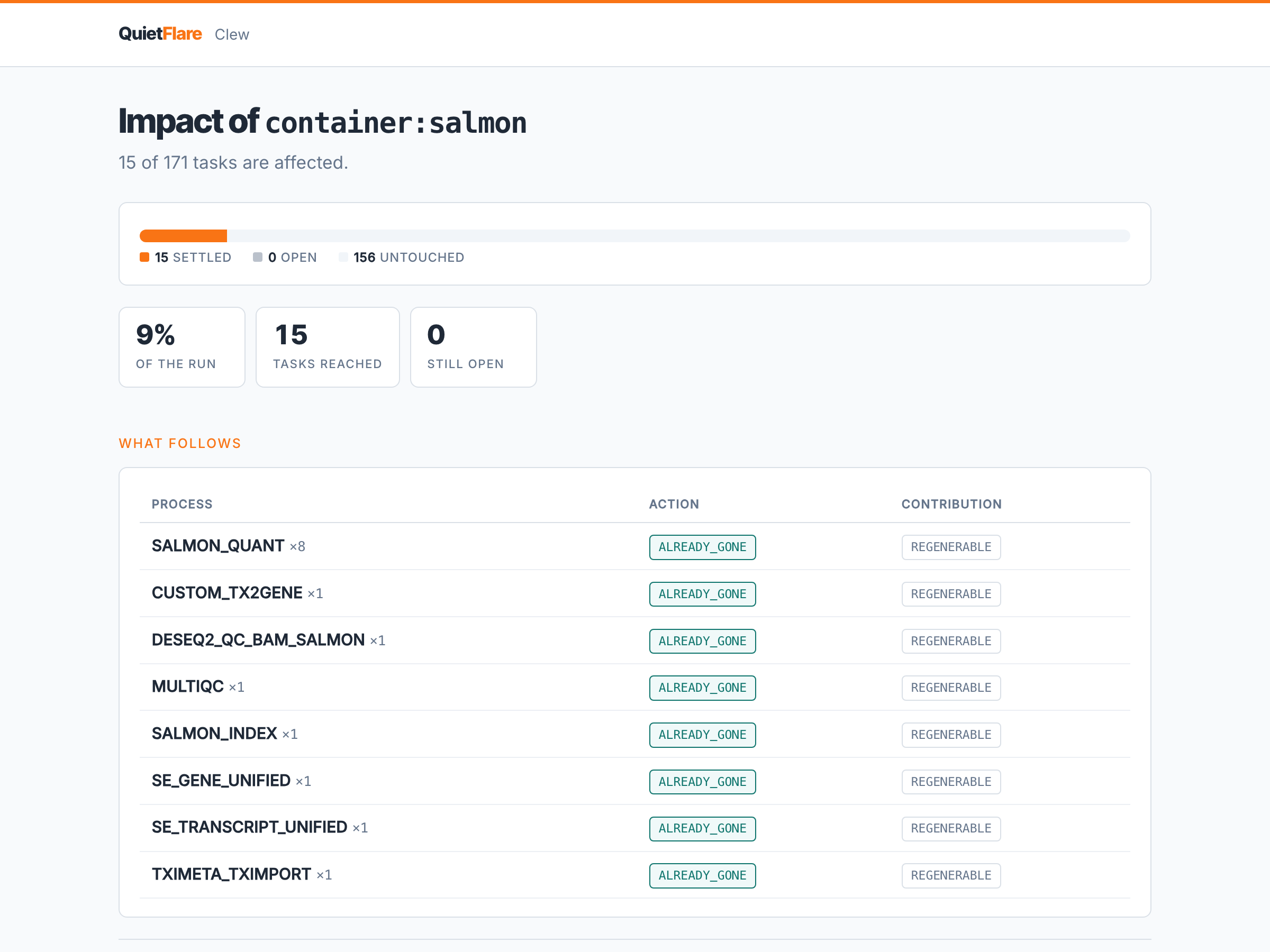
Impact gives every affected task a verdict, re-run, quarantine, delete or
disclose, with the derivation chain as evidence and the policy version
that produced it. Reclaim proposes only the directories the graph proves
redundant and deletes nothing without --apply. Drift names the first
task on each chain whose outputs differ, and why. A verdict that depends
on a file existing is withheld, never guessed. Add --html report.html
to any of the three for a one-page report. More in
storage, reclaim and
drift.
3. Triage
clew triage --graph graph.json --json triage.json "the duplicate marking step flags optical duplicates wrongly"
clew decide --record triage.json --ask container:gatk4 --actor "qa lead" --reason "the advisory names our version"
A classifier picks one of the run's own triggers and says how sure it is. Versioned settings then ask it, hold it for a person, or dismiss it. A held incident waits until someone decides under their own name. More in triage and triggers.
4. Seal
clew evidence seal --plan plan.json --out bundle/
clew evidence verify bundle/
A bundle holds the plan, the policy it was computed under, the triage
record and decision, and the hashes of every input. verify recomputes
every verdict from the bundle alone, with no database and no
credentials. An optional event log on Postgres keeps what people decided,
append-only and hash-chained, and clew gate reads it before a run
starts. More in evidence, event log,
policy and gate.
5. Share
clew dashboard --bundles bundles/ --out clew.html
clew mcp --bundles bundles/
One self-contained HTML page over every bundle, and a read-only MCP server that answers an auditor's questions from the bundles alone, with a citation on every answer. More in for auditors.
6. Automate
pip install "clew-lineage[agent]"
clew ui
A Mainsheet agent runs steps 3
and 4 under a policy gate, in a sandbox, with a signed record of the run.
clew ui is the page: impact, drift and reclaim on a run you pick, and
the agent at work. clew serve offers the same seven tools over MCP to
any agent, and no tool decides a held incident. More in
the agent.
Command reference
| Command | Does |
|---|---|
clew extract <engine> |
build a graph from an engine's record |
clew digest |
hash a run's files once, for graphs without content digests |
clew stitch |
join run graphs where one run consumed another's outputs |
clew impact |
what a removal, defect or update reaches, and what to do |
clew reclaim |
which work directories are safe to delete, with proof |
clew drift |
where two runs of the same workflow part ways, and why |
clew triage |
turn an incident report into a trigger, or hold it for a person |
clew decide |
record a person's decision on an incident that triage held |
clew evidence |
seal, verify, witness and sign evidence bundles |
clew log |
the append-only event log: init, append, list, verify, head |
clew rulebook |
the versioned remediation policy: show, export, check, diff, register |
clew gate |
block a run whose inputs the log says are not usable |
clew dashboard |
one self-contained HTML page over sealed bundles |
clew mcp |
read-only MCP server over sealed bundles, for auditors |
clew ui |
a local page: impact, drift and reclaim on a run you pick, and the agent at work |
clew serve |
Clew's working tools over MCP, for any agent |
clew build |
have an agent write an adapter or an extractor, then check it |
clew providers |
every adapter and extractor installed, or approve one a judge passed |
Every command answers --help with its flags.
Providers: your pipeline, your engine
Clew knows nothing about any field. What a site knows about one pipeline, that an id in a launch sheet is a specimen and which tasks it entered, lives in an adapter. An engine Clew cannot read yet gets an extractor. Both are one Python class, found by name, with no change inside Clew. An agent can write one: it works in a sandbox, a conformance check it never sees runs on what it wrote, and nothing loads until a person has read the code and approved it under their name.
clew build adapter --graph graph.json --name site-ligands --kind ligand --sheet ligands.smi
clew providers --approve ~/.clew/ui/jobs/<build>/verdict.json --actor "your name"
Providers has the three ways to build one, by hand, with your own coding agent, or with Clew's.
What is guaranteed
- Storage is checked, never assumed. A verdict that depends on a file existing is withheld until the file is looked at.
- Rules are versioned data. Every plan names its policy version and hash, and an old plan replays under the rules that produced it.
- A model never writes a verdict. It picks a trigger from a fixed list, or recommends on a held incident. Settings and people decide, and the record names the model asked.
- Facts are append-only. The event log is hash-chained with two clocks, and a bundle witnesses the log head it saw.
- Evidence verifies offline. A bundle re-derives every verdict with no database and no credentials.
- Agents are governed. Under Mainsheet every tool call passes a policy gate and is signed. Over MCP the tools stay safe by what they take: an id, never a trigger or code.
- The engine stays neutral. A test fails the build if the graph, the ledger or the contracts mention a sample, a donor, a consent or an engine.
Status
Verified on real Nextflow, Snakemake, Cromwell and Horus runs. DNAnexus and Latch are built from the platform APIs and await their first live runs. Triage has one eval baseline, on the release notes of sixteen projects. The adapter builder has run live once. 946 tests run on Python 3.9, 3.11 and 3.13 on every push. CHANGELOG.md lists what changed in each release.
Contributing
Issues and pull requests are welcome, especially from people who run workflows for a living and can say where the model is wrong. See CONTRIBUTING.md. No agreement to sign.
License
Clew MCP questions
What workflow engines does Clew support?
Clew reads records from Nextflow, Snakemake, Cromwell, Horus, DNAnexus, and Latch.
Can Clew be used to reclaim disk space?
Yes, the reclaim command identifies work directories that are safe to delete based on the workflow graph.
How does Clew handle AI model decisions?
Models are only used to propose or recommend; versioned rules and people make the actual decisions, and the record tracks which model was consulted.
Can an auditor verify Clew's decisions offline?
Yes, Clew can seal decisions into evidence bundles that allow for offline verification without needing a database or credentials.