
PAODO Workspaces MCP server
Commit Nov 14, 2026Provides isolated Docker sandboxes for AI agents with dedicated filesystems, terminals, and MCP endpoints for collaborative agentic workflows.
Also known as paodo-solution/PAODO-Workspaces
- Stars
- 7
- Tools
- —
- Downloads, 30 days
- —
- Latest version
- —
- Last commit
- Nov 14, 2026
- License
- MIT
What is PAODO Workspaces MCP?
PAODO Workspaces provides isolated Docker sandboxes for AI agents with dedicated filesystems, terminals, and MCP endpoints for collaborative agentic workflows.
Summary generated from the project's README
About PAODO Workspaces MCP server
Providing isolated Docker sandboxes for AI agents is what PAODO-Workspaces enables for developers building complex agentic organizations. Each workspace operates as a dedicated container with its own filesystem, terminal, and ReAct loop coding agent. Users can manage these environments through a chat interface, an external HTTP API, or by exposing specific skills as MCP tools. This setup allows agents to function like multiple instances of VS Code and Claude Code working together in a controlled environment.
Setting up the platform requires Docker, Node.js 24, and an API key from a supported AI model provider. Once running, you can connect workspaces into an agent graph where specialist agents discover and delegate tasks to one another using validated contracts. Security is managed through per-workspace secrets, restricted non-root users, and an optional internet proxy that uses an allowlist of domains. You can also use shared drives to let different agents collaborate on the same files.
What you can do with it
- 1Expose agent skills to MCP clientsYou can turn a workspace's specific capabilities into tools for an external MCP client using a unique access key.
- 2Build a collaborative agent networkDevelopers can link different specialist workspaces together so they can communicate and delegate work through a directed graph.
- 3Automate repetitive agent tasksYou can set up a workspace agent to perform specific coding or system tasks on a recurring schedule.
- 4Securely manage third-party credentialsYou can provide agents with necessary API keys without exposing the actual values to the container or the agent itself.
Written from the project's README. Every use case is checked against a quote from it.
Automated checks
Ran Nov 15, 2026Full report →Not verified yet. A server needs a score of 80, no serious finding, and enough data for us to check. How checks work · What to fix for more points

- Source repository linked and reachablepaodo-solution/paodo-workspaces is public and reachablegithub.com/paodo-solution/paodo-workspaces ↗Pass
- Package names this repository as its sourceNot checked
- Build provenance (Sigstore attestation)Not checked
- Open source license (OSI)MITspdx.org/licenses/MIT.html ↗Pass
- Commit or release in the last yearLast commit or release 2026-11-13github.com/paodo-solution/paodo-workspaces ↗Pass
- OpenSSF ScorecardNot checked
- Package name not close to a popular packageNot checked
- No critical advisory in the package or its dependenciesNot checked
- No hidden instructions to the model0 tool descriptions and the README read; no override phrases, credential paths or hidden charactersPass
- Destructive tools are labelledNot checked
- Remote endpoint answers the MCP handshakeNot checked
README
View on GitHubPAODO Workspaces
The open platform for building your agentic org chart.
Website · Demo video · Quick start · Docs · Deploy
Every agent gets a real machine: a filesystem, a terminal, and the tools for the job to carry a unit of work from start to finish.
Each workspace is an isolated Docker container running its own ReAct loop coding agent. Give it scripts to run and instructions to follow, then call it through the workspace chat interface or an external API / MCP. Workspaces can be wired into a graph, so agents discover each other and delegate tasks. Think of it as multiple instances of VS Code + Claude Code, each in its own sandbox environment, wired together for collaboration.
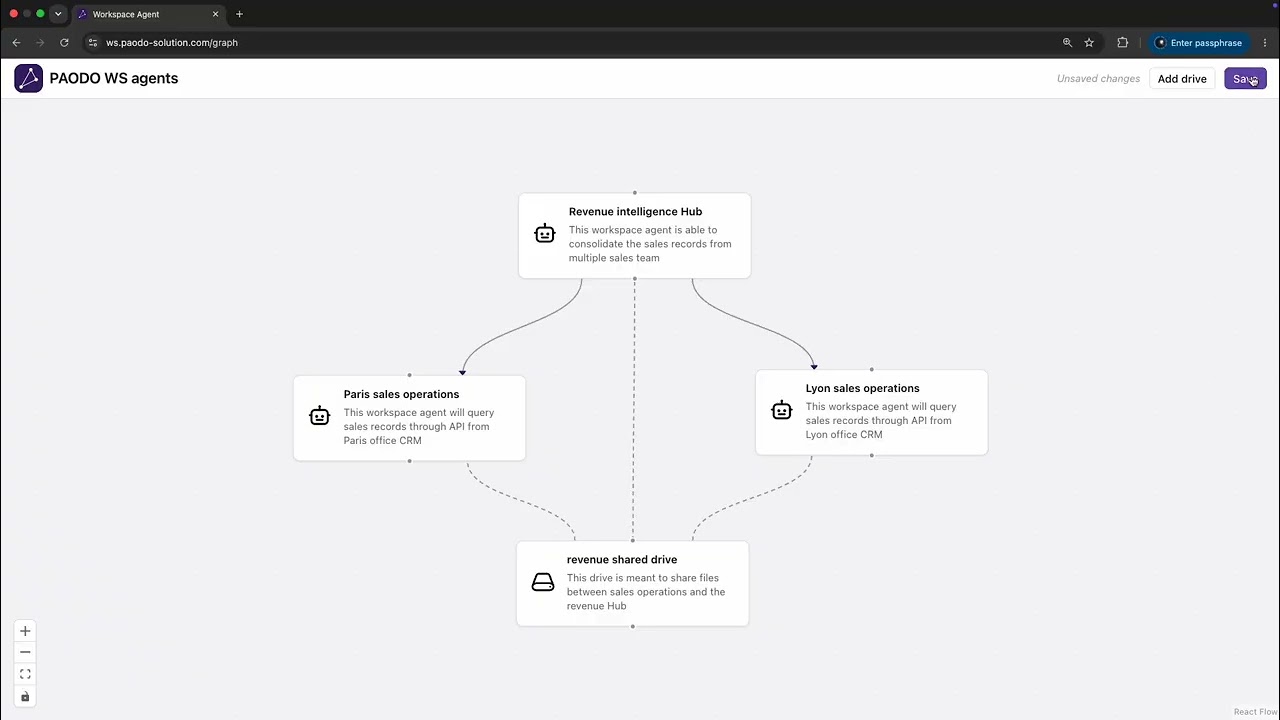
Demo video of PAODO in action :
Features
-
Isolated workspaces — one Docker container per workspace, with its own agent and
AGENTS.mdinstructions, running as a restricted non-root user -
Internet access — sealed by default: a workspace only reaches the network once you enable it, and can then be restricted to an allowlist of exact domains that the proxy enforces, per workspace
-
ReAct agent — full tool set (file read/edit/write, shell, glob, directory listing,
apt_install, web fetch, todo list, context compaction); streams progress live and is interruptible (press escape to kill the running command) -
File browser — view, edit, upload, and download files from the UI, with syntax highlighting
-
HTTP API — call any workspace's agent externally with a per-workspace API key
-
Workspace MCP — expose a workspace's skills as MCP tools through a per-workspace, independently revocable access key
-
Scheduled triggers — run a workspace agent on a recurring schedule
-
Live console — shell output and file changes stream to the UI in real time
-
Per-workspace secrets — give each workspace its own third-party API keys; a credential proxy injects the real values into outbound requests so the keys never reach the agent or its container
-
Agent graph — connect specialist workspaces so one agent can call another through defined, validated skills
-
Shared drives — connect shared storage to selected workspaces so agents can exchange files and collaborate on the same materials.
-
CLI access — Access the app directly through console, optimized for coding agents.
Quick start
Requirements: Docker (running), Node.js 24 or newer (nvm use reads .nvmrc), and an API key for at least one supported AI model provider.
git clone https://github.com/paodo-solution/PAODO-Workspaces.git
cd PAODO-Workspaces
npm install                   # host tooling only: tests, lint, editor
cp .env.example .env          # set USERNAME and PASSWORD
npm run dev
npm run dev runs the whole stack in Docker, with its own Node 24, so the app itself does not depend on your
local Node. The first run takes about two minutes while it builds the images; later runs start in seconds.
Open http://localhost:3000, sign in with the USERNAME and PASSWORD from .env, and add your provider API key under the gear icon → Settings → Provider API keys.
For VPS deployment, see the deploy guide.
How it works
Each workspace runs in its own Docker sandbox and is accessible via the chat UI, external API, or MCP server. Agents in connected workspaces and MCP clients can invoke skills using defined input/output contracts.
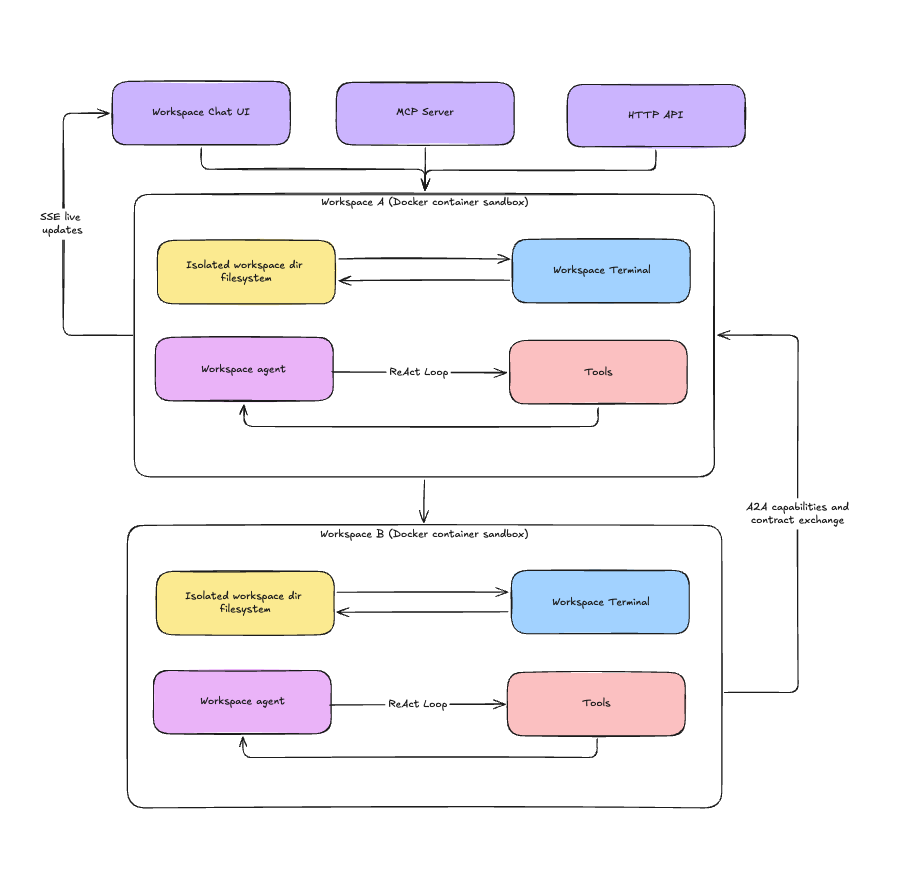
server.ts boots a Node.js HTTP server that mounts Next.js plus a WebSocket server on one port, so shell output and file events stream over /ws without a separate process. Requests hit Next.js API routes, which run the ReAct loop in lib/agent/runner.ts and stream events back over SSE.
Every sandboxed tool call runs inside a per-workspace Docker container (ws_<id>) as a restricted non-root user, with only that workspace's directory mounted.
For the full architecture, see doc/.
The agent runs a ReAct loop with the following tools:
- Files —
file_read·file_write·file_edit·list_directory·glob - System —
execute_command·stop_task·apt_install·http_get - Session —
todo_write·compact_context·workspace_history·workspace_restore - Agent graph —
list_agents·call_agent - Shared drives —
drive_ls·drive_read·drive_download·drive_upload·drive_delete
Agent graph
Workspaces can call each other. The graph page connects them into a directed acyclic graph; an edge A → B lets A's agent invoke B's. Agents find their neighbors with list_agents and call them with call_agent.
Calls are contract-first: each workspace publishes typed skills (.skills/*.json), and the platform validates the caller's input and the callee's output against the skill's schema. The callee runs in a fresh, isolated conversation. No graph edge, no call.
Workspace API access
Enable API access from the workspace panel to generate a key, then:
curl -X POST http://localhost:<port>/api/workspaces/<id>/agent \
  -H "Authorization: Bearer <api-key>" \
  -d '{"message": "list all files and summarize what this workspace does"}'
The response is a Server-Sent Events stream. Each data: frame has a type:
token/reasoning— the answer and the agent's thinking, streamed as they are producedtool_start/tool_result— each tool call with itsargsand output (idpairs them)error— the run failed, with acoderesponse— terminal aggregate: the whole answer in one frame, for non-streaming clientsdone— end of stream, carrying theconversationId
Each call starts its own conversation, visible in the workspace UI. To thread calls together
instead, pass the conversationId returned in the X-Conversation-Id header back in the next
request body. Stop an in-flight run with that id:
curl -X POST http://localhost:<port>/api/workspaces/<id>/agent/stop \
  -H "Authorization: Bearer <api-key>" \
  -d '{"conversationId": "<id>"}'
Workspace MCP access
Enable MCP access from the workspace panel to mint a bearer secret, then point any MCP client at the workspace:
{
  "mcpServers": {
    "paodo-<id>": {
      "type": "http",
      "url": "http://localhost:<port>/api/workspaces/<id>/mcp",
      "headers": { "Authorization": "Bearer <mcp-secret>" }
    }
  }
}
The client sees the workspace's declared skills and nothing else — no agent tools, no filesystem, no
graph. Each skill's .skills/*.json contract becomes the tool's input and output schema, and calls
run through the same validated path the agent network uses. The secret is stored hashed, shown once,
and revoked independently of the API key.
There is no publication step: the endpoint reads .skills/ fresh on every request, so a skill the
agent adds is immediately callable and one it deletes is gone. Handing out the secret is therefore
the authorization decision — the workspace panel lists the currently exposed tools.
Unlike the chat API, skill calls are one-shot: each runs in a fresh, isolated conversation with no
conversationId to continue. Those conversations are still persisted in the workspace UI and
dashboard for auditing.
Known limitations
-
No automatic compaction — the agent compacts context on demand via
compact_context, but never automatically by size. -
No file write queue — concurrent writes to the same file can overwrite each other under load.
-
No image reading — the agent handles images as raw files but can't see their content.
License
MIT — see LICENSE.
paodo-solution.com/workspaces · Built by PAODO
PAODO Workspaces MCP questions
How are agent workspaces isolated?
Each workspace runs in its own isolated Docker container as a restricted non-root user with its own dedicated directory.
Can agents collaborate with each other?
Yes, you can connect specialist workspaces into an agent graph where agents can discover and delegate tasks to one another through defined skills.
How do I access a workspace via MCP?
You can enable MCP access in the workspace panel to generate a bearer secret, then point your MCP client to the workspace's specific HTTP MCP endpoint.
Does the agent have internet access?
Internet access is sealed by default and must be enabled manually, at which point it can be restricted to a specific allowlist of domains.