
Canary MCP server
Commit Nov 15, 2026Provides an agentic risk desk for Interactive Brokers accounts, enabling AI clients to monitor market data, portfolio context, and risk limits.
Also known as osauer/ibkr, ibkr
- Stars
- 11
- Tools
- —
- Downloads, 30 days
- —
- Latest version
- 2.3.1
- Last commit
- Nov 15, 2026
- License
- MIT
What is Canary MCP?
Canary provides an agentic risk desk for Interactive Brokers accounts, enabling AI clients to monitor market data, portfolio context, and risk limits.
Summary generated from the project's README
About Canary MCP server
Canary acts as an agentic risk desk for Interactive Brokers accounts, allowing AI clients to monitor market data and portfolio context. It runs locally alongside IB Gateway or TWS on macOS or Linux, ensuring that no account data is sent to a remote server. The server provides read-only tools for MCP hosts like Claude Desktop, Claude Code, Cursor, or Zed, enabling users to ask questions about their account status and data health.
Users can utilize the tool to perform twenty different discipline checks against custom limits and view exposure by underlying assets. While the standard MCP server is read-only and contains no order or preview tools, a separate trading binary exists for executing authorized trades through a gated CLI. This setup ensures that the AI agent can observe the portfolio and identify breaches without having the ability to independently decide or execute trades through the MCP interface.
What you can do with it
- 1Monitor account healthAsk an AI agent to identify which parts of your trading account require immediate attention.
- 2Analyze portfolio exposureRequest a breakdown of your current market exposure organized by the underlying assets.
- 3Verify risk limit complianceCheck if your current positions are breaching any of your predefined risk discipline limits.
- 4Review historical trade performanceExamine how stock and ETF prices moved following your past trading decisions.
Written from the project's README. Every use case is checked against a quote from it.
Automated checks
Ran Nov 13, 2026Full report →Not verified yet. A server needs a score of 80, no serious finding, and enough data for us to check. How checks work · What to fix for more points

- Source repository linked and reachableosauer/ibkr is public and reachablegithub.com/osauer/ibkr ↗Pass
- Package names this repository as its sourceNot checked
- Build provenance (Sigstore attestation)Not checked
- Open source license (OSI)MITspdx.org/licenses/MIT.html ↗Pass
- Commit or release in the last yearLast commit or release 2026-11-12github.com/osauer/ibkr ↗Pass
- OpenSSF ScorecardNot checked
- Package name not close to a popular packageNot checked
- No critical advisory in the package or its dependenciesNot checked
- No hidden instructions to the model0 tool descriptions and the README read; no override phrases, credential paths or hidden charactersPass
- Destructive tools are labelledNot checked
- Remote endpoint answers the MCP handshakeNot checked
README
View on GitHubCanary


A risk desk for your Interactive Brokers account. It reads your account for you and your AI agent, checks it against your limits, and, in the trading build, places the trades you authorise.
Canary runs beside your IB Gateway or TWS and nothing runs on a server of mine. It tells you what needs attention today. It runs twenty discipline checks against limits you set and names the ones your positions breach. It shows exposure by underlying. Canary Edge shows what the price did 1, 5 and 20 sessions after your past stock and ETF trades, from your broker statements, where a decision repeated often enough to count. The same readings come as text, as JSON, in a paired phone app, and as MCP tools for Claude Desktop, Claude Code, Cursor or Zed.
It comes in two builds. The standard binary reads; it has no compiled order path. The trading binary, a separate download, also executes orders, and only the ones you authorised: a transaction you confirmed, or a close or reduction the daemon runs under a bucket you listed in your written policy, a list that ships empty. Every order is pinned to one account, client ID and mode, consumes a preview token for that exact draft, is journaled with its origin before it is sent, and passes the risk policy's order limits, the mandate gate and the freeze. An agent trades only through the gated CLI. The MCP server has no order or preview tool in any build. Canary never decides a trade on its own.
Documentation · Install · First session · Agentic trading · Canary Edge · MCP tools · Safety · Privacy
Start
You need IB Gateway 10.37+ or TWS with API socket access enabled, an IBKR Pro account, and macOS or Linux on arm64 or amd64. Paper and live both work. There is no Windows build; use WSL.
Terminal, and every MCP host. One signed binary in ~/.local/bin:
curl -fsSL https://raw.githubusercontent.com/osauer/canary/main/install.sh | sh
canary status    # show which Gateway and account Canary reached
canary brief     # review what changed and what needs attention
The install guide shows how to inspect the script first and covers every other installation path.
Claude Desktop. Download the MCP Bundle,
canary.mcpb,
open it with Claude Desktop, then quit and relaunch Claude. The
walkthrough
covers the first connection.
Any other MCP host. Install the binary as above, then point the host at its
absolute path; which canary prints it.
{
  "mcpServers": {
    "canary": {
      "command": "/ABSOLUTE/PATH/TO/canary",
      "args": ["mcp"]
    }
  }
}
A first question that works in any host:
What needs attention today, and which data is missing or stale?
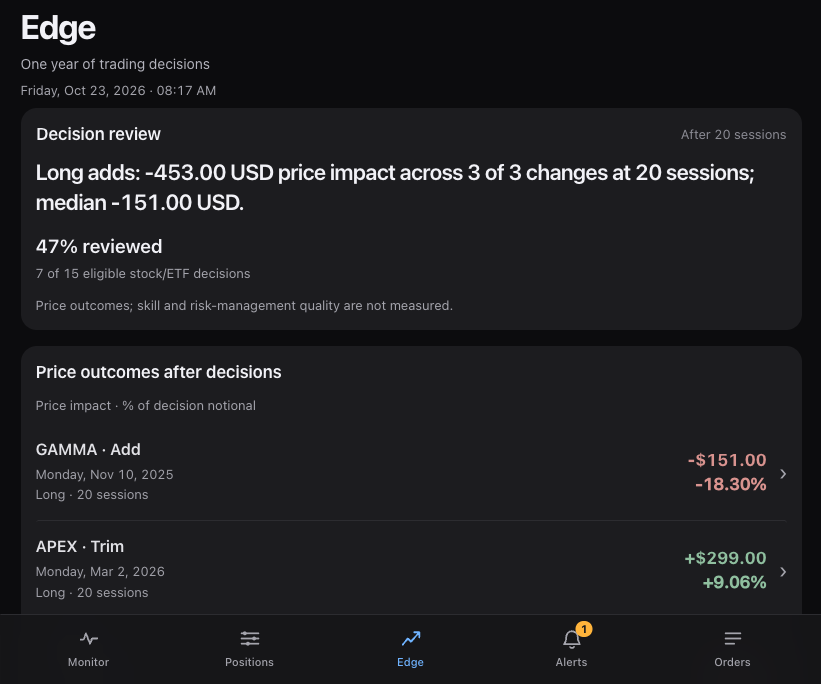
Canary Edge in the paired app, rendered from synthetic data: what the price did after past decisions, and how much evidence supports each row.
Ways in
| You want to… | Start with | What you get |
|---|---|---|
| Ask an agent about the account | The MCP Bundle, or canary mcp from any local framework that can launch a stdio MCP server |
Read-only tools; the MCP server has no order or preview tool |
| Work in a terminal or script | canary brief, canary positions --by underlying, and --json |
Every reading as text or JSON, from the same source as the app and the MCP tools |
| Check the desk from a phone | canary app, then canary app pair |
A paired web app on your phone; local by default, remote access optional |
| Read Canary from your own Go program | github.com/osauer/canary/v2, the daemon client |
The daemon's read methods over its local socket; its one submit method is served by a trading daemon only |
| Build directly on the TWS protocol | github.com/osauer/canary/v2/pkg/ibkr |
A low-level transport; it carries no policy, authorisation or journal, those stay in your program |
MCP hosts
Ask plain questions rather than naming tools. The host guide covers Claude Code, Cursor, Zed, continuously running agents, logs, and connection checks. The generated MCP reference lists every tool and its schema.
Terminal and paired app
Every data command supports --json:
canary account
canary positions --by underlying
canary edge
canary rules
canary regime --explain
canary stress --details
Run canary status first for connection problems and canary data health for
missing or stale data. canary --help and the
CLI reference list every command and flag.
For the paired app, run canary app on the machine that owns the Gateway or
TWS session, then run canary app pair and scan the QR code. The
app guide covers pairing, remote access, and push
notifications.
Experimental: moomoo and Futu through OpenD
Canary can also read a Futu or moomoo account through OpenD, Futu's local gateway, while OpenD is running and logged in. This support is experimental. Reading balances and holdings, order and fill history, and converting to the base currency have been tested only against a stand-in for OpenD written for Canary's tests, so check what Canary shows against your broker. Canary cannot place, change or cancel orders through OpenD: it refuses the request and sends nothing to your broker.
Add this to ~/.config/ibkr/config.toml:
[broker]
kind = "opend"
With one real account on your login, Canary uses it. With several, it picks none:
canary status lists them, and you set account under [opend] to its id.
A simulated account is never picked: to use one, set account to its id.
With this setting, Canary shows account balances and stock and ETF positions, and
quotes for the Hong Kong and US markets where your OpenD login has the quote rights;
no other market's quotes have been read. A holding in a market without a quote right
shows the price OpenD reports with the holding, not a market quote. Options, futures and anything else in the account appear in a separate
list at the value OpenD reports, unconverted and not checked by Canary. Canary's exposure
figures and checks against your limits do not count them, so those figures do not
cover your whole account.
Holdings outside the account's base currency are converted at a rate worked out
from OpenD's own account totals, not a quoted rate; where that is not possible they
are not measured, and the checks against your limits report that they cannot judge
them. Many features
are not available, among them daily P&L, the regime, portfolio stress, Edge, statement
reporting, the market overview, the market tape and technical analysis; canary status lists most of them. Canary with moomoo and Futu
has the details.
Each daemon serves one broker. To run OpenD beside IBKR, start a second daemon
with its own XDG_CONFIG_HOME, XDG_STATE_HOME, XDG_CACHE_HOME,
XDG_RUNTIME_DIR and CANARY_SOCKET. The
configuration reference lists every key.
Go wire-protocol library

pkg/ibkr is a clean-room Go library for the TWS wire protocol. It transports
broker requests only. Its API reference is on
pkg.go.dev, and its
statement coverage is updated on each push to main as a
line-by-line report.
go install github.com/osauer/canary/v2/cmd/canary@latest
installs the v2 CLI, not the current v3 release; use the installer for the
binary. Start with the package documentation and the
wire protocol page.
Safety and privacy
The standard binary has no compiled order path, and the installer, updater and MCP Bundle never install the trading binary. The trading binary executes what you authorised and nothing else. The daemon checks every order at preview, at admission and at the final send: account, client ID and mode pins, the preview token for that draft, the journal entry written before the send, the risk policy's order limits, the mandate gate and the freeze. Gated orders has the detail.
Canary has no telemetry and does not send account IDs, balances, quantities, or P/L to the maintainer. PRIVACY.md is the data map. SECURITY.md covers the threat model and signed releases.
Documentation and legal
Canary is an independent third-party client for Interactive Brokers' publicly
documented TWS API. It is not built, endorsed, sponsored, or supported by
Interactive Brokers Group, Inc. or its affiliates. pkg/ibkr redistributes no
Interactive Brokers code, libraries, jars, or market data. Canary's OpenD client
is likewise independent and is not built, endorsed, sponsored, or supported by
Futu or its affiliates; pkg/futu includes protocol definitions from Futu's
public client under the Apache License 2.0, as
its notice sets out. Nothing here is
investment advice.
Canary is a private project of Oliver Sauer.
MIT. See LICENSE.
Canary MCP questions
Can the MCP server execute trades?
No, the MCP server is read-only and does not include any order or preview tools in any build.
What platforms are supported for running Canary?
Canary supports macOS and Linux on arm64 or amd64; Windows users should use WSL.
Does Canary send my financial data to a central server?
No, Canary runs locally beside your IB Gateway and has no telemetry, meaning it does not send account IDs, balances, or P/L to the maintainer.
Can I use Canary with brokers other than Interactive Brokers?
Yes, it has experimental support for reading Futu or moomoo accounts through OpenD.