
fde-mastery MCP server
Commit Nov 8, 2026Provides a governed execution platform for enterprise AI agents with durable workflows, policy enforcement, and observability.
Also known as LloydCoder/fde-mastery
- Stars
- 1
- Tools
- —
- Downloads, 30 days
- —
- Latest version
- —
- Last commit
- Nov 8, 2026
- License
- Apache-2.0
What is fde-mastery MCP?
fde-mastery provides a governed execution platform for enterprise AI agents with durable workflows, policy enforcement, and observability.
Summary generated from the project's README
About fde-mastery MCP server
Managing enterprise AI agents with strict governance and durable workflows is what FDE Mastery enables for engineering teams. It provides a modular monolith architecture that establishes clear boundaries between control, data, and trust planes to ensure secure agent execution. Developers can use the Python or TypeScript SDKs to integrate these capabilities into their own applications, managing everything from identity and tenancy to model and tool access through centralized registries.
The platform handles complex operational requirements such as policy enforcement, human approvals for high-impact actions, and OpenTelemetry-compatible observability. It supports various deployment models, including local testing with in-memory storage or production setups using PostgreSQL, Redis, and Docker Compose. By utilizing specific tools like platformctl for manifest inspection and doctor checks, teams can maintain high standards across eight enterprise domains, including finance, cybersecurity, and legal workflows.
What you can do with it
- 1Enforce human approval for actionsAn AI agent can be restricted so that high-risk tasks require manual verification before proceeding.
- 2Manage multi-tenant AI workloadsDevelopers can ensure that different customers have isolated identities and data boundaries within the same platform.
- 3Monitor agent performance and driftTeams can use evaluation datasets and observability tools to track how well their AI models are performing over time.
- 4Secure the AI supply chainOrganizations can automate security checks and generate software bills of materials during the build process.
Written from the project's README. Every use case is checked against a quote from it.
Configuration
FDE_STORAGE_BACKEND
| Name | Description | |
|---|---|---|
| FDE_STORAGE_BACKEND | — |
Automated checks
Ran Nov 15, 2026Full report →Not verified yet. A server needs a score of 80, no serious finding, and enough data for us to check. How checks work · What to fix for more points

- Source repository linked and reachablelloydcoder/fde-mastery is public and reachablegithub.com/lloydcoder/fde-mastery ↗Pass
- Package names this repository as its sourceNot checked
- Build provenance (Sigstore attestation)Not checked
- Open source license (OSI)Apache-2.0spdx.org/licenses/Apache-2.0.html ↗Pass
- Commit or release in the last yearLast commit or release 2026-11-08github.com/lloydcoder/fde-mastery ↗Pass
- OpenSSF ScorecardNot checked
- Package name not close to a popular packageNot checked
- No critical advisory in the package or its dependenciesNot checked
- No hidden instructions to the model0 tool descriptions and the README read; no override phrases, credential paths or hidden charactersPass
- Destructive tools are labelledNot checked
- Remote endpoint answers the MCP handshakeNot checked
README
View on GitHubFDE Mastery
FDE Mastery is a governed execution platform for teams building, integrating, and operating enterprise AI agents and workflows.
It provides reusable identity and tenancy boundaries, agent execution, durable workflows, policy enforcement, human approvals, model and tool gateways, evaluations, observability, and operational controls across eight enterprise domains.
Architecture at a glance
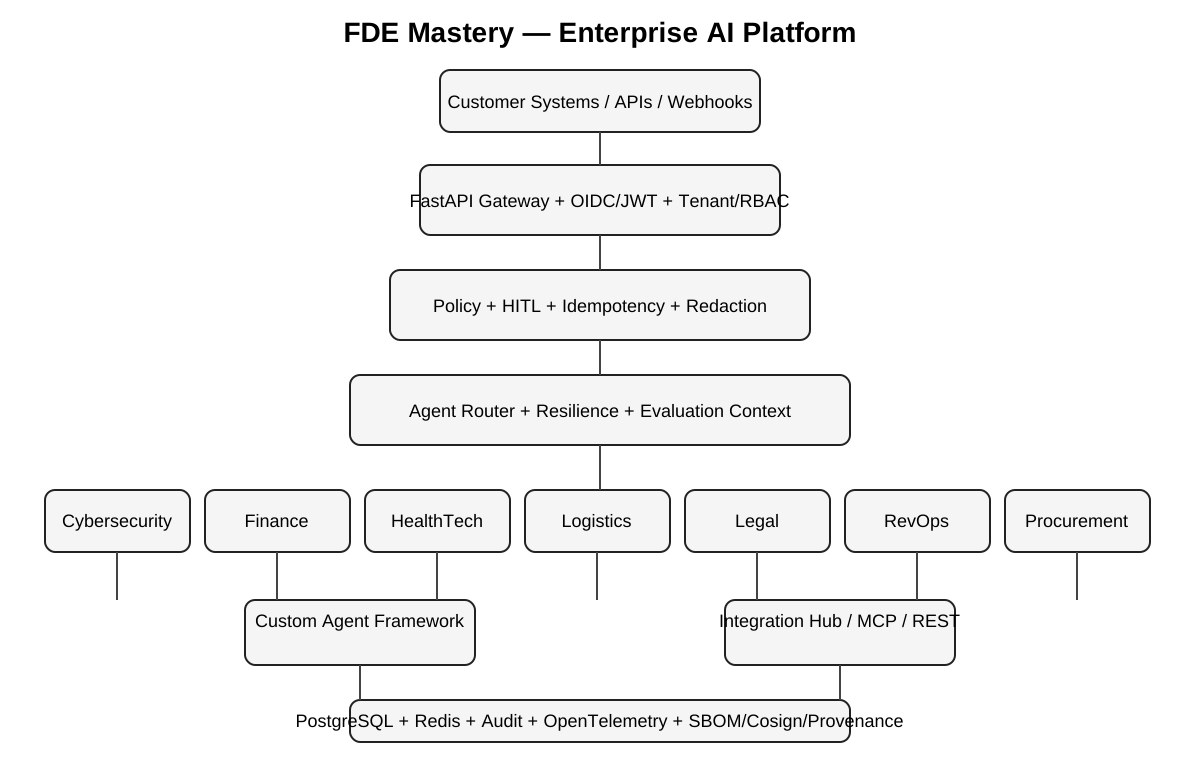
The diagram describes platform boundaries; it is not a screenshot or live deployment demonstration. See the architecture guide.
Why FDE Mastery
| Concern | Platform approach |
|---|---|
| Identity and tenancy | Tenant-aware identity context, scoped authorization and PostgreSQL RLS foundations |
| Agent execution | Versioned agent lifecycle, budgets, checkpoints and durable workflow boundaries |
| Consequential actions | Independent trust/policy controls, risk tiers and expiring human approvals |
| Tool and model access | Registries, capability boundaries, policy checks and provider adapters |
| Reliability | Leased work, retries, recovery, idempotency and incident lifecycle contracts |
| Evaluation | Golden and adversarial datasets, quality/safety gates and drift signals |
| Operations | OpenTelemetry-compatible observability, tenant-aware FinOps and deployment controls |
| Supply chain | CI security checks, SBOM generation, image signing and build provenance |
FDE Mastery is a modular monolith with explicit control-plane, data-plane and trust-plane boundaries. It does not split components into microservices before independent scaling or isolation is justified.
Quick start
Run the repository tests with local in-memory and mock-provider settings. No production credentials are required.
git clone https://github.com/LloydCoder/fde-mastery.git && cd fde-mastery/packages/platform-core
python -m venv .venv && source .venv/bin/activate
python -m pip install -e ".[test]"
FDE_STORAGE_BACKEND=memory FDE_RATE_LIMIT_BACKEND=memory FDE_MONTH1_PROVIDER=mock MOCK_LLM=true FDE_ENVIRONMENT=test python -m pytest -q
Windows PowerShell activation uses .venv\Scripts\Activate.ps1. Python 3.11 matches the primary CI runtime; package metadata supports Python 3.10 and newer.
Installation
| Tool | Requirement |
|---|---|
| Python | 3.10+; Python 3.11 is the CI baseline |
| Git | Required to clone |
| Docker Compose | Optional, for container deployment |
| Node.js | 20+ for the TypeScript SDK |
From packages/platform-core, install the platform and quality tools:
python -m pip install -e ".[test,quality,security,observability,sbom]"
Optional dependency groups are defined in pyproject.toml. The production-oriented Compose definition is deployment/docker-compose.production.yml. It requires deployment-specific PostgreSQL, OIDC, application/admin key and managed-secret configuration. Follow the deployment guide; never use example credentials in production.
Usage
Inspect platform capabilities
From the repository root:
PYTHONPATH=packages/platform-core python -m platformctl manifest
PYTHONPATH=packages/platform-core python -m platformctl doctor
Run the API locally
After installing the package, from packages/platform-core:
FDE_STORAGE_BACKEND=memory FDE_RATE_LIMIT_BACKEND=memory FDE_MONTH1_PROVIDER=mock MOCK_LLM=true FDE_ENVIRONMENT=test python -m uvicorn deployment.api_gateway.main:app --host 127.0.0.1 --port 8000
In another terminal:
curl --fail http://127.0.0.1:8000/v1/health
See API reference for authentication, tenant binding, idempotency and request metadata. Do not send customer data to a local test configuration.
SDKs
| SDK | Runtime | Source |
|---|---|---|
| Python | Python 3.10+; standard-library HTTP client | sdks/python |
| TypeScript | Node.js 20+ | sdks/typescript |
Configuration
The tracked API gateway example is .env.example. It contains placeholders only. Copy values into an untracked environment file and replace every placeholder before use.
| Variable | Template example | Purpose |
|---|---|---|
FDE_API_KEYS |
Placeholder | Application API keys |
FDE_ADMIN_API_KEYS |
Placeholder | Separate administrator API keys |
FDE_STORAGE_BACKEND |
memory |
Storage adapter |
FDE_DATABASE_URL |
Local PostgreSQL URL | Durable database connection |
FDE_DB_CREATE_TABLES |
false |
Automatic table creation |
FDE_RATE_LIMIT_BACKEND |
memory |
Rate-limit backend |
FDE_REDIS_URL |
Local Redis URL | Redis connection |
FDE_RATE_LIMIT_WINDOW_SECONDS |
60 |
Rate-limit window |
FDE_RATE_LIMIT_REQUESTS |
60 |
Request allowance |
FDE_MAX_BODY_BYTES |
262144 |
Maximum request body size |
See Configuration reference. Template values are not production recommendations.
Platform domains and capabilities
| Domain | Example workflow |
|---|---|
| Cybersecurity | SIEM alert enrichment and SOC triage |
| Finance | Transaction risk and governance |
| HealthTech | Compliance and triage support |
| Logistics | Supply-chain risk analysis |
| Legal | Contract risk workflows |
| RevOps | Pipeline and account operations |
| Procurement | Supplier risk and quote comparison |
| Custom | Tenant-defined workflows and policies |
The platform provides versioned agent/tool/model/policy registries, durable workflows, tenant-scoped events, evaluation, incident management, AI FinOps, integration and interoperability boundaries, and deployment profiles.
High-impact actions remain subject to policy and human approval. Procurement is recommendation-oriented: the platform does not autonomously award suppliers, create purchase orders, modify vendor master data or approve spend.
These are reusable platform capabilities and reference integrations. They are not a security certification, regulatory approval or evidence of a live customer deployment.
Documentation
| Guide | Description |
|---|---|
| Documentation index | Documentation map and reading paths |
| Getting started | Local setup and first checks |
| Architecture | Platform boundaries and dependency rules |
| Architecture decisions | Accepted architecture decision records |
| API and SDKs | Versioned API and client contracts |
| Configuration | Runtime environment settings |
| Deployment | Deployment model and operations |
| Production readiness | Eight-gate promotion model |
| Build status | Historical implementation and verification ledger |
| Security standards | Engineering control references |
| AI threat model | AI-specific threat considerations |
Contributing
Issues and pull requests are welcome. Read CONTRIBUTING.md, follow the Code of Conduct, and use the provided templates.
License and acknowledgements
FDE Mastery is distributed under the Apache License 2.0. The project uses and is informed by OWASP, NIST AI RMF, OpenTelemetry, CycloneDX, Sigstore Cosign and SLSA provenance.
Responsible use
Domain examples use synthetic or illustrative data. They are not financial, medical or legal advice. Customer deployments require their own threat model, data-protection decisions, integration validation, evaluation evidence, security review, operational runbooks and approval policy.
- Defects: GitHub Issues.
- Vulnerabilities: follow SECURITY.md; do not publish exploit details.
- Setup: see Getting started and Configuration.
- Deployment: see DEPLOYMENT.md.
fde-mastery MCP questions
What programming languages are supported by the SDKs?
The platform provides a Python SDK for Python 3.10+ and a TypeScript SDK for Node.js 20+.
Does the platform autonomously perform procurement actions?
No, procurement is recommendation-oriented; the platform does not autonomously award suppliers or create purchase orders.
Can I run the platform locally without production credentials?
Yes, you can run repository tests using local in-memory and mock-provider settings without requiring production credentials.