
Enforces quality control for AI agents through fail-closed checklists and tamper-evident, hash-chained receipt ledgers.
Also known as Jott2121/agent-gate, mcp-agent-gate
- Stars
- 3
- Tools
- —
- Downloads, 30 days
- 145
- Latest version
- 0.1.1
- Last commit
- Nov 11, 2026
- License
- MIT
What is agent-gate MCP?
agent-gate enforces quality control for AI agents through fail-closed checklists and tamper-evident, hash-chained receipt ledgers.
Summary generated from the project's README
About agent-gate MCP server
Ensuring AI agents meet strict quality standards before completing tasks is the primary function of agent-gate. It provides a mechanism for agents to validate their own work through a fail-closed checklist system, meaning a task is only marked as finished if every requirement is explicitly proven. This prevents agents from claiming success when critical steps, such as human approval for irreversible actions or secret detection, are missing.
Developers can integrate this server into MCP clients like Claude Desktop or Claude Code by installing the package via pip and configuring the python command in their settings. The server manages a tamper-evident ledger where every decision is recorded as a hash-chained receipt using sha256. This creates an append-only audit trail stored in a local jsonl file, allowing users to verify the integrity of the entire decision history using the verify_chain function. It is designed for those building autonomous agent workflows that require deterministic verification and honest logging.
What you can do with it
- 1Verify agent task completionAsk the AI to run a checklist to ensure all necessary steps were completed before finishing a job.
- 2Create an immutable audit trailInstruct the agent to log its decisions into a secure, hash-chained ledger for later review.
- 3Detect tampered activity logsCheck if any past decisions or receipts in the agent's history have been modified or deleted.
- 4Enforce human oversightRequire the agent to confirm that a human has approved any irreversible or outward actions.
Written from the project's README. Every use case is checked against a quote from it.
How to install agent-gate MCP
Formats verified 10 Nov 2026Add to CursorAdd to GooseInstall agent-gate MCP in Claude Code
$ claude mcp add agent-gate -- uvx mcp-agent-gateInstall agent-gate MCP in Cursor
~/.cursor/mcp.json
{
  "mcpServers": {
    "agent-gate": {
      "command": "uvx",
      "args": [
        "mcp-agent-gate"
      ]
    }
  }
}Install agent-gate MCP in VS Code
.vscode/mcp.json
{
  "servers": {
    "agent-gate": {
      "type": "stdio",
      "command": "uvx",
      "args": [
        "mcp-agent-gate"
      ]
    }
  }
}Install agent-gate MCP in VS Code CLI
$ code --add-mcp '{"name":"agent-gate","type":"stdio","command":"uvx","args":["mcp-agent-gate"]}'Install agent-gate MCP in Claude Desktop
claude_desktop_config.json
{
  "mcpServers": {
    "agent-gate": {
      "command": "uvx",
      "args": [
        "mcp-agent-gate"
      ]
    }
  }
}Install agent-gate MCP in Codex
$ codex mcp add agent-gate -- uvx mcp-agent-gateInstall agent-gate MCP in Codex config.toml
~/.codex/config.toml
[mcp_servers.agent-gate]
command = "uvx"
args = ["mcp-agent-gate"]
Install agent-gate MCP in Gemini CLI
$ gemini mcp add -s user agent-gate uvx -- mcp-agent-gateInstall agent-gate MCP in Gemini settings.json
~/.gemini/settings.json
{
  "mcpServers": {
    "agent-gate": {
      "command": "uvx",
      "args": [
        "mcp-agent-gate"
      ]
    }
  }
}Automated checks
Ran Nov 14, 2026Full report →Passed our automated checks. That is not a security audit: read the code and give the server the narrowest access it needs. How checks work

- Source repository linked and reachablejott2121/agent-gate is public and reachablegithub.com/jott2121/agent-gate ↗Pass
- Package names this repository as its sourceNot checked
- Build provenance (Sigstore attestation)No build attestation published for this releaseNot checked
- Open source license (OSI)MITspdx.org/licenses/MIT.html ↗Pass
- Commit or release in the last yearLast commit or release 2026-11-11github.com/jott2121/agent-gate ↗Pass
- OpenSSF ScorecardNot checked
- Package name not close to a popular packageNo popular package one edit away from mcp-agent-gatePass
- No critical advisory in the package or its dependencies29 resolved dependencies checked; no critical advisoryosv.dev ↗Pass
- No hidden instructions to the model0 tool descriptions and the README read; no override phrases, credential paths or hidden charactersPass
- Destructive tools are labelledNot checked
- Remote endpoint answers the MCP handshakeNot checked
README
View on GitHub
agent-gate




An MCP server that lets an AI agent gate its own work before it claims "done": deterministic checks, then an independent refute-first review, then a tamper-evident honest receipt.
Agents that grade their own homework ship low-quality output. agent-gate turns that discipline into tools an agent must actually pass: a fail-closed checklist and an append-only, hash-chained receipts ledger. It is Fleet Mode, an agent-orchestration doctrine, made into a runnable tool. Receipts over hype, enforced by the data structures.
🧩 One layer of a five-repo cost-governance stack for operating AI agents cost-efficiently; bow is the flagship that runs every layer in production.
agent: "done!" -> verify_gate(evidence) -> { passed: false, blocking: ["independent_refute_review", "no_secrets"] }
Why
The expensive failures in agent systems are the silent ones: a model update degrades output, a change quietly breaks a workflow, an agent declares success while the work is wrong. The fix is not a smarter model. It is a gate the agent cannot talk its way past:
- Fail-closed. A check counts as satisfied only if it is explicitly true. Missing proof is not proof. (Mirrors a promotion gate, not an informal check.)
- Tamper-evident receipts. Every decision is recorded as
(decision, metric, value, verdict)linked into a sha256 chain. Edit or delete any past receipt andverify_chain()returns false. The honest log is enforced by the structure, not by good intentions. - Human-gated by default. "Any irreversible/outward act got human approval" is a required check. Agents draft, humans approve.
Tools (over MCP)
| Tool | What it does |
|---|---|
gate_checklist(name="ship") |
Returns the checklist the agent must satisfy before claiming done. |
verify_gate(evidence, name="ship") |
Evaluates evidence fail-closed and returns {passed, blocking}. |
record_receipt(decision, metric, value, verdict) |
Appends an honest, hash-chained receipt; returns it. |
read_receipts() |
Returns every receipt plus whether the chain is intact. |
The default ship gate encodes Fleet Mode: deterministic_checks_pass, independent_refute_review, no_secrets, human_gated_if_irreversible, honest_receipt_logged.
Install & wire into an MCP client
pip install mcp-agent-gate # or: pip install -e . (from source)
Add it to your MCP client (Claude Desktop / Claude Code) config:
{
  "mcpServers": {
    "agent-gate": { "command": "python", "args": ["-m", "agent_gate.server"] }
  }
}
Now your agent can call verify_gate(...) before it tells you it is finished, and you get a tamper-evident trail of what it decided. Receipts persist to ~/.agent-gate/receipts.jsonl (override with AGENT_GATE_LEDGER).
Use it directly (no MCP client needed)
from agent_gate.gate import DEFAULT_SHIP_GATE
from agent_gate.ledger import Ledger

res = DEFAULT_SHIP_GATE.evaluate({
    "deterministic_checks_pass": True,
    "independent_refute_review": True,
    "no_secrets": True,
    "human_gated_if_irreversible": True,
    # honest_receipt_logged missing  ->  fail-closed
})
print(res.passed, res.blocking)   # False ['honest_receipt_logged']

led = Ledger("receipts.jsonl")
led.append(decision="ship v0.1", metric="tests", value="pass", verdict="shipped")
print(led.verify_chain())         # True  (until someone edits the log)
Design
- Tested, stdlib-only core.
agent_gate/gate.py(fail-closed checklist) andagent_gate/ledger.py(hash-chained receipts) are pure stdlib: fast to read, fast to trust.agent_gate/server.pyis a thin MCP adapter over them (the one runtime dependency:mcp). - Tests pass on Python 3.11-3.13 (see CI). The MCP tools are tested by calling them, not just importing.
Tests
pip install -e ".[dev]" && python -m pytest -q
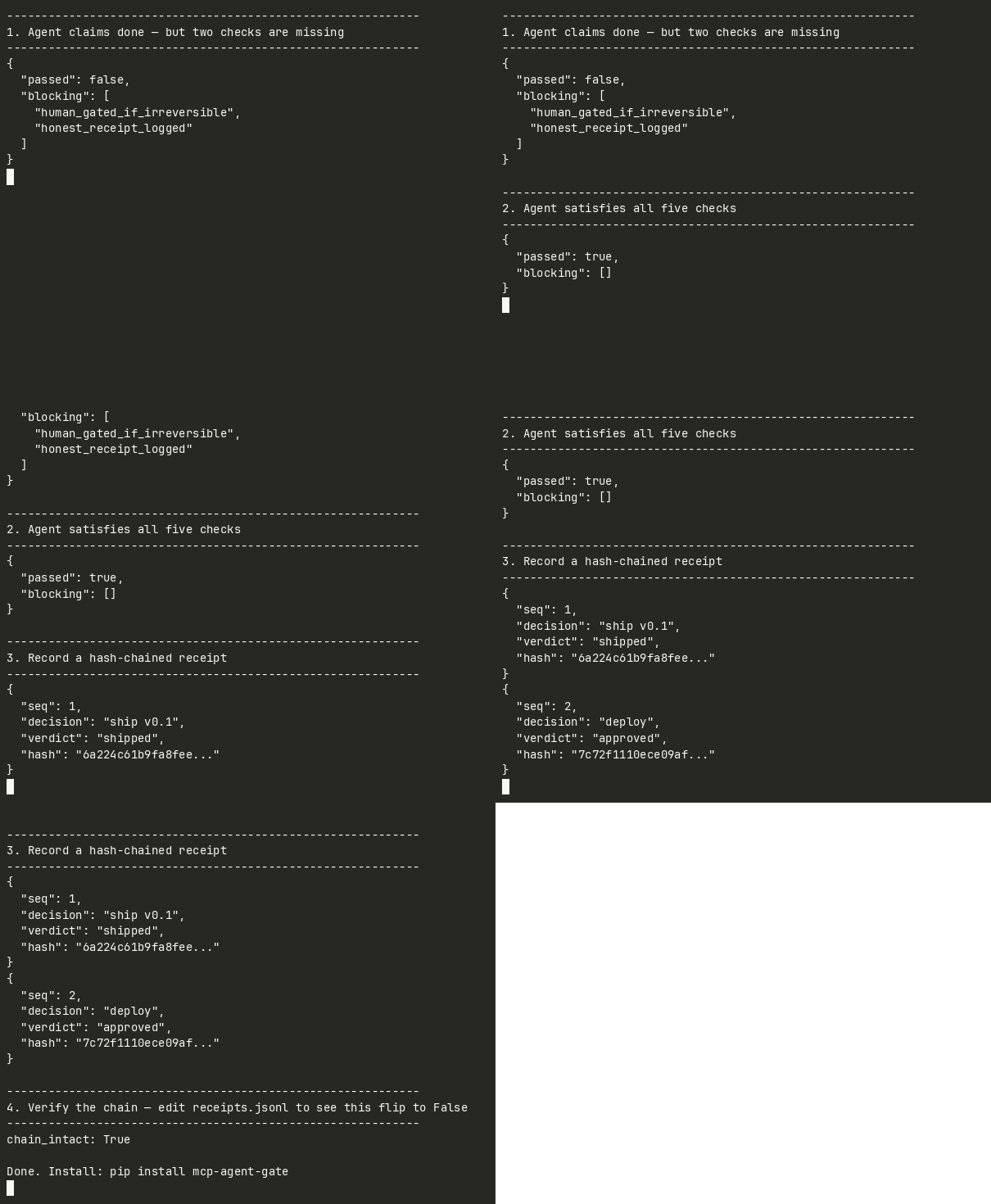
Demo
Run it yourself: PYTHONPATH=. python3 examples/demo.py
------------------------------------------------------------
1. Agent claims done — but two checks are missing
------------------------------------------------------------
{
  "passed": false,
  "blocking": [
    "human_gated_if_irreversible",
    "honest_receipt_logged"
  ]
}

------------------------------------------------------------
2. Agent satisfies all five checks
------------------------------------------------------------
{
  "passed": true,
  "blocking": []
}

------------------------------------------------------------
3. Record a hash-chained receipt
------------------------------------------------------------
{
  "seq": 1,
  "decision": "ship v0.1",
  "verdict": "shipped",
  "hash": "015202a168512f15..."
}
{
  "seq": 2,
  "decision": "deploy",
  "verdict": "approved",
  "hash": "9533d304d4dd07e5..."
}

------------------------------------------------------------
4. Verify the chain — edit receipts.jsonl to see this flip to False
------------------------------------------------------------
chain_intact: True
This repo gates itself
agent-gate is about not shipping unverified work, so the repository holds itself to the same bar:
- Coverage-gated test matrix —
ci.ymlruns pytest on Python 3.11–3.13 and fails the build if line coverage drops below the threshold (currently 97% covered). - CodeQL — static analysis (
security-extended) runs on every push, PR, and weekly; findings surface in the Security tab. - Pinned supply chain — every GitHub Action is pinned to a full commit SHA; Dependabot keeps those pins and the Python deps current.
- Branch protection —
mainrequires the CI and CodeQL checks to pass before a merge. - Disclosure policy — see SECURITY.md.
Contributing
See CONTRIBUTING.md.
About
Built by Jeff Otterson (Jott2121). agent-gate operationalizes the gating discipline from bow (an autonomous all-Claude chief-of-staff agent) and the Fleet Mode doctrine. Siblings in the same line: rag-guard and agent-cost-attribution. MIT licensed.
Companion instrument
sabot is the measurement side of this idea. agent-gate adds a fail-closed gate to an agent workflow; sabot plants controlled faults inside running LangGraph, CrewAI and AutoGen pipelines and measures whether gates and reviewer stages like these actually fire. Median own-check detection across three production frameworks: 16.7%, with a pre-registered spec, an Apache-2.0 harness, and every raw trace published.
agent-gate MCP questions
How do I add agent-gate MCP to Claude Code?
Run claude mcp add agent-gate -- uvx mcp-agent-gate in your terminal. Add --scope user to make it available in every project.
How do I add agent-gate MCP to Cursor?
Open ~/.cursor/mcp.json and add the server under mcpServers, using the Cursor config shown in the install section above.
What is a fail-closed gate?
A fail-closed gate ensures a check is only considered satisfied if it is explicitly proven true; missing proof results in failure.
How does the receipt ledger ensure data integrity?
The ledger uses an append-only, hash-chained structure where every decision is linked via SHA256, making any edits or deletions detectable.
Can I use this without an MCP client?
Yes, the core logic can be used directly in Python projects by importing the gate and ledger modules.
Where are the receipts stored?
By default, receipts are persisted to ~/.agent-gate/receipts.jsonl, but this can be customized using the AGENT_GATE_LEDGER environment variable.