
groundskeeper MCP server
Commit Nov 14, 2026Lets an AI client monitor Yarbo robot mowers, manage mowing schedules, and configure safety rules using aerial imagery and camera integrations.
Also known as Groundskeeper-robot/groundskeeper
- Stars
- 11
- Tools
- —
- Downloads, 30 days
- —
- Latest version
- —
- Last commit
- Nov 14, 2026
- License
- MIT
What is groundskeeper MCP?
groundskeeper lets an AI client monitor Yarbo robot mowers, manage mowing schedules, and configure safety rules using aerial imagery and camera integrations.
Summary generated from the project's README
About groundskeeper MCP server
Monitoring and managing Yarbo robot mowers through a self-hosted control panel is what Groundskeeper enables for homeowners. This system runs in a single container on your local network and connects to the Yarbo cloud to manage mowing schedules, track robot health, and view live progress on high-resolution aerial imagery. It is designed for users who want more granular control and safety oversight than the standard mobile app provides.
Users can integrate Frigate cameras to create safety guards that pause or dock the robot if people or pets are detected. The server also connects with Home Assistant and Tempest weather stations to adjust mowing based on soil moisture, rain, or temperature. To use an AI client, you simply connect via MCP using a token from the settings. The assistant can help find the sharpest available GIS imagery for your yard or explain why a scheduled mow is currently being delayed by safety rules.
What you can do with it
- 1Optimize yard mappingAsk the AI to find the highest resolution aerial imagery available for your specific property.
- 2Automate safety protocolsSet up camera-based rules to ensure the robot pauses if a pet enters the mowing area.
- 3Diagnose mowing delaysInquire about the current status of the robot and any environmental factors preventing a scheduled start.
- 4Configure weather-based schedulesUse weather station data to prevent the robot from mowing when the ground is too wet.
Written from the project's README. Every use case is checked against a quote from it.
Automated checks
Ran Nov 14, 2026Full report →Not verified yet. A server needs a score of 80, no serious finding, and enough data for us to check. How checks work · What to fix for more points

- Source repository linked and reachablegroundskeeper-robot/groundskeeper is public and reachablegithub.com/groundskeeper-robot/groundskeeper ↗Pass
- Package names this repository as its sourceNot checked
- Build provenance (Sigstore attestation)Not checked
- Open source license (OSI)MITspdx.org/licenses/MIT.html ↗Pass
- Commit or release in the last yearLast commit or release 2026-11-14github.com/groundskeeper-robot/groundskeeper ↗Pass
- OpenSSF ScorecardNot checked
- Package name not close to a popular packageNot checked
- No critical advisory in the package or its dependenciesNot checked
- No hidden instructions to the model0 tool descriptions and the README read; no override phrases, credential paths or hidden charactersPass
- Destructive tools are labelledNot checked
- Remote endpoint answers the MCP handshakeNot checked
README
View on GitHubA self-hosted recorder, map and guarded control panel for Yarbo robots. It runs in one container on your own network. It records every mow, shows the yard on aerial imagery, explains why the robot can't run, and starts, pauses or docks it only when every safety check passes.
Groundskeeper is an independent community project. It is not affiliated with, endorsed by or supported by Yarbo. It controls a machine with spinning blades: read Safety before switching control on, and use it at your own risk.
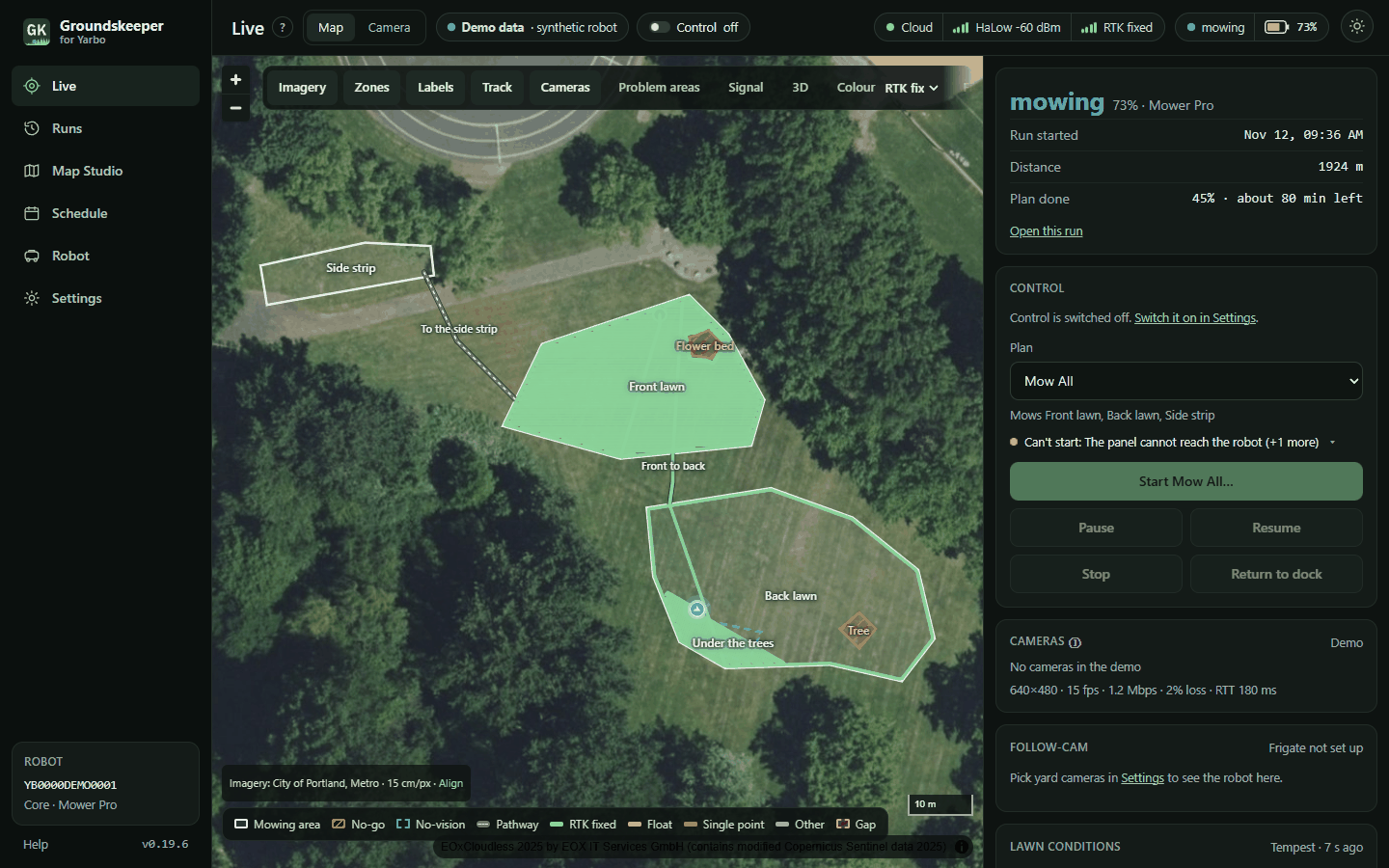
 Every mow, its coverage, gaps and trends |
 One run: coverage by area, a gap, replay |
 The 3D map with the follow camera |
 Map Studio: an area's shape and mow settings |
 Schedule windows and why a start would wait |
 Robot health: RTK, link, battery, deck |
 Settings → Safety: control is off until you switch it on |
 The light theme |
 On a phone |
The screenshots come from the built-in demo (DEMO=1): a made-up robot mowing a made-up yard laid out on a public
park's lawn, so no real home appears. python scripts/screenshots.py makes them again.
Highlights
The sharpest free aerial map of your yard
Most map apps stop at 30–60 cm per pixel. County and state GIS services often fly at 7–15 cm, sharp enough to see pavers and sprinkler heads, but they are hard to find. Groundskeeper ships a catalog of 131 imagery sources in 18 countries, with state, county and city services for every US state and DC, and picks the sharpest free one that covers your yard.
- One card per source that covers your yard, each with its own sample of your yard, its resolution, licence and season. Leave it on Automatic or pick one.
- Add any map service by pasting its address; the panel works out what kind it is and lets you try it at your yard.
- Line the photo up with the robot's map by clicking matching points.
- Private by design: the panel only contacts sources whose coverage contains your yard, so your location is never sent to the rest.
- The catalog is plain JSON, one file per source. Found a sharper service for your county? Add it and everyone there gets it.
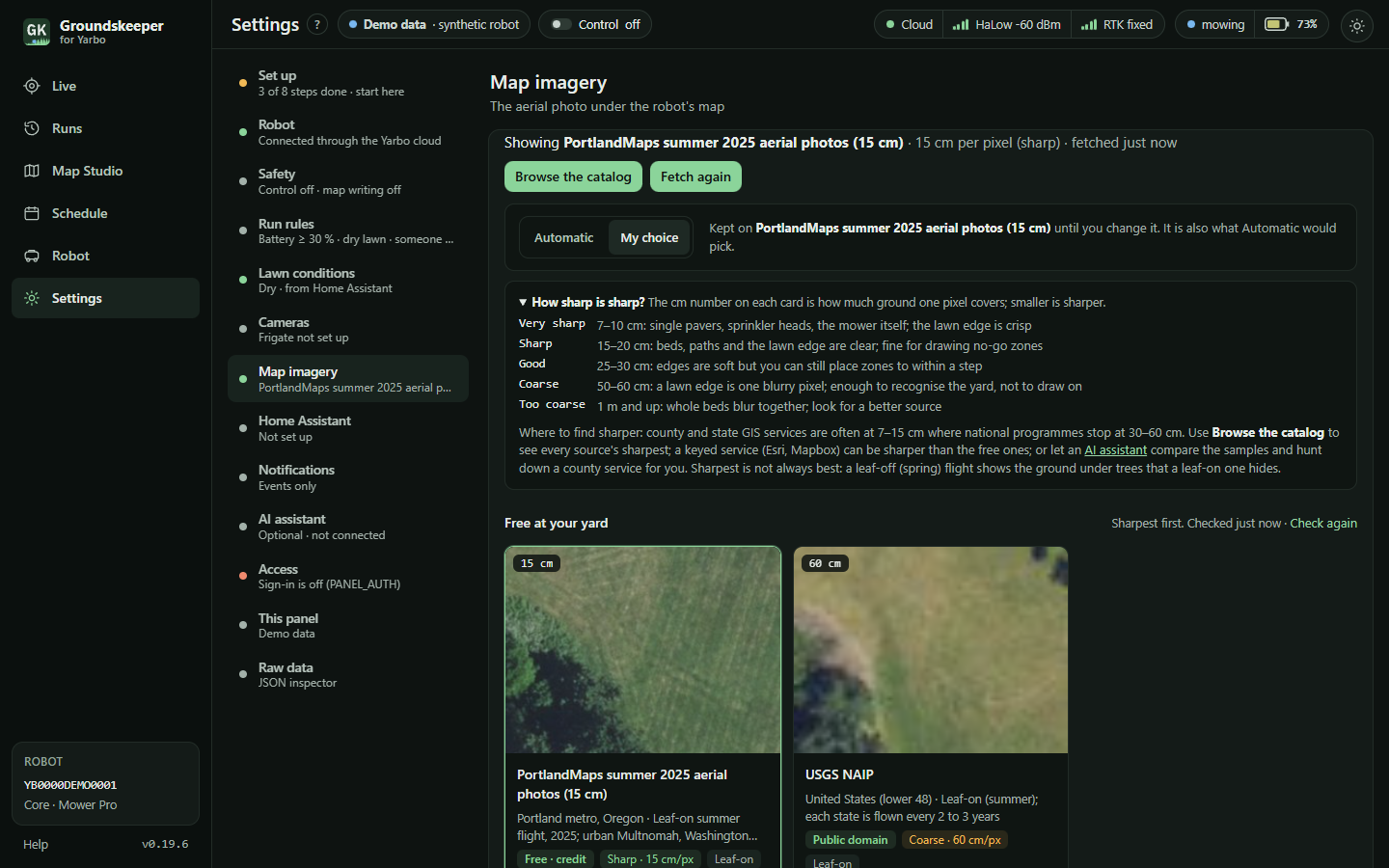
More: Map imagery, the catalog.
Through the Yarbo cloud
Groundskeeper talks to the robot through Yarbo's cloud, the same way the official app does. Firmware V3.14.4x closed the robot's own broker on the home network, so the cloud is the only route.
- Sign in to your Yarbo account in Settings → Robot. The robot's serial comes from the account. The cloud carries everything: position while it mows, battery, RTK, the map, plans, map and settings writes, and the commands to start, pause, resume, stop and dock, each behind its checks.
- Works alongside the Yarbo app: a mow started from the phone is recorded like any other, and the panel notes the commands other clients send.
- Control stays off until you switch it on, so you can run read-only for as long as you like.
Your Frigate cameras keep watch
Tick the Frigate cameras that see the yard and draw the ground each one covers on the map. Then:
- The yard must be clear to start: no person, dog or cat on a yard camera for the last 10 minutes (you choose the time and the labels).
- Guards while it mows: a person or pet in a camera's coverage pauses the robot, docks it or just notifies you, your choice (acting needs control on). Resuming on its own afterwards is off unless you switch it on.
- Follow-cam: live video from whichever camera's coverage holds the robot, switching as it moves. The camera layout puts it full size with two-tap Pause, Stop and Return to dock buttons beside it.
- Snapshots in the "ready to mow" notification, so you can see the yard before you confirm a start.
More: Integrations, Safety.
Home Assistant and your weather station
- Tempest weather station: read straight from the hub's local broadcast, no account or cloud. Rain, temperature and humidity decide whether the lawn is Dry, Damp or Wet, and rain starting during a mow can send the robot home (with control on; otherwise it notifies you).
- Weather from Home Assistant instead of a Tempest, or as a backup: rain, temperature and humidity sensors, picked from a list of your entities. Soil moisture sensors (Zigbee ones work) keep the lawn "wet" until the ground has dried, however long ago it rained.
- Presence: an alarm panel,
zone.home, people or trackers decide whether someone is home before a start. - Notifications to your phone through the companion app: errors, stuck, maintenance due, and before a scheduled start, a "ready to mow" note with a camera snapshot for you to confirm.
- Sensors back into Home Assistant: state, battery, RTK, whether it is mowing, the link, lawn conditions and the last run, for your own dashboards and automations.
More: Integrations.
Set it up by asking an AI assistant (MCP)
Connect Claude, or any assistant that speaks MCP, with one command and a token from Settings. Then ask it:
Find the most detailed aerial map of my yard: check every source that covers it, look at the samples, and if a county or state service would be sharper, find it for me.
Walk me through setting up cameras, run rules, lawn conditions, the schedule and alerts.
What's the robot doing, and would it start right now?
- It reads everything you can see and helps with setup, saying what it will change and waiting for your yes.
- It can only make safety settings stricter, never looser, and it can't switch control or map writing on.
- Coordinates, the robot's serial and your Yarbo account are removed from what it reads, so it can search for imagery by region without ever learning your address.
- Commands to the robot are off unless you switch on Assistant commands, and even then every check applies.
More: AI assistants (MCP).
What it does
- Live: the robot on aerial imagery with its track coloured by RTK quality, the plan's progress, the battery, the link, the lawn conditions and why the robot can't run right now. It also has a 3D map with a follow camera.
- Runs: every mow is recorded, with coverage and gaps, planned versus driven, problem areas, signal maps and replay.
- Map Studio: inspect, measure, diff and export the robot's map. It can edit no-go zones, pathways, dead ends, no-vision zones, areas and plans, and every write is read back and verified.
- Schedule: the panel owns the schedule, with run rules (dry lawn, daylight, someone home, the yard clear on cameras), and it can ask you before it starts.
- Guards: if a person appears in a yard camera's coverage (Frigate) the robot pauses, and if rain starts it docks.
- Robot: health, maintenance timers and an event log of everything sent or refused.
- Integrations, all optional: Home Assistant (sensors, presence, notifications), Frigate, a Tempest weather station, and AI assistants over MCP.
Quick start
mkdir groundskeeper && cd groundskeeper
curl -fsSLO https://raw.githubusercontent.com/Groundskeeper-robot/groundskeeper/main/docker-compose.yml
docker compose up -d
Open http://<host>:8425 and set the admin password. The setup code it asks for is in the log:
docker logs groundskeeper. Then the setup guide walks you through the Yarbo cloud sign-in (the robot's serial
comes from your account), the imagery, cameras, Home Assistant and safety settings. All data stays in
./data. It includes your yard's location, so back it up and keep it private.
Updating: run docker compose pull && docker compose up -d. To stay on one release line, pin the image tag in
docker-compose.yml (for example :1.0). Each release's changes are in the changelog and on the
releases page.
Testing what's next. Pre-release images are in their own package, ghcr.io/groundskeeper-robot/groundskeeper-dev:
:edge is built on every merge to main, :nightly once a night when main changed (:nightly-YYYYMMDD for a
given night), and :sha-<commit> for an exact commit. Point docker-compose.yml at one to try a fix before it is
released. They passed the same checks as a release but have not been tried on a robot, so back up ./data first: a
newer build may change the database in a way the last release cannot read. Settings → This panel shows nightly or
edge beside the version; say which when you report a problem. To go back, switch the image to a release; if
that release then won't start or shows errors about the database, stop the panel, put the backup of ./data back,
and start it again.
Other options are in .env.example. The panel runs as PUID:PGID (1000:1000 by default), so
set those to your own user if you want to edit ./data by hand. It runs on amd64 and arm64, including a Raspberry
Pi 4 or 5.
As a Python package. pyproject.toml lets another Python tool depend on Groundskeeper (pip install . or
uv sync in a checkout). An installed copy is the library only: the panel's catalog/, web/ and docs/ folders
are not in it, so running the panel needs a checkout or the image. app.codec and app.cloud are not a stable API
and can change in any release, patch releases included, so pin the version you depend on.
On Unraid, use the Docker template: copy deploy/unraid/groundskeeper.xml to
/boot/config/plugins/dockerMan/templates-user/my-groundskeeper.xml, then Docker → Add Container → pick
groundskeeper. The container then shows like any other Unraid app (update check, autostart, Edit), not as
"3rd Party". A Compose Manager stack is in deploy/ if you prefer that.
Safety
- The panel asks for a password. You set it on the first visit, using a one-time code from the container's log. Programs use named API tokens instead.
- Control is off on a new install. Switching it on means typing ENABLE, and it is logged.
- Only five run commands exist: start a plan, pause, resume, stop and dock, plus switching the robot's cameras on and
keeping it awake for the Cameras tile (people only, cloud only, never off). Manual driving (
cmd_vel) is blocked for good. - Every start passes hard interlocks that can't be overridden: the robot is online, it has no active error and enough battery, the phone app isn't driving it, and the yard is clear. Soft checks, such as a wet lawn, need a person to override them.
- Guards that resume a paused robot on their own are opt-in.
- Commands go through the Yarbo cloud (the official SDK's route), the only route since firmware V3.14.4x closed the robot's own broker. They pass the same checks and are logged.
Documentation
- User guide: the same pages as the in-app Help.
- Developer docs: design, the Yarbo protocol, map write formats, robot states, the UI system and the imagery catalog.
- Changelog
- Contributing and AGENTS.md, the rules for AI coding agents.
- Security: report problems privately.
License
MIT. The Docker image also includes Yarbo's SDK, which is PolyForm Noncommercial: see THIRD_PARTY_NOTICES.md. Yarbo is a trademark of its owner, used here only to say which robot this works with.
groundskeeper MCP questions
Can I use an AI assistant to set up my robot?
Yes, you can connect Claude or any MCP-compatible assistant to help find aerial maps, walk through camera setup, and check robot status.
Is Groundskeeper affiliated with Yarbo?
No, it is an independent community project and is not affiliated with, endorsed by, or supported by Yarbo.
How does the system ensure safety when using AI commands?
AI assistants can only make safety settings stricter, never looser, and cannot switch control or map writing on.
Does the system share my location with map providers?
No, the panel is private by design and only contacts sources that cover your specific yard, so your location is never sent to others.