
ShadeNet MCP server
Commit Nov 15, 2026Provides anonymous, zk-proof gated web egress for AI agents through a local HTTPS proxy or MCP server.
Also known as dmarzzz/shade-tree-node
- Stars
- 9
- Tools
- —
- Downloads, 30 days
- —
- Latest version
- —
- Last commit
- Nov 15, 2026
- License
- MIT
What is ShadeNet MCP?
ShadeNet provides anonymous, zk-proof gated web egress for AI agents through a local HTTPS proxy or MCP server.
Summary generated from the project's README
About ShadeNet MCP server
ShadeNet provides an anonymous egress layer for AI agents to access the web when standard connections are restricted. It functions as a proxy that uses zero-knowledge proofs to gate access, ensuring that agents can browse without a stable identity or account. This system is designed for LLM agents like Claude Code, Hermes, and Codex, allowing them to maintain privacy through a proof-gated Tor onion service.
Developers can implement this using a local HTTPS proxy or the provided MCP server. The system offers two primary implementations: a Node.js version for full-stack operations and a Rust-based binary for agents that requires no local Tor daemon. Users can run the service via the shadenet CLI, using commands like shadenet proxy or shadenet mcp to expose tools such as shadenet_fetch and shadenet_search. Access is managed through staking on the Sepolia testnet, where members use Groth16 proofs to secure CONNECT tunnels with specific payload limits.
What you can do with it
- 1Anonymous web browsing for agentsAn AI agent can access the internet without revealing a permanent identity or account.
- 2Self-contained agent deploymentDeploy an agent with built-in egress that does not require a separate Tor installation.
- 3Privacy-preserving network egressRoute agent traffic through a proxy to hide the source IP from the destination.
Written from the project's README. Every use case is checked against a quote from it.
Automated checks
Ran Nov 15, 2026Full report →Not verified yet. A server needs a score of 80, no serious finding, and enough data for us to check. How checks work · What to fix for more points

- Source repository linked and reachabledmarzzz/shade-tree-node is public and reachablegithub.com/dmarzzz/shade-tree-node ↗Pass
- Package names this repository as its sourceNot checked
- Build provenance (Sigstore attestation)Not checked
- Open source license (OSI)MITspdx.org/licenses/MIT.html ↗Pass
- Commit or release in the last yearLast commit or release 2026-11-14github.com/dmarzzz/shade-tree-node ↗Pass
- OpenSSF ScorecardNot checked
- Package name not close to a popular packageNot checked
- No critical advisory in the package or its dependenciesNot checked
- No hidden instructions to the model0 tool descriptions and the README read; no override phrases, credential paths or hidden charactersPass
- Destructive tools are labelledNot checked
- Remote endpoint answers the MCP handshakeNot checked
README
View on GitHub
Research preview launched: Sepolia testnet, unaudited, trusted setup. What that means
ShadeNet
Cover for local agents.
The canopy of Shade Trees gives agents anonymous egress when the clearnet won’t let them through. Access is anonymous and zk-proof gated.
ShadeNet is a proxy for AI agents: private web access with no account or stable identity, through a local HTTPS proxy or an MCP server. Built for LLM agents such as Hermes, Claude Code, Codex, Pi and nanocodex.


Add ShadeNet to an agent. Run a Shade Tree node to provide cover. The two sides meet through a proof-gated Tor onion service, one admitted CONNECT tunnel at a time.
The best shade asks for proof, not a name.
Site · Canopy · Research · Docs · Protocol · Security
ShadeNet is not affiliated with Shade Network or Shade Protocol.
[!WARNING] ShadeNet is a research preview on Sepolia. The code is unaudited, the proof keys come from a trusted setup, and it should not be considered secure against a motivated actor: do not use it for real funds or sensitive traffic.
The proof keys are the output of the RLN trusted setup ceremony that Privacy & Scaling Explorations (PSE) ran in 2023. ShadeNet did not run the ceremony. This project adopted its output and re-verified it from public inputs, and no outside verifier has confirmed that check yet. The keys are sound if at least one contributor to each was honest (60 contributed to the membership key, 62 to the withdrawal key). If all of them colluded, proofs could be forged.
Known limits of the preview:
- The network is still small, in nodes and in members, so each member hides among few others.
- Clients trust the node list the Elder Trees sign.
- Rate limits are enforced per node; replay protection across nodes is best effort.
- Staking links the staking wallet to its member commitment on chain.
- The node that serves a tunnel sees the destination hostname, the timing and the byte counts.
- As with any Tor-based system, an observer watching both ends of a tunnel can correlate timing.
Implementation maturity
Maturity describes implementation scope and validation, not security assurance. Both implementations are research previews under the warning above.
| Implementation | Status | Current scope | Validation |
|---|---|---|---|
| Node.js / JavaScript | Full-stack reference preview | Proxy and SDK, Shade Tree node, Elder Tree, membership/operator tools, and contributor harnesses. This remains the operator and in-process JavaScript path. | Full suite on Node.js 20, 22, and 24; bootstrap E2E; best-effort real-Tor E2E. |
| Rust | Primary agent distribution preview | The checksummed -live binary creates identities, runs the embedded-Arti CONNECT Proxy, launches one proxy-scoped agent, and exposes the reusable Rust egress client. It does not provide a Shade Tree node or Elder Tree. |
All-target, all-feature Cargo CI; shared v4 conformance vectors; Rust-to-JavaScript proof and Proxy interop; scheduled real-Hermes/Arti E2E gate. |
Use the checksummed Rust -live release for agents. It needs
neither Node.js nor a client-side Tor daemon. Use the Node.js implementation for
canopy operation, the JavaScript SDK, and repository development.
Agent developers
Start with the complete no-Node agent guide. The installer
detects the platform, downloads the matching checksum, verifies both its digest
and filename, and installs without sudo into ~/.local/bin:
curl -q -fsSL --proto '=https' --proto-redir '=https' \
  https://raw.githubusercontent.com/dmarzzz/shade-tree-node/main/scripts/install.sh | SHADENET_VERSION=v0.7.5 sh
shadenet --version
Automatic mode first tries the selected release's self-contained -live agent
and falls back to its verifier-only binary only when that live asset is absent.
On Apple Silicon it detects Rosetta shells and still selects the native arm64
live build. v0.7.5 is the latest release; pin it with SHADENET_VERSION=v0.7.5 if you need a
fixed build. v0.6.0 installs only the older shade-tree binary, without init, status or
mcp, and has no Intel macOS live build. The
installer options and manual verification steps cover the rest. Checksums
provide transfer integrity; GitHub attestations provide the stronger build
provenance check.
The bundled Sepolia canopy admits one public staked tier, limit 8: the bond in the
current network record (shadenet init prints it; the Get access page
shows it) buys eight proof slots per fixed 60-second epoch, each a CONNECT tunnel
with a 40 MiB payload ceiling. init creates an owner-only identity, a proxy token
and config.toml; then stake the identity commitment it prints (never the leaf). Without a
key, register-member creates a funding wallet, prints its address and the Sepolia ETH to send,
and stakes once it arrives; --key-file funded-sepolia.key pays from a key you hold, and a
sponsor can stake it from the Get access page instead:
shadenet init
shadenet register-member --identity ~/.config/shadenet/identity.json
shadenet status --wait        # returns once the registration is final
The current contract, RPC, deployment block, tiers, Elders, signer, and rate
policy are bundled defaults; --network path/to/deployment.json selects another
canopy. Start the self-contained Proxy and, in another terminal, route only the
agent process:
shadenet proxy
shadenet run --no-proxy api.openai.com -- your-agent
shadenet run passes proxy variables only to its child and refuses to launch
if the authenticated Proxy preflight fails. It puts the local token only in the
child's proxy URLs; the raw SHADENET_PROXY_TOKEN and other operator settings
are removed from the child environment. Keep the model API host on
--no-proxy: it has its own network path and would waste tunnels. Software that
ignores proxy variables must be configured with the authenticated URL
http://shadenet:$SHADENET_PROXY_TOKEN@127.0.0.1:8118. Agents that speak MCP
can use shadenet mcp instead (shadenet_fetch, shadenet_fetch_fallback,
shadenet_status, shadenet_search). Rust applications
can use the shadenet SDK crate; JavaScript applications can import
ShadeTreeClient. The exact public semantics and their non-atomic
cross-gateway caveat are recorded in
docs/PUBLIC-STAKING.md.
The same live binary can reclaim an unslashed bond without revealing the identity secret:
shadenet exit-member --identity ~/.config/shadenet/identity.json --key-file gas.key
# Wait until `shadenet member-status` reports its withdrawal time has passed.
shadenet withdraw-member --identity ~/.config/shadenet/identity.json \
  --recipient 0xFRESH_SEPOLIA_ADDRESS --key-file gas.key
The gas payer may be unrelated to both the original funder and recipient. Each action is authorized by a locally generated Groth16 proof; only the public commitment and action-bound proof reach the chain.
How it works
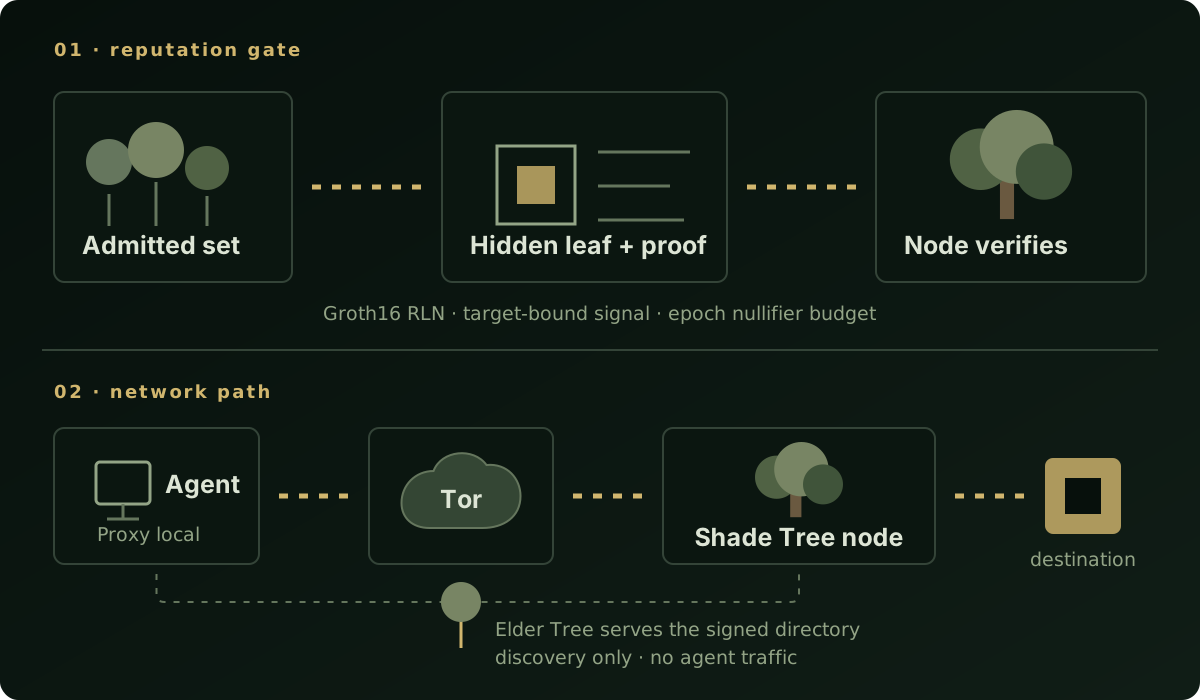
ShadeNet is a Tor-based egress layer. The node sees Tor, not the Proxy host's source IP. Each CONNECT tunnel carries a Groth16 RLN proof that a rate-commitment leaf belongs to an admitted Merkle root without revealing which leaf. The proof binds the target-and-nonce signal to a private per-epoch message slot. The node verifies it before egress and uses epoch-scoped nullifiers to enforce its view of the member's tunnel limit.
Roles
| Name | What it does |
|---|---|
| Proxy | Runs beside the agent, reads the signed canopy directory, and opens each tunnel through Tor |
| Shade Tree node | Verifies the proof and makes the destination-facing connection |
| Elder Tree | The bootnode that caches signed announcements and serves the canopy |
| canopy | A group of Shade Tree nodes and the signed directory that lists them (formerly Grove and Canopy) |
The Elder Tree is outside the traffic path. Its pinned signer controls discovery and can omit, reorder, or add candidates. See the threat model for the exact trust boundary.
Tor exit addresses are public, and shared traffic often trips abuse controls. ShadeNet gates each tunnel and publishes no egress-IP list. Destinations still see and can block a node IP.
Run a node
A Shade Tree node is a Tor onion service with a proof-gated CONNECT gateway. Its public IP becomes the destination-facing egress IP.
Nodes reject loopback, private, link-local, documentation, multicast, and other
special-purpose destination addresses after DNS resolution. The explicit
SHADE_TREE_ALLOW_PRIVATE_TARGETS=1 escape hatch is for isolated local tests
only. The research preview is live on Sepolia (see the warning above and
network/sepolia/deployment.json); a production
deployment beyond the preview still depends on the other deployment
gates.
For a local research node, install the current CLI and let the guided command prepare its onion identity:
git clone https://github.com/dmarzzz/shade-tree-node.git
cd shade-tree-node
npm ci && npm link
shade-tree-node join node
A node can run near GPU workers, model servers, or an Ethereum validator. Give egress a dedicated public IP when possible. Keep validator keys and authenticated RPC endpoints out of the node. Read the operator guide and current deployment plan.
Interactive services grow one small ASCII tree when ready. Bootstrap installs use structured JSON logs and separate loopback metrics for each role. See the monitoring guide.
Boundaries
- The destination sees the node IP and can share or block it.
- The node sees the destination hostname, port, timing, and byte counts. With HTTPS it does not terminate application TLS.
- Tor does not stop an observer who can watch both ends from correlating timing.
- Enrollment through staked or paid sets can create public onchain links.
- A node can refuse, delay, truncate, or misroute a valid tunnel.
- Co-located services keep separate trust boundaries only if the operator does.
- Replay and rate accounting are strongest per node. The optional cross-node tally is fail-open and suppresses later replays only after propagation, so concurrent attempts can still pass on different nodes.
- Client RLN slots are durably coordinated across Proxy, SDK, and Rust processes
under the member's public identity commitment. The state contains only
{version, epoch, nextSlot}and fails closed if it is corrupt, unavailable, or remains locked. Allocation happens before proving, so a crash or local proof failure consumes a slot; state resets only when the protocol epoch advances.
One proof buys one epoch slot, not one HTTP request. With session tickets on — as in the live record — that slot is a book of six single-use tunnel tickets at one node (see ECONOMICS.md); with tickets off it is a single CONNECT tunnel. Either way HTTP/2 and keep-alive can carry many requests inside a tunnel. Both opaque traffic directions share a 40 MiB allowance per RLN epoch slot on each node; reaching it closes the tunnel. Read the protocol and threat model for the exact guarantees.
Repository
| Path | Role |
|---|---|
packages/node/ |
The JS node: gateway/ (proof gate and destination tunnel), bootnode/ (Elder Tree discovery service and operator tools), client/ (local proxy, discovery, node rotation), lib/ |
packages/sdk/ |
@shadenet/sdk, the JavaScript SDK (browser and Node) |
crates/ |
Rust binary, reusable egress/protocol crates, and RLN prover |
contracts/ |
Optional Sepolia membership and operator sets |
network/ |
Signed test-network records |
specs/ |
Canonical protocol and public Data API contracts |
npm ci
npm run test:fast       # quick first check; skips slow proof/onchain suites and Foundry
npm test                # full pre-PR check
cargo test --workspace
See CONTRIBUTING.md for the test layout. Report security issues through the private channel in SECURITY.md. Ask questions in Discussions. ShadeNet is open source under the MIT license.
ShadeNet MCP questions
What is ShadeNet?
ShadeNet is a proxy for AI agents that provides private web access without a stable identity using a local HTTPS proxy or MCP server.
Is ShadeNet secure for sensitive traffic?
No, it is currently a research preview on the Sepolia testnet and should not be used for real funds or sensitive traffic.
How can AI agents use ShadeNet via MCP?
Agents that support the Model Context Protocol can use the 'shadenet mcp' command to access tools like shadenet_fetch and shadenet_search.