
Lets an AI client access structured SEC EDGAR filing data, including financial statements, insider trades, and full-text search capabilities.
Also known as dgunning/edgartools
- Stars
- 2,850
- Tools
- —
- Downloads, 30 days
- 1,202,597
- Latest version
- 6.2.0
- Last commit
- Nov 14, 2026
- License
- MIT
What is EdgarTools MCP?
EdgarTools lets an AI client access structured SEC EDGAR filing data, including financial statements, insider trades, and full-text search capabilities.
Summary generated from the project's README
About EdgarTools MCP server
EdgarTools provides a way for developers and AI clients to access structured SEC EDGAR filing data. It transforms raw filings into typed Python objects, making it easier to work with financial statements, insider trades, and fund holdings. The tool is designed for users who need more than just raw JSON facts, offering standardized rows for metrics like total revenue and providing full-text search capabilities across filings dating back to 2001.
This MCP server runs locally in your own process using Python 3.11 or newer. To use it, you must identify yourself to the SEC by providing a contact email via the EDGAR_IDENTITY environment variable. There are no API keys or vendor quotas required, though the server respects the SEC fair-access limit of 10 requests per second. It is particularly useful for building RAG applications because it can convert entire filings into markdown format.
What you can do with it
- 1Analyze multi-year financial trendsA developer can request standardized income statements or balance sheets across several fiscal years for a specific company.
- 2Perform full-text filing searchesAn AI client can search through the text of every filing since 2001 to find specific mentions of topics like tariffs.
- 3Extract structured insider trading dataUsers can parse Form 4 filings to view buys, sells, and grants as structured dataframes.
- 4Prepare data for RAG systemsThe tool can convert complex HTML filings into clean markdown to improve retrieval-augmented generation performance.
Written from the project's README. Every use case is checked against a quote from it.
How to install EdgarTools MCP
Formats verified 10 Nov 2026Add to CursorAdd to GooseInstall EdgarTools MCP in Claude Code
$ claude mcp add --env 'EDGAR_IDENTITY=<EDGAR_IDENTITY>' edgartools -- uvx edgartoolsInstall EdgarTools MCP in Cursor
~/.cursor/mcp.json
{
  "mcpServers": {
    "edgartools": {
      "command": "uvx",
      "args": [
        "edgartools"
      ],
      "env": {
        "EDGAR_IDENTITY": "<EDGAR_IDENTITY>"
      }
    }
  }
}Install EdgarTools MCP in VS Code
.vscode/mcp.json
{
  "servers": {
    "edgartools": {
      "type": "stdio",
      "command": "uvx",
      "args": [
        "edgartools"
      ],
      "env": {
        "EDGAR_IDENTITY": "<EDGAR_IDENTITY>"
      }
    }
  }
}Install EdgarTools MCP in VS Code CLI
$ code --add-mcp '{"name":"edgartools","type":"stdio","command":"uvx","args":["edgartools"],"env":{"EDGAR_IDENTITY":"<EDGAR_IDENTITY>"}}'Install EdgarTools MCP in Claude Desktop
claude_desktop_config.json
{
  "mcpServers": {
    "edgartools": {
      "command": "uvx",
      "args": [
        "edgartools"
      ],
      "env": {
        "EDGAR_IDENTITY": "<EDGAR_IDENTITY>"
      }
    }
  }
}Install EdgarTools MCP in Codex
$ codex mcp add edgartools --env 'EDGAR_IDENTITY=<EDGAR_IDENTITY>' -- uvx edgartoolsInstall EdgarTools MCP in Codex config.toml
~/.codex/config.toml
[mcp_servers.edgartools]
command = "uvx"
args = ["edgartools"]

[mcp_servers.edgartools.env]
EDGAR_IDENTITY = "<EDGAR_IDENTITY>"
Install EdgarTools MCP in Gemini CLI
$ gemini mcp add -s user -e 'EDGAR_IDENTITY=<EDGAR_IDENTITY>' edgartools uvx -- edgartoolsInstall EdgarTools MCP in Gemini settings.json
~/.gemini/settings.json
{
  "mcpServers": {
    "edgartools": {
      "command": "uvx",
      "args": [
        "edgartools"
      ],
      "env": {
        "EDGAR_IDENTITY": "<EDGAR_IDENTITY>"
      }
    }
  }
}Configuration
EDGAR_IDENTITYRequiredYour name and email for SEC EDGAR API identification (e.g. 'Your Name your.email@example.com')
| Name | Description | |
|---|---|---|
| EDGAR_IDENTITY | Your name and email for SEC EDGAR API identification (e.g. 'Your Name your.email@example.com') | Required |
Automated checks
Ran Nov 12, 2026Full report →Passed our automated checks. That is not a security audit: read the code and give the server the narrowest access it needs. How checks work

- Source repository linked and reachablePass
- Open source license (OSI)Pass
- Commit or release in the last yearPass
- Package name not close to a popular packagePass
- Remote endpoint uses HTTPSNot checked
- Destructive tools are labelledNot checked
- No hidden instructions to the modelPass
- No critical advisory in the package or its dependenciesPass
README
View on GitHubEdgarTools — Python Library for SEC EDGAR Filings
EdgarTools is a Python library for SEC EDGAR filings as structured data: financial statements, insider trades, fund holdings, proxy statements and dozens of other filing types, through one consistent Python API. SEC publishes every filing since 1994 for free, and almost none of it is ready to use; EdgarTools turns a filing into a typed Python object. Free and open source, MIT-licensed.
Docs · Cheat sheet · Agents: Skill · MCP server · Hosted: edgar.tools
EdgarTools 6.0 needs Python 3.11 or newer and renames or removes some 5.x APIs. Read Upgrading to 6.0 before you upgrade.
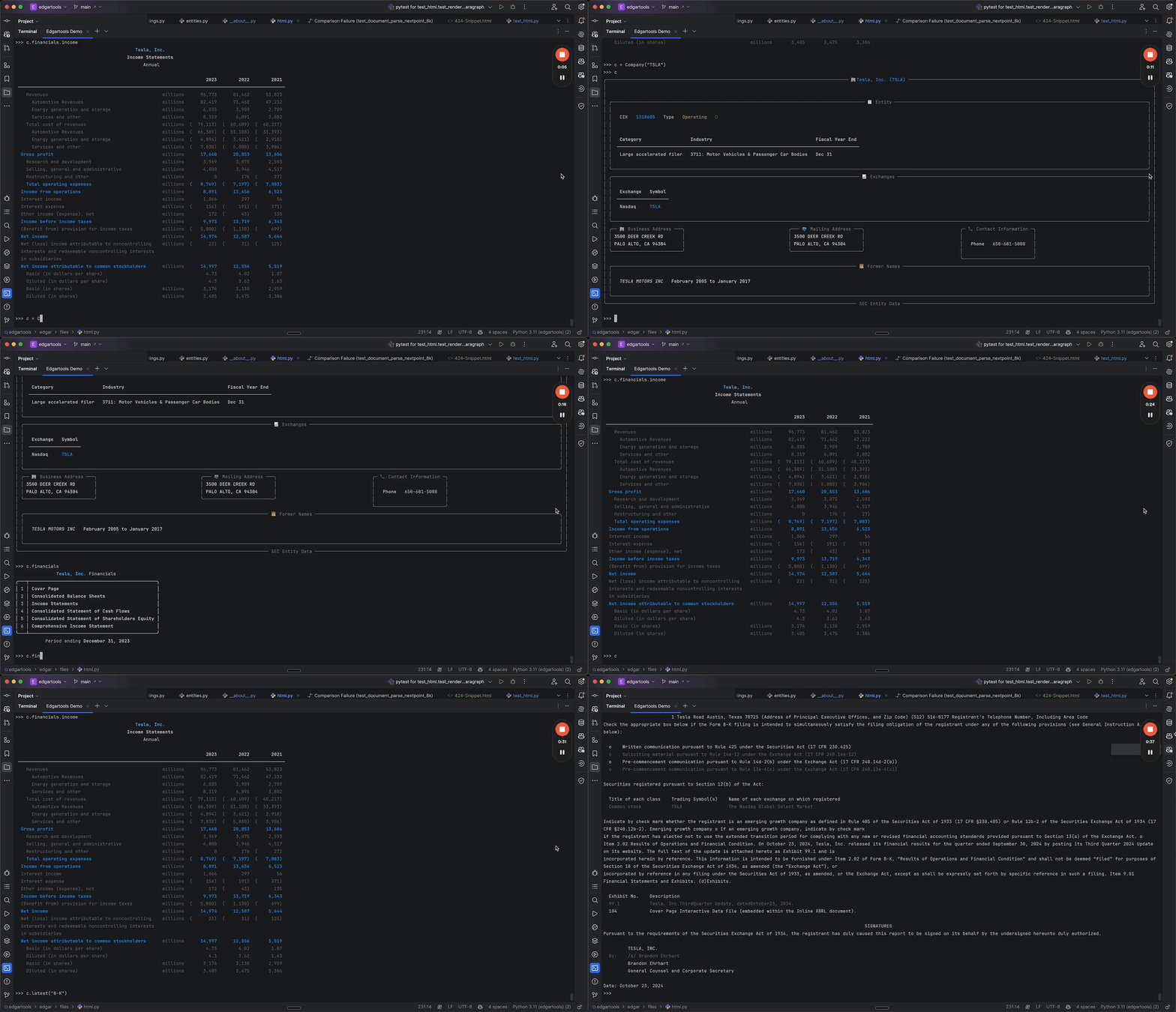
Quick Start
1. Install. The package is edgartools; the module you import is edgar. Python 3.11+.
uv add edgartools # or: pip install edgartools
2. Identify yourself to the SEC. EDGAR requires a contact email on every request. There is no key, signup or rate-limit tier.
from edgar import Company, set_identity

set_identity("your.name@example.com")
3. Get data.
# Five fiscal years of standardized income statement, from XBRL
Company("NVDA").income_statement(periods=5)
#> Total Revenue $215.9B $130.5B $60.9B
Why not just call SEC's APIs?
data.sec.gov gives you JSON facts and filing indexes. Everything past that is your code. EdgarTools does that part:
- Section text and markdown. Item 1A, Item 7 or any Item of a 10-K or 10-Q as text, and whole filings as markdown for RAG. Raw HTML is where hand-rolled parsers break.
- Parsed forms, not XML. 13F holdings, Form 4 transactions, N-PORT portfolios and 8-K items as typed objects and DataFrames.
- Statements that line up. Rows standardized across filers, so "Total Revenue" means the same thing for a bank and a chipmaker, plus discrete quarters (Q4 derived from the 10-K) and trailing twelve months.
- Search and plumbing. Full-text search over filing content, the live filing feed, rate limiting, caching and offline storage.
It runs in your own process, MIT-licensed, with no API key and no vendor quota; SEC's fair-access limit of 10 requests a second still applies, and EdgarTools keeps to it.
What you can do
Full-text search across SEC filings
Search the text of every filing since 2001, not just form types and dates.
from edgar import search_filings

# Every 10-K filed since 2025 that mentions tariffs
results = search_filings("tariff", forms="10-K", start_date="2025-01-01")
hit = results[0]
hit.accession_number, hit.form, hit.filed, hit.company  # a hit's fields; filed is the filing date
hit.get_filing()  # the Filing behind a hit, ready for .obj() or .markdown()

# Structured: 8-Ks that reported a cybersecurity incident (Item 1.05) in 2025
search_filings(forms="8-K", items="1.05", start_date="2025-01-01", end_date="2025-12-31")
#> 19 total
Financial statements over several years
Company("MSFT").income_statement(periods=10) # also .balance_sheet() and .cash_flow_statement()
One metric across companies
Pick rows by their standardized label, never by position: the first row of an income statement is not always total revenue.
import pandas as pd

revenue = {
    ticker: Company(ticker).income_statement(periods=3, as_dataframe=True)
            .set_index("label").filter(like="FY").loc["Total Revenue"] / 1e9
    for ticker in ["JPM", "PFE", "CAT"]
}
pd.DataFrame(revenue).round(1)  # $ billions
#> FY 2025 182.4 62.6 67.6
Quarterly figures and trailing twelve months
nvda = Company("NVDA")
nvda.get_ttm_revenue()                                 # the last four quarters, summed
nvda.income_statement(period="quarterly", periods=8)   # discrete quarters; Q4 is derived from the 10-K
Sections and markdown for RAG
filing = Company("NVDA").latest("10-K")
filing.markdown()          # the whole filing as markdown

tenk = filing.obj()
tenk.risk_factors          # Item 1A as text
tenk["Item 1C"]            # any Item by number
Find filings, by anything
from edgar import find, get_current_filings, get_filings

get_filings(2025, 4, form="10-K")   # every 10-K filed in Q4 2025
get_current_filings()               # the live feed, as SEC posts it
find("0000320193-25-000079")        # an accession number, CIK or ticker


13F institutional holdings
thirteenf = Company("BRK.A").get_filings(form="13F-HR").latest().obj()
thirteenf.holdings  # one row per security: Issuer, Cusip, Ticker, SharesPrnAmount, Value, ...
Institutional Holdings guide →

Insider trades from Form 4
form4 = Company("TSLA").get_filings(form="4").latest().obj()
form4.to_dataframe()  # buys, sells, grants and exercises

Fund holdings from N-PORT
from edgar import Fund

Fund("VOO").get_portfolio()  # the latest N-PORT holdings as a DataFrame
8-K events and earnings releases
eightk = find("0001045810-26-000073").obj()  # NVIDIA, 2026-08-26
eightk.items      # ['Item 2.02', 'Item 9.01']
eightk.earnings   # the EX-99.1 press release tables, parsed
Library or hosted?
EdgarTools is this library: free, MIT-licensed, running in your own Python process. edgar.tools is the hosted platform built on it: the same parsing, kept running and current, with every answer cited to its filing. You are not paying for the parsing; you are paying for it to be run and answerable. No feature is ever removed from the library to sell the platform.
| If you want to… | Use |
|---|---|
| Build something that runs: pipelines, backfills, backtests, model corpora, notebooks, custom joins, anything repeated across hundreds of names or run inside your own network | The library |
| Ask, not build: what the companies you cover filed and what changed since last time, who sold, who holds it, one person across every company they touch, screens across a universe, alerts, cited answers to forward or share with a team. From a browser, a phone, Excel, Claude or ChatGPT, or an agent that cannot run Python | edgar.tools. Free account to start |
| Own a maintained dataset (insider trades, 13F, BDC portfolios, material events), every row traceable to its filing, without running the pipeline | edgar.tools data licensing |
| Fetch one known filing or one JSON document, once, from a script | Neither: call EDGAR directly |
Both have an MCP server: the library's runs locally (see AI Integration below), and edgar.tools' is hosted at app.edgar.tools/mcp. Attach one per client, not both: they overlap and split your assistant's routing.
AI integration
EdgarTools ships an agent skill and a local MCP server, both in the ai extra. For an assistant that cannot run Python, use the hosted connector from the section above instead.
pip install "edgartools[ai]"
python -c "from edgar.ai import install_skill; install_skill()"  # the skill, for Claude Code and Claude Desktop
The MCP server works with any MCP client. For Claude Desktop, add it to claude_desktop_config.json:
{
  "mcpServers": {
    "edgartools": {
      "command": "uvx",
      "args": ["--from", "edgartools[ai]", "edgartools-mcp"],
      "env": {
        "EDGAR_IDENTITY": "Your Name your.email@example.com"
      }
    }
  }
}
uvx needs uv; without it, pip install "edgartools[ai]" and run python -m edgar.ai. Setup for other clients: MCP server guide · Skill guide.
Support the project
The SEC changes filing formats and ships a new XBRL taxonomy every year. Sponsorship is what keeps the parsers current and pays for new ones as new disclosures appear.
- GitHub Sponsors: monthly or one-time. Companies can sponsor on their existing GitHub bill.
- Buy Me a Coffee: a one-time thank-you.
- Consulting: help from the library's author with SEC data pipelines and financial AI built on it.
Docs, help and contributing
- Documentation · Cheat sheet · Notebooks · Blog
- Questions go to Discussions; bugs and feature requests to Issues.
- Contributions are welcome, including AI-assisted ones. Read the contributing guide and point your assistant at AGENTS.md.
EdgarTools is distributed under the MIT License.
EdgarTools MCP questions
How do I add EdgarTools MCP to Claude Code?
Run claude mcp add --env 'EDGAR_IDENTITY=<EDGAR_IDENTITY>' edgartools -- uvx edgartools in your terminal. Add --scope user to make it available in every project.
How do I add EdgarTools MCP to Cursor?
Open ~/.cursor/mcp.json and add the server under mcpServers, using the Cursor config shown in the install section above.
Can I search for specific text within SEC filings?
Yes, you can perform full-text searches across every filing since 2001, including specific form types and dates.
What kind of financial data can be extracted?
The tool provides structured data for income statements, balance sheets, cash flow statements, 13F holdings, and insider trades.