
bawbel-gate MCP server
Commit Nov 15, 2026Enforces runtime security for MCP agents through capability manifests, session taint tracking, and a non-configurable rule-of-two invariant.
Also known as bawbel/gate
- Stars
- 2
- Tools
- —
- Downloads, 30 days
- —
- Latest version
- —
- Last commit
- Nov 15, 2026
- License
- Apache-2.0
What is bawbel-gate MCP?
bawbel-gate enforces runtime security for MCP agents through capability manifests, session taint tracking, and a non-configurable rule-of-two invariant.
Summary generated from the project's README
About bawbel-gate MCP server
Securing MCP agents by enforcing strict runtime boundaries is what gate enables for developers using Model Context Protocol. It acts as a deterministic proxy between an agent host and its MCP servers, ensuring that every tool call adheres to predefined capability manifests. By intercepting JSON-RPC communication, the server applies security checks including session taint tracking and a non-configurable rule-of-two trifecta invariant to prevent unauthorized actions.
To use this tool, developers install it via pip and configure a gate.yaml file specifying upstream servers and their respective manifest paths. The gate is launched by the MCP client as a stdio server, which then spawns the actual MCP servers as subprocesses. It includes a learning mode to observe agent behavior and synthesize draft manifests, alongside a hash-chained audit log that records every decision. This setup ensures that even if a model is compromised by untrusted content, the underlying tool execution remains constrained by the proxy's enforcement logic.
What you can do with it
- 1Generate security manifests from observationsA developer can record an agent's tool usage in learning mode to automatically draft capability manifests.
- 2Restrict tool arguments with patternsYou can limit a tool's scope by requiring that specific arguments match a certain pattern.
- 3Audit all agent decisionsEvery decision made by the proxy is recorded in an append-only, hash-chained log for security reviews.
Written from the project's README. Every use case is checked against a quote from it.
Configuration
GITHUB_TOKENOTEL_EXPORTER_OTLP_ENDPOINT
Automated checks
Ran Nov 14, 2026Full report →Not verified yet. A server needs a score of 80, no serious finding, and enough data for us to check. How checks work · What to fix for more points

- Source repository linked and reachablebawbel/gate is public and reachablegithub.com/bawbel/gate ↗Pass
- Package names this repository as its sourceNot checked
- Build provenance (Sigstore attestation)Not checked
- Open source license (OSI)Apache-2.0spdx.org/licenses/Apache-2.0.html ↗Pass
- Commit or release in the last yearLast commit or release 2026-11-13github.com/bawbel/gate ↗Pass
- OpenSSF ScorecardOpenSSF Scorecard 7.5 / 10; weakest: Code-Review 0, CII-Best-Practices 0, Fuzzing 0scorecard.dev/viewer/?uri=github.com/bawbel/gate ↗Pass
- Package name not close to a popular packageNot checked
- No critical advisory in the package or its dependenciesNot checked
- No hidden instructions to the model0 tool descriptions and the README read; no override phrases, credential paths or hidden charactersPass
- Destructive tools are labelledNot checked
- Remote endpoint answers the MCP handshakeNot checked
README
View on GitHubbawbel-gate
Runtime enforcement for MCP agents. A deterministic proxy between the agent host and its MCP servers that enforces capability manifests, session taint, and a non-configurable rule-of-two trifecta invariant, with a hash-chained audit log.
The gate never reads model output. Every decision is made on structured JSON-RPC.









Design · Architecture · Security · Contributing
pip install bawbel-gate

bawbel-gate serve --config gate.yaml --learn         # observe, enforce nothing
bawbel-gate learn synthesize --out manifests/draft/  # draft manifests
bawbel-gate serve --config gate.yaml                 # enforce
serve is launched by your MCP client, not run by hand. Before the first serve, write
gate.yaml and one manifest per server. Usage walks through each step and lists
what is not supported yet; Commands lists every command and option.
Status: v0.1.0 feature-complete (pre-release)
The enforcement core (policy engine, taint tracking, trifecta invariant, audit chain),
integrity pinning, learning mode, the embedded console, and the bawbel-hub server are
implemented. Gaps are listed under
Not yet supported. The test suite
passes, including property, replay, and corpus tests. Releases are published to PyPI as
bawbel-gate. Pre-1.0: interfaces may change between minor versions.
How it works
flowchart TD
    HOST["Agent host<br/>JSON-RPC tools/call"]
    M["Capability manifest<br/>DESIGN.md 5.2 steps 1-4:<br/>grant match, conditions,<br/>argument guards"]
    T["Session taint<br/>5.2 step 5: taint rules,<br/>lattice_min"]
    TRI["Trifecta invariant<br/>5.2 step 6: third leg<br/>forces at least approve.<br/>Not configurable"]
    A["Allow<br/>call reaches the server"]
    AP["Approve<br/>human approval,<br/>timeout denies"]
    D["Deny<br/>JSON-RPC error -32031<br/>with the deny reason"]
    AUD[("Hash-chained audit log<br/>every decision,<br/>append only")]
    SRV[("MCP servers")]

    HOST --> M --> T --> TRI
    M -->|"no grant, failed condition, guard hit"| D
    TRI --> A
    TRI --> AP
    TRI --> D
    AP -->|granted| A
    AP -->|"denied or timeout"| D
    A --> SRV
    A --> AUD
    AP --> AUD
    D --> AUD

    classDef check fill:#EEEDFE,stroke:#534AB7,color:#26215C
    classDef ok fill:#E1F5EE,stroke:#0F6E56,color:#04342C
    classDef warn fill:#FAEEDA,stroke:#854F0B,color:#412402
    classDef bad fill:#FCEBEB,stroke:#A32D2D,color:#501313
    class M,T,TRI check
    class A ok
    class AP warn
    class D bad
Every tools/call passes three checks, in order. The capability manifest check covers
DESIGN.md 5.2 steps 1 to 4: absence of a grant is a deny, and a failed condition or an
argument guard hit is a deny, never a fallthrough to the next grant. Taint rules and the
trifecta invariant can only move an effect down the lattice (allow to approve to
deny), never up, so the manifest's base grants are a static ceiling on what a session
can do. The trifecta step is not configurable: no manifest field, environment variable,
or flag disables it. Every decision is appended to the hash-chained audit log, and no
decision reads model output, only structured JSON-RPC.
The problem
Agent hosts grant flat trust to everything in context. A tool response, a skill file, and a user message carry equal instruction authority inside the model, because the model processes one token sequence with no privilege boundary. That is not fixable at the model layer. bawbel-gate fixes the consequence layer instead: a deterministic proxy between the agent host and its MCP servers that enforces per-component capability grants, session taint, and the trifecta invariant, regardless of what the model decides to do.
Usage
The gate is a stdio MCP server. Your MCP client launches bawbel-gate serve; the gate
spawns each upstream MCP server as a stdio subprocess and proxies between them. The
upstream servers' tools reach the client as {server}__{tool}.
Install
From PyPI (Python 3.10 or later):
pip install bawbel-gate
bawbel-gate --version
The ops extra adds the OpenTelemetry exporter. Without it, decision spans are no-ops.
pip install "bawbel-gate[ops]"
export OTEL_EXPORTER_OTLP_ENDPOINT=http://localhost:4317
Unreleased changes on the develop branch:
pip install "git+https://github.com/bawbel/gate.git@develop"
Install (development)
git clone https://github.com/bawbel/gate.git
cd gate
git checkout develop
pip install -e ".[dev]" --break-system-packages
pytest                        # full suite
pre-commit run --all-files    # lint gate
1. Write gate.yaml
schema: bawbel/gate-config/v1    # exact string, required
# absolute path; the directory must already exist
audit_log: /home/you/.bawbel/gate.audit.jsonl
approval:
  channel: terminal          # see "Approvals" in step 6
  timeout_seconds: 120       # 5 to 3600
  on_timeout: deny           # the only accepted value
servers:
  - name: github             # tools reach the client as github__<tool>
    command: github-mcp
    args: []
    manifest: manifests/github-mcp.cap.yaml
  - name: filesystem
    command: fs-mcp
    args: ["--root", "/work"]
    manifest: manifests/fs-mcp.cap.yaml
manifestpaths resolve relative to the directory that containsgate.yaml. Every server needs a manifest file, in learning mode too (step 3).audit_logresolves relative to the gate process's working directory, which the MCP client chooses. Use an absolute path. Default:gate.audit.jsonl.- Server names must be unique. At least one server is required.
- Upstream servers inherit the gate's environment. Put their credentials there (the
envblock of the gate's client entry, step 2) and remove them from the upstream entries, so a direct connection to an upstream server fails auth.
2. Point your MCP client at the gate
Replace the upstream server entries in the client config with one entry for the gate:
{
  "mcpServers": {
    "bawbel-gate": {
      "command": "bawbel-gate",
      "args": ["serve", "--config", "/home/you/.bawbel/gate.yaml"],
      "env": {"GITHUB_TOKEN": "<token>"}
    }
  }
}
Remove the direct entries for the upstream servers. A host that can reach a server directly bypasses the gate (DESIGN.md 10, item 3).
3. Learn: record what the agent does
Learning mode forwards every call, enforces nothing, and still writes the audit chain.
It loads each server's manifest at startup. For a server that has no manifest yet, point
gate.yaml at a deny-all placeholder. Learning mode does not enforce it:
schema: bawbel/capability-manifest/v1
subject: {kind: mcp-server, name: github-mcp}
provenance_class: tool.response.github
instruction_authority: none
trifecta: {private_data: true, untrusted_content: true, external_comms: true}
grants:
  tools:
    - name: "*"
      effect: deny
Observations are appended to learn.observations.jsonl in the gate process's working
directory when the session ends. serve has no option to move that file, so start the
gate from a known directory (serve -c is short for serve --config):
{
  "mcpServers": {
    "bawbel-gate": {
      "command": "sh",
      "args": [
        "-c",
        "cd /home/you/.bawbel && exec bawbel-gate serve -c gate.yaml --learn"
      ]
    }
  }
}
The observations file holds the first 32 characters of every argument value in clear text. Treat it as sensitive and delete it after synthesis.
4. Review and synthesize draft manifests
cd /home/you/.bawbel
bawbel-gate learn report                             # tools and argument shapes
bawbel-gate learn synthesize --out manifests/draft/  # a draft per server
synthesize overwrites an existing <server>.cap.yaml in the output directory. Write to a
separate directory, review each draft, then copy it to the path gate.yaml names.
What a draft contains, and what to review:
| Draft content | Review |
|---|---|
allow for each observed tool, approve for tool names that look like writes |
Remove grants the agent should not have |
conditions narrowed to the common prefix of observed argument values |
Check each pattern |
Wildcard "*": deny as the last grant |
Keep it |
All three trifecta flags true |
Set each flag to what the server actually does |
Taint rule: once this server has responded, its tools need approve while external_comms is true |
Keep or tighten; no rule can loosen step 6 |
| Argument guard: outbound secret scan, 64 KiB byte cap | Keep |
integrity_watch: tool_schema, on_drift: suspend |
Pin the schema in step 5 |
Minimal hand-written manifest (DESIGN.md 4.1 has the annotated version):
schema: bawbel/capability-manifest/v1
subject:
  kind: mcp-server
  name: github-mcp
provenance_class: tool.response.github
instruction_authority: none
trifecta:
  private_data: true
  untrusted_content: true
  external_comms: true
grants:
  tools:
    - name: get_issue
      effect: allow
    - name: create_pull_request
      effect: allow
      conditions:
        args.base_repo: {pattern: "myorg/*"}
    - name: "*"
      effect: deny
5. Lint, pin, and harden
Lint is a static check. It runs in CI without starting any server:
bawbel-gate lint manifests/
bawbel-gate lint manifests/prod \
  --forbid-effect allow --tools-with external_comms
The second command fails if any manifest that declares external_comms: true contains an
allow grant, so no tool on an egress-capable server can run without an approval. lint
reads *.yaml files recursively; other extensions are skipped.
Pin each server's tool schema after reviewing its tool descriptions. verify takes the
result.tools array of the server's tools/list response:
{
  jq -nc '{jsonrpc: "2.0", id: 1, method: "initialize",
           params: {protocolVersion: "2025-06-18", capabilities: {},
                    clientInfo: {name: "pin", version: "0"}}}'
  jq -nc '{jsonrpc: "2.0", method: "notifications/initialized"}'
  jq -nc '{jsonrpc: "2.0", id: 2, method: "tools/list"}'
} | github-mcp \
  | jq -c 'select(.id == 2) | .result.tools' > github-tools.json

# compare with the stored pin
bawbel-gate verify github-tools.json manifests/github-mcp.cap.yaml
# write the pin
bawbel-gate verify github-tools.json manifests/github-mcp.cap.yaml --accept
--accept stores the hash in the manifest's tool_schema_integrity field and rewrites the
YAML file. Comments are not preserved. In enforcement mode, a pinned server whose live
tools/list hashes differently is suspended at session start: its tools are withheld and
calls to it are denied with drift:suspended.
Merge an AVE record's mitigation stanza into a manifest:
# print the diff only
bawbel-gate harden --ave AVE-2026-00041 \
  --manifest manifests/github-mcp.cap.yaml
# apply it
bawbel-gate harden --ave AVE-2026-00041 \
  --manifest manifests/github-mcp.cap.yaml --write
harden reads mitigations/ave-mitigations.json relative to the current directory. That
file ships in this repository, not in the installed package: run from a clone, or pass
--mitigations PATH. Stanzas whose review_status is not reviewed are refused unless
--allow-unreviewed is passed.
6. Enforce
Remove --learn from the client args. In each session:
-
Each pinned server's
tools/listis hashed and compared to its pin. Drift suspends the server. -
tools/listreturns{server}__{tool}names, without tools whose grant resolves todeny. -
Each
tools/callruns the pipeline in How it works. An allowed call is forwarded. A denied call is not forwarded and returns:{ "jsonrpc": "2.0", "id": 7, "error": { "code": -32031, "message": "bawbel-gate: denied", "data": {"reason": "condition_failed", "ave": []} } }data.reasonis one of the deny reasons, except that a deny produced by adenygrant or a taint rule currently carriesresolved.data.aveis always empty in the current code. -
Every decision is appended to
audit_log. The chain head is printed on stderr when the session ends.
Approvals
The terminal channel writes the approval prompt (tool, secret-redacted arguments, reason,
taint classes, timeout) to stderr and reads the answer from stdin. When an MCP client
launches the gate, stdin is the client's JSON-RPC stream, so the client's next message is
read as the answer. The call is denied and audited as approval_denied, and the consumed
client message gets no response. In a client-launched deployment, plan for every approve
effect to resolve to deny. The webhook and slack channels pass config validation but
are not implemented, and the console approval endpoint is not connected to the proxy.
7. Audit and operate
bawbel-gate audit verify /home/you/.bawbel/gate.audit.jsonl
bawbel-gate audit tail /home/you/.bawbel/gate.audit.jsonl -n 50 --follow
bawbel-gate posture --audit-log /home/you/.bawbel/gate.audit.jsonl
audit verify exits 0 with ok: N records, chain intact, or exits 1 with the first broken
link on stderr. posture and clear default to bawbel-audit.jsonl, not to the gate's
audit_log; pass --audit-log.
bawbel-gate clear --session ID --confirm --audit-log FILE appends a SESSION_CLEAR
record. It does not signal a running gate. Taint lives in the gate process and ends with
the session, which ends when the client disconnects.
serve --console 127.0.0.1:7317 starts the read-only console on loopback (see
Embedded console).
Not yet supported
- Upstream servers that validate the MCP handshake. The gate sends
initializewith emptyparamsand nonotifications/initialized. Servers built on the official MCP Python SDK reject that handshake, and the gate then exposes none of their tools (#27). - MCP methods other than
initialize,tools/list, andtools/call. They return-32601, and the gate advertises only thetoolscapability, so resources and prompts are not reachable through the gate (DESIGN.md 3.3). - Transports other than stdio, on either side of the gate.
- Clean stdout. The mode banner and the console URL with its token are written to stdout, the JSON-RPC channel, and clients log them as parse errors (#28).
- Error responses for malformed JSON-RPC from the client. A line that is not JSON is dropped with a stderr warning: no response, no audit record.
- Fleet ingest from gates to bawbel-hub. Gates do not send records yet, and the hub has no per-gate identity or TLS. See bawbel-hub (M7).
Commands
Every command takes --help. bawbel-gate --version prints the installed version.
| Command | What it does | Arguments and options | Notes |
|---|---|---|---|
serve |
Runs the proxy on stdio. Launched by the MCP client | --config, -c PATH (required); --learn; --console HOST:PORT (env BAWBEL_CONSOLE_ADDR) |
Enforces unless --learn. --console HOST without a port uses 7317. Exits when the client closes stdin |
learn report |
Prints tools called per server, call counts, argument types, and argument prefixes | --obs PATH (default learn.observations.jsonl) |
Reads the file learning mode wrote |
learn synthesize |
Writes one draft manifest per observed server | --out DIR (required); --obs PATH (default learn.observations.jsonl) |
Overwrites <server>.cap.yaml in DIR. Output is a draft, not policy |
lint MANIFEST_DIR |
Validates every *.yaml under MANIFEST_DIR against the capability manifest schema |
--forbid-effect EFFECT; --tools-with FLAG; --schema (accepted, no effect) |
--forbid-effect fails on any EFFECT grant; --tools-with limits that to manifests whose trifecta.FLAG is true. Exit 1 on any failure |
verify TOOLS_JSON MANIFEST |
Compares a tools/list result against the manifest's tool_schema_integrity pin |
--accept |
No pin: prints the hash, exit 0. Drift: exit 1 unless --accept. --accept rewrites the manifest without comments |
harden |
Merges an AVE record's capability_mitigation stanza into a manifest |
--ave AVE_ID (required); --manifest FILE; --write; --allow-unreviewed; --mitigations PATH (default mitigations/ave-mitigations.json) |
Prints the diff. Writes only with --write. Refuses unreviewed stanzas by default |
audit verify FILE |
Replays the hash chain | none | Exit 0: ok: N records, chain intact. Exit 1: first broken link on stderr |
audit tail FILE |
Prints the last audit records as JSONL | -n, --lines N (default 20); -f, --follow |
|
posture |
Prints an agent risk posture report from an audit log | --audit-log PATH (default bawbel-audit.jsonl, env BAWBEL_AUDIT_LOG); --json |
|
clear |
Appends a SESSION_CLEAR audit record for a session |
--session ID (required); --confirm (required); --audit-log PATH (default bawbel-audit.jsonl) |
Does not reach a running gate |
enroll |
Enrolls this gate with a bawbel-hub | --hub URL (required); --token TOKEN (required) |
Prints the assigned gate_id |
hub serve |
Runs the bawbel-hub ingest service and fleet console | --db PATH (default bawbel-hub.db, env BAWBEL_HUB_DB); --host (default 127.0.0.1, env BAWBEL_HUB_HOST); --port (default 8443, env BAWBEL_HUB_PORT) |
Prints the admin token at startup |
hub token new |
Mints a single-use enrollment token | --db PATH (default bawbel-hub.db, env BAWBEL_HUB_DB) |
Pass the token to enroll --token |
What is built
| Milestone | Component | Status |
|---|---|---|
| M0 | Project scaffold, schemas, migration script | done |
| M1 | MCP multiplexer, learning mode, audit skeleton | done |
| M2 | Policy engine, taint tracker, trifecta invariant, audit chain | done |
| M3 | Integrity pinning, drift detection, harden --ave |
done |
| M4 | Approval UX budget, benign corpus, latency gates | done |
| M5 | OTel spans, CEF/syslog export, posture report | partial: no CEF/syslog exporter |
| M6 | Embedded console + Console API | done |
| M7 | bawbel-hub: fleet ingest, state store, enrollment | partial: gate-side push not wired |
Policy engine (M2)
Six-step decision pipeline per DESIGN.md 5.2:
- Match grant by tool name (exact then wildcard).
- No match ->
deny: no_grant. Fail closed. - Conditions fail ->
deny: condition_failed. No fallthrough to next grant. - Argument guards: secret scan and byte cap.
- Taint rules:
lattice_minonly, effects never rise. - Trifecta invariant:
private_touched AND untrusted_seen AND external_comms-> at leastapprove. Cannot be disabled by any manifest field or flag.
Effect lattice: allow (2) > approve (1) > deny (0). Deny absorbs everything.
Trifecta invariant
The rule-of-two protection against prompt injection exfiltration. When a session has touched private data, seen untrusted content (a tool response, a web fetch, an issue body), and calls a tool with external comms capability, a human must approve. This is not configurable. No manifest field, environment variable, or debug flag can bypass it.
Integrity pinning (M3)
Tool schemas are hashed at review time (bawbel-gate verify). On each session
start the gate re-hashes and compares. Any mutation -- a poisoned description, an
injected tool, a rug-pull -- is detected as drift. The server is suspended and all its
tools withheld until the operator reviews the changed tool definitions and runs
bawbel-gate verify --accept, which stores the new hash. verify reports the stored
and current hashes; it does not produce a diff.
Audit log (M2)
Append-only JSONL. Every record carries hash = sha256(canonical(record) || prev).
The chain is verified on demand (bawbel-gate audit verify). Argument payloads are
hashed, never stored (args_sha256). The forensic record is local and
tamper-evident; OTel decision spans (ops extra) are an operational feed on top of it.
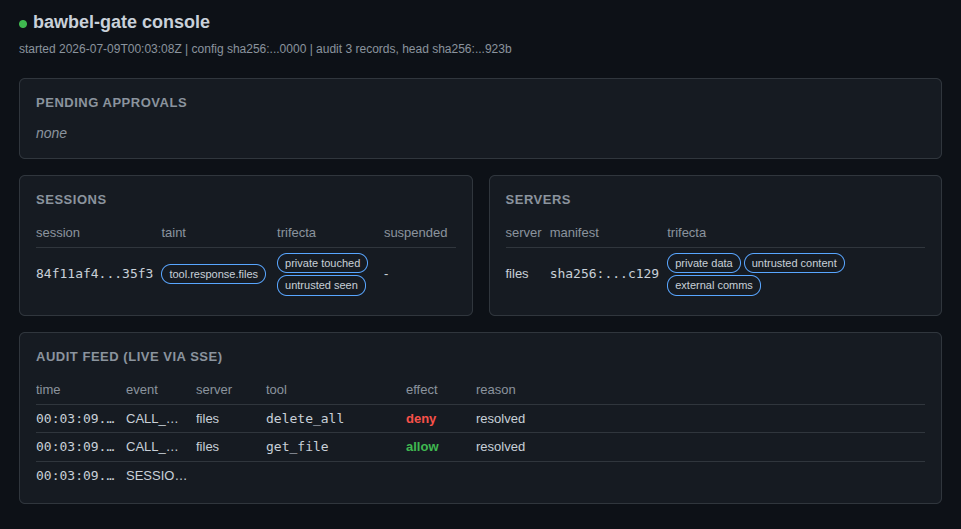
Embedded console (M6)
bawbel-gate serve --console 127.0.0.1:7317 starts a loopback HTTP server. A
random bearer token is printed once at startup. Endpoints:
| Endpoint | Method | Description |
|---|---|---|
/v1/state |
GET | Full snapshot: sessions, servers, pending approvals, audit head |
/v1/events |
GET | SSE stream of audit records as they are written |
/v1/approvals/{id} |
POST | Console approval channel (race-safe: first writer wins). Not yet connected to the proxy; see Approvals |
/ |
GET | Embedded UI bundle |
The console is read-only except for the approval endpoint. No endpoint can issue tool calls, edit manifests, or clear taint; those remain CLI-only.
/v1/state reflects live session taint and per-server manifest state as the gate
runs:
bawbel-gate MCP questions
Does the gate read model output?
No, the gate never reads model output; all decisions are made based on structured JSON-RPC.
How can I observe agent behavior without enforcing rules?
You can use learning mode, which forwards every call and writes to an audit chain without enforcing anything.
Can the trifecta invariant be disabled?
No, the trifecta invariant is non-configurable and cannot be disabled via manifest fields, environment variables, or flags.