
Gortex MCP server
Commit Nov 15, 2026Indexes code into a knowledge graph to provide AI agents with high-precision context and up to 50x token savings.
Also known as zzet/gortex
- Stars
- 2,078
- Tools
- —
- Downloads, 30 days
- —
- Latest version
- —
- Last commit
- Nov 15, 2026
- License
- Apache-2.0
What is Gortex MCP?
Gortex indexes code into a knowledge graph to provide AI agents with high-precision context and up to 50x token savings.
Summary generated from the project's README
About Gortex MCP server
Indexing code into a high-precision knowledge graph is what Gortex enables for AI coding agents and IDEs. By using tree-sitter AST analysis and compiler-grade resolution for languages like Python, TypeScript, Go, and Rust, it builds a persistent map of functions, classes, and call chains. This approach allows agents to access specific context rather than reading entire files, which can result in up to 50x token savings.
Developers use this tool via a single static binary available for macOS, Linux, and Windows. It operates as a long-living daemon that serves multiple IDE windows and supports 19 different coding agents including Claude Code, Cursor, and Windsurf. The system includes over 175 configurable MCP tools and a web UI for visualizing the force-directed knowledge graph. It works locally with no external dependencies or network requirements for the core indexing process.
What you can do with it
- 1Analyze code impactAsk the agent to determine what parts of the system will break if a specific function is modified.
- 2Reduce LLM costsMinimize the number of tokens sent to an AI model by providing only the necessary code snippets.
- 3Trace cross-repository dependenciesIdentify how an API provider in one repository connects to a consumer in another.
- 4Simulate code changesPreview the results of a workspace edit before actually writing any changes to the disk.
Written from the project's README. Every use case is checked against a quote from it.
Automated checks
Ran Nov 13, 2026Full report →Not verified yet. A server needs a score of 80, no serious finding, and enough data for us to check. How checks work · What to fix for more points

- Source repository linked and reachablePass
- Open source license (OSI)Pass
- Commit or release in the last yearPass
- Package name not close to a popular packageNot checked
- Remote endpoint uses HTTPSNot checked
- Destructive tools are labelledNot checked
- No hidden instructions to the modelPass
- No critical advisory in the package or its dependenciesNot checked
README
View on GitHubHigh-performance and efficient code-intelligence engine for AI agents and IDE
Indexes code into graph and exposes it via CLI, MCP Server, and web UI. Multi-repository support by default.
Single static binary for macOS, Linux, and Windows — no dependency chain, simple installation and use.






[!IMPORTANT] Gortex has no cryptocurrency token or coin. We have not issued, authorized, or endorsed any cryptocurrency token, coin, token sale, or airdrop. Any claims of an official Gortex token or an affiliation with such projects are false. Verify announcements through the official Gortex repository.
High-quality parsing 257 languages/grammars through tree-sitter AST analysis, in-process resolvers, enhanced with compiler-grade resolution for Python, TypeScript / JavaScript, PHP, C#, Go, C, C++, Java, Kotlin, Swift, Zig, Rust, Ruby, Elixir, Ocaml, Haskell, and others - producing a persistent provenance-tiered knowledge graph of functions, classes, call chains, HTTP routes, and cross-service contracts and calls with a strong confidence model. 175 (configurable) MCP tools - use only what you need. Zero dependencies. Plug and play across 19 coding agents. Up to 50× fewer tokens per response. Reproducible benchmarks.
19 AI coding agents (Claude Code, Kiro, Cursor, Windsurf, VS Code / Copilot, Continue.dev, Cline, OpenCode, Antigravity, Codex CLI, Gemini CLI, Zed, Aider, Kilo Code, OpenClaw, Hermes, Oh My Pi, Pi, Kimi) supported out of the box.
One install configures every one detected on your machine — see docs/agents.md.
Why it matters
- 50× fewer tokens per response — graph-native lookups beat naive file reads. Agents read just what they need, not the full file, not the 500-line file around it.
- Full development cycle - no 'read file before edit'. Agents ask for sources, tell what to change, and don't waste context of reading noise.
- 257 languages/grammars - every file in the repository reachable; no mix of tools and bloating/hallycinating agents. Three tiers (bespoke tree-sitter, regex, forest-backed signatures) plus Jupyter and Databricks notebooks → docs/languages.md
- Cross-repo by default — N repos in one graph; contracts, references, and call chains span repo boundaries with evidence-gated resolution, contract matching, impact analysis, per-session isolation → docs/multi-repo.md
- Extreamly fast analysis — a precomputed depth-3 reach index turns blast-radius queries into O(seeds × reach) map lookups. Safe to ask "what breaks if I change this?" on every edit. No dozens of tool calls to grasp context.
- Zero external dependencies — single binary, everything in-process. No network, no model download to get started. Install, start daemon, use.
- Agent integrations (20) —
gortex initconfigures every detected coding assistant on the machine → docs/agents.md - 100+ MCP tools, 16 resources, 3 prompts — symbol lookup, call chains, blast radius, dataflow, clone detection, refactoring, code actions → docs/mcp.md
- Semantic search default-on — baked GloVe-50d (3.8 MB embedded), store-native FTS5/BM25 + vector with adaptive alpha fusion, zero deps; opt-in MiniLM / Ollama / OpenAI → docs/semantic-search.md
- Speculative execution —
preview_edit/simulate_chainanswer "what would change if I applied this WorkspaceEdit?" without touching disk - Live editor overlays — push unsaved buffers as a shadow graph; tools read through it. Branching for parallel speculative sessions
- GCX1 wire format — published, round-trippable. An additional −27% tokens vs JSON at same fidelity → docs/wire-format.md
- Long-living daemon — one process serves every IDE window; live fsnotify, an on-disk SQLite graph store, incremental restart, OS-supervised lifecycle
- 10 LLM providers (optional) — local llama.cpp, Anthropic, OpenAI, Ollama, Claude / Codex CLI subprocess, Gemini, Bedrock, DeepSeek, Requesty → docs/llm.md
- Composable safety —
verify_change,check_guards,audit_agent_configflag broken callers, guard violations, stale docs before they ship - PR review, end to end —
gortex prstriages open PRs (per-PR blast radius, merge-order conflicts via shared communities, AI-ranked queue, reviewer suggestions);gortex reviewemits line-anchored findings with a BLOCK/REVIEW/APPROVE verdict from a graph-grounded rulepack; MCP tools (pr_risk,get_pr_impact,review,review_pack,post_review, …) expose it to agents → docs/cli.md - HTTP server + Web UI — versioned
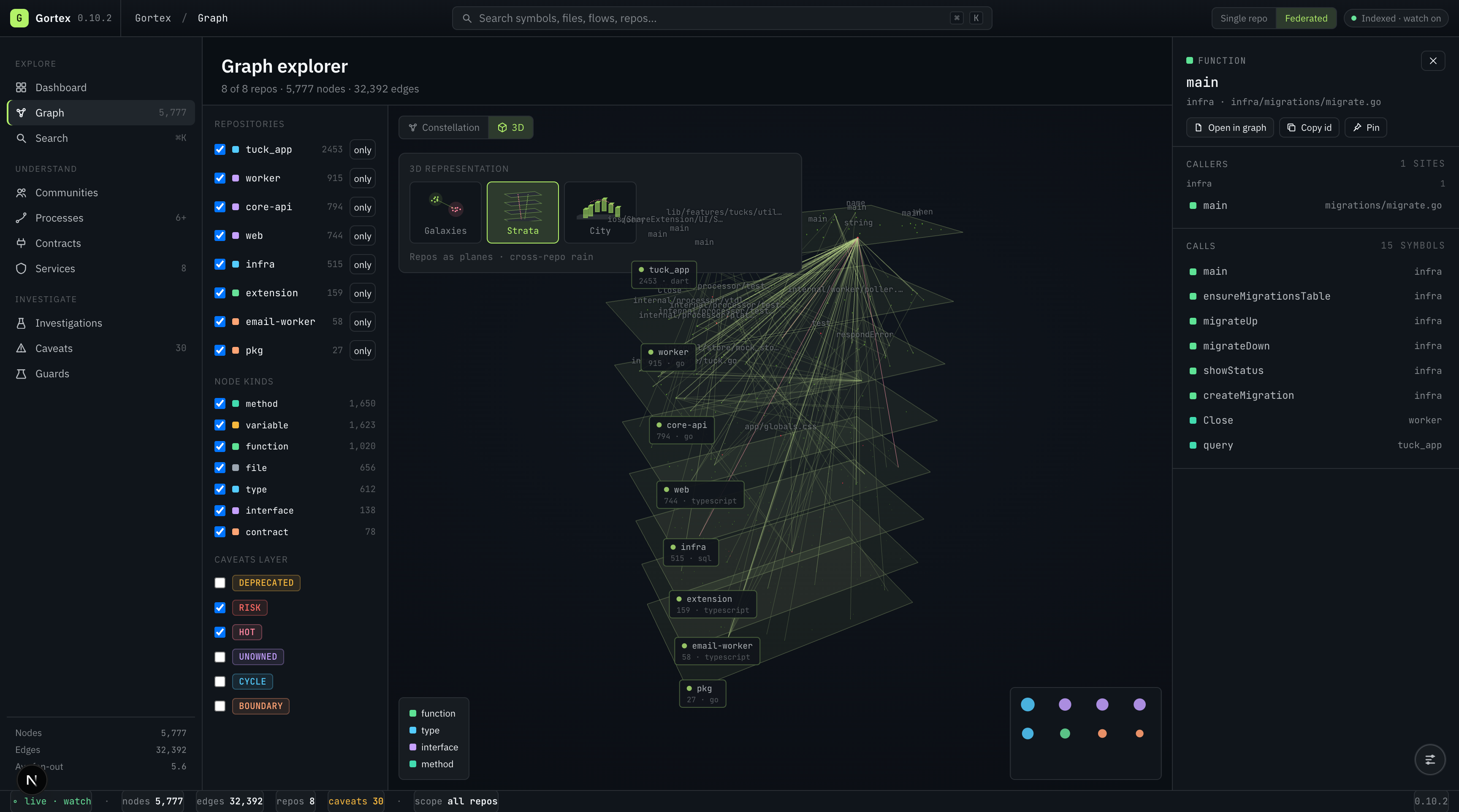
/v1/*API + MCP 2026 Streamable HTTP; standalone Next.js 15 UI with five 3D graph modes → docs/server.md - Telemetry off by default — opt-in anonymous tool/command counts only (no code, paths, names, or exact counts); nothing transmitted unless you configure an endpoint.
gortex telemetry on|off|status; honoursDO_NOT_TRACK→ docs/telemetry.md
Full catalog of features: docs/features.md. Complete CLI reference: docs/cli.md.
Install
# macOS / Linux
curl -fsSL https://get.gortex.dev | sh

# Windows (PowerShell)
irm https://get.gortex.dev/install.ps1 | iex
Detects OS/arch, verifies SHA256 + cosign, installs to PATH. Re-run to upgrade. Homebrew, .deb / .rpm / .apk, scoop, signed binaries, and from-source builds: docs/installation.md.
Quick Start
gortex install                          # one-time machine setup (MCP, skills, slash commands)
gortex daemon start --detach            # background daemon
gortex track ~/projects/myapp           # add a repo
cd ~/projects/myapp && gortex init      # per-repo: .mcp.json, hooks, community routing
Your AI assistant now uses graph queries. Full 15-minute walkthrough: docs/onboarding.md.
Cross-Repo API Contracts
Gortex auto-detects API contracts across repos and matches providers to consumers, surfaced via the contracts MCP tool and the web UI Contracts page.
| Contract type | Detection | Provider | Consumer |
|---|---|---|---|
| HTTP routes | Framework annotations (gin, Express, FastAPI, Spring, …) | Route handler | HTTP client calls (fetch, http.Get) |
| gRPC | Proto service definitions | Service RPC | Client stub calls |
| GraphQL | Schema type/field definitions | Schema | Query/mutation strings |
| Message topics | Kafka / RabbitMQ / NATS / Redis pub/sub | Publish calls | Subscribe calls |
| WebSocket | Event emit/listen patterns | emit() |
on() |
| Env vars | os.Getenv, process.env, .env files |
Setenv / .env |
Getenv / process.env |
| OpenAPI | Swagger / OpenAPI spec files | Spec paths | (linked to HTTP routes) |
| Temporal workflows | Go / Java SDK annotations | Activity / workflow function | ExecuteActivity / ExecuteChildWorkflow |
Contracts are normalised to canonical IDs (e.g. http::GET::/api/users/{id}) and matched across repos to detect orphan providers / consumers and mismatches. See docs/contracts.md.
Scale — battle-tested on large repos
Measured on an Apple Silicon laptop with the default CGO build.
| Repository | Files | Nodes | Edges | Index time | Throughput | Peak heap |
|---|---|---|---|---|---|---|
| torvalds/linux | 70,333 | 1,690,174 | 6,239,570 | ~3 min | 300 files/s | 5.07 GB |
| microsoft/vscode | 10,762 | 204,501 | 808,902 | ~1 min | 143 files/s | 580 MB |
| zzet/gortex (self) | 430 | 5,583 | 53,830 | 3.4s | 127 files/s | 52 MB |
Parsing dominates wall time (65–80 %); reference resolution and search-index build scale sub-linearly.
Token savings dashboard
gortex savings reports tokens saved vs naive file reads — per-call, per-session, and cumulative across restarts, priced in USD against the headline model.
Gortex Token Savings
====================
Cost avoided:   $168.69 (claude-opus-4) across 1,878 calls · 11,246,094 tokens saved

Today       ████████░░░░░░░░   50.0%  saved 9,200 / 18,400 tokens   $0.14
Last 7 days ██████████░░░░░░   62.5%  saved 60,100 / 96,200 tokens  $0.90
All time    ███████████████░   93.3%  saved 11,246,094 / 12,050,716 tokens  $168.69
--verbose adds the per-tool breakdown; --json is machine-readable. Full reference: docs/savings.md.
Architecture
gortex binary
  CLI (cobra)    ──> MultiIndexer ──> Graph store (SQLite, shared, per-repo indexed)
  MCP (stdio)    ──────────────────> Query Engine (repo/project/ref scoping)
  HTTP /v1/*     ──────────────────> same tools + /v1/graph + /v1/events (SSE)
  Daemon (unix)  ──────────────────> shared graph for every MCP client, session isolation
                  MultiWatcher    <── filesystem events (fsnotify, per-repo)
                  CrossRepoResolver ──> cross-repo edge creation (type-aware)
                  Persistence     ──> the same SQLite store, written as it indexes
Data flow, graph schema (node and edge kinds, multi-repo fields, test taxonomy), persistence model: docs/architecture.md.
Documentation
| Topic | Reference |
|---|---|
| First-time walkthrough | onboarding.md |
| Installation & supply-chain verification | installation.md |
| Full feature catalog | features.md |
| CLI reference | cli.md |
| MCP tools, resources, prompts | mcp.md |
| Multi-repo workspaces | multi-repo.md |
| HTTP server + Web UI + MCP 2026 transport | server.md |
| Cross-repo API contracts | contracts.md |
| Semantic search | semantic-search.md |
| Optional LLM features | llm.md |
| LSP integration | lsp.md |
| Per-community skills & agent usage | skills.md |
| AI agent adapters (20) | agents.md |
| Supported languages (257) | languages.md |
| Token savings | savings.md |
| GCX1 wire format | wire-format.md |
| Architecture & graph schema | architecture.md |
| Evaluation methodology | 04-evaluation/ |
| Telemetry & privacy | telemetry.md |
| Versioning policy | versioning.md |
Building from source
make build          # binary with version stamping
make test           # go test -race; PKGS=./internal/<pkg>/... narrows it
make lint           # golangci-lint
Requires Go 1.26+ and CGO (for tree-sitter C bindings).
License
Apache License 2.0. See LICENSE.md. Copyright 2024-2026 Andrey Kumanyaev me@zzet.org.
Contributing
See CONTRIBUTING.md for guidelines on adding features, language extractors, and submitting PRs.
New contributors are very welcome — join us on Discord and introduce yourself. It's the easiest place to ask questions, check whether someone is already working on something, and get feedback on a design before you write the code.
Gortex MCP questions
What programming languages are supported?
It supports 257 languages and grammars through tree-sitter AST analysis and compiler-grade resolution.