
OpenAgentMap MCP server
Commit Nov 11, 2026Lets an AI client search and discover a curated map of over 117,000 AI agent tools, orchestrators, and MCP servers ranked by usefulness.
Also known as vrtexe/open-agent-map
- Stars
- 0
- Tools
- —
- Downloads, 30 days
- —
- Latest version
- —
- Last commit
- Nov 11, 2026
- License
- MIT
What is OpenAgentMap MCP?
OpenAgentMap lets an AI client search and discover a curated map of over 117,000 AI agent tools, orchestrators, and MCP servers ranked by usefulness.
Summary generated from the project's README
About OpenAgentMap MCP server
Finding specific AI agent tools, orchestrators, or MCP servers is what OpenAgentMap enables for developers. It provides access to a curated map containing over 117,000 entries collected from 48 different catalogs and registries. Users can interact with this data through an MCP server that integrates directly into clients like Claude Code, allowing for discovery without leaving the chat interface.
The server provides five specific tools: search, recommend, top, get, and list_tags. It uses a unique usefulness metric ranging from 0 to 100, which calculates rankings based on activity, monthly use, mentions in curated lists, and GitHub stars. This allows developers to find tools that are not just popular, but actively maintained and widely used.
Setup requires Node.js and involves adding the server via the Claude MCP command. While it can run locally using a cloned repository, you can also point the OPEN_AGENT_MAP_DATA environment variable to a remote data URL. For advanced users, integrating the OpenViking CLI enables semantic search capabilities to find tools through natural language descriptions.
What you can do with it
- 1Performing semantic tool discoveryUse natural language to find tools even if your query does not match the exact names in the registry.
Written from the project's README. Every use case is checked against a quote from it.
Configuration
NO_FETCH
| Name | Description | |
|---|---|---|
| NO_FETCH | — |
README
View on GitHubOpenAgentMap
OpenAgentMap is a searchable map of AI agent tooling: about 117,000 CLI agents and harnesses, orchestrators, MCP servers, skills, plugins, frameworks and model infrastructure, collected from 48 catalogs, registries and package indexes, checked against GitHub and ranked by how useful they are.
Open the map, or ask it from your agent with the MCP server:
git clone https://github.com/vrtexe/open-agent-map
claude mcp add open-agent-map -- node "$PWD/open-agent-map/mcp/server.mjs"
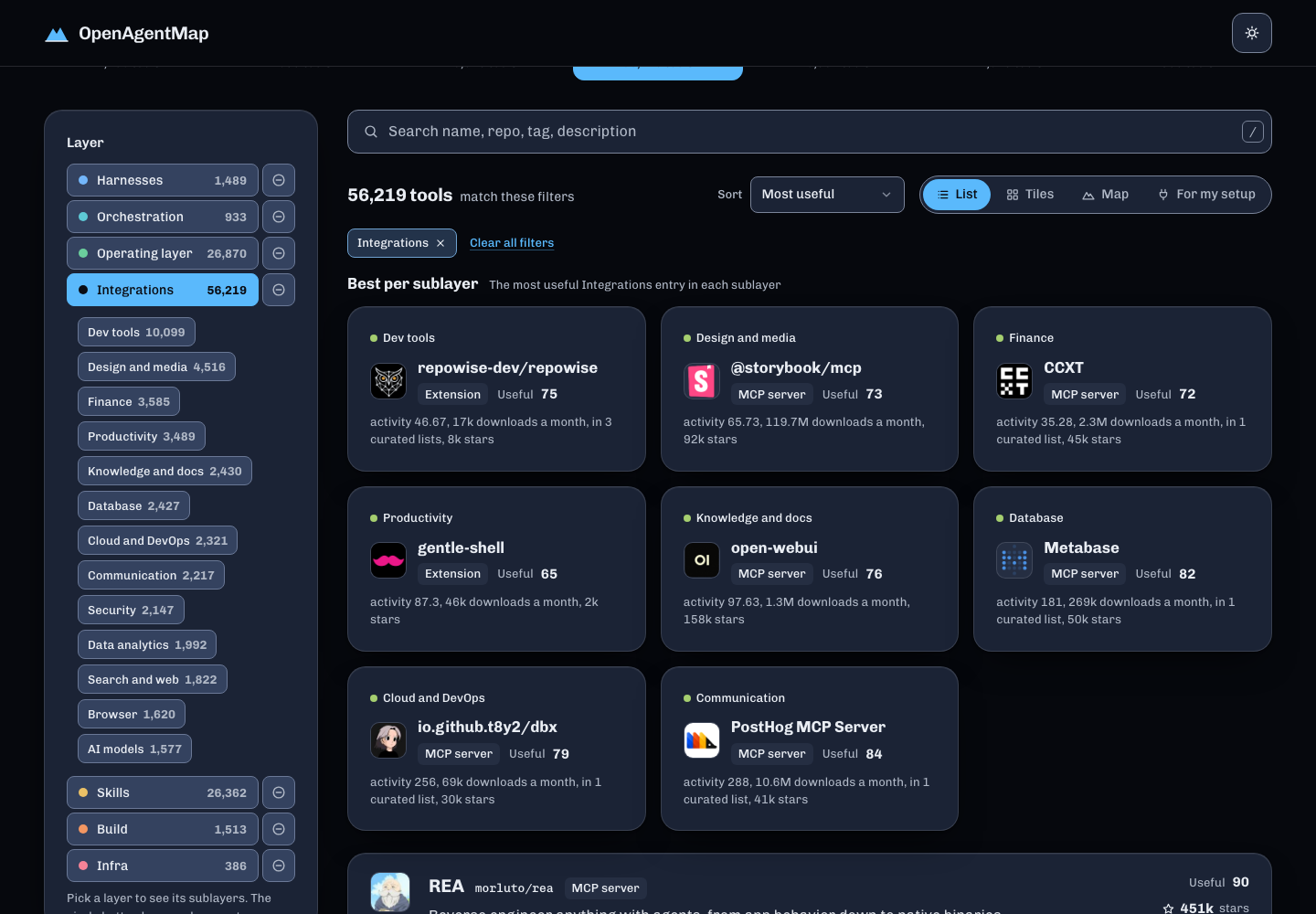
The site is a static page in docs/, served by GitHub Pages.
What the site offers
- Search with ranking: an exact name match first, then a name that starts with the word, then a whole-word match, then any match; the name weighs most, then the repository, tags and description.
- Filters that combine: layer (include or exclude), sublayer, the agent a tool works with, form, tags (match all or any), status and origin.
- Sorting by usefulness (the default), activity, stars, use, last change or name, and list, tile and map views.
- Picks: with a filter or search active, the three most useful results come first; with one layer selected, the best entry of each sublayer.
- For my setup: choose the agent you use and see the three most useful entries per layer and sublayer that work with it.
- The filter state lives in the URL, so a filtered view can be shared as a link.
How entries are measured
- Usefulness (0 to 100) combines activity (40%), monthly use (25%), mentions in curated lists (20%) and stars (15%), each on a log scale against the top 1% of entries. An entry with 20,000 or more stars but little activity and little use gets 40% off and the warning "stars far ahead of activity". Each entry shows the reason in words.
- Activity is the OpenRank score from OpenDigger, computed from issues, pull requests, reviews and contributors. OpenDigger scores only repositories above a minimum level of activity, so most entries have none and sort after the scored ones.
- Stars, last change, license and status come from the GitHub API. A skill or plugin inside a larger repository shows that repository's stars separately and does not rank by them.
- Use is monthly downloads (npm, PyPI, Homebrew, and packages found through ecosyste.ms for repositories with 1,000 or more stars) or installs and uses (VS Code, skills.sh, Smithery), as each source reports it.
- Layers, forms and tags are assigned by rules in
build/taxonomy.jsonfrom GitHub topics, source categories and descriptions. They are a guide, not a verified classification. - Descriptions are the project's own GitHub description where there is one, otherwise the text of the source that lists it. Sources whose license does not allow reuse of their text, or that have no license, contribute only links and counts (
linksOnlyinbuild/sources.json). - An entry drops out only when its repository is archived or gone. A project that has not changed recently stays in.
Sources
The curated lists, registries and readers are listed in build/sources.json and build/readers/. They include, among others, the official MCP Registry, the Agent Client Protocol registry, Anthropic's Claude plugin marketplace and skills, Claude plugin marketplaces found on GitHub, skills.sh, the Gemini CLI extension gallery, Pi packages, npm, PyPI (through ecosyste.ms), Homebrew, the VS Code Marketplace, GitHub topic search, and community lists such as bradAGI/awesome-cli-coding-agents, punkpeye/awesome-mcp-servers, hesreallyhim/awesome-claude-code and VoltAgent/awesome-agent-skills. Thanks to their maintainers.
Known gaps: Smithery's public API returns only a few hundred of its servers, the npm and PyPI keyword searches stop at their result caps, GitHub code search finds at most 1,000 plugin marketplaces per query, and some stores (Hermes, Kiro, the OpenCode ecosystem page, the Codex plugin directory, cursor.directory) offer no machine-readable listing.
Rebuilding
Requirements: Node.js 20 or later and the GitHub CLI (gh), signed in. All commands run from build/.
-
Refresh the reader output (each reader writes
data/<id>.jsonl;readers/CONTRACT.mddescribes the format):for r in gh-topics claude-marketplaces npm pypi skills-sh harness-stores vscode skill-meta brew-acp smithery; do node readers/$r.mjs; done node readers/validate.mjsgh-topicsandclaude-marketplacesare throttled by GitHub's search limits and take the longest. -
Build the site data. This parses the source lists, fetches GitHub metadata in bulk for new repositories and writes
docs/data/anddocs/index.html:node library.mjs --complete -
Refresh activity and package downloads, then build again so they are included (values older than a week are refetched). The package lookup is slow, about 1.5 hours for 3,000 repositories:
node readers/openrank.mjs node readers/pkg-lookup.mjs # MIN_STARS=100 to cover more repositories NO_FETCH=1 node library.mjs --complete -
Preview locally. Browsers block loading data from a
file://page, so use the small server:node serve.mjs # http://127.0.0.1:8080 -
Commit
docs/and push; GitHub Pages serves it from themainbranch'sdocsfolder.
build/cache/, build/data/ and build/ov/ hold fetched inputs and exports and are not committed. A weekly commit of docs/data/ keeps the history needed for trends over time.
Site data format
docs/data/meta.json holds the build date, the layer names, the sources, the field list and dictionaries for repeated values. docs/data/rows-NN.json hold the entries in chunks of 10,000, ordered by usefulness, so the first chunk contains the most useful tools. Each row is an array in the order of meta.fields; list and category values are indexes into meta.dict, and an empty url means the repository's GitHub page.
Asking from an agent
mcp/server.mjs is an MCP server over the site data, with no dependencies beyond Node.js. It offers five tools:
search: tools matching words, with optional filters for layer, sublayer, agent, form and tags. Rare words weigh more than common ones such as "mcp", and among equal matches the more useful entry comes first.recommend: the most useful matches for a task, grouped by sublayer.top: the best entries of a layer, sublayer, agent or form, by usefulness, activity, stars, use or last change.get: the full record of one repository or name.list_tags: the valid filter values with counts.
MCP servers and skills count as compatible with every agent. Add the server to Claude Code with:
claude mcp add open-agent-map -- node /path/to/open-agent-map/mcp/server.mjs
It reads docs/data/ from the checkout. Set OPEN_AGENT_MAP_DATA to another directory or to the site's https://.../data URL to read from there instead.
Semantic search with OpenViking
When the OpenViking CLI ov is on the path and the index below exists, search and recommend also use its semantic matches, which find tools described in other words than the query. Set OPEN_AGENT_MAP_OV=0 to turn this off. To build or refresh the index after a site build:
cd build
node ov-export.mjs
ov rm viking://resources/open-agent-map -r
ov add-resource ov --to viking://resources/open-agent-map --processing-mode vectors_only --wait
node ask.mjs "<question>" queries the same index from the command line.
License
The code is under the MIT License. The data in docs/data/ is under CC BY 4.0: reuse it freely and credit OpenAgentMap. Descriptions remain their authors' text.
OpenAgentMap MCP questions
What can I find with OpenAgentMap?
You can search a map of approximately 117,000 AI agent tools, including CLI agents, orchestrators, MCP servers, skills, plugins, and frameworks.
How is usefulness measured for the tools?
Usefulness is a score from 0 to 100 that combines activity, monthly use, mentions in curated lists, and GitHub stars on a log scale.
How do I add this to Claude?
You can add the MCP server to Claude Code using the command: claude mcp add open-agent-map -- node "$PWD/open-agent-map/mcp/server.mjs"
Does it support semantic search?
Yes, if the OpenViking CLI is installed and the index is present, the search and recommend tools can use semantic matches to find tools described in different words.