
agent-coord MCP server
Commit Nov 11, 2026Provides a machine-wide coordination layer for multiple AI coding agents to prevent file conflicts, duplicate work, and contradictory decisions.
Also known as v2matosevic/agent-coord
- Stars
- 0
- Tools
- —
- Downloads, 30 days
- —
- Latest version
- —
- Last commit
- Nov 11, 2026
- License
- MIT
What is agent-coord MCP?
agent-coord provides a machine-wide coordination layer for multiple AI coding agents to prevent file conflicts, duplicate work, and contradictory decisions.
Summary generated from the project's README
About agent-coord MCP server
Developers running multiple AI coding agents like Claude Code, Codex, or Cursor on a single machine can use agent-coord to prevent file conflicts and duplicate work. It acts as a machine-wide coordination layer that synchronizes different agent sessions across various terminals and repositories. By using a local SQLite database, it manages shared presence, file locks, and resource leases to ensure that two agents do not attempt to edit the same file or use the same development port simultaneously.
The system provides specific tools for different environments, such as a PreToolUse hook for Claude Code to block conflicting edits and a global git pre-commit guard to reject commits on files currently being edited by another agent. It also includes a shared task board and an agent-to-agent messaging system. Users can manage the fleet through a browser dashboard, a terminal watch command, or various CLI tools to search history and record architectural decisions. The setup is designed to be zero-dependency and fails open, meaning coordination issues will not freeze your active work.
What you can do with it
- 1Coordinate shared hardware resourcesEnsure that multiple agents do not attempt to bind to the same TCP port or database instance.
- 2Avoid redundant task executionAgents can claim specific units of work from a shared board to prevent two agents from building the same feature.
- 3Synchronize architectural decisionsBroadcast a project-level technical choice to all active agents to prevent contradictory implementation paths.
Written from the project's README. Every use case is checked against a quote from it.
Automated checks
Ran Nov 16, 2026Full report →Not verified yet. A server needs a score of 80, no serious finding, and enough data for us to check. How checks work · What to fix for more points

- Source repository linked and reachablev2matosevic/agent-coord is public and reachablegithub.com/v2matosevic/agent-coord ↗Pass
- Package names this repository as its sourceNot checked
- Build provenance (Sigstore attestation)Not checked
- Open source license (OSI)MITspdx.org/licenses/MIT.html ↗Pass
- Commit or release in the last yearLast commit or release 2026-11-11github.com/v2matosevic/agent-coord ↗Pass
- OpenSSF ScorecardNot checked
- Package name not close to a popular packageNot checked
- No critical advisory in the package or its dependenciesNot checked
- No hidden instructions to the model0 tool descriptions and the README read; no override phrases, credential paths or hidden charactersPass
- Destructive tools are labelledNot checked
- Remote endpoint answers the MCP handshakeNot checked
README
View on GitHubagent-coord




A machine-wide coordination layer so multiple AI coding agents running at once don't step on each other. Shared presence, file locks, a universal git commit guard, agent-to-agent messaging, and duplicate-work detection — across every terminal, window, and repo on your machine.
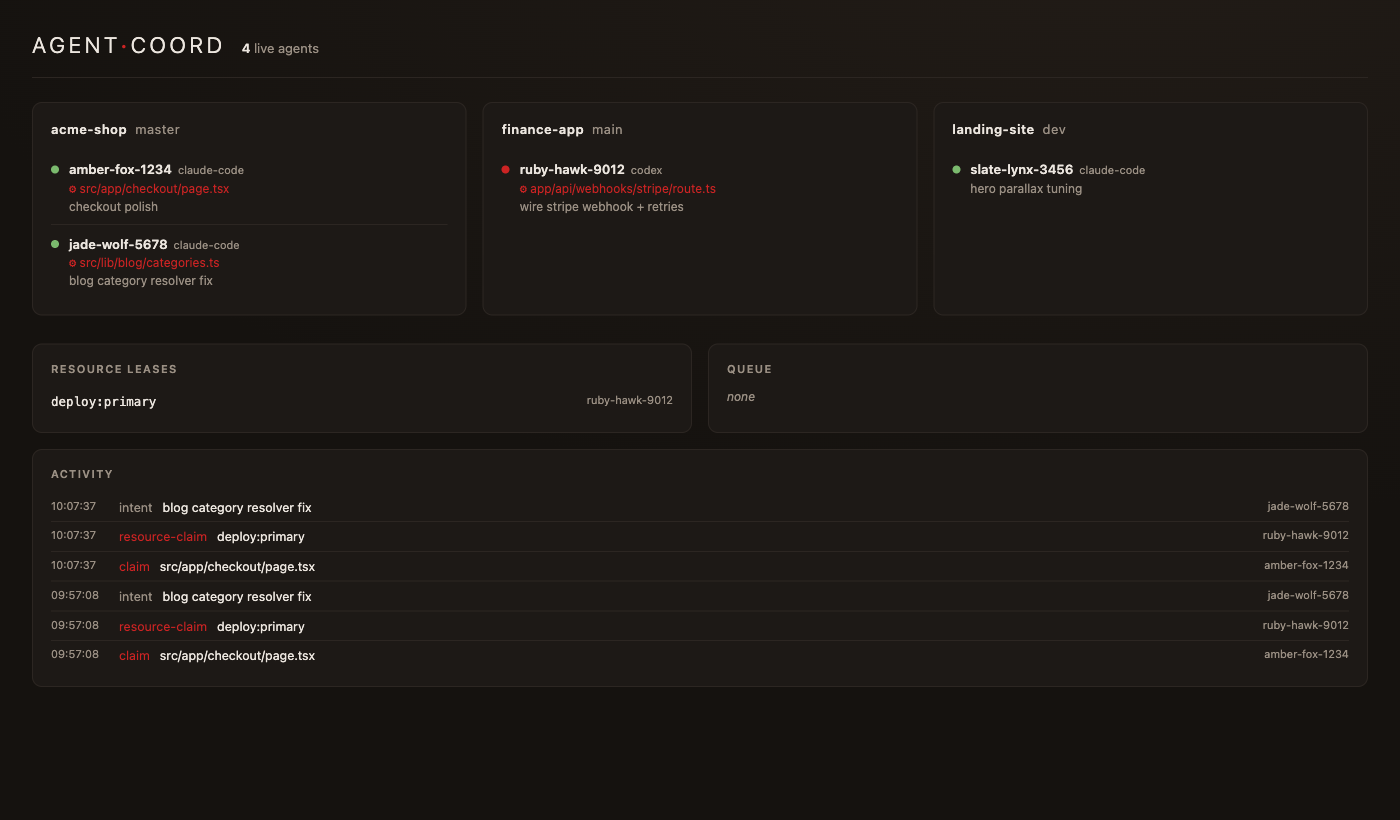
Built on Node's built-in node:sqlite (WAL). The hooks and CLI are zero-dependency;
only the MCP server pulls one package (@modelcontextprotocol/sdk). No native
build, no daemon, no SPOF — it fails open but loud, so a glitch never freezes
your work.
Why
Every AI coding agent is an island: a Claude Code session, a Codex session, and a Cursor agent each see only their own context and their own working tree. Run a few at once on one repo — or sharing one dev port / DB / deploy — and they edit the same file simultaneously, duplicate each other's work, make contradictory decisions, and collide on shared singletons. That's a distributed-systems failure with no coordination primitive. This adds one.
Install
Option A — let your coding agent do it (recommended)
Clone the repo, open it in your agent (Claude Code, Codex, Cursor, …), and paste:
Read
AGENTS.mdin this repo and set up agent-coord for me: install it, run the health check, and tell me what's live and what I need to do next.
The agent follows the AGENTS.md runbook — installs, verifies
(doctor 10/10), and reports back. Codex hook trust is a separate step below.
git clone https://github.com/v2matosevic/agent-coord.git
cd agent-coord
# then open this folder in your agent and paste the message above
Option B — one command yourself
node setup.mjs # any OS — Windows / macOS / Linux
or, on Windows (also builds the VS Code Fleet panel):
./setup.ps1
Both are idempotent (safe to re-run) and fail-soft (skip a step if a CLI
isn't installed). They wire Claude and Codex hooks, Claude's statusline, the global git
pre-commit net, and the MCP server into Claude and Codex, then run the health
check. Requires Node 22.16+ (22.x) or Node 24+. Setup probes SQLite before
modifying configuration. Open new agent sessions afterward to pick it up.
In Codex, review/trust the new hooks in /hooks. Until trusted, use MCP claims
and message polling. See Codex integration.
Verify any time:
node cli/doctor.mjs # expect: 10/10 configuration checks passed
What you get
Version 1.9.1 fixes stale presence after terminal closure. Known exited agent processes stop blocking on the next coordination check, and background MCP keepalives cannot revive ended sessions. AD/Hephaestus readers receive an explicitly ended heartbeat instead of falling back to an older live snapshot. If no coordination process remains to check, the original three-minute timeout still applies. See the release notes.
To upgrade an existing clone, run git pull --ff-only, node setup.mjs, and
node cli/doctor.mjs, then open fresh agent sessions. Preserve the existing
coordination store. Already-running MCP servers keep their loaded version until
restarted; the MCP whoami response reports that version.
| Agent | What it gets |
|---|---|
| Claude Code | Full enforcement — a PreToolUse hook claims the file you're about to edit or blocks it (exit 2) if a peer holds it. Bash guard reserves dev port / DB / deploy. Statusline shows the fleet and your own identity. MCP tools for active coordination. |
| Codex | Trusted native hooks claim all patch paths, guard recognized shell writes/resources, and deliver peer messages between local tool calls. Hooks and MCP share session identity. Without hooks, use MCP claims and polling plus the commit guard. |
| Any committer (Codex / Cursor / Aider / manual) | The global git pre-commit rejects a commit that stages a file another live agent is actively editing. |
How it works
flowchart LR
    subgraph agents [Agents on one machine]
        CC["Claude Code<br/>(hooks: pre-write block)"]
        CX["Codex hooks + MCP<br/>Other clients: MCP awareness"]
        GIT["Any committer<br/>(global git pre-commit net)"]
    end
    STORE[("~/.agent-coord<br/>SQLite (WAL)<br/>presence · leases · messages · tasks")]
    CC <--> STORE
    CX <--> STORE
    GIT <--> STORE
    STORE --> OBS["statusline · terminal watch · browser dashboard<br/>VS Code panel · macOS menu bar"]
No daemon — every hook, CLI, and MCP call opens the same SQLite store directly
(WAL, BEGIN IMMEDIATE for atomic claims) and exits. If anything breaks, the
guards fail open but loud: you lose coordination, never your work.
The coordination model
- Rooms & resources. A room = a repo (branch-independent), the unit of file
conflict. Resources = shared singletons. A real OS singleton like a TCP
port:3000is machine-wide (two repos on one port collide regardless of project); a per-project one like a deploy is keyed to the workspace (deploy:<ws>), so an unrelated repo's deploy can't block yours. - Self-healing locks (warm/cold). A file lock only blocks while it's warm — the holder edited that file in the last few minutes. Once they move on it goes cold and a waiting agent takes it automatically — no force-release, no asking the human to unlock. Active concurrent edits still block.
- Talk that reaches heads-down agents. Agents leave each other messages
(
post_message, workspace-scoped). Unread messages surface not just at the next prompt but between tool calls, so a peer can reach an agent mid-build. - Shared task board. Agents
claim_taskdiscrete units of work (atomic — one winner under a race), so a peer simply sees a task is taken instead of two agents building the same thing. Title dedup, dead-owner auto-reclaim, and adepends_onlist that marks tasks blocked/ready.node cli/tasks.mjsshows it. - Duplicate-work de-confliction. Beyond the board,
announce_intentwarns the later starter that a peer is already on similar work (text-similarity). The deterministic tiebreaker (who started first) decides who yields; the later starter is advised, then auto-blocked if it keeps duplicating. Ask a peer to stand down withrequest_yieldinstead of fighting locks. - One identity per session. Each agent is a single, stable identity across its hooks and its MCP tools — so locks, messages, and commit provenance all line up (no ghost twins, and the statusline tells you which terminal is which agent).
- Autonomous push hand-off. Told to push a history with other agents' commits,
an agent runs
pending_push_review(author + live status + verdict per commit) instead of asking you. - Decisions stay decided.
record_decisionpins a project-level choice ("httpOnly JWT cookies, no localStorage") — broadcast to live peers, shown to every arriving agent, latest-per-topic. The failure it kills: two agents making contradictory architectural choices in different files, which no file lock can see. - Searchable memory. Everything above accumulates into the store, and
search(FTS5 full-text) answers "has this been discussed / decided / built already?" across messages, decisions, tasks, and issues — best match first, not just chronological dumps. - One-call check-in, token-frugal by design. The coordination layer writes
INTO model context, so its own chattiness is a cost every agent pays.
announce_intentreturns the whole arrival brief (your identity, live peers + their tasks, the board, standing decisions, unread mail) — one call instead of awhoami/list_active_agents/list_tasksround, and the only arrival channel an agent without native hooks has. Every list an agent ingests is capped but lossless and loud: message backlogs drain in batches with an exactremainingcount (a directed message stuck behind broadcasts is flagged urgently), and truncation always says so — a partial dump never reads as "that was everything". - Hooks fast enough to forget. They run on every tool call, so they're
measured, not guessed: repo root + branch resolved by filesystem instead of
git rev-parsespawns (subprocess fallback for exotic layouts), liveness writes throttled through a local marker, and no write lock taken to discover an empty mailbox. ~38ms per event on macOS against a ~30ms node-boot floor.
Commands
node cli/doctor.mjs                 # 10 configuration/runtime checks (Codex trust checked separately)
node cli/status.mjs                 # one-shot fleet table
node cli/watch.mjs                  # live fleet in the terminal (2s)
node cli/dashboard.mjs [port]       # live browser dashboard (default :7777)
node cli/tasks.mjs                  # shared task board (--add "title" | --done <id>)
node cli/worktree.mjs new           # isolate an agent: own worktree + branch + port
node cli/insights.mjs [--since 7d]  # retro: files edited by 2+ agents + conflicts
node cli/digest.mjs [--since 7d]    # write a durable per-project hotspot digest (~/.agent-coord/digests/)
node cli/pending-push.mjs           # who authored the unpushed commits + push verdicts
node cli/search.mjs "<query>"       # full-text search messages/decisions/tasks/issues (--kinds, --limit)
node cli/release.mjs --file <p> | --resource <id> | --agent <id> | --all
All CLIs run under node --disable-warning=ExperimentalWarning <script>.
MCP tools (Claude + Codex)
whoami, announce_intent, list_active_agents, get_global_state,
check_conflicts, claim_files, release_files, claim_resource,
release_resource, log_activity, post_message, read_messages,
pending_push_review, ask_agent, check_replies, reply, request_yield,
query_history, list_tasks, claim_task, claim_next_task, update_task,
record_decision, list_decisions, search, report_issue, list_issues,
resolve_issue.
Issue log — "come back later and fix it" (cross-project)
The coordination tables above are workspace-scoped and short-lived — built for
agents working together right now. The issue log is the opposite: a durable,
cross-project backlog of problems worth fixing later. An agent that hits a real
bug, a recurring friction, a broken build, or a coordination failure — in any
repo — files it with report_issue (auto-tagged with the project, agent, branch,
and area). The operator surveys the whole machine's backlog from one place and
fixes them on their own time, so a future "fix this" starts with full context
instead of from zero.
node cli/issues.mjs                       # open issues across ALL projects (grouped)
node cli/issues.mjs --here                # only the current repo
node cli/issues.mjs i-1a2b3c4d            # full context of one issue
node cli/issues.mjs --resolve <id> "how it was fixed"
node cli/issues.mjs --export              # mirror to ~/.agent-coord/issues/*.md
Issues are also indexed by search (so "has this come up before?" finds them) and
this repo's open count shows in every agent's session brief. Stored in the global
SQLite store and (on --export) mirrored to ~/.agent-coord/issues/ — outside any
repo, so client context never leaks into a public push. Machine-local for now.
VS Code extension (optional)
An Activity Bar Fleet panel — every agent across every repo (who, file held,
leases, queue, activity) + an "Open in Tab" view. setup.ps1 builds and installs
it; see vscode-extension/README.md. It reads the
store via your system node (no extension dependencies).
macOS menu bar (optional)
The Mac-native counterpart to the VS Code panel: a SwiftBar/xbar plugin that
lives in the menu bar showing the live fleet — agent count (🟢 / 🔴 when files are
contended / ⚠️ when degraded), a dropdown of agents grouped by repo with the file
each holds, contended files, resource leases, the task board, and a link to the
dashboard. node setup.mjs generates it on macOS; or run it directly:
node cli/install-macos-menubar.mjs # generates the plugin + installs it if SwiftBar/xbar is found
Needs SwiftBar (brew install --cask swiftbar) or xbar.
The plugin is read-only and resolves node itself (GUI apps don't inherit your
fnm/Homebrew PATH), so it works regardless of how Node is installed.
Desktop notifications (macOS)
Native banners when you're blocked on a file, a peer messages you, or asks
you to yield — so a heads-down human hears what the system already tells
heads-down agents. On by default on macOS (AGENT_COORD_NOTIFY=0 mutes, =1
forces on); uses terminal-notifier if installed, else the built-in osascript.
Fired from the hooks, non-blocking and fail-safe, with same-event alerts deduped
within a short window so a retried edit never spams.
Tests
npm test                          # full suite, each test in an isolated throwaway store
node test/run-all.mjs messages    # filter by name
CI runs the suite on Windows, macOS, and Linux (Node 22.16.0 + 24) on every push and PR. The minimum Node 22 version is pinned deliberately; the local verification and release status are recorded in the release notes.
Uninstall
git config --global --unset core.hooksPath   # prior value in ~/.agent-coord/git-hookspath.prior
claude mcp remove agent-coord --scope user
codex mcp remove agent-coord
# restore a ~/.claude/settings.json.bak.*  and delete ~/.agent-coord/
Before removing the store, read git-hookspath.prior and restore that path if
it was set. A backup made by an older installer may point back to agent-coord;
that does not recover the original setting. Remove only handlers marked
x-agent-coord from Codex's hooks.json, preserving other tools' hooks.
See Codex removal.
How it compares
Most multi-agent tooling solves concurrency by isolation: a git worktree or container per agent (claude-squad, container-use, vibe-kanban, ccmanager…). That works — until the agents are supposed to be working on the same tree, or they share a dev port, a database, a deploy target. The few projects that do shared-tree coordination (mcp_agent_mail, swarm-protocol) keep their file leases advisory: the agent is asked to check before writing.
agent-coord's stance is enforcement at the chokepoints: the PreToolUse
hook blocks the write (exit 2) while a peer's lease is warm, risky shell
commands claim shared resources (a machine-wide port, a per-repo deploy) before
they run, and the git
pre-commit/pre-push hooks catch every committer — including agents with no
hook support at all. Awareness (presence, messages, board, decisions, search)
rides on top of that floor, and the locks self-heal so enforcement never needs
a human with a key. Isolation tools and agent-coord compose, by the way: a
worktree-per-agent setup still shares ports, DBs, and pushes.
Honest limits
Coordination is advisory-by-default; the hard blocks are Claude Code or trusted Codex
PreToolUse (pre-write) and the git pre-commit hook (at commit, every committer).
Clients without native hooks get awareness via MCP and the commit net. Codex
hooks do not cover hosted tools or arbitrary scripts; shell parsing is heuristic.
Git's --no-verify and repository-specific core.hooksPath overrides can bypass
the global guard. Check the effective hook path when diagnosing a missed block.
Locks are whole-file. A single-user machine is assumed — there's no auth boundary
in the store. See DESIGN.md §9 for the full list.
Docs
AGENTS.md— install/operation runbook for AI agents.docs/SYSTEM.md— complete as-built reference.docs/AGENT-PROTOCOL.md— how agents should coordinate.docs/CODEX.md— native Codex setup, behavior, trust and limits.docs/RELEASING.md— release validation, source archives and publication.DESIGN.md— original architecture & rationale.docs/FUTURE.md— roadmap beyond the macOS expansion.CHANGELOG.md— what's been built.docs/LIVE-TEST.md— first live two-agent validation.
Contributing & security
PRs welcome — read CONTRIBUTING.md first (zero-dependency
rule, bounded failure behavior, test expectations). Security model and how to report
a vulnerability: SECURITY.md. Licensed MIT.
Developed on Windows and macOS, with automated tests on Windows, macOS and Linux. Native Codex hook fixtures and MCP integration tests are separate from validation inside a user's trusted Codex session. Single-user machine by design.
agent-coord MCP questions
How does it handle file conflicts?
It uses self-healing locks where a file lock remains active while an agent is actively editing it, and automatically releases once the agent moves on.
Does it require a background daemon to run?
No, it is zero-dependency and does not require a daemon; every hook, CLI, and MCP call opens the SQLite store directly and then exits.
Can agents communicate with each other?
Yes, agents can leave messages for one another that surface between tool calls, allowing peers to reach an agent mid-build.