
An early-warning system that detects third-party API schema changes and automatically generates pull requests to fix broken code.
Also known as tiltmeter-dev/tiltmeter
- Stars
- 1
- Tools
- —
- Downloads, 30 days
- —
- Latest version
- 0.5.1
- Last commit
- Nov 13, 2026
- License
- MIT
What is Tiltmeter MCP?
Tiltmeter is an early-warning system that detects third-party API schema changes and automatically generates pull requests to fix broken code.
Summary generated from the project's README
About Tiltmeter MCP server
Tiltmeter acts as an early-warning system for developers whose AI agents or applications rely on third-party JSON APIs. It monitors real traffic to learn the shape of API responses, allowing it to detect when a vendor renames a field, changes a data type, or introduces null values. This prevents the silent failures often seen in AI agents that attempt to guess new response structures instead of crashing.
Users can integrate this as an MCP server to allow clients like Claude Code, Cursor, or LangChain to verify API stability using tools like has_drifted and get_schema before executing tasks. The system operates locally using a SQLite file and does not store response bodies, ensuring privacy. When a breaking change is detected, the tiltmeter fix command utilizes agents such as the built-in LangChain Deep Agent, Claude Code, or Codex to automatically adapt the codebase and open a pull request with the necessary fixes.
What you can do with it
- 1Verify API stability before executionAn AI agent can check if a third-party endpoint has changed its schema before attempting to process the data.
- 2Automate code repairs via pull requestsA developer can trigger an automated process to fix broken code caused by a renamed or removed API field.
- 3Detect breaking schema changesThe system identifies when a field type changes from an integer to a string to prevent runtime errors.
Written from the project's README. Every use case is checked against a quote from it.
How to install Tiltmeter MCP
Formats verified 10 Nov 2026Install Tiltmeter MCP in Claude Code
$ claude mcp add --env ANTHROPIC_API_KEY=<YOUR_ANTHROPIC_API_KEY> tiltmeter -- uvx tiltmeterInstall Tiltmeter MCP in Cursor
~/.cursor/mcp.json
{
  "mcpServers": {
    "tiltmeter": {
      "command": "uvx",
      "args": [
        "tiltmeter"
      ],
      "env": {
        "ANTHROPIC_API_KEY": "<YOUR_ANTHROPIC_API_KEY>"
      }
    }
  }
}Install Tiltmeter MCP in VS Code
.vscode/mcp.json
{
  "servers": {
    "tiltmeter": {
      "type": "stdio",
      "command": "uvx",
      "args": [
        "tiltmeter"
      ],
      "env": {
        "ANTHROPIC_API_KEY": "<YOUR_ANTHROPIC_API_KEY>"
      }
    }
  }
}Install Tiltmeter MCP in Claude Desktop
claude_desktop_config.json
{
  "mcpServers": {
    "tiltmeter": {
      "command": "uvx",
      "args": [
        "tiltmeter"
      ],
      "env": {
        "ANTHROPIC_API_KEY": "<YOUR_ANTHROPIC_API_KEY>"
      }
    }
  }
}Install Tiltmeter MCP in Codex
~/.codex/config.toml
[mcp_servers.tiltmeter]
command = "uvx"
args = ["tiltmeter"]

[mcp_servers.tiltmeter.env]
ANTHROPIC_API_KEY = "<YOUR_ANTHROPIC_API_KEY>"
Install Tiltmeter MCP in Gemini CLI
~/.gemini/settings.json
{
  "mcpServers": {
    "tiltmeter": {
      "command": "uvx",
      "args": [
        "tiltmeter"
      ],
      "env": {
        "ANTHROPIC_API_KEY": "<YOUR_ANTHROPIC_API_KEY>"
      }
    }
  }
}Configuration
ANTHROPIC_API_KEYSecretOnly needed for explanations written by Claude.
TILTMETER_CONFIGPath to tiltmeter.yaml. Defaults to tiltmeter.yaml in the working directory.
| Name | Description | |
|---|---|---|
| ANTHROPIC_API_KEY | Only needed for explanations written by Claude. | Secret |
| TILTMETER_CONFIG | Path to tiltmeter.yaml. Defaults to tiltmeter.yaml in the working directory. |
Automated checks
Ran Nov 13, 2026Full report →Passed our automated checks. That is not a security audit: read the code and give the server the narrowest access it needs. How checks work

- Source repository linked and reachabletiltmeter-dev/tiltmeter is public and reachablegithub.com/tiltmeter-dev/tiltmeter ↗Pass
- Package names this repository as its sourcetiltmeter names tiltmeter-dev/tiltmeter as sourcepypi.org/project/tiltmeter/ ↗Pass
- Build provenance (Sigstore attestation)Sigstore attestation for tiltmeterpypi.org/project/tiltmeter/ ↗Pass
- Open source license (OSI)MITspdx.org/licenses/MIT.html ↗Pass
- Commit or release in the last yearLast commit or release 2026-11-13github.com/tiltmeter-dev/tiltmeter ↗Pass
- OpenSSF ScorecardNot checked
- Package name not close to a popular packageNo popular package one edit away from tiltmeterPass
- No critical advisory in the package or its dependencies67 resolved dependencies checked; no critical advisoryosv.dev ↗Pass
- No hidden instructions to the model0 tool descriptions and the README read; no override phrases, credential paths or hidden charactersPass
- Destructive tools are labelledNot checked
- Remote endpoint answers the MCP handshakeNot checked
README
View on GitHubTiltmeter


An early-warning system for the third-party APIs your AI agents depend on, with the fix as a pull request. · tiltmeter.dev
Volcanologists bolt tiltmeters to the ground to sense tiny deformations long before an
eruption. Tiltmeter does the same for the APIs under your agents. It learns the shape of
their JSON responses from real traffic, notices when a vendor renames a field, starts
sending null or turns a number into a string, and tells you, your CI and the agents
themselves before anything goes on tilt. Then tiltmeter fix hands the change to an agent
that adapts the code reading that API and opens the pull request, leaving what it cannot
know for a human.
Typed code crashes loudly when an API changes. Agents don't. They read the new response, fill the gaps with guesses, or retry until the budget is gone.
Highlights
- Agents can check before they act. An MCP server lets Claude Code, Cursor, LangChain
or any MCP client call
has_driftedbefore trusting an API, andget_schemato see which fields to expect. - No spec required. Tiltmeter learns from real responses, so it works with any JSON API, documented or not.
- Breaking or harmless, at a glance. Every change is classified as breaking, warning or info, and a removed field next to a similar new one is flagged as a probable rename.
- Explanations on demand. With an Anthropic API key, Claude explains what changed, the likely cause and what to do about it.
- Fixes, too.
tiltmeter fixhands the drift to an agent that adapts the code reading that API, shows you the diff and opens a pull request. Use the built-in LangChain Deep Agent, or your own Claude Code or Codex login. - Provider mode. API providers announce a change once, in a signed notice on their own domain, and every customer that follows them gets the pull request before the old responses stop. No server in between.
- A CI gate with alerts. Exit codes fail the build on breaking drift. Slack and webhook alerts take one line of config.
- Local and private. One SQLite file and no account. Credentials are expanded at request time and never stored. Response bodies are not stored or sent to the LLM, only their shape.
Quickstart
First, see which API changes that already shipped your code still uses, with nothing to set up:
$ uvx tiltmeter scan
✗ api.groq.com  Groq no longer serves 16 models it retired, the latest on August 16, 2026.  took effect 2026-08-16
    groq-retired-models-2026-08 · unsigned: drafted by Tiltmeter from the provider's public documentation
    src/llm.js:37  llama-3.1-8b-instant: retired; use openai/gpt-oss-20b
        groq: 'llama-3.1-8b-instant',
    src/store.js:108  llama-3.3-70b-versatile: retired; use openai/gpt-oss-120b
        groq: { fast: 'llama-3.1-8b-instant', smart: 'llama-3.3-70b-versatile' },
    fix: tiltmeter fix --notice groq-retired-models-2026-08 --allow-unsigned --repo .

1 of 15 known API changes affects .: 2 lines in 2 files.
It searches the folder for every entry of a catalog of known changes (retired models at Anthropic, OpenAI and Groq, Stripe's moved subscription periods, Jira's removed search, and more), drafted by Tiltmeter from each provider's public documentation. It records nothing and sends nothing.
Then watch the APIs you call, so the next change does not wait for a catalog:
pip install tiltmeter        # or: uv tool install tiltmeter
tiltmeter init               # writes tiltmeter.yaml with a public example API
tiltmeter check              # the first check records the baseline
Already calling an API from a web app? Export a HAR from your browser's DevTools (Network
tab, "Export HAR") and let Tiltmeter write the config from the JSON calls the page made.
Tokens and cookies become ${VAR} placeholders:
tiltmeter init --from-har session.har --host api.example.com
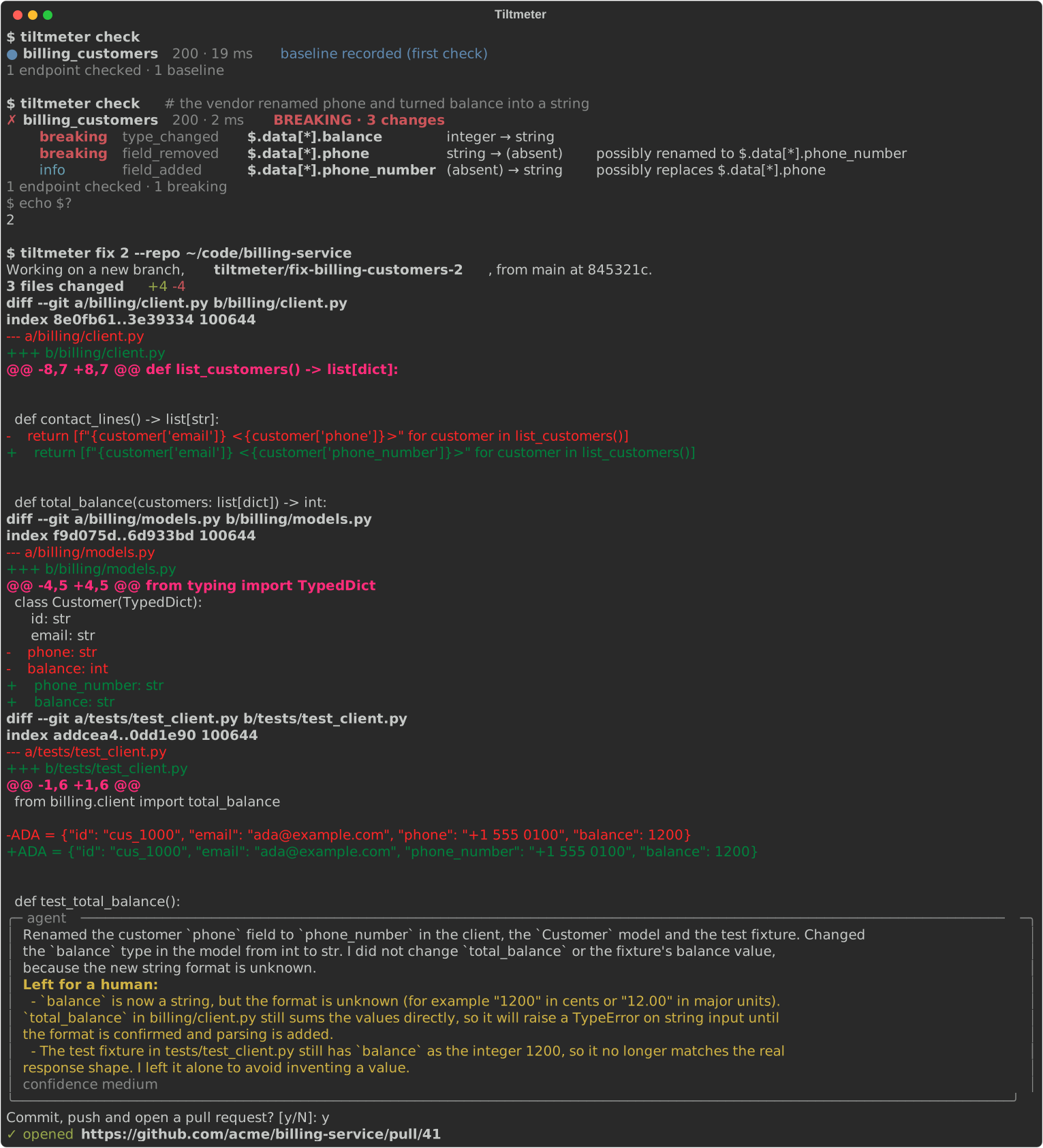
Run tiltmeter check again from cron or CI, or leave tiltmeter watch running. This is
what you get when a vendor renames phone and turns balance into a string:
$ tiltmeter check
✗ billing_customers  200 · 13 ms  BREAKING · 3 changes
    breaking  type_changed   $.data[*].balance       integer → string
    breaking  field_removed  $.data[*].phone         string → (absent)  possibly renamed to $.data[*].phone_number
    info      field_added    $.data[*].phone_number  (absent) → string  possibly replaces $.data[*].phone
1 endpoint checked · 1 breaking
$ echo $?
2
The getting started guide runs that exact scenario against a fake API on your machine in about five minutes.
Give your agents a tiltmeter
claude mcp add tiltmeter -- tiltmeter serve --config /absolute/path/to/tiltmeter.yaml
Then add a line like this to your agent's instructions:
Before you rely on a third-party API, call
has_driftedfor it. If it drifted, read the summary and adapt before trusting the response.
| Tool | What it answers |
|---|---|
has_drifted(endpoint_id, since?) |
Did the responses change at warning level or worse recently? Returns a summary and the changes. |
get_schema(endpoint_id) |
Which fields, types and enum values to expect, as JSON Schema. |
get_changes(endpoint_id?, since?, min_severity?, limit?) |
The change history, newest first. |
list_endpoints() |
Which APIs are watched and how their last check went. |
check_api(endpoint_id, explain?) |
Calls one API now and records the result. |
check_all(explain?) |
Calls every API now. |
scan_code(path?, within_days?, include_unaffected?) |
Does the project's own code still use something a provider retired or removed? The file and line of each use, with no network. |
Setups for Cursor, Claude Desktop and LangChain agents are in the agents guide.
Let it fix your code
When a check finds drift, tiltmeter fix hands it to an agent that finds the code reading
that API, adapts it, shows you the diff and opens a pull request:
$ pip install "tiltmeter[fix]"            # or plain tiltmeter, then --agent claude-code or codex
$ tiltmeter fix 2 --repo ~/code/billing-service
✗ billing_customer  #2  200 · 10 ms  BREAKING · 3 changes
Working on a new branch, tiltmeter/fix-billing-customer-2, from main at 162dadd.
3 files changed  +5 -5
diff --git a/billing/client.py b/billing/client.py
-    return f"{customer['name']} <{customer['phone']}>"
+    return f"{customer['name']} <{customer['phone_number']}>"
...
Commit, push and open a pull request? [y/N]: y
✓ opened https://github.com/acme/billing-service/pull/41
- Your checkout is never touched. The agent works in a temporary git worktree on a new
branch, and nothing is committed until you approve the diff or pass
--yes. - It stays inside the worktree. No network access, and only tracked files are there to
read;
.envfiles, keys and.gitare blocked. The built-in agent and Claude Code get file tools only. Codex keeps its shell, locked in its OS sandbox under the same limits. - It says what it could not do. Tiltmeter sees types, not values. When a number turns into a string, the agent updates the types and leaves the format question to a human in the pull request instead of guessing a conversion.
- Bring your own agent. Already use Claude Code or Codex?
tiltmeter fix 2 --agent claude-codeor--agent codexruns on your own login, with no API key and no extra install.
--dry-run shows the diff and throws it away, and --no-pr commits to a local branch.
Before anything is committed, Tiltmeter warns about changed files that nothing else in the
repository imports, and keeps a fix that only touches such code, unchanged for months, in a
local commit unless you pass --allow-unused. The fix guide covers the flags,
what the model sees and how to review the result.
Provider mode
Providers shouldn't just announce changes; they should apply them. A provider describes a change once, in an API change notice: a small signed JSON file in Tiltmeter's vocabulary, served from its own domain next to its public key. Customers follow the provider, and each one gets a pull request that adapts its own code.
# The provider, from two versions of its spec (or from a check of its staging API):
$ tiltmeter notice create --from-openapi v2.yaml v3.yaml --effective 2026-12-01 -o notice.json
$ tiltmeter notice sign notice.json --key api-change-key.pem
$ tiltmeter notice publish notice.json --feed site/.well-known/api-changes.json

# Each customer, on a schedule (the GitHub Action does it for you):
$ tiltmeter notices apply --repo . --yes
✓ opened https://github.com/acme/billing-service/pull/42
- api.other.example  2026-11-20-invoices  not affected: no tracked file mentions api.other.example
-
Only signed notices act. The signature is checked against the key the provider serves at
/.well-known/api-change-key, and every endpoint in the notice must be on the provider's domain. -
No agent when nothing is affected. A plain text search for the API's host, paths, SDKs and the changed field names decides first, so repositories that don't use the API cost nothing and get nothing.
-
Same sandbox, same review. The fix runs like
tiltmeter fix, and the pull request quotes the provider as plain text and lists what is left for a human. -
Works before providers do. A provider that publishes no notices but an OpenAPI spec can be followed directly: Tiltmeter keeps its last version, finds what changed in its responses, and handles it like a notice.
-
For providers, from CI. Every pull request that changes your spec gets a draft notice as a comment; merging signs and publishes it.
Field report, October 2026. We searched public code for fields that Stripe and Spotify
removed. 78 repositories still read Stripe's subscription.current_period_end, gone since
API version 2025-03-31, and 228 use Spotify fields and endpoints that changed for new apps
in February 2026. One of them was Stripe's own subscription sample, which no longer
type-checks against Stripe's SDK. Tiltmeter fixed it and 14 others we checked by hand, and
the pull requests are open: the fix for Stripe's sample.
Since then Tiltmeter has opened 84 pull requests for changes at Stripe, Jira, Spotify, OpenAI,
Anthropic, Groq, Slack, OpenWeatherMap, Hugging Face and HubSpot. So far 21 have landed: 17 were
merged as Tiltmeter wrote them, and 4 were adopted by maintainers who landed the fix themselves.
inbox-zero and
QOwnNotes
carried Tiltmeter's commit into changes of their own, and
aicommits
made the same change in its own commit. OpenMetadata merged Tiltmeter's commit in
its own pull request for its 2.1
release.
Serenity BDD,
AiSOC,
utopia and KodeRover's
zadig moved their Jira calls off
/rest/api/3/search, an endpoint Jira Cloud removed.
ruflo,
radare2's r2ai,
mcp-chat, ByteDance's
deer-flow and
learn-claude-code moved their
defaults off Claude models Anthropic has retired.
Harvard's Machine Learning Systems book
and KindleEar moved off the Groq models Groq shut
down. Share-The-Link and
nestjs-saas-starter read subscription
periods from subscription items, as Stripe's API has required since 2025-03-31.
Tencent's AI-Infra-Guard and SciSharp's
BotSharp moved their Hugging Face calls off
api-inference.huggingface.co, which no longer resolves. Six were closed: anything-llm asks for
a linked issue first, three touched code their projects no longer use, PraisonAI kept Groq's
models because enterprise contracts still have them, and Irene Voice Assistant gave no reason.
One repository was deleted. The migration tracker shows
every pull request and its status, by provider.
Subscribe with a few lines of tiltmeter.yaml; the notices guide
covers both sides.
What counts as drift
| Change | Example | Default severity |
|---|---|---|
field_removed |
phone was in every response and is gone |
breaking |
field_now_optional |
email was always there and is now missing from some objects |
breaking |
type_changed |
balance went from integer to string |
breaking |
nullable_introduced |
phone can now be null |
breaking |
content_type_changed |
the JSON body became an HTML error page | breaking |
status_changed |
200 to 503 is breaking, 404 to 200 is info, 200 to 202 is a warning | depends |
enum_value_added |
status returned suspended besides active and past_due |
warning |
latency_regression |
median latency over 3x the baseline and at least 250 ms slower | warning |
field_added |
a new phone_number field |
info, or warning with strict: true |
Override any of them globally or per endpoint with severity_overrides. Provider notices
and spec diffs also report endpoint_removed (an endpoint is gone, possibly moved to
another path) and value_retired (requests can no longer send a value, such as a retired
model), both breaking.
Use it in CI
| Exit code | Meaning |
|---|---|
| 0 | No new drift. Info-only changes and new baselines also exit 0. |
| 1 | Warning-level drift. |
| 2 | Breaking drift. |
| 3 | A check could not run (network error, unexpected status, invalid JSON) and nothing broke. An error inside Tiltmeter that nobody planned for also exits 3, after its traceback. |
| 4 | Usage or configuration error, or a history database that cannot be used. |
On GitHub, the Tiltmeter Action keeps the baseline in the Actions cache, writes the changes to the job summary and fails the job on drift:
- uses: tiltmeter-dev/tiltmeter-action@v1
  env:
    STRIPE_API_KEY: ${{ secrets.STRIPE_API_KEY }}
With mode: scan it needs no config at all: it runs tiltmeter scan on the repository,
annotates each use of a known API change on its line and, with code-scanning: true,
files it as a code scanning alert:
- uses: tiltmeter-dev/tiltmeter-action@v1
  with:
    mode: scan
    within: 30 # a change still ahead counts in its last 30 days
Anywhere else, keep .tiltmeter/ between runs. The CI guide has
ready-to-copy jobs for GitHub Actions, GitLab CI and cron.
Commands
| Command | What it does |
|---|---|
tiltmeter scan [PATH] |
Searches code for known API changes that already shipped; a clean result describes the catalog checked and how to start monitoring your own API. No config needed. |
tiltmeter init |
Writes tiltmeter.yaml, from an example or a browser's HAR export (--from-har). |
tiltmeter check |
Calls every endpoint once and reports drift. |
tiltmeter watch |
Checks on an interval until stopped. |
tiltmeter history, show ID, schema ENDPOINT |
The stored checks, one check, and the learned schema. |
tiltmeter explain ID |
Asks Claude what a check's changes mean. |
tiltmeter fix ID |
Lets an agent adapt your code to a check's drift, in a pull request. --notice takes a notice file, URL or catalog entry instead, and --follow-up answers the review of a pull request that is already open. |
tiltmeter prs |
Lists the pull requests Tiltmeter opened on GitHub and which ones need you: changes requested, a comment to answer, failed checks or a branch to update, each with the fix --follow-up command to run. It only reads. |
tiltmeter notices check, notices apply |
Lists, or applies, the new notices and spec changes of the providers you follow. |
tiltmeter notice create, sign, publish, verify |
Writes and publishes change notices, as a provider. |
tiltmeter hunt NOTICE |
Finds public repositories that still use what a notice changes: searches GitHub code through the GitHub CLI, clones the most starred and checks each one. It only reads. |
tiltmeter serve |
Runs the MCP server on stdio. |
Every command takes --help, and most take --json.
How it works
- Observe. A check calls the endpoint and turns the JSON body into a shape: for
every path, which JSON types appeared, how many objects contained each field and, for
fields that look categorical (
active,past_due,USD), which values were seen. - Compare. The baseline is the merge of the shapes from the last 20 successful checks. Tiltmeter reports only what contradicts it: a missing optional field is fine, a field that was in every object and is now gone is not.
- Report once. The new shape joins the baseline, so the check that sees a change reports it, and from then on it is the new normal.
graph TD;
  start([start]) --> observe
  observe -. fetch failed .-> persist
  observe --> load_baseline --> compare
  compare -. drift worth explaining .-> explain --> persist
  compare --> persist
  persist -. a notifier wants it .-> notify --> finish([end])
  persist --> finish
The pipeline is a small LangGraph graph that only sequences the steps. The diff itself is plain, deterministic Python with no LLM in the loop. How it works covers the details.
Configuration
endpoints:
  - id: stripe_customers
    url: https://api.stripe.com/v1/customers
    params:
      limit: 10
    headers:
      Authorization: Bearer ${STRIPE_API_KEY}   # expanded from the environment at request time
    ignore_paths:
      - $.data[*].metadata                      # free-form, changes all the time

notify:
  - type: slack
    webhook_url: ${SLACK_WEBHOOK_URL}
Every option is described in the configuration reference, and
examples/ has a config you can run as is.
How it compares
- OpenAPI diff tools such as oasdiff compare two versions of a spec. They are the right tool when the vendor publishes and maintains one, and they cannot see changes the vendor did not document.
- Contract testing such as Pact needs the provider to run your contracts, which third-party vendors don't do.
- Uptime and synthetic monitors tell you an API is up. You write and maintain the response assertions yourself.
- Tiltmeter learns the contract from real responses, so it needs nothing from the vendor and catches undocumented changes. It also hands what it learns to your agents.
Privacy and security
${VAR}placeholders are expanded right before a request or notification is sent. The values are never written to disk, sent to the LLM or kept in the LangGraph state, and they are scrubbed from error messages.- The history stores shapes, status codes, latencies and changes, never response bodies
unless you set
store_samples: true. - Agents can only check the endpoints in your config. They cannot make Tiltmeter call an arbitrary URL.
tiltmeter fixsends the change list and the files the agent opens to Anthropic. It never sees response values,${VAR}values or untracked files such as.env, and paths matchingfix.ignoreare blocked.- Provider notices come from third parties: they are applied only when signed by the provider's domain, and their text reaches agents and pull requests as inert data.
SECURITY.md has the full threat model and how to report a vulnerability.
Roadmap
- Fixes in CI and over MCP. Run
tiltmeter fixfrom the GitHub Action when a scheduled check finds drift, and let agents request a fix through an MCP tool. - A hosted GitHub App for provider mode. Install it instead of keeping a workflow: providers push notices to tiltmeter.dev and the affected repositories get their pull requests right away, with a dashboard for providers of who merged and who still reads the old fields.
- Changelog awareness. Read vendor changelogs next to observed responses.
- Hosted checks and a team dashboard.
Documentation
- Getting started: a five-minute tour on your machine.
- Scanning for known changes:
tiltmeter scan, its catalog and what counts as a use. - Configuration reference: every option, placeholders and ignore patterns.
- Agents and MCP: Claude Code, Cursor, Claude Desktop and LangChain.
- CI and scheduling: GitHub Actions, GitLab CI and cron.
- Fixing code:
tiltmeter fix, the agent and how to review its pull requests. - Following your pull requests:
tiltmeter prs, what each pull request waits for and what it cannot see. - Provider notices: publish API changes as a provider, apply them as a customer.
- Hunting for affected repositories:
tiltmeter hunt, what it sends to GitHub and its limits. - API change notices, v1: the open format and how notices are signed.
- How it works: shapes, baselines, the diff rules and the pipeline.
- FAQ and troubleshooting.
Contributing
Bug reports, ideas and pull requests are welcome. CONTRIBUTING.md explains how to set up the project and what a good change looks like. Everyone taking part is expected to follow the code of conduct.
License
Tiltmeter MCP questions
How do I add Tiltmeter MCP to Claude Code?
Run claude mcp add --env ANTHROPIC_API_KEY=<YOUR_ANTHROPIC_API_KEY> tiltmeter -- uvx tiltmeter in your terminal. Add --scope user to make it available in every project.
How do I add Tiltmeter MCP to Cursor?
Open ~/.cursor/mcp.json and add the server under mcpServers, using the Cursor config shown in the install section above.
How does Tiltmeter detect API changes?
It learns the shape of JSON responses from real traffic and notices when vendors rename fields, change types, or send null values.
Can Tiltmeter fix the code automatically?
Yes, the tiltmeter fix command uses an agent to adapt the code reading the API and opens a pull request with the changes.
Does Tiltmeter store my sensitive data?
No, it uses a local SQLite file, credentials are expanded at request time and never stored, and response bodies are not stored or sent to the LLM.
How can I use this with my AI agents?
You can add the Tiltmeter MCP server to clients like Claude Code or Cursor, allowing agents to call tools like has_drifted or get_schema before acting.