
Saccade MCP server
Commit Oct 9, 2026Performs perceptual visual regression, image evidence inspection, and performance analysis for humans, CI, and AI agents.
Also known as Tavrin/saccade
- Stars
- 0
- Tools
- —
- Downloads, 30 days
- —
- Latest version
- 0.3.0
- Last commit
- Oct 9, 2026
- License
- Apache-2.0
What is Saccade MCP?
Saccade performs perceptual visual regression, image evidence inspection, and performance analysis for humans, CI, and AI agents.
Summary generated from the project's README
About Saccade MCP server
Developers and AI agents can perform perceptual visual regression and performance analysis using Saccade. This local MCP server allows coding agents to inspect bounded results and follow recorded actions by reading registered capture roots and writing reports to a separate output directory. It is designed to help humans and automated systems detect visual differences, locate them in specific regions, and verify them against declared policies.
The tool provides various methods for comparison, including OCR text differences, embedding similarity, and hashing. Users can generate offline HTML reports or versioned JSON data for review. While the server supports complex tasks like image delivery tuning and media analysis, it requires specific feature flags for advanced capabilities like AVIF encoding or document OCR. It does not approve baselines; that task remains reserved for human users. Setup involves installing the Rust package and can be extended with Python bindings or a local HTTP API.
What you can do with it
- 1Visual verification for coding agentsAn AI agent can inspect bounded visual results and follow recorded next actions by reading capture roots.
- 2CI visual regression testingIntegrate visual regression into continuous integration pipelines using Playwright to group page pairs and record failures.
- 3Image delivery auditingAudit served image formats and search for specific encodings to meet perceptual targets.
- 4Media integrity inspectionInspect single images for metadata, compression history, and C2PA credentials without needing a baseline.
Written from the project's README. Every use case is checked against a quote from it.
Automated checks
Ran Nov 15, 2026Full report →Not verified yet. A server needs a score of 80, no serious finding, and enough data for us to check. How checks work · What to fix for more points

- Source repository linked and reachabletavrin/saccade is public and reachablegithub.com/tavrin/saccade ↗Pass
- Package names this repository as its sourceNot checked
- Build provenance (Sigstore attestation)Not checked
- Open source license (OSI)Apache-2.0spdx.org/licenses/Apache-2.0.html ↗Pass
- Commit or release in the last yearLast commit or release 2026-10-09github.com/tavrin/saccade ↗Pass
- OpenSSF ScorecardNot checked
- Package name not close to a popular packageNot checked
- No critical advisory in the package or its dependenciesNot checked
- No hidden instructions to the model0 tool descriptions and the README read; no override phrases, credential paths or hidden charactersPass
- Destructive tools are labelledNot checked
- Remote endpoint answers the MCP handshakeNot checked
README
View on GitHub



saccade
saccade is a visual and performance evidence tool for humans, CI and AI agents. It measures perceptual differences, locates them in measured regions (with optional advisory observations), and checks them against the thresholds and policies you declare. It writes offline HTML reports and versioned JSON. Performance conclusions require comparable captures, timing provenance and repeat evidence. Only a human can approve a baseline.
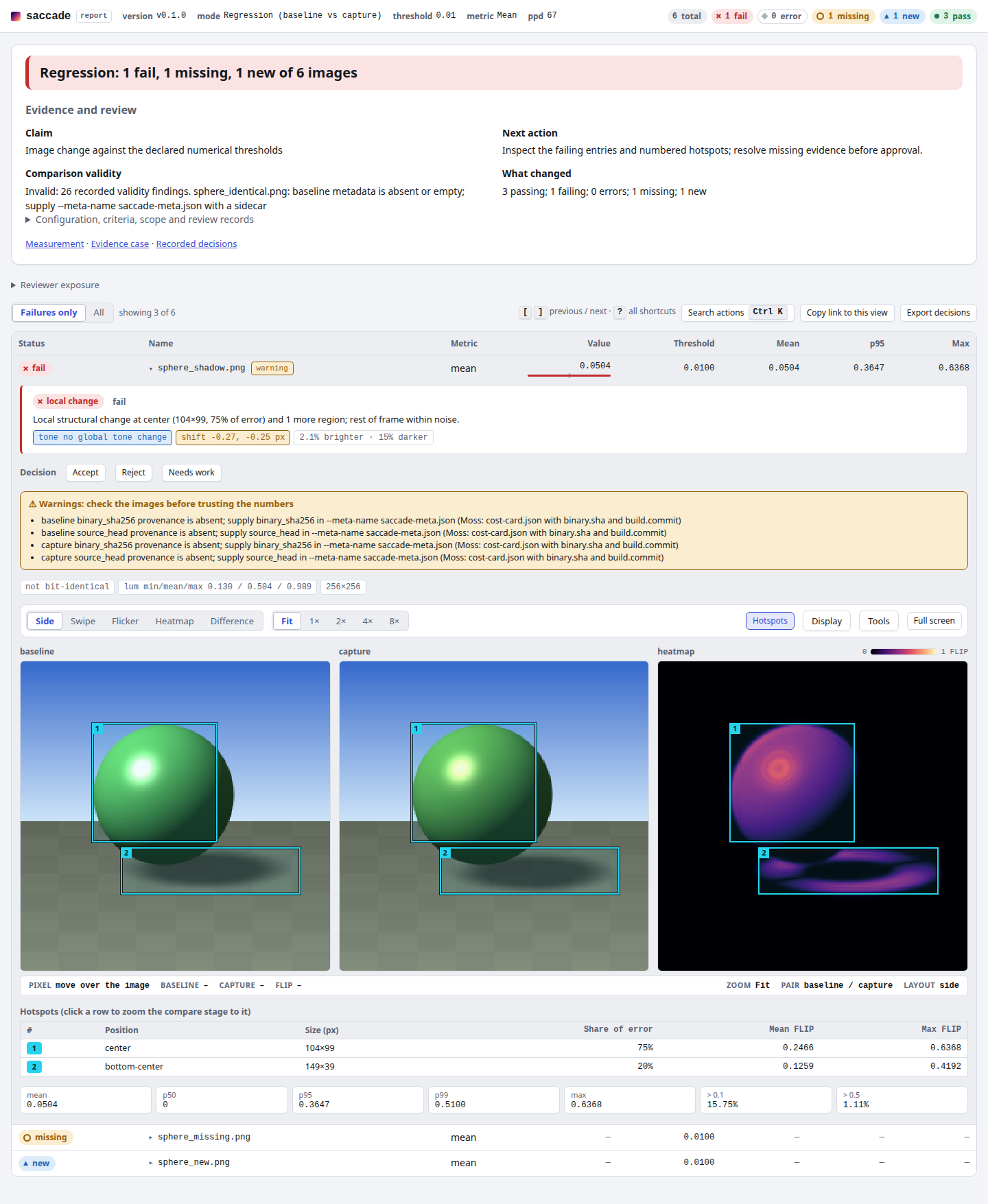
Quickstart
saccade demo --out saccade-demo
saccade view saccade-demo
The demo exits 1 on purpose: it contains changed and missing captures.
Open saccade-demo/report/index.html to see the result. The
quickstart walkthrough has copyable examples for
comparison, exact identity, configuration, evidence export and local review.
Not sure which command fits? Use the task map
and the five tested guides: visual CI,
controlled rendering,
document export,
media intake and
delivery tuning. saccade doctor shows what your
install can run.
Use cases
Visual verification for coding agents
The local MCP server reads registered capture roots and writes reports under a separate output root. Its tools cannot approve baselines. Agents can inspect bounded results and follow recorded next actions.
saccade mcp --root captures --out-root agent-reports
saccade compare captures/before captures/after --out agent-reports/change --json
See the agent guide and MCP and plugin setup.
CI visual regression
The local Playwright package provides toMatchSaccade and capture stabilization.
A sweep groups page pairs and records capture failures as failures.
node integrations/playwright/sweep.cjs sweep.json captures capture-options.json
saccade sweep compare sweep.json --captures captures/captures.json --out sweep-report --json
See the Playwright matcher, sweep
and CI integration. Sweep needs the optional products feature.
Render and engine evidence
Declared spatial policies distinguish texture_noise_only from
systematic_shift. Required-effect checks can fail on an empty footprint;
capture layers restrict measurement scope and fixed-camera sequences measure
temporal stability. Supply the policies and capture provenance with your inputs.
saccade compare before after --config render-evidence.toml --out render-report --json
saccade experiment sequence before-frames after-frames --fixed-camera --out temporal-report --json
See rendering evidence and engine capture ingestion, temporal settling and one-flag masks.
Image delivery tuning
Audit served formats and search declared encodings for a perceptual target. Local and URL-template adapters record bytes and content types and do not modify originals.
saccade imgtune audit --urls images.txt --accept 'image/avif,image/webp,image/*' --out audit.json --json
saccade imgtune search tuning.json --out tuning-report.json --json
See image tuning. Enable products, plus imgtune-avif for AVIF.
Media analysis records
A media record keeps status and provenance for metadata, quality, fingerprints and optional model sections. Disabled or failed sections are recorded as such. The Python package and local HTTP API use the same analysis path.
saccade analyze-media image.jpg --profile cpu-lite --output-size 1200x800 --json
saccade keyframes video.mp4 --out frames --json
See media analysis, Python and HTTP API.
Install with pip install saccade-vision (Python 3.10+); the import stays import saccade.
Single-image provenance and integrity
Inspect C2PA credentials, metadata and compression-history indicators without a
baseline. Heuristics have stated limits and do not establish a real/fake verdict.
GPS disclosure is opt-in; C2PA validation needs credentials.
saccade inspect-image received.jpg --output-size 1600x900 --out inspection --json
saccade inspect-image received.png --hash-index hashes/saccade-hash.v1.json --out indexed-inspection --json
General comparison
Pick registration, hashes, embedding similarity/search, OCR text differences, no-reference quality or document rasterization to fit the question. Model workflows require supplied pinned artifacts and the relevant features.
saccade compare before.png after.png --align similarity --out aligned-report --json
saccade text before.png after.png --out text-report --json
saccade assess image.jpg --out quality-report --json
See choosing a comparison, registration, hashing, embeddings and search, OCR, quality and documents.
Performance evidence
Compare supplied timing sidecars using paired statistics and uncertainty intervals, or locate changes in a sequence. Saccade does not run the benchmark; missing or rejected provenance cannot qualify a speedup.
saccade compare before after --out perf-report --json
saccade history onset --store history --json
See paired statistics, change points, identity/performance, timing verdicts, ablation tables and report linking. The performance sidecar kit has fixtures and recipes for producers. Label images can be scored with mask metrics, boxes exchanged as COCO or YOLO (box interchange), and extracted video frames described by a frame map.
Install
Install with Rust 1.89 or newer:
cargo install saccade --version 0.3.0 --locked
saccade doctor --json
To build this checkout, use cargo install --locked --path crates/saccade.
Release archives include checksums,
licences and third-party notices. See release instructions.
| Cargo features | Default? | Purpose and requirements |
|---|---|---|
compression, parallel, graphics |
Yes | FLIP, compression scores, graphics and temporal measurements; CPU processing. |
ai, evaluation |
Yes | Provider review adapters and evaluation; calls require explicit authorization and budgets. |
workbench, mcp |
Yes | Local report browsing and bounded agent tools. |
assist |
No | Experimental explain, mask audit, visible-condition checks and batch advice. |
products |
No | Sweep, image tuning, design-source and notifier adapters. Browser captures separately need Node.js and Playwright. |
imgtune-avif |
No | AVIF encoding/decoding; system dav1d >=1.3.0 development library and pkg-config. |
semantic-regions, embeddings, local-models |
No | Pinned CPU model artifacts and dynamically loaded ONNX Runtime 1.22 (API 22). Runtime/model pulls are explicit provisioning operations; analysis never downloads them. |
ocr, ocr-provider |
No | Local PP-OCRv5 Latin with pinned models/runtime; separately opt-in hosted document OCR with spend/egress controls. |
documents, credentials |
No | SVG/PDF rasterization and offline C2PA validation. |
media-http |
No | Bounded URL inputs for media analysis; network fetches require an explicit URL input. |
local-vlm, vision-providers |
No | Configured local/hosted vision adapters; observations remain advice. |
geometry, dense-motion, prechecks, schema |
No | Mesh measurements, dense motion, experimental safety/accessibility checks and schema generation. |
Video extraction invokes external ffmpeg and ffprobe; neither is bundled.
See model/runtime provisioning and AVIF prerequisites.
Default comparisons need no provider account or GPU. Add optional features with
cargo install ... --features products,ocr, for example.
Crates
| Crate | Purpose |
|---|---|
saccade-core |
Shared image measurements, evidence contracts and Rust workflows. |
saccade-print |
ICC-managed print raster comparisons and diagnostics. |
saccade-geo |
Native TIFF measurements with grid and nodata metadata. |
saccade-a11y |
Accessibility pre-checks on declared regions or on regions it finds itself. |
saccade |
Command-line interface and MCP server. |
saccade-py |
Python bindings for shared measurements. |
With the prechecks feature, a11y auto finds text and UI regions in an image
and checks them, offline:
saccade a11y auto screenshot.png --out accessibility-report
Metrics and algorithms
Each qualification covers only the recorded contract and evidence. A passing score does not prove correctness or that a difference is invisible.
| Metric or algorithm | Qualification status and scope |
|---|---|
| Native decoded-sample identity | Exact equality contract; covers only supplied, complete pairs. |
| NVIDIA FLIP / HDR-FLIP | Reference-backed implementation; viewing conditions and HDR mapping must be declared. |
| SSIMULACRA2 / Butteraugli 0.9.3 | Reference checks recorded; perceptual targets are user policy. See implementation evidence. |
| ColorVideoVDP, numerical buffers, motion and mesh distances | Declared display/unit/frame/camera contracts; fixture checks do not qualify a consumer renderer. |
| Registration; aHash/dHash/pHash; FAST/oriented-BRIEF matching | Generated-fixture validation; match confidence is uncalibrated. |
| Embedding similarity and image/text retrieval | Pinned model/export provenance; retrieval calibration remains unqualified. |
| PP-OCRv5 Latin and positional text diff | Generated strict and typographic contracts reviewed; font-specific failures remain. |
| Blur, noise, blockiness, banding, clipping and forensic indicators | Descriptive, content-dependent heuristics; no authenticity qualification. |
| Spatial classes, effect occupancy, layers and temporal tiles | Constructed/fixture contracts; no general renderer or physical-effect qualification. |
| Paired Hodges–Lehmann estimates, bootstrap and change points | Constructed statistical checks; actual timing requires independent qualified runs. |
| Safety/accessibility prechecks | Experimental checks; no certification or formal compliance. |
| AI assist, Jev support and routing (Jev is a decision model from TypeSafe), blind-order handling | Unqualified in this release; experimental. |
LPIPS, DISTS, MUSIQ (quality-score) |
Runs only a reviewed export you supply (local-models build, pulled runtime); no pinned checkpoint ships or downloads by default, so a stock install exits 2 with the missing piece named. |
| TrustMark payload decoding | Optional local TrustMark Q decoder with verified payload bits, BCH schema and correction status. See TrustMark. |
AI layer
AI observations are advisory. They cannot approve baselines, create exclusions, override deterministic failures, establish equality or qualify timing. Providers are opt-in, with source-root egress authorization, dedicated credential files and call/spend caps; image text and provider output are data, never instructions.
The release qualification attempt with a $15 cap stopped at the prerequisite
check, before any provider request or spend. No frozen corpus with an observed
immutable Gemini revision or exact-source heavy receipt was supplied. Explain,
mask audit, visible-condition checks, blind orders, Jev support, deterministic
cascade routing and optional Jev evidence routing all remain unqualified.
Assist commands still require --experimental; Jev routing stays off by default.
See assist workflows, qualification policy
and the release guide.
Known limitations
- OCR can misread œ in large serif text and omit dashes with some sans fonts; omitted characters and missing spaces before € remain errors.
- Retrieval scores lack qualified calibration. Model/runtime smokes establish execution, not production accuracy or export parity.
- GI occupancy uses supplied masks/layers as a proxy; it does not prove physical illumination, causality or correct rendering.
- LPIPS, DISTS and MUSIQ have no shipped checkpoints (
quality-scoreneeds your reviewed export); TrustMark Q decoding requires explicitly provisioned local models. - Captures define the evidence scope. Equal images do not establish application correctness, and perceptual passes do not establish native sample identity.
- Performance conclusions need matched workload, clocks, warmup and repeat noise. Missing checks remain unknown; human approval records do not authenticate an operator.
Documentation and integrations
- Documentation, CLI reference and JSON contracts/schemas.
- MCP server and plugins, agent guide,
Python package (PyPI:
saccade-vision), HTTP API and CI. - CHANGELOG, release guide and contributing.
9 reproducible cases with commands, expected exits and measured output. Pages gallery.
License
MIT OR Apache-2.0, at your option.
FLIP uses the BSD-3-Clause flip-rs port. See third-party notices;
release archives also include generated dependency notices.
MCP Registry ownership: mcp-name: io.github.Tavrin/saccade
Saccade originated in the Moss engine’s visual testing tools.
Verify final QR/barcode payloads independently of visual comparison with the optional
optical-code feature; PDF/SVG pages also require documents.
Rust callers can use saccade-core workflows for command-level
comparison, approval, history, manifests, batch and review without CLI dispatch.
Saccade MCP questions
What can Saccade do for coding agents?
The local MCP server reads capture roots and writes reports, allowing agents to inspect bounded results and follow recorded next actions.
Does Saccade run performance benchmarks?
No, Saccade does not run the benchmark itself; it compares supplied timing sidecars using paired statistics.