
knowledge-manager MCP server
Commit Nov 8, 2026Turns runbooks and project notes into reviewable JSON modules that AI agents can search and load via MCP without a vector database.
Also known as suiuiui6/knowledge-manager
- Stars
- 1
- Tools
- —
- Downloads, 30 days
- —
- Latest version
- —
- Last commit
- Nov 8, 2026
- License
- MIT
What is knowledge-manager MCP?
knowledge-manager turns runbooks and project notes into reviewable JSON modules that AI agents can search and load via MCP without a vector database.
Summary generated from the project's README
About knowledge-manager MCP server
Knowledge Manager is a tool designed for engineering teams to transform unstructured runbooks, design notes, and project documentation into structured, reviewable JSON modules. Instead of relying on a complex vector database or a hosted RAG service, it uses a Git-native approach where knowledge is stored as plain files. This allows developers to audit, diff, and version their knowledge base through standard pull requests.
Users interact with the system via a command line interface to initialize a knowledge base, add notes, and review staged modules before they are published. To connect with AI agents, the server provides an MCP stdio interface. Once configured, clients like Claude Code can use tools such as search_modules, load_module, and list_categories to retrieve specific context on demand. The system supports various LLM providers including DeepSeek, Claude, and OpenAI, requiring API keys to be set via environment variables for the extraction process.
What you can do with it
- 1Provide context to coding agentsA developer can expose a team's internal runbooks to an AI agent through an MCP connection.
- 2Audit knowledge via pull requestsTeams can use Git to review changes to their knowledge base before they are officially added.
- 3Sync documentation from external toolsUsers can pull project knowledge directly from Confluence or Notion into their local knowledge base.
Written from the project's README. Every use case is checked against a quote from it.
Configuration
DEEPSEEK_API_KEYRELEASE_DIR
| Name | Description | |
|---|---|---|
| DEEPSEEK_API_KEY | — | |
| RELEASE_DIR | — |
Automated checks
Ran Nov 15, 2026Full report →Not verified yet. A server needs a score of 80, no serious finding, and enough data for us to check. How checks work · What to fix for more points

- Source repository linked and reachablesuiuiui6/knowledge-manager is public and reachablegithub.com/suiuiui6/knowledge-manager ↗Pass
- Package names this repository as its sourceNot checked
- Build provenance (Sigstore attestation)Not checked
- Open source license (OSI)MITspdx.org/licenses/MIT.html ↗Pass
- Commit or release in the last yearLast commit or release 2026-11-08github.com/suiuiui6/knowledge-manager ↗Pass
- OpenSSF ScorecardNot checked
- Package name not close to a popular packageNot checked
- No critical advisory in the package or its dependenciesNot checked
- No hidden instructions to the model0 tool descriptions and the README read; no override phrases, credential paths or hidden charactersPass
- Destructive tools are labelledNot checked
- Remote endpoint answers the MCP handshakeNot checked
README
View on GitHubKnowledge Manager


Give your AI agent a knowledge base you can review in a pull request.
Knowledge Manager turns runbooks, design notes, and project knowledge into reviewable JSON modules. Agents find them through MCP and load only what they need. No vector database and no hosted service are required.
中文:把 runbooks 和项目笔记整理成可 review、可 diff 的 JSON 知识模块, 通过 MCP 让 AI Agent 按需读取。不需要向量数据库,也不需要托管服务。
Quick Start
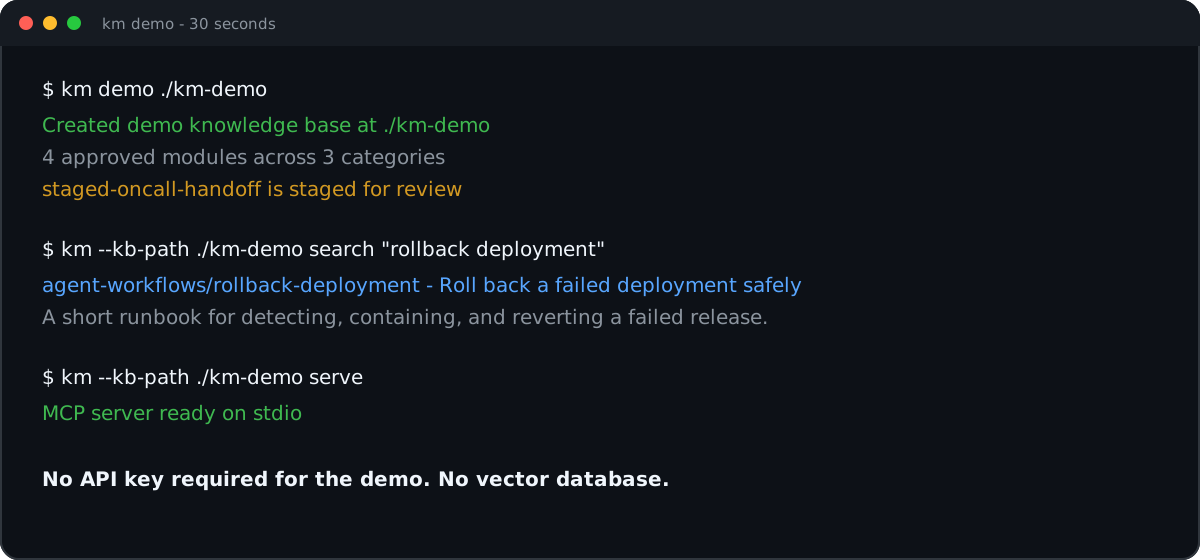
1. Try the demo without an API key
uv tool install git+https://github.com/suiuiui6/knowledge-manager.git
km demo ./km-demo
km --kb-path ./km-demo search "rollback deployment"
The demo creates four approved modules and one staged draft. It uses an empty provider key because the demo path does not call an LLM.
pipx users can install the same build with:
pipx install git+https://github.com/suiuiui6/knowledge-manager.git
2. Connect an MCP client
The built-in connector writes the MCP entry for a supported client:
km --kb-path ./km-demo connect claude-code
To preview the JSON without writing it:
km --kb-path ./km-demo connect claude-code --print
The expected entry is:
{
  "mcpServers": {
    "knowledge-manager": {
      "command": "km",
      "args": ["--kb-path", "/absolute/path/to/km-demo", "serve"],
      "env": {}
    }
  }
}
Restart the client after changing the MCP configuration.
3. Add your own notes
Set a provider key in the environment, then run the review-gated workflow:
export DEEPSEEK_API_KEY="<your-key>"       # POSIX shells
$env:DEEPSEEK_API_KEY = "<your-key>"       # PowerShell

km init ./my-kb
km --kb-path ./my-kb add notes.md -c engineering
km --kb-path ./my-kb review
km --kb-path ./my-kb serve
Never commit a real key. The generated config.json is ignored by Git and the
documented provider flow reads credentials from the environment or local config.
Why this approach?
For small-to-medium knowledge bases (<= 1M words), structured modules are often simpler to operate than embedding-heavy pipelines.
| Approach | Strength | Tradeoff |
|---|---|---|
| Knowledge Manager | Human-readable modules + deterministic file storage | Requires a review step during ingest |
| Classic RAG | Strong semantic recall at larger scale | More moving parts (chunking, embeddings, re-indexing) |
| Hosted knowledge service | Managed operations and shared hosting | Less local control and a separate service to secure |
Who it is for: Teams running AI-assisted engineering workflows who want reusable, reviewable project knowledge without operating a full RAG stack.
- Structured modules, not chunks. Preserve intent with explicit sections
(
overview,details,examples,references,caveats). - Git-native JSON storage. Plain files, atomic writes, and easy review in pull requests.
- MCP-ready retrieval. Expose index + module loading tools so clients can choose what to read at runtime.
Reproducible walkthroughs
- Give Claude Code a reviewable knowledge base
- Extract a runbook with DeepSeek, then review it
- Keep retrieval deterministic for a small team
These are end-to-end walkthroughs with commands and expected observations, not customer testimonials or production benchmarks.
Validation and CI
The repository uses Ubuntu GitHub Actions. CI installs the project from
pyproject.toml, runs the full pytest suite, builds and installs the wheel, and
exercises km demo. Black and Mypy run as separate quality reports while the
repository's existing formatting and typing debt is being reduced. The Poetry
lock remains the local developer lockfile; CI uses the official PyPI index
instead of a regional mirror. Windows checks are currently audit-only-windows
because the local sandbox can prevent pytest from creating temporary
directories; they are not represented as a passing production gate.
Black is enforced across src, tests, and scripts. Mypy freezes the
existing legacy typing debt and requires new modules to pass without being
added to the baseline.
Run the same checks locally after installing the project:
poetry install
poetry run pytest -q
poetry run black --check src tests scripts
poetry run mypy src
python -B tools/check_public_surface.py
The public-surface workflow checks documentation, tracked paths, and credential-like content. It runs on every pull request and does not require a provider key.
M-scale performance evidence is a manual, non-blocking workflow. The current 50k-module run records a known segmentation fault; it is not a merge gate and does not represent production-scale readiness.
Architecture and scope
Knowledge Manager follows the workflow extract -> staging -> review -> publish -> serve. It provides a CLI, an MCP stdio server, and a FastAPI HTTP service over Git-native JSON modules with atomic file updates and inspectable indexes. The design targets small to medium knowledge bases where reviewability and version control matter more than operating a large retrieval platform.
The current project does not require GraphRAG, Neo4j, a vector database, Celery, LangGraph, or a microservice deployment. Those technologies are outside the current architecture and would require a separate requirement, capability validation, and reproducible benchmark before consideration.
Security and configuration
Provider credentials must be supplied through environment variables or controlled local configuration. Do not commit API keys, tokens, private keys, or production configuration. Start from .env.production.example, the sanitized sample knowledge base, and the release and rollout runbooks under docs/runbooks.
Who should use this?
- Teams that want inspectable, versioned knowledge artifacts in git.
- Agent workflows that benefit from selective module loading via MCP.
- Projects where maintainability and editorial control matter more than retrieval automation at massive scale.
Who should not use this?
- Workloads that require large-scale semantic retrieval over tens of millions of words.
- Systems already optimized around production embedding infrastructure.
Features
- Keep knowledge Git-native and auditable: every approved module is JSON you can diff, review, and version with your repo.
- Turn unstructured docs into reusable modules with clear sections (
overview,details,examples,references,caveats). - Add a human checkpoint before publish: extract → staging → review → approve.
- Use one workflow across models with provider support for DeepSeek (default
deepseek-v4-pro), Claude, and OpenAI. - Reuse knowledge from editors and agents through MCP via
knowledge://index,load_module,search_modules, andlist_categories. - Keep retrieval responsive for hot modules with a thread-safe LRU cache.
- Process long documents reliably with chunked extraction (
chunk_size,chunk_overlap). - Operate with visibility through verbose CLI logs for provider/model choice, chunking, and extraction progress.
- Enterprise ingestion and governance: Confluence + Notion source pull, provenance stamping, routing-policy controls, ops exports, and dual source/module views.
- Ship with confidence: focused schema, storage, HTTP, MCP, CLI, enterprise, and integration tests back the production path.
Typical Use Cases
- Build a shared team knowledge layer from product docs, runbooks, and incident writeups, then expose it to coding agents via MCP.
- Replace copy-pasted prompt context with reviewed, versioned modules that can be searched and loaded on demand.
- Keep architecture decisions and operational caveats close to code so AI-assisted workflows stay accurate over time.
Installation
git clone https://github.com/suiuiui6/knowledge-manager.git
cd knowledge-manager
poetry install
The km command is available after install via the entry point declared in pyproject.toml.
Detailed Setup
1. Initialize a knowledge base
km init ./my_kb
This creates:
my_kb/
├── index.json        # auto-maintained module index
├── config.json       # LLM provider + extraction config
└── .staging/         # pending modules awaiting review
2. Configure your LLM
Edit my_kb/config.json or use the CLI:
km --kb-path ./my_kb config set llm_providers.deepseek.api_key "sk-..."
The default provider is deepseek with model deepseek-v4-pro. Switch providers with:
km --kb-path ./my_kb config set extraction.provider claude
3. Extract modules from raw notes
km --kb-path ./my_kb add notes.txt -c auth
The LLM reads notes.txt, chunks it when needed, returns up to max_modules_per_extraction structured modules, and writes them to .staging/.
4. Review staged modules
km --kb-path ./my_kb review
For each staged module:
a— approve (move to KB and update index)r— reject (delete from staging)s— skip (leave in staging for later)
5. Browse and search
km --kb-path ./my_kb list                    # all modules
km --kb-path ./my_kb list -c auth            # filter by category
km --kb-path ./my_kb search "jwt token"      # ranked keyword search
km --kb-path ./my_kb show auth-jwt -c auth   # full module JSON
km --kb-path ./my_kb stats                   # KB statistics
Search ranks exact word matches first, then English stem matches, with partial matching as a fallback for short queries.
6. Serve as MCP
km --kb-path ./my_kb serve
This launches a stdio MCP server. Clients (Claude Code, etc.) see:
- Resource
knowledge://index— full index JSON - Tool
load_module(module_id, category)— full module content - Tool
search_modules(query)— ranked keyword search with exact, stem, and short-query partial matching - Tool
list_categories()— categories with counts
Enterprise Operations
Register external sources and inspect sync health:
km --kb-path ./my_kb source add-confluence team-docs --base-url https://example.atlassian.net/wiki --space-key ENG --email docs@example.com --token-env CONFLUENCE_API_TOKEN --category architecture
km --kb-path ./my_kb source add-notion ops-notes --database-id db-1 --token-env NOTION_TOKEN --category operations
km --kb-path ./my_kb source status
km --kb-path ./my_kb source pull team-docs
Run enterprise eval and operations gates:
km --kb-path ./my_kb eval run ./eval-suite.json
km --kb-path ./my_kb ops
km --kb-path ./my_kb ops-export-review-backlog ./review-backlog.json
km --kb-path ./my_kb ops-export-risky-misses ./risky-misses.json
km --kb-path ./my_kb ops-export-source-backlog ./source-backlog.json
The same control-plane data is exposed through:
- HTTP:
/api/ops,/api/ops/backlog/review,/api/ops/backlog/risky-misses,/api/ops/backlog/source,/api/dual-view - MCP resources:
knowledge://ops,knowledge://ops/backlog/review,knowledge://ops/backlog/risky-misses,knowledge://ops/backlog/source,knowledge://dual-view
Runtime Environment Contract
Deployment-owned process settings are read from environment variables:
KM_KB_PATHKM_UI_HOSTKM_UI_PORTKM_LOG_LEVEL
KM_UI_PORT must be an integer TCP port. KM_LOG_LEVEL must be one of DEBUG, INFO, WARNING, ERROR, or CRITICAL.
Security mode, tenancy, and MCP exposure remain application config and stay in kb/config.json.
Migration Note
Before this change, commands without --kb-path defaulted to the current working directory.
After this change, commands without --kb-path resolve the KB path from KM_KB_PATH first and fall back to the current working directory only when KM_KB_PATH is unset.
Any shell profile, service unit, or automation that exports KM_KB_PATH therefore changes the default KB target for bare km ... commands.
Production Verification
Before production cutover, verify both:
python scripts/verify_install_smoke.py
RELEASE_DIR=/opt/knowledge-manager/release-artifacts/run-$(date +%Y%m%d%H%M%S)
install -d -o km -g km "$RELEASE_DIR"
python3.11 /opt/knowledge-manager/scripts/verify_install_smoke.py --project-root /opt/knowledge-manager --python python3.11 --format json > "$RELEASE_DIR"/verify-install-smoke.json
/opt/knowledge-manager/.venv/bin/km --kb-path /opt/knowledge-manager/kb verify-production-readiness --matrix-summary <fresh-matrix-summary.json> > "$RELEASE_DIR"/verify-production-readiness.json
/opt/knowledge-manager/.venv/bin/km --kb-path /opt/knowledge-manager/kb verify-deployment --base-url http://127.0.0.1:8420 --matrix-summary <fresh-matrix-summary.json> --format json > "$RELEASE_DIR"/verify-deployment.json
/opt/knowledge-manager/.venv/bin/km --kb-path /opt/knowledge-manager/kb support bundle --output-dir "$RELEASE_DIR" --matrix-summary <fresh-matrix-summary.json>
python3.11 /opt/knowledge-manager/scripts/collect_host_deploy_proof.py --output-dir "$RELEASE_DIR"
python3.11 /opt/knowledge-manager/scripts/verify_release_artifacts.py --release-dir "$RELEASE_DIR"
python3.11 /opt/knowledge-manager/scripts/collect_release_evidence.py --release-dir "$RELEASE_DIR" --kb-path /opt/knowledge-manager/kb --base-url http://127.0.0.1:8420 --matrix-summary <fresh-matrix-summary.json>
# host-deploy-proof.json is written into $RELEASE_DIR by collect_host_deploy_proof.py
# verify-release-artifacts.json is written into $RELEASE_DIR by verify_release_artifacts.py
Module schema
{
  "id": "auth-jwt",
  "category": "auth",
  "title": "JWT authentication in our API",
  "summary": "How JWT tokens are issued, signed (RS256), and validated.",
  "created_at": "2026-05-28T10:00:00Z",
  "updated_at": "2026-05-28T10:00:00Z",
  "content": {
    "overview": "...",
    "details": "...",
    "examples": "...",
    "references": "...",
    "caveats": "..."
  },
  "metadata": {
    "tags": ["auth", "jwt", "security"],
    "related_modules": ["auth/oauth-flow"],
    "confidence": "high",
    "source": "internal-runbook"
  }
}
id must match ^[a-z0-9-]+$. The full schema is in src/knowledge_manager/schemas.py.
Architecture
┌────────────┐      ┌──────────────┐
│  raw text  │─────▶│  Extractor   │  (LLM call)
└────────────┘      └───────┬──────┘
                            ▼
                       .staging/*.json
                            │
                       human review
                            ▼
            ┌────────────────────────────┐
            │   <category>/<id>.json     │
            │   index.json (auto)        │
            └──────────────┬─────────────┘
                           │
                  ┌────────┴────────┐
                  │                 │
                  ▼                 ▼
              CLI (km)         MCP server
                                 │
                      Claude Code / clients
| Module | Responsibility |
|---|---|
schemas.py |
Pydantic models (Module, Index, Config, ...) |
storage.py |
Atomic file I/O, CRUD, staging, index rebuild |
cache.py |
Thread-safe LRU module cache |
llm_clients.py |
DeepSeek / Claude / OpenAI async clients |
extractor.py |
LLM-powered raw-text → module extraction |
mcp_server.py |
FastMCP server (resource + 3 tools) |
cli.py |
Click CLI (10 top-level commands plus config subcommands) |
CLI reference
| Command | Description |
|---|---|
km init [PATH] |
Initialize a knowledge base |
km list [-c CAT] |
List modules (optionally by category) |
km stats |
Show KB statistics |
km search QUERY |
Keyword search across modules |
km show ID -c CAT |
Show full module JSON |
km add FILE [-c CAT] |
Extract modules from FILE into staging |
km review |
Interactive review of staged modules |
km delete ID -c CAT [--yes] |
Delete a module |
km rebuild |
Rebuild index.json from on-disk modules |
km config {set,get,list} |
Manage config.json |
km serve |
Run MCP server over stdio |
All commands accept a global --kb-path PATH. Without it, commands use
KM_KB_PATH when set and fall back to the current directory.
Configuration
config.json example:
{
  "llm_providers": {
    "deepseek": {
      "api_key": "sk-...",
      "model": "deepseek-v4-pro",
      "base_url": "https://api.deepseek.com",
      "default": true,
      "temperature": 0.3,
      "max_tokens": 4096
    },
    "claude": {
      "api_key": "sk-ant-...",
      "model": "claude-sonnet-4-6",
      "default": false
    }
  },
  "extraction": {
    "provider": "deepseek",
    "max_modules_per_extraction": 10
  },
  "cache": {
    "enabled": true,
    "max_modules": 50
  }
}
config.json is gitignored — never commit API keys.
Logging
Use km --verbose ... to enable operational logging during CLI runs. Verbose logs include metadata such as provider name, model, chunk counts, module counts, and payload sizes, but they intentionally exclude raw note content, full prompts, LLM responses, API keys, and local file paths.
Development
poetry run pytest -q
poetry run black --check src tests scripts
poetry run mypy src
python -B tools/check_public_surface.py
Validation reports are generated during verification and are kept out of the source release when they contain local paths or runtime artifacts. The repository includes durable assessment and runbook documentation under docs/.
Contributing
Read CONTRIBUTING.md, SECURITY.md, and
CODE_OF_CONDUCT.md before opening an issue or pull request.
Run python -B tools/check_public_surface.py before submitting changes. Live
provider checks are opt-in, and credentials must stay outside Git.
Enterprise Replacement Summary
- Register enterprise sources with
km source add-confluenceandkm source add-notion. - Pull and stage changes with
km source pull <source-id>. - Audit routing and freshness with
km ops,km ops-export-review-backlog,km ops-export-risky-misses, andkm ops-export-source-backlog. - Review rollout procedures in
docs/runbooks/enterprise-rollout.mdand eval gates indocs/runbooks/eval-gate.md. - Use
km migrate dry-run <export.json> --source-kind <kind>before cutover, and followdocs/runbooks/migration-cutover.mdfor replacement rollouts.
Replacement Readiness
- Hybrid retrieval quality can now be measured with first-hit rank, MRR, nDCG, and recall in addition to hit rate.
- Source ingestion runs are tracked as durable jobs with visible status, failure state, checkpoints, and resume metadata.
- Tenant-aware module isolation and explainable permission decisions are available as the foundation for deeper enterprise tenancy.
- Migration dry runs, job views, ops exports, and the admin dashboard reduce switching risk from incumbent knowledge tools.
Example knowledge base
See examples/sample_knowledge_base/ for a small working KB you can copy as a starting point.
License
MIT
knowledge-manager MCP questions
Does this require a vector database?
No, it uses Git-native JSON modules and deterministic file storage instead of an embedding-heavy pipeline.
What is the workflow for adding new knowledge?
The workflow follows an extract, staging, review, and publish process to ensure human oversight.
Can I use my own LLM providers?
Yes, it supports providers like DeepSeek, Claude, and OpenAI through environment variables or local configuration.