
Wavefunction MCP server
Commit Nov 10, 2026An open-source desktop coding agent for macOS that uses local models or API keys to perform tasks in isolated environments.
Also known as stoyan-stoyanov/wavefunction
- Stars
- 20
- Tools
- —
- Downloads, 30 days
- —
- Latest version
- —
- Last commit
- Nov 10, 2026
- License
- MIT
What is Wavefunction MCP?
Wavefunction is an open-source desktop coding agent for macOS that uses local models or API keys to perform tasks in isolated environments.
Summary generated from the project's README
About Wavefunction MCP server
Wavefunction provides a desktop coding agent for macOS users who want to manage complex programming tasks through a minimal interface. It allows developers to run local models or connect via API keys and ChatGPT sign-ins, ensuring you are never locked into a single provider. The application organizes work into projects and individual chats, which can run in parallel using Git worktrees to prevent file conflicts.
For security, the agent performs computer use within a local Docker container rather than controlling your actual mouse or keyboard. This isolated environment allows the agent to browse the web and interact with a virtual desktop while leaving your personal files and keychain untouched. You can also utilize over 70 ready-made connectors or integrate any MCP server to extend the agent's capabilities. The tool is designed for Apple Silicon Macs and supports advanced workflows like scheduled routines and parallel helper chats that report back to a parent conversation.
What you can do with it
- 1Parallel task executionYou can instruct the agent to start child chats that work on sub-tasks simultaneously and report their progress back to the main conversation.
- 2Isolated environment testingDevelopers can let the agent use a web browser and run commands inside a Docker container to keep the host system secure.
- 3Automated coding routinesYou can set up a chat to automatically execute the same set of instructions on a specific schedule.
- 4Safe Git branch managementEach new conversation can automatically start on its own Git branch and checkout to keep project files organized.
Written from the project's README. Every use case is checked against a quote from it.
Automated checks
Ran Nov 15, 2026Full report →Not verified yet. A server needs a score of 80, no serious finding, and enough data for us to check. How checks work · What to fix for more points

- Source repository linked and reachablestoyan-stoyanov/wavefunction is public and reachablegithub.com/stoyan-stoyanov/wavefunction ↗Pass
- Package names this repository as its sourceNot checked
- Build provenance (Sigstore attestation)Not checked
- Open source license (OSI)MITspdx.org/licenses/MIT.html ↗Pass
- Commit or release in the last yearLast commit or release 2026-11-10github.com/stoyan-stoyanov/wavefunction ↗Pass
- OpenSSF ScorecardNot checked
- Package name not close to a popular packageNot checked
- No critical advisory in the package or its dependenciesNot checked
- No hidden instructions to the model0 tool descriptions and the README read; no override phrases, credential paths or hidden charactersPass
- Destructive tools are labelledNot checked
- Remote endpoint answers the MCP handshakeNot checked
README
View on GitHub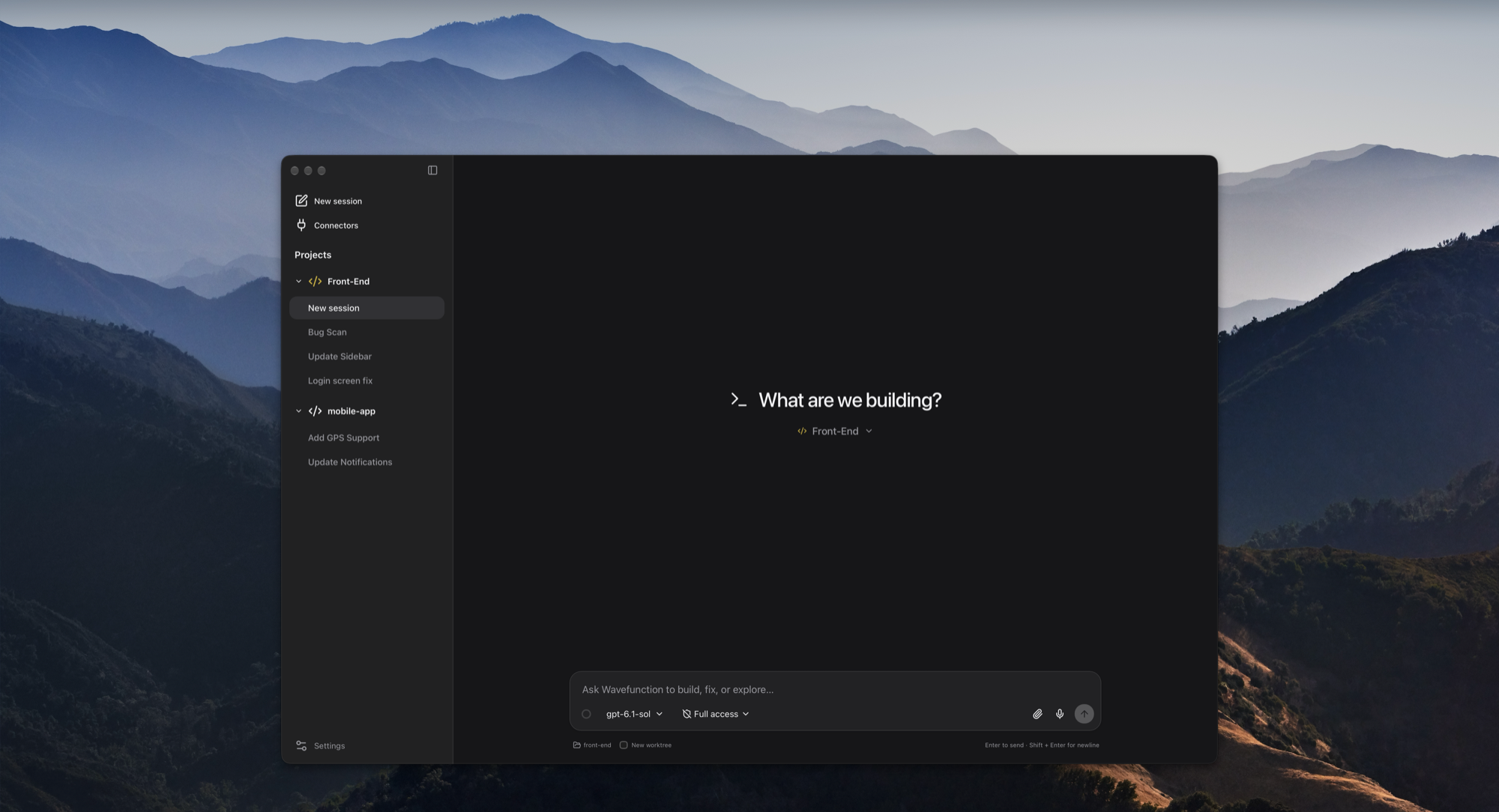
Why Wavefunction
- Less is more. Coding agents are turning into super apps, adding more with every release. Wavefunction goes the other way: simpler is better, and building comes first.
- Free to choose. Pick any model and switch whenever you like. Run models locally or require zero data retention. You're never tied to one provider's plans or limits.
- Open source, on the desktop. Most open-source agents shine in the terminal. Wavefunction is built to be a great desktop app: minimal, considered and fast, and open source down to the prompt.
Agents and sessions
Wavefunction has one built-in coding agent. Each chat is a separate conversation with it, with its own model, folder and history, and chats run side by side. A project is a folder, usually a Git repository, and groups the chats that work in it.
- Worktrees. In a Git repository a new chat starts on its own branch in its own checkout, so chats in one project don't step on each other. Untick New worktree before the first message to work in the project's folder instead.
- Talk to it while it works. A message sent during a task steers that task. Queue follow-up runs it after the task instead. When the agent needs a decision, it asks with a question card.
- Helpers. For bigger tasks the agent starts helpers: child chats that work in parallel and report back. They share the parent's checkout by default, or get an isolated worktree whose changes the parent reviews and brings in. Open one to read its transcript, redirect it or stop it.
- Going back. Fork a chat from any message, or rewind to put the code and the conversation back to how they were at that point.
- Long conversations. The ring in the message box shows how full the context is. Near the limit the conversation is summarised, keeping your requests and the confirmed state of the work. Compact now does it on demand.
- Routines. A chat can set up a routine: a chat that gets the same instruction on a schedule, such as every 15 minutes or weekdays at 9, while the app is open.
- Projects from a chat. Ask a chat to create a project (and clone a repository into it), archive old chats or remove a project.
- Modes. Plan mode reads and explains without changing anything. Full access runs commands outside the sandbox without asking each time; commands that can't be undone still ask.
Computer use that leaves your Mac alone
Other agents take over your mouse, keyboard and screen to get things done. Wavefunction gets a desktop of its own, so you keep working while it clicks. Watch it, or take control at any time.
- Your Mac stays yours. It never moves your pointer, types on your keyboard or records your screen. Its desktop runs in a local Docker container that can reach the web, but not your files or keychain.
- Secure sign-ins. When a site needs your login, you sign in privately. The agent pauses and never sees what you type, and the chat stays signed in for next time.
- Files in and out. Downloads come to your Mac in the folder you choose, and files you add are ready to upload.
Computer use needs Docker Desktop and a model that can read images.
Connectors and skills
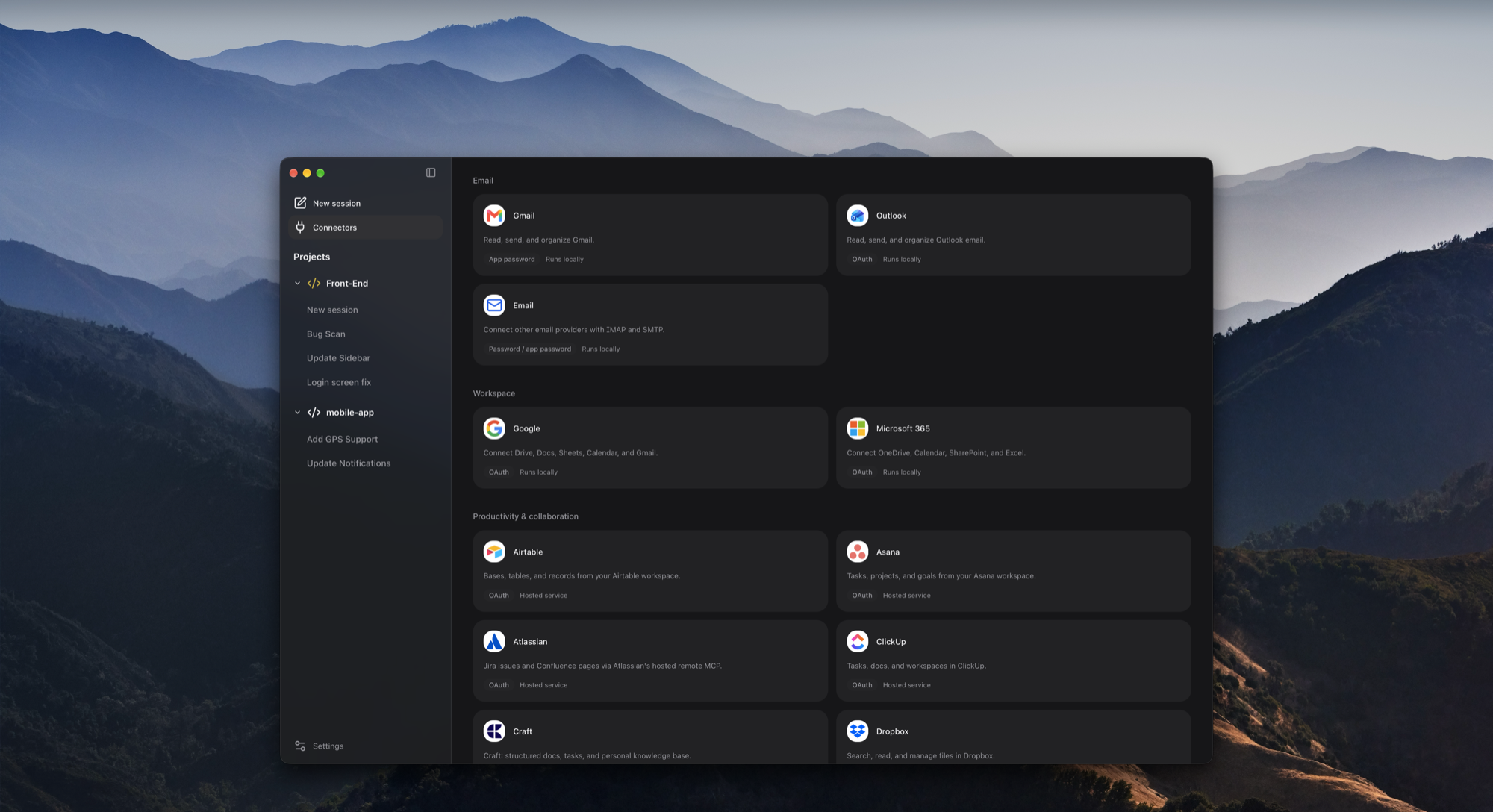
70+ ready-made connectors, plus any MCP server you add. Wavefunction follows your AGENTS.md and loads SKILL.md skills from the .agents/skills, .claude/skills and .opencode/skills folders in your projects and home folder, and from ~/.codex/skills, so it works with the setup you already use.
Usage tracking
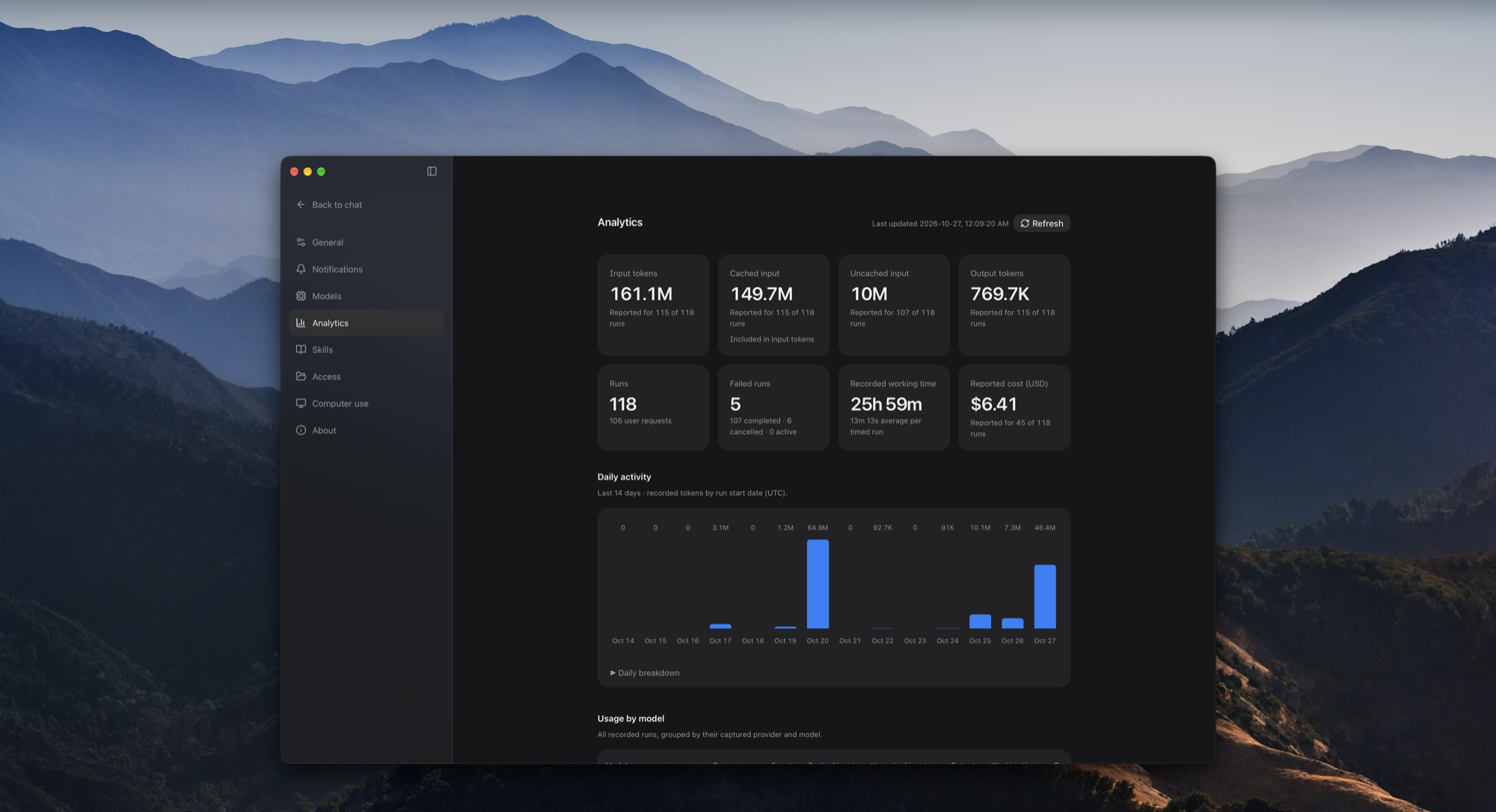
Settings › Analytics totals what every run used, from the numbers your providers report:
- input tokens, split into cached and uncached, and output tokens;
- runs, failed runs and working time;
- cost in US dollars, where the provider reports one;
- the last 14 days day by day, and totals per model.
When only some runs reported a figure, it says how many ("Reported for 12 of 15 runs") instead of counting the rest as zero.
Secure and private
Use local models or require zero data retention. With Require zero data retention on in Settings → Models, OpenRouter and Vercel AI Gateway send chats only to providers that keep no prompts or responses. Other providers set it on your account with them.
- Your conversations, skills and settings stay on your Mac, in
~/Library/Application Support/app.harness.coding(the app's identifier from before it was named Wavefunction, kept so existing data stays where it is). Provider and connector keys are local files only your user account can read; they are not encrypted. - Commands run in the macOS sandbox by default, and folders outside your project need your grant. A command that needs to run outside the sandbox asks first, unless you've given that chat full access.
- A fixed check asks before commands it recognizes as irreversible, such as deletes or force pushes. It catches an overeager agent, not every case; see the known issues and SECURITY.md.
Get started
Download the DMG from the latest release, open it and drag Wavefunction to Applications. It's signed and notarized by Apple, and it updates itself.
You need a Mac with Apple Silicon (macOS 11 or later). Setup walks you through connecting a provider, choosing models and creating your first project. Model usage is billed by your provider.
Build from source
The app is a Tauri shell in Rust (src-tauri) around a React interface (frontend) and a Python agent engine (backend). The build freezes the engine with PyInstaller and bundles it, with its own Python, into the app.
You need macOS, Node.js 22+, uv (it installs Python 3.12), Rust and the Xcode Command Line Tools.
npm run setup           # frontend packages and the Python environment, from their lockfiles
npm run desktop:build   # the engine, then the app
open src-tauri/target/release/bundle/macos/Wavefunction.app
desktop:build also writes a ZIP and its checksum to dist/desktop. Its signature is ad hoc, so the app runs on the Mac that built it but warns elsewhere. For a signed, notarized DMG you can hand to others, use npm run release:local, which needs a Developer ID certificate and an App Store Connect API key (releasing).
While working on the interface, npm run dev:fixture runs it in your browser against a disposable synthetic workspace, with no account or model provider. npm run desktop:dev runs the app itself with the interface reloading as you edit. Before a pull request:
npm run check
Development and the architecture explain the rest.
Contributing
Interested in contributing? We welcome new contributors. Start with CONTRIBUTING.md and the code of conduct, and report security issues privately as described in SECURITY.md.
License
MIT. Dependencies keep their own licenses; see THIRD_PARTY_NOTICES.md.
Wavefunction MCP questions
Does Wavefunction take control of my mouse and keyboard?
No, it runs its own desktop in a local Docker container so it never moves your pointer or types on your keyboard.
What models can I use with Wavefunction?
You can use local models with Ollama, your own API keys, or a ChatGPT sign-in.
Can I use my own MCP servers?
Yes, Wavefunction supports any MCP server you add.
What are the system requirements for Wavefunction?
You need a Mac with Apple Silicon running macOS 11 or later.