
devst MCP server
Commit Oct 26, 2026Provides an AI-assisted development environment with documentation linting, task registry, code intelligence, and a local MCP server.
Also known as someguy3021/devst-public
- Stars
- 0
- Tools
- —
- Downloads, 30 days
- —
- Latest version
- —
- Last commit
- Oct 26, 2026
- License
- CC-BY-4.0
What is devst MCP?
devst provides an AI-assisted development environment with documentation linting, task registry, code intelligence, and a local MCP server.
Summary generated from the project's README
About devst MCP server
Maintaining accurate repository documentation while using AI coding agents is what devst enables. It provides a documentation-first development environment designed to prevent stale specs and lost knowledge during AI-driven sessions. Developers can use the zero-dependency CLI or the Tauri desktop companion to enforce documentation standards, manage tasks, and track environment changes.
The system operates as a local MCP server via the devst mcp command, exposing 25 read-only tools to any AI harness. These tools provide access to a task registry, architecture models, code intelligence, and a status panel. It uses a SQLite-backed registry to manage tasks and an append-only journal to record every state change.
Users can run devst check to lint documentation or devst env to scan stack manifests like package.json or Cargo.toml. The tool includes specialized features like devst freeze to guard UI edits and devst visual for layout snapshots. It is built as a self-contained Windows binary that requires no external Node.js runtime dependencies.
What you can do with it
- 1Enforce documentation standardsA developer can run a command to ensure all repository headers, maps, and cross-references meet the required project conventions.
- 2Provide context to AI agentsAn AI client can use the local MCP server to access the task board, reminders, and code intelligence without manual parsing.
- 3Track development progressTeams can use the task registry to reconcile declared work against actual git commits when closing a session.
Written from the project's README. Every use case is checked against a quote from it.
README
View on GitHubdevst
Documentation-first tooling for AI-assisted development — a zero-dependency CLI and a Tauri desktop companion that keep your repository's documentation alive when AI agents write most of the code.






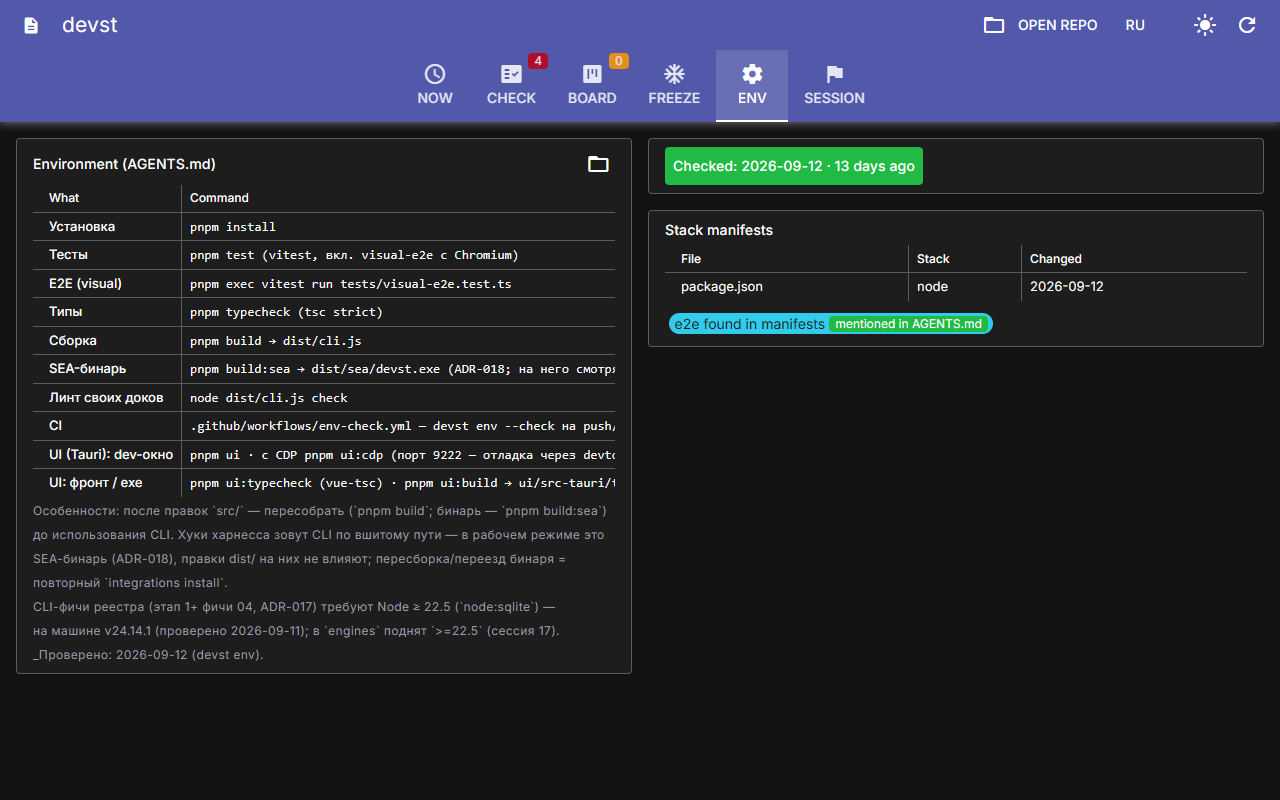
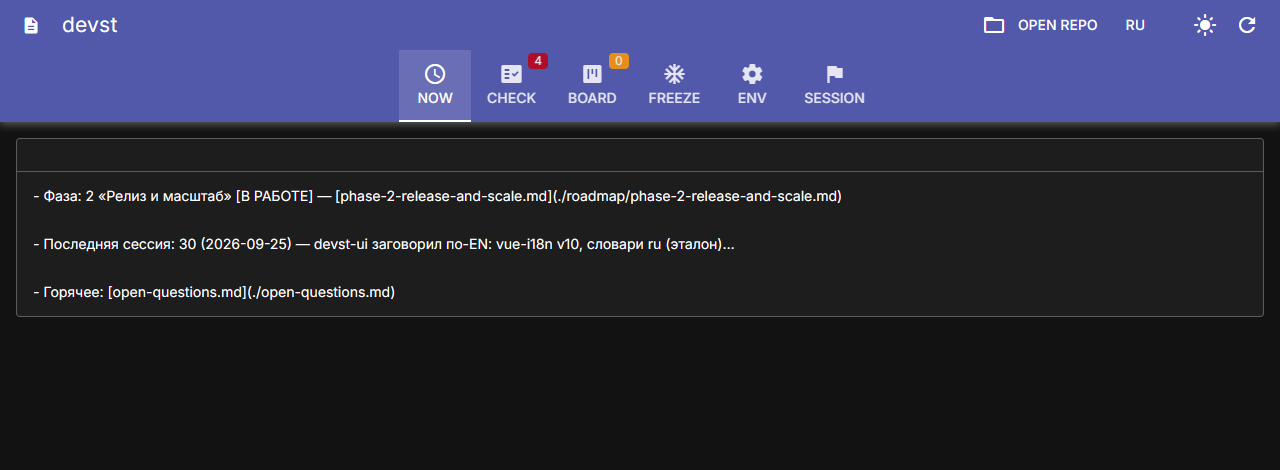
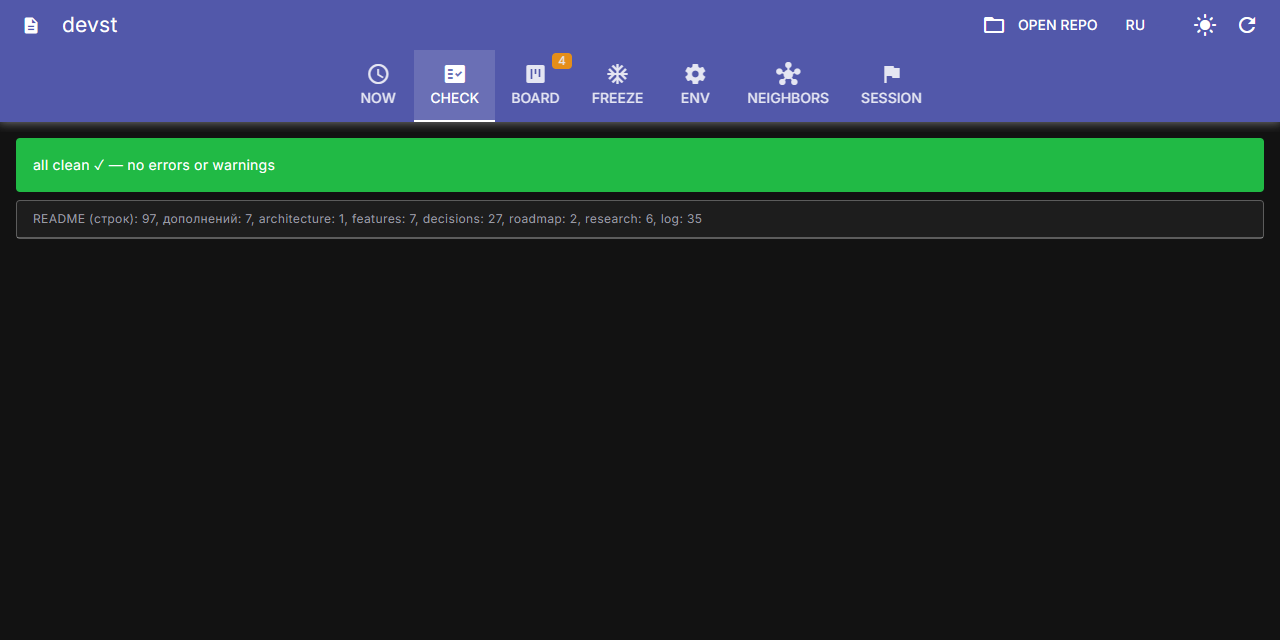
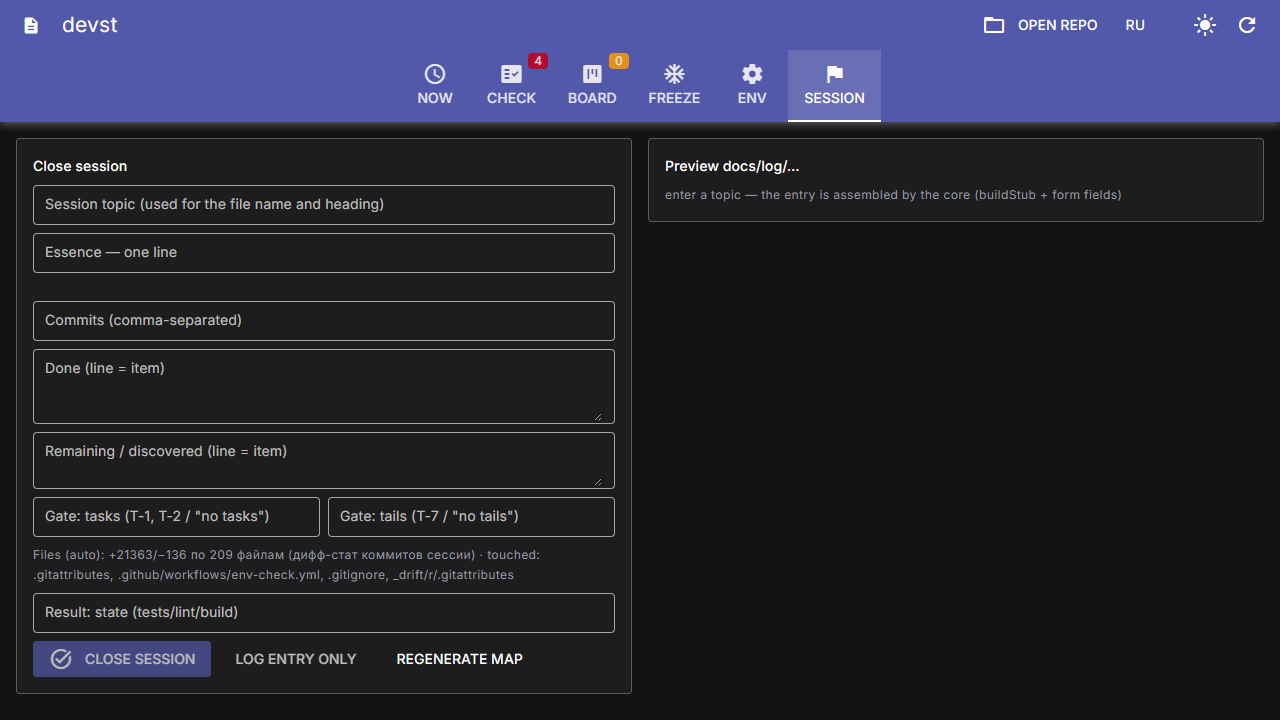
| Now panel | Check list | Close-session gate | Freeze tree |
|---|---|---|---|
 |
 |
 |
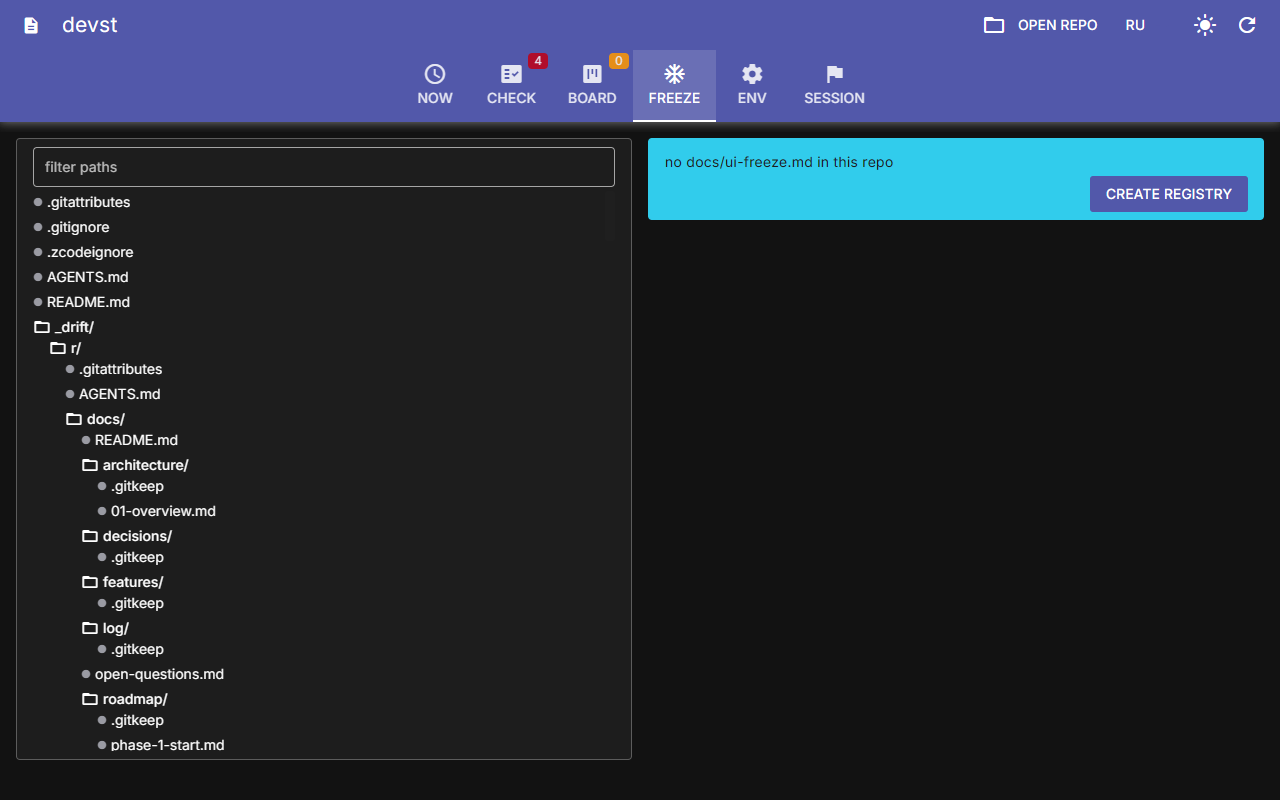 |
Screenshots show the desktop companion (English interface, dark theme) working against a real repository.
Why
When an AI coding agent does most of the diffing, in-repo documentation stops being a courtesy and becomes infrastructure:
- The spec problem. The agent reads
AGENTS.mdanddocs/before every task. Stale docs silently steer it wrong — and it will confidently follow. - The trail problem. Agents happily commit work without recording it. Knowledge evaporates between sessions; the next session re-derives everything from scratch.
- The trust problem. "The code is the docs" fails when nobody — human or model — can tell which of three contradictory paragraphs is the current one.
devst answers with conventions enforced by tooling: docs that are scaffolded, linted, freshness-checked, and wired into the AI harness itself.
What's inside
| Area | Command | What it does |
|---|---|---|
| Convention linting | devst check |
Enforces the documentation standard — headers, map, freshness, cross-references; exits non-zero for CI and pre-commit hooks |
| Docs map & "Now" panel | devst map · devst status |
Regenerates the documentation map and a five-second state panel: phase, last session, open work |
| Task registry | devst task … · devst board |
SQLite-backed tasks & questions with links, timers, TTL; closing runs a gate that reconciles what the task declared against what the commits show; tags (closed vocabulary + free-form) and six honest verification levels at close — deep / smoke / skim / delegated / blind / manual — recorded with date and actor, revisited by devst audit |
| Feature specs | devst feature … |
Machine-readable spec items per feature, each with a verbatim source quote and task links; the agent marks "done" with proof, a human confirms through the same verification inbox; feature close refuses with unresolved must-have items |
| Agent access (MCP) | devst mcp |
A local MCP server (stdio JSON-RPC, zero-deps) exposing 25 read-only tools — the "Now" panel, the registry, ADRs, reminders, code intelligence — to agents of any harness; wired by integrations install --mcp, verified by doctor. Every answer carries a _meta envelope: freshness, completeness, truncation |
| Environment recon | devst env |
Scans stack manifests (package.json, Cargo.toml, pyproject, Makefile, compose, CI), drafts the Environment table; CI fails when it goes stale |
| UI freeze registry | devst freeze |
Records frozen UI areas (including a default-deny mode), validates staged diffs against the registry, guards edits via hooks |
| Visual baselines | devst visual |
Layout snapshots + screen hashes; opt-in true pixel diff with a zero-dependency PNG decoder |
| Bug Hunt | devst bugs emit · ingest |
Ships an obfuscated overlay artifact to external testers; ingests their reports into pinpoint BUG-* cards mapped to screens and files |
| Reminders | devst remind |
One reminder pipeline over detector providers: undocumented commits, uncommitted work, stale tasks |
| Harness integrations | devst integrations install · doctor |
Installs skills, slash-commands and hooks into the AI harness from machine-independent canonical templates; doctor verifies the wiring |
| Linked repos | devst links check · pin · mirror |
Tracks related devst repositories: id:// cross-links, sha256+HEAD pins, digests of the neighbor's session logs, byte-for-byte mirrors — surfaced in reminders and a desktop tab |
| Activity journal | devst log add · log query |
An append-only SQLite journal (FTS5) of every state change — freeze set/unset, task create/close/tag/verify, pins, installs, analyze — plus manual events; queried from the CLI and via MCP get_history. The journal is history, never state: the registry stays editable, the journal does not |
| Code intelligence | devst analyze · devst blast |
An import/call graph built by a parser cascade — its own scanner for every language, embedded parsers (TypeScript, the Lezer family, PHP, Lua, Elixir) where available — plus blast radius, git analytics (churn, hotspots, ownership), health findings and a 0–10 change risk; clean-room by design, served via MCP and a desktop "Code" panel |
| Architecture model | devst arch init/check |
A machine-readable architecture model — roles, a default-deny import matrix, node contracts; presets from official rulebooks (FSD, Clean Architecture); violations checked over the code graph; a generated canon doc; served via MCP and a desktop tab |
| Desktop companion | devst-ui |
Tauri v2 app: "Now" panel, check list, freeze tree with drag-and-drop, task board with tags, the verification inbox (a human confirms verified levels — the CLI can only request), the activity journal, a "Code" panel and a side reader panel (markdown, code, images) — the same pure core running in the webview |
How a session flows
SessionStart hook ──▶ injects the "Now" panel + reminders + lint status
        │
        ▼
agent reads L0/L1 ──▶ AGENTS.md → docs map → doc headers → work
        │
        ▼
PostToolUse hook ──▶ lints every touched doc, guards frozen UI files
        │
        ▼
session close ──▶ log entry (budget-checked) → task gate (declared vs done)
        │            → devst undocumented → devst check must be green
        ▼
CI ──▶ docs conventions + environment freshness on every push
While the agent works, devst mcp serves the same facts as typed read-only MCP
tools — board, decisions, reminders, code context — so any harness gets the canon
without parsing human-oriented output.
The philosophy underneath is detect, don't block: the CLI lints, the skill teaches, hooks enforce — warnings first, humans always decide. The full methodology is described in docs/methodology.md.
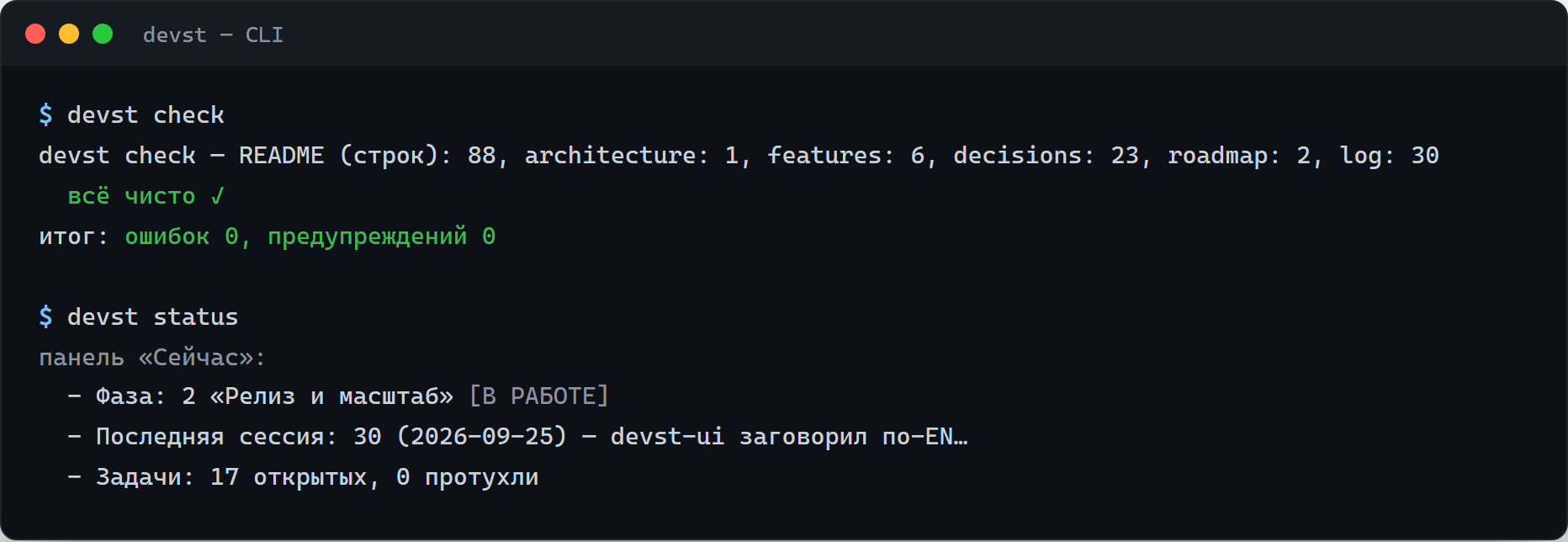
CLI in action
Architecture in one glance
Pure core (strings & lists, no node:* imports) → thin shells (FS, git, SQLite,
processes) → the same core executed in the Tauri webview → a single self-contained
binary (Node SEA) that carries its integration templates as embedded assets and
ships as the desktop app's sidecar.
┌──────────────────────────────────────────────────────────┐
│ Desktop UI (Tauri v2) — Vue 3 + Quasar in the webview    │
├──────────────────────────────────────────────────────────┤
│ Delivery — skill, slash-commands, hooks, scaffolding     │
├──────────────────────────────────────────────────────────┤
│ Shells — cli · mcp · registry · integrate · bugs · visual│
├──────────────────────────────────────────────────────────┤
│ Pure core — check · registry · freeze · env · map · …    │
└──────────────────────────────────────────────────────────┘
Details and the module map: docs/architecture/overview.md.
Documentation
- The dev-standard methodology — the conventions devst enforces
- Architecture overview — layers, storage, distribution, testing
- Features — sixteen feature deep-dives: visual baselines, Bug Hunt, the desktop window, the task registry, reminders, the practice installer, linked repos, the MCP server, actors & roles, code intelligence, task tags & verification, the activity journal, UI-only verification, spec items as data, the reader panel, architecture roles & boundaries
- Decision records — all 32 ADRs, in English
- Русская версия — полное зеркало документации (английский — источник истины)
Engineering highlights
- 0 runtime dependencies — Node stdlib only; strict
tscgreen. - 571 automated tests, including real-Chromium E2E of every desktop screen
(Playwright against a vite build with a
MockKerneladapter). - 31 recorded ADRs — every architectural decision documented, superseded ones preserved, never renumbered.
- One self-contained binary (Node SEA, ~98 MB, with embedded code parsers) + desktop sidecar: one implementation of the rules, not two.
Download
Prebuilt Windows binaries are attached to GitHub Releases:
devst.exe— the CLI (self-contained, no Node required)devst-ui.exe— the desktop companion (needs only WebView2, preinstalled on Windows 10/11)
Both are unsigned — SmartScreen will show a warning on first run. The source code is not published; see Status & scope.
Status & scope
devst started as a personal tooling project and this repository exists to show its documentation, design record and engineering practice. To be explicit about what that means:
- The source code is not public; binaries are provided as-is, without warranty.
- It is not seeking users or contributors: issues may go unanswered, breaking changes will be unannounced, support is not promised.
- It is Windows-first (SEA binary + Tauri); cross-platform builds are future work.
License
Documentation and assets are licensed under CC BY 4.0 — attribution: someguy3021 / devst.
devst MCP questions
What does the MCP server provide?
The local MCP server exposes 25 read-only tools including the 'Now' panel, registry, ADRs, reminders, and code intelligence to any AI harness.
Does devst require Node.js to run?
No, the CLI is a self-contained Node SEA binary that requires no runtime dependencies.
What operating systems are supported?
It is currently Windows-first, providing prebuilt Windows binaries for the CLI and the desktop companion.
How does devst handle code intelligence?
It uses an import/call graph built by a parser cascade that includes its own scanner and embedded parsers for languages like TypeScript, PHP, and Lua.