
navette MCP server
Commit Oct 19, 2026Enables AI agents to navigate, read, screenshot, and interact with websites using the operating system's native WebView.
Also known as slabbdev/navette, navette
- Stars
- 7
- Tools
- —
- Downloads, 30 days
- —
- Latest version
- 1.7.0
- Last commit
- Oct 19, 2026
- License
- MIT
What is navette MCP?
navette enables AI agents to navigate, read, screenshot, and interact with websites using the operating system's native WebView.
Summary generated from the project's README
About navette MCP server
Navette provides a lightweight way for AI agents to interact with the web by utilizing the native WebView already present in your operating system. Instead of downloading heavy browser engines like Chromium, this single Rust binary uses macOS WKWebView, Windows WebView2, or Linux WebKitGTK to perform tasks. This approach significantly reduces RAM usage and improves startup speeds compared to traditional automation frameworks.
Developers can connect to the server via MCP stdio or a local HTTP API. The server includes specialized tools for navigating URLs, reading page content in markdown or HTML, taking screenshots, and performing complex interactions like clicking, typing, and uploading files. It is designed for agents that need to handle JavaScript-heavy sites, manage user sessions, or navigate through login forms.
Security is a core focus, with features like origin-bound credential storage in the OS keychain. This ensures that sensitive passwords are injected directly into the page by the daemon and never exposed to the agent or the network. The server also supports session isolation and can run as a resident daemon to minimize latency for subsequent requests.
What you can do with it
- 1Automated web navigation and readingAn agent can navigate to a specific URL and extract the page content in a structured format.
- 2Visual verification through screenshotsA developer can instruct an agent to capture a visual representation of a webpage to verify its layout.
- 3Securely handling user loginsAn agent can trigger a login process using stored credentials without ever seeing the actual password.
Written from the project's README. Every use case is checked against a quote from it.
Automated checks
Ran Nov 14, 2026Full report →Not verified yet. A server needs a score of 80, no serious finding, and enough data for us to check. How checks work · What to fix for more points

- Source repository linked and reachableslabbdev/navette is public and reachablegithub.com/slabbdev/navette ↗Pass
- Package names this repository as its sourceNot checked
- Build provenance (Sigstore attestation)Not checked
- Open source license (OSI)MITspdx.org/licenses/MIT.html ↗Pass
- Commit or release in the last yearLast commit or release 2026-10-19github.com/slabbdev/navette ↗Pass
- OpenSSF ScorecardNot checked
- Package name not close to a popular packageNot checked
- No critical advisory in the package or its dependenciesNot checked
- No hidden instructions to the model0 tool descriptions and the README read; no override phrases, credential paths or hidden charactersPass
- Destructive tools are labelledNot checked
- Remote endpoint answers the MCP handshakeNot checked
README
View on GitHubnavette — v1.9.0
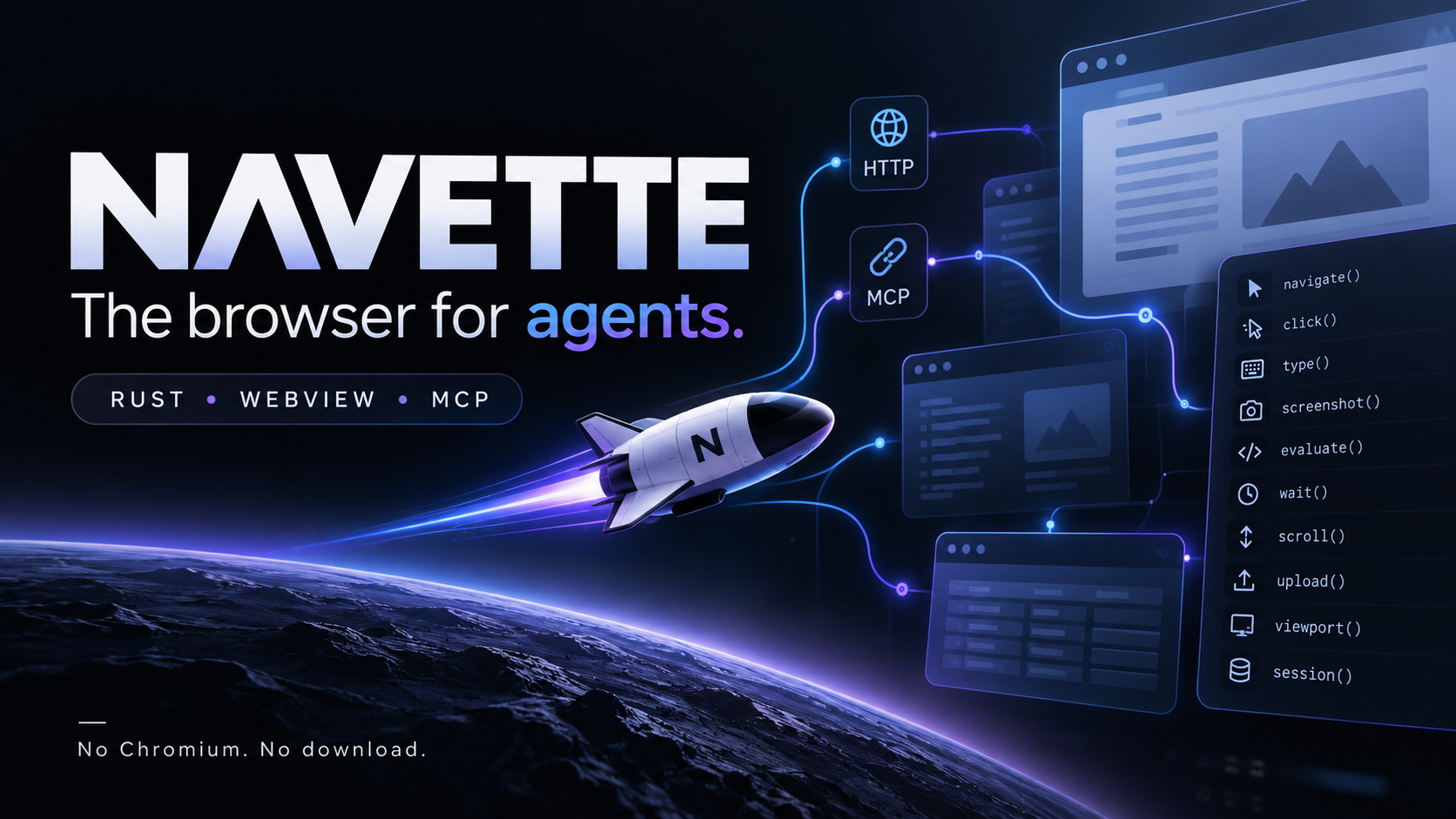
The browser for agents. One tiny Rust binary driving the WebView your OS already ships — no Chromium, no download, no RAM bonfire.
Navette is French for shuttle — the small vessel that carries your agent from page to page. Always fueled (the engine ships with your OS), light enough to ignore, and it skips the human web's garbage so your agent doesn't have to.
Single Rust binary, three modes:
$ ls -lh target/release/navette
-rwxr-xr-x  1 user  staff   725K  navette
725 KB installed on macOS (release binaries track it; the OS-keychain store for logged-in states costs ~100 KB). Windows-x64 / linux-x64 ride the wry backends. Playwright ships 218 MB. Lightpanda ships 96 MB (and cannot screenshot). Measured claims, reproducible with one command (BENCHMARKS.md):
- Faster than Playwright + Chromium on every metric we measured — install, cold start, navigate→read (8 ms), act (1 ms), peak RAM, 100-page crawl (0.9–2.8 s, parity with Lightpanda within variance and ~2–3x faster than Playwright), real-web success rate (95–100% vs 85%).
- Crawls at Lightpanda's speed while rendering (parity within variance through the zero-bias raw-CDP probe, where Lightpanda is the fastest page-reader at 3.3–3.4 ms — it parses a partial DOM and cannot render — and navette is the fastest full-rendering reader: 17.9–19.4 ms vs Chromium's 28–34 ms through the identical client).
- The two rows Lightpanda wins — fresh-process boot and peak RAM — are the price of rendering. If your agent only reads static pages, use fetch + readability; if it needs JS, sessions, actions and vision, that price is the product.
FAQ
Why not Apple's Safari MCP server (2026)? Same thesis, different scope: navette is agent-first (8 primitives, ghost windows, resident daemon), open source, and cross-platform by design (WebView2 on Windows is Chromium — preinstalled). Apple's is macOS-and-Safari-shaped.
Why not just fetch + readability? For static pages, do that — it beats everyone. navette exists for what fetch can't do: JS-built pages, logins, sessions, forms, screenshots, acting like a human.
Why not an ML extraction model? Two trades, not a ranking — pulpie-mcp lives on the ML side of this lane. Trained extraction models survive hostile HTML — agency templates, mangled CMS output — where a DOM walk picks the wrong node, at roughly ~600 ms of compute per page. navette's native DOM walk costs ~10 ms per page and wins wherever the markup is sane, which is most documentation, news and dev-tool pages — most of what agents actually read. The layers compose: when one target's markup is hostile enough that native extraction picks garbage, hand that page's raw HTML to an ML pass.
Is navette a crawler? No — deliberately. navette does navigate/read/screenshot/act on a URL you hand it; robots → sitemap → link discovery is a layer above, not a core primitive. Point a crawler at navette when its targets need a real engine.
Screenshot fidelity? Capture is native per engine (v1.3+) — what the compositor drew, not a re-render — and viewport-sized; set the viewport before navigating for repeatable captures. Full-page capture is not implemented yet; tracked honestly rather than approximated.
Security? The server binds 127.0.0.1 only, non-local Host headers are refused (DNS-rebinding guard; /health exempt), token comparison is constant-time, and proxy URLs are credential-redacted in logs. Session isolation is CI-enforced on every engine — a cookie imported into one session must not appear in another's jar, or the build fails: macOS (non-persistent WKWebsiteDataStore per session) · Windows (one WebView2 profile per session + InPrivate — InPrivate alone shares one profile across controllers, #6) · Linux (fresh WebContext per session; cookies never touch disk — HTTP cache/HSTS still do, #6). Cross-run state moves explicitly: state_export / state_import. The agent's JS executes in the OS WebKit sandbox, not in your terminal. For anything beyond a private laptop, --token SECRET requires Authorization: Bearer on every route (except /health) — an MCP host attaches with the NAVETTE_TOKEN env var. Logged-in states belong in the OS keychain, not in plaintext sidecar files (#8): navette state save NAME writes the jar inside the daemon and only metadata ever returns — the request carries a name, the keychain holds the secret, and macOS re-prompts on a new binary (ACL), an implicit per-release consent. Credentials go one step further (stage 2, shipped): a human saves a login with navette creds set SITE (hidden stdin, bound to the exact origin of the session's current page), then any agent fills the login form with POST /login {"site": SITE} — the password is resolved inside the daemon and injected into the page; it never appears in the request, the response, or a log, and there is no read-back API at all. The fill is refused on any other origin — a hostile page or a prompt-injected agent can neither harvest the secret nor aim it elsewhere. 2FA stays human (session_show). The one honest limit: at fill time the password does reach the page — the same as human typing; the origin-binding is the defense.
Operator flags (serve): --proxy URL (HTTP CONNECT / SOCKS5, wry backends — macOS follows the system proxy), --user-agent UA (per-serve override), --idle-release MIN (drop idle WebKit sessions, the daemon stays resident).
Build & run
brew install slabbdev/tap/navette   # macOS arm64
cargo install navette-browser   # any platform, from source
docker run -i --rm ghcr.io/slabbdev/navette navette mcp   # container, stdio MCP (amd64+arm64)
navette serve --port 8765       # HTTP API on loopback
navette mcp                     # MCP stdio for agent hosts
navette state save NAME         # the session's login state → OS keychain
navette creds set NAME          # a login the agent can use but never see
navette install-daemon          # resident: warm from login
Or build from source:
cargo build --release          # rustup; macOS fully shipped — Windows (WebView2) / Linux (WebKitGTK) backends aboard
./target/release/navette serve --port 8765   # HTTP API on loopback
./target/release/navette mcp                 # MCP stdio for agent hosts
./target/release/navette install-daemon      # resident: warm from login, 24 ms first page
./target/release/navette uninstall-daemon
The mcp mode auto-starts serve if nothing is listening (it idles politely if the port is already served by another navette). The resident daemon is a LaunchAgent with KeepAlive — the cold start an agent feels drops to 24–37 ms while sessions are warm. With --idle-release MIN that window gains an honest edge: idle sessions drop, and the first request after that re-warms through the pre-warm path in ~100 ms — the daemon itself never exits.
HTTP API (127.0.0.1 only, JSON)
| Route | Body | Returns |
|---|---|---|
GET /health |
— | {ok, name, engine} |
GET /sessions |
— | sessions with url + title |
POST /navigate |
{url, session?, with_content?, format?} |
{ok, url, title[, content]} — with_content folds the read into one round-trip |
POST /read |
{session?, format?} markdown/text/html |
{ok, content} |
POST /screenshot |
{session?} |
PNG bytes |
POST /click |
{selector, session?, wait_navigation?} |
{ok} (real pointer+mouse events — opens Radix/HeadlessUI menus too; opt-in auto-wait for form-POST navigations) |
POST /type |
{selector, value, session?} |
{ok} (React-safe native setter) |
POST /evaluate |
{js, session?} |
{ok, result} |
POST /wait |
{selector, ms?, session?} |
{ok} |
POST /sessions/state |
{session, store?} |
cookies JSON — the logged-in state; with store, the jar goes to the OS keychain under that name and only {stored, origin, cookies} returns — the jar never rides the wire |
POST /sessions/load |
{session, cookies} or {session, store} |
{ok, imported[, origin, saved_at]} restore a logged-in state from JSON or from the keychain |
GET /states |
— | stored states — names, origins, timestamps; never the jars |
POST /states/delete |
{name} |
{ok} remove one |
POST /creds/set |
{site, username, password, session} |
{site, origin} — HUMAN step (the CLI prompts on hidden stdin); the credential binds to the session page's exact origin |
GET /creds |
— | sites + origins + usernames — never passwords |
POST /creds/delete |
{site} |
{ok} remove one |
POST /login |
{site, session?, submit?} |
fill + submit the login form from the keychain — the password never appears in the request, the response, or a log; 403 unless the session is on the credential's origin |
POST /sessions/viewport |
{width, height, session?} |
{ok, width, height} set the viewport (default 1280x800) |
POST /sessions/show |
{session?} |
{ok, visible} put the session's window ON SCREEN — titled, keyable, centered; for one-time human logins inside a session |
POST /sessions/hide |
{session?} |
{ok, visible} order the window back out (session and state untouched) |
POST /hover |
{selector, session?} |
{ok} (mouseover/mousemove at the element's center) |
POST /key |
{key, selector?, session?} |
{ok} (keydown+keyup on the focused element) |
POST /scroll |
{y?, selector?, session?} |
{ok, y} absolute scroll or scrollIntoView |
POST /upload |
{selector, filename, content_base64, mime?, session?} |
{ok, files} — fills a file input with in-memory content (DataTransfer; no OS dialog) |
POST /sessions/close |
{session} |
{ok} |
Sessions are created lazily; ghost windows are attached only when a screenshot needs them.
JS dialogs (alert/confirm/prompt) are auto-handled in-page: alert logs and no-ops, confirm accepts, prompt returns its default — agents never deadlock on a hidden modal.
MCP for agent hosts
Register once (ZCode example, workspace .zcode/config.json):
{ "mcp": { "servers": { "navette": {
    "command": "/abs/path/to/navette/target/release/navette",
    "args": ["mcp"]
} } } }
The host gets 19 tools: navigate, read, screenshot (returned as MCP image content — the agent sees the page), click, hover, type, key, evaluate, wait, scroll, upload, viewport, sessions, session_close, session_show / session_hide (put the window on screen so a human can log in, then take it away — the state stays), login (fill + submit from the keychain — the agent never sees the password), state_export / state_import (cookies — the Playwright storageState equivalent — with an optional store name that parks the jar in the OS keychain so it never crosses the wire).
Architecture
src/main.rs          HTTP server (std::net), routes, agent-first JS snippets
src/mcp.rs           MCP stdio adapter + serve auto-start
src/webviewkit.rs    the kit contract — a trait every backend must implement,
                     so surface parity is compile-enforced (a backend that
                     misses a primitive or drifts on a signature won't build)
src/backend_macos.rs WKWebView via raw objc2 — ghost windows, lazy attach,
                     measured cold-start ordering (AppKit -> listener -> pre-warm)
src/backend_wry.rs   Windows (WebView2) / Linux (WebKitGTK) via wry + tao —
                     same surface, IPC-shim results, URL-matched navigation
src/backend_stub.rs  fallback for other targets (placeholder, same contract)
The 8 primitives are engine-agnostic; each platform backend is a thin layer over the system WebView behind this exact surface — now pinned by the WebviewKit trait, the seam a future hand-rolled backend (direct WebKitGTK/WebView2 FFI, no wry) would plug into. Engine strategy: system-first, embedded fallback (WebView2 Fixed Version / WebKitGTK via apt / WPE) — see ONEPAGER.md.
Status
v1.9.0 (2026-10-08) — current. Native key input on macOS, verified: show_window is the focus gate (the ghost's window becomes a titled, key window — the Window Server must confirm isKeyWindow before any CGEvent is posted, so a keystroke can never land in someone else's app); single characters ride with an attached unicode string, so the delivered e.key is what the agent asked for on any keyboard layout (verified on AZERTY: a, Enter, Z, Tab, ArrowLeft all landed isTrusted: true in native mode); delivery is verified in-page before mode: native is ever reported — anything less falls back to synthetic, honestly. Also: NAVETTE_EVAL_TIMEOUT_SECS (default 20, clamped 5–300) for slow/contended environments (#7 mitigation). All three engines now ship attempt-first native input: SendInput (Windows, verified end-to-end), XTEST (Linux/X11), CGEvents (macOS, verified).
v1.8.1 (2026-10-08) — session isolation, CI-enforced on every engine. Session isolation, CI-enforced on every engine: each session gets its own WebView2 profile + InPrivate on Windows (InPrivate alone shares one profile across controllers — measured; named profiles isolate cookies/storage/cache per session), non-persistent WKWebsiteDataStore on macOS, isolated WebContexts on Linux; a cross-session cookie leak now fails the build on all three OSes. Security hardening: constant-time token comparison, DNS-rebinding Host guard (non-local Host → 403, /health exempt), proxy-credential redaction in logs. Also: demo/signed-webhook — sealed counterparty events, fraud analysis as a diff (HMAC-chained mock, closes #5); the tollbooth dataset went CC BY 4.0 with x402/paywall signals (v1.8.0).
v1.8.0 (2026-10-08) — visible session windows + real pointer events: session_show/session_hide bring a ghost session on-screen with its page state intact for one-time human logins (OAuth, 2FA, captchas), then park it off-screen again; /click dispatches pointerover/pointerdown/pointerup before the mouse events, so Radix/headless-UI components open like they do for a human; the macOS /wait boolean-stringification bug is fixed (the bridge reports 1, the probe expected true — every present selector "timed out"). Internals: the backend contract is now the webviewkit kit, compile-enforced per backend. Tollbooth round 2: the walled-web bench measures x402/paywall signals alongside robots.txt AI clauses and llms.txt (200 URLs × 5 categories; dataset in bench/, CC BY 4.0). A full working recipe — publish on a site with no API — ships as demo/dailydev.
v1.7.0 (2026-10-07) — native keyboard input: POST /key attempts real OS-level events first (CGEvent on macOS, SendInput on Windows, XTEST on Linux — isTrusted: true) and falls back automatically to the synthetic dispatch, reporting which mode ran. Windows is the platform where native input is verified end-to-end; macOS and headless Linux fall back cleanly (see issue #3 for exactly where each stands). Operator release: --token (Bearer auth on the HTTP API), --proxy (HTTP CONNECT / SOCKS5 per serve), --user-agent (per-serve override). Idle-release watchdog: navette serve --idle-release 15 drops WebKit sessions after 15 minutes without requests — daemon stays resident, memory comes back, the next request re-warms on demand (validated on macOS and Linux). 18 MCP tools including file upload (page-side DataTransfer — no OS dialog), scroll; published on crates.io as navette-browser (cargo install navette-browser → navette); a bench workflow measures navigate/read/screenshot on all three engines. CI green on all three OSes: macOS (WKWebView), Windows (WebView2), Linux (WebKitGTK).
Recent releases: v1.8.1 — cross-engine session isolation (CI-asserted), constant-time token, DNS-rebinding guard, docs/SECURITY.md · v1.8.0 — visible session windows, pointer-event clicks, macOS /wait fix, webviewkit kit, tollbooth round 2 · v1.7.0 — native keyboard input (attempt-first /key, honest mode reporting) · v1.6.0 — the operator release (--token, --proxy, --user-agent), linux-arm64 asset · v1.5.0 — idle-release watchdog, the tollbooth bench harness, the native-vs-ML extraction trade documented · v1.4.1 — container image (ghcr, amd64+arm64), --help/--version, brew tap, official MCP registry listing · v1.3.0 — full platform parity (native screenshots per engine, cookie state export/import, viewport control, resident daemon everywhere, hover + key, auto-handled dialogs).
Known gaps, stated plainly: real (OS-level) mouse input, request/response network interception, OS file-dialog automation. MIT.
navette MCP questions
Is navette a crawler?
No, it is designed to navigate, read, screenshot, and act on specific URLs provided to it; link discovery and sitemap crawling are considered layers above it.