
AgentBridge MCP server
Commit Nov 13, 2026Provides a Python-based trust layer for AI agents to handle protocol translation, authorization, budgets, and verifiable audit history.
Also known as shadowhunter-92/agentbridge
- Stars
- 4
- Tools
- —
- Downloads, 30 days
- —
- Latest version
- —
- Last commit
- Nov 13, 2026
- License
- Apache-2.0
What is AgentBridge MCP?
AgentBridge provides a Python-based trust layer for AI agents to handle protocol translation, authorization, budgets, and verifiable audit history.
Summary generated from the project's README
About AgentBridge MCP server
Developers building AI agents that interact with external systems can use AgentBridge to implement a Python-based trust layer. This tool acts as a middle layer to handle protocol translation between different agent communication standards, including MCP, A2A, BeeAI ACP, OpenAI tool calling, Gemini tool calling, and AGNTCY ACP. It is designed to work alongside existing agent frameworks rather than replacing them.
By integrating this server, teams can apply governance controls such as agent identity, authorization, and budget management. It supports SQLite and PostgreSQL for managing tenant namespaces and audit payloads. The system provides signed action receipts and readback verification to help reconcile outcomes if connections drop. Because it is currently in an engineering alpha stage, it is intended for synthetic evaluation and non-sensitive data testing rather than unsupervised production use.
What you can do with it
- 1Enforce agent governanceApply specific identity, authorization, and budget constraints to agent actions.
- 2Verify action outcomesUse signed receipts to verify that an agent's requested action actually occurred.
- 3Maintain audit historyCreate a verifiable record of agent requests and parameters for independent reviewers.
Written from the project's README. Every use case is checked against a quote from it.
README
View on GitHubAgentBridge
Production target restriction: HTTP named-target execution is disabled for generic MCP/A2A/ACP transports in
prodandproductionuntil destination-atomic authority/fencing is qualified. Translation and nonproduction synthetic evaluation remain available. See destination contract.
Protocol interoperability and governed execution for AI agents.



AgentBridge is an open-source Python project for translating selected AI-agent tool-call formats and applying controls such as agent identity, authorization, budgets, approvals and audit history. The long-term goal is a portable trust layer that works alongside existing agent frameworks and gateways—not another all-in-one agent platform.
Engineering alpha; production NO-GO. The November 3 recorded
mainis44a06c364e348966e0b14c724f14e3a14d192433, the approved PR #85 merge. Its own 16-job core CI run passed. The reviewed source separately passed 24 checks across seven workflows. The bounded worker-lifecycle drill now tests renewal, expiry, stale refusal and signed readback after one lost-ACK effect; it does not qualify physical HA or production recovery. All 16 branches were retained at this snapshot. Earlier consolidation counts describe their dated observations. Actual AWS multi-node traffic, broader physical HA, trusted published releases and external acceptance remain open. See the dated progress checklist. The older evaluator wheel remains separate, unsigned and unpublished. Current source, evidence and open gates · Documentation index · Security policy
Protecting the code and release boundaries
This code is published under Apache 2.0; the existing license grants remain in force. Security-critical changes require review and must not imply certification. See code/IP safeguards, four-product execution criteria, and the security policy. The reconciled R4 engineering work and reviewed fixes are incorporated in main through PR #41. Production acceptance remains open.
Why AgentBridge?
AI-agent frameworks can call tools, but organizations also need to answer:
- Who requested an action, and with which authority?
- Exactly what parameters, target and cost were authorized?
- What happened if the connection dropped after execution?
- What evidence can an independent reviewer actually verify?
The protocol mesh provides a useful starting point. The evolving Trust and Evidence components aim to address the more difficult authorization, ambiguous outcome, reconciliation and auditability questions. Those guarantees remain scope- and destination-dependent, not universal.
At a glance
| Capability | Maintained implementation scope | Qualification remaining |
|---|---|---|
| Canonical tool-call translation across six adapter families | Limited subset with explicit unsupported-feature rejection | Full protocol lifecycle/version matrix |
| Agent signatures, budgets, policies and approval controls | Selected paths; opt-in enrolled tenant SDK/HTTP and shared-SQL admission/settlement | Remaining ingress, destination and adversarial qualification |
| SQLite / PostgreSQL support | Bounded tenant namespaces, offline migration, admission caps, retained-task/event/audit-payload caps and shared tenant stream allocations | Remaining evidence bytes, large-history performance, protected retention, physical connection limits, live migration and HA |
| Separately signed action receipt + readback verification | Tested in bounded sandbox / PostgreSQL paths | Independent administration and real destination acceptance |
| Production network isolation, HA and full MCP/A2A conformance | Not qualified | Still not qualified |
| Native queued tasks | Signed acceptance and atomic admission; private one-shot synthetic dispatch, bounded result and read-only recovery | Public worker/transport, historical-key recovery, acknowledged remote cancellation and production qualification |
| Enterprise managed service or formal certification | Not available | Not available |
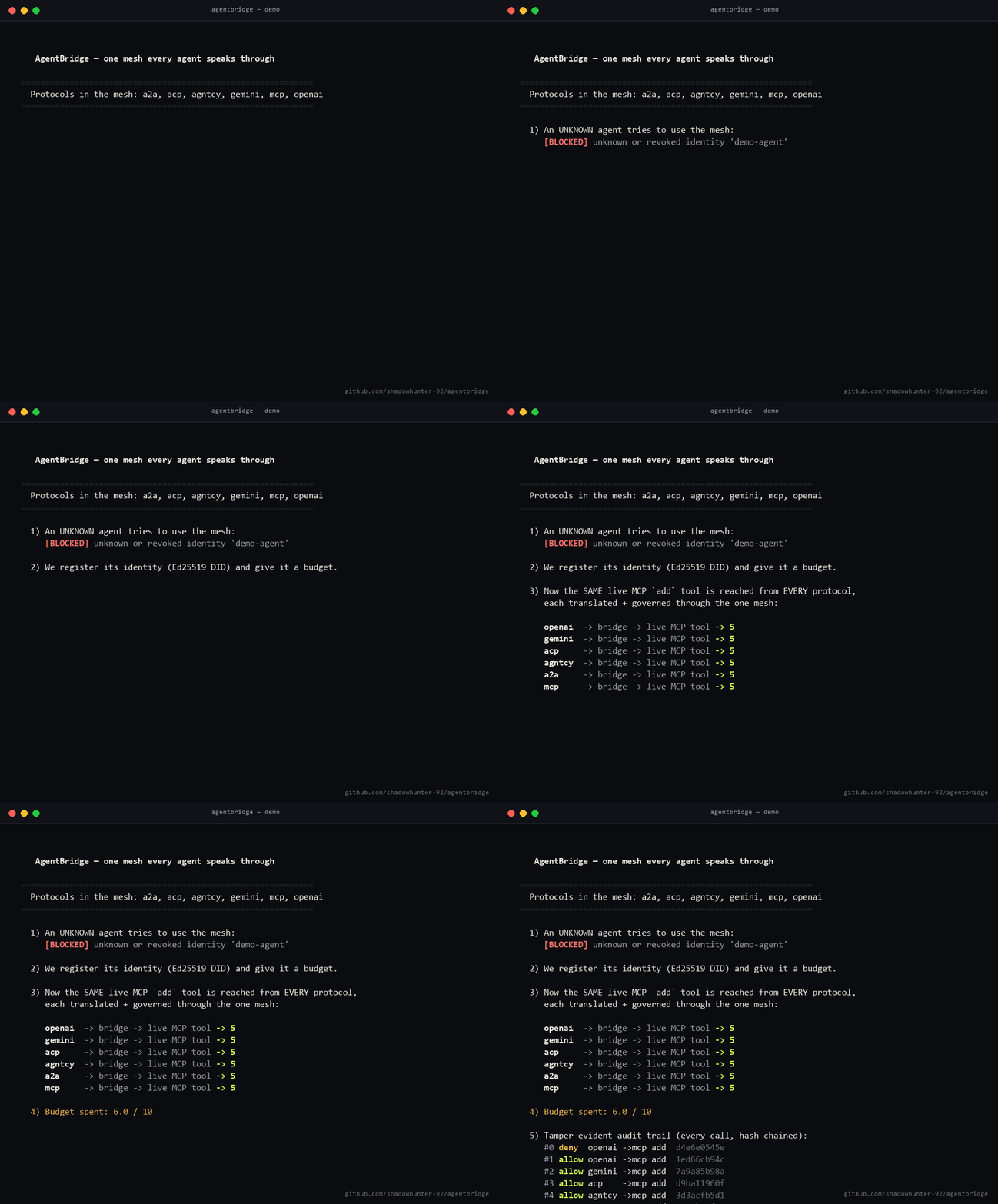
Protocol families: MCP, A2A, BeeAI ACP, OpenAI tool calling, Gemini tool calling and AGNTCY ACP. A 6 × 6 basic call translation matrix does not imply all sessions, streaming, async tasks, extensions or current-version transports are interoperable. See protocol details and the review compatibility contract.
Quick start
Requires Python 3.11 or 3.12. Use a new virtual environment and synthetic or non-sensitive data for the examples.
git clone https://github.com/shadowhunter-92/agentbridge.git
cd agentbridge
# Pin the recorded reviewed main for this basic example:
git checkout --detach b0afb7f1da1634330747389e19c896fd7002bd83
python -m venv .venv

# Activate your virtual environment first:
# macOS/Linux: source .venv/bin/activate
# Windows PowerShell: .venv\Scripts\Activate.ps1

python -m pip install -e ".[mcp]"
python examples/quickstart.py
python examples/demo_story.py
This pins reviewed main, including opt-in tenant governance, queued acceptance,
private preparation, first-admission linkage
and audit payload limits. Use the documented opt-in tenant factory for tenant
features. The private dispatch addition belongs to this later follow-up and
requires its own selected-head evidence. Editable source installation is separate
from the older local evaluator wheel or a signed public release. The CI badge
tracks main; see exact source pins.
To execute the local test suite:
python -m pip install -e ".[test]"
python -m pytest tests/ -q
Some PostgreSQL tests require an explicit disposable test database and are skipped without it. Never point test or recovery drills at production data. Read CONTRIBUTING.md for the development setup.
Translate a tool call
from src.protocols import default_registry
from src.protocols.canonical import CanonicalCall

call = default_registry.get("openai").from_canonical_call(
    CanonicalCall("add", {"a": 2, "b": 3})
)
translated = default_registry.translate_call(call, "openai", "mcp")
print(translated)
This example translates a basic tool-call shape. It does not prove remote execution, authorization or full protocol lifecycle fidelity.
Architecture
flowchart LR
    A["Agent or application"] --> B["Identity / policy / approvals"]
    B --> C["Canonical protocol adapters"]
    C --> D["Approved target / tool"]
    B --> E["Budget + operation state"]
    D --> F["Outcome evidence / reconciliation"]
    E --> F
    F --> G["Audit + independent verification"]
The translation mesh is already useful on its own. The security-critical execution and evidence path is being qualified incrementally. A signed receipt is a statement from its signer, not automatic proof of a remote side effect.
One foundation, four proposed offerings
| Offering | Intended role | Stage |
|---|---|---|
| AgentBridge OSS | Open-source adapters, examples and reusable SDK | Engineering alpha; installable verification SDK |
| AgentBridge Trust | Identity, policy, approvals and safe execution | Engineering and hardening |
| AgentBridge Evidence | Receipts, independent observation and audit verification | Bounded technical demonstrations |
| AgentBridge Enterprise | Managed policies, deployment, support and governance | Commercial hypothesis, not shipped |
These are product directions, not four available paid products. Independent adoption and willingness to pay have not yet been established.
Documentation
| Start here | What it covers |
|---|---|
| Quick API reference | Control plane interfaces |
| Integrations | Framework examples |
| Protocol support | Adapter mapping and limitations |
| Deployment | Developer setup and deployment considerations |
| Roadmap | Scope and known limitations |
| OSS evaluator kit | Pinned synthetic/read-only assessment |
| Production gate register | Review evidence and remaining blockers |
| Security policy | Responsible vulnerability disclosure |
| Contributing | Local setup, PRs, review expectations |
Get involved
We especially welcome feedback from engineers building agents that change external state: payments, procurement, deployments, customer records or other operational systems. What breaks during retries? How do you verify that an action happened? What does your existing gateway already solve?
- Try the basic local examples and pinned synthetic evaluator workflow on
main. - Report a reproducible bug.
- Request a developer evaluation (no credentials, private logs or customer data in public issues).
- Propose an improvement, ideally with a bounded failing test.
Independent evaluations and comparisons are more useful than GitHub-star counts. We have not claimed external integrations or paying customers without verifiable evidence.
Security and license
AgentBridge does not guarantee exactly-once external execution, complete MCP/A2A standards conformance, independent custody of production signing keys, or readiness to run unsupervised high-impact actions. Review SECURITY.md before testing privileged functionality and do not post vulnerabilities or secrets in public issues.
Licensed under the Apache License 2.0. See AI assistance disclosure for development transparency.
This repository is the authoritative source for AgentBridge by
shadowhunter-92; it is not affiliated with unrelated projects using the
same name.
Maintained engineering alpha
The maintained source combines the alpha documentation, R4 implementation and reviewed audit fixes. Readiness depends on checks on the exact selected commit and independent operational acceptance; a source merge does not constitute certification.
See engineering release register, recovery/operator drills, limited protocol contract, release procedure, and external evaluator kit.
Local continuation checks
From the pinned source checkout, run python -m examples.qualify_trust_evidence
for the controller-signed Trust/Evidence workflow. The optional durable task SDK
is documented in task lifecycle.
Run python tools/check_documentation.py to check local Markdown targets.
Current source and branch evidence is indexed in current alpha status; the 88-row handoff register preserves its historical checkpoint.
AgentBridge MCP questions
What protocols does AgentBridge support?
It supports MCP, A2A, BeeAI ACP, OpenAI tool calling, Gemini tool calling, and AGNTCY ACP.
Is AgentBridge ready for production use?
No, it is currently in an engineering alpha stage and is not qualified for production network isolation or high-impact unsupervised actions.
Can AgentBridge translate tool calls between different formats?
Yes, it can perform canonical tool-call translation across several adapter families.
What databases are supported?
The project includes support for SQLite and PostgreSQL.