
okf-cli MCP server
Commit Nov 6, 2026Search, navigate, validate, and refactor Open Knowledge Format (OKF) v0.2 catalogues using hybrid BM25 and semantic search.
Also known as rierek/okf-cli
- Stars
- 0
- Tools
- —
- Downloads, 30 days
- —
- Latest version
- —
- Last commit
- Nov 6, 2026
- License
- Apache-2.0
What is okf-cli MCP?
okf-cli is an MCP server. Search, navigate, validate, and refactor Open Knowledge Format (OKF) v0.2 catalogues using hybrid BM25 and semantic search.
Summary generated from the project's README
About okf-cli MCP server
Managing and navigating large collections of Open Knowledge Format v0.2 markdown bundles is what okf-cli enables for developers and AI agents. This tool provides a way to search, validate, and refactor knowledge catalogues that use YAML frontmatter. It works locally and can be integrated into AI workflows through an MCP server that registers skills with clients like Claude Code, Codex, and Kimi Code.
Users can perform hybrid searches combining local SQLite BM25 with optional semantic search using Voyage embeddings. The server supports safe refactoring through commands like rename and archive, which automatically update inbound and outbound links. It also includes tools to check provenance and freshness using the generated, sources, verified, and stale_after fields. Every mutating command provides a unified diff preview before any changes are applied to the files.
What you can do with it
- 1Hybrid knowledge retrievalPerform ranked searches across a catalogue using both keyword and semantic matching.
- 2Safe link refactoringRename a markdown file while automatically updating all references to it throughout the catalogue.
- 3AI agent onboardingPrepare a fresh AI agent session to interact with an OKF catalogue in a single step.
Written from the project's README. Every use case is checked against a quote from it.
README
View on GitHubokf-cli — CLI and MCP server for Open Knowledge Format (OKF) v0.2 catalogues
Search, navigate, validate and refactor a catalogue of Open Knowledge Format (OKF) v0.2 bundles — markdown files with YAML frontmatter, built for humans and AI agents.
Documentation: https://rierek.github.io/okf-cli/ — install, first steps, features, command reference and agent onboarding.
- Agent-ready.
readreturns one section, or a page together with the pages it links to, in one call; one command registers an MCP server and an agent skill with Claude Code, Codex, opencode, omp, Kimi Code, OpenClaw and Hermes;primeonboards a fresh agent session in one call. - Predictable. Every command answers
--jsonwith one envelope, and every failure has an exit code that names its class. - Hybrid search. Local SQLite FTS5/BM25 plus optional semantic arm (Voyage embeddings), narrowed by one
--wherefilter language. - Safe refactoring.
renameandarchivemove a concept and rewrite every inbound and outbound link. Every mutating command previews a unified diff before--applywrites it. - Trust and freshness. OKF v0.2 provenance (
generated,sources,verified,stale_after) is checked bycheck, recorded byverifyand queried by--where. - Catalogue-aware. Works across many bundles at once, not only one.
Keywords: Open Knowledge Format, OKF v0.2, knowledge base CLI, markdown frontmatter, MCP server, Claude Code, agent memory, Obsidian, BM25, link checker, wikilinks.
Install
brew install okf-cli
Release binaries and a source build: Installation. First steps, command reference and agent onboarding are on the same site.
Versioning: major and minor of okf-cli follow the OKF spec version (spec 0.2, so okf-cli 0.2.x). Only the patch number counts CLI releases.
The Python CLI of the earlier releases is still published as wheel and sdist (pipx install git+https://github.com/rierek/okf-cli, or uv run --script cli/okf-cli.py from a clone; Python 3.11 or newer). It offers the same commands; what differs is listed under Differences from the Python CLI.
Demo
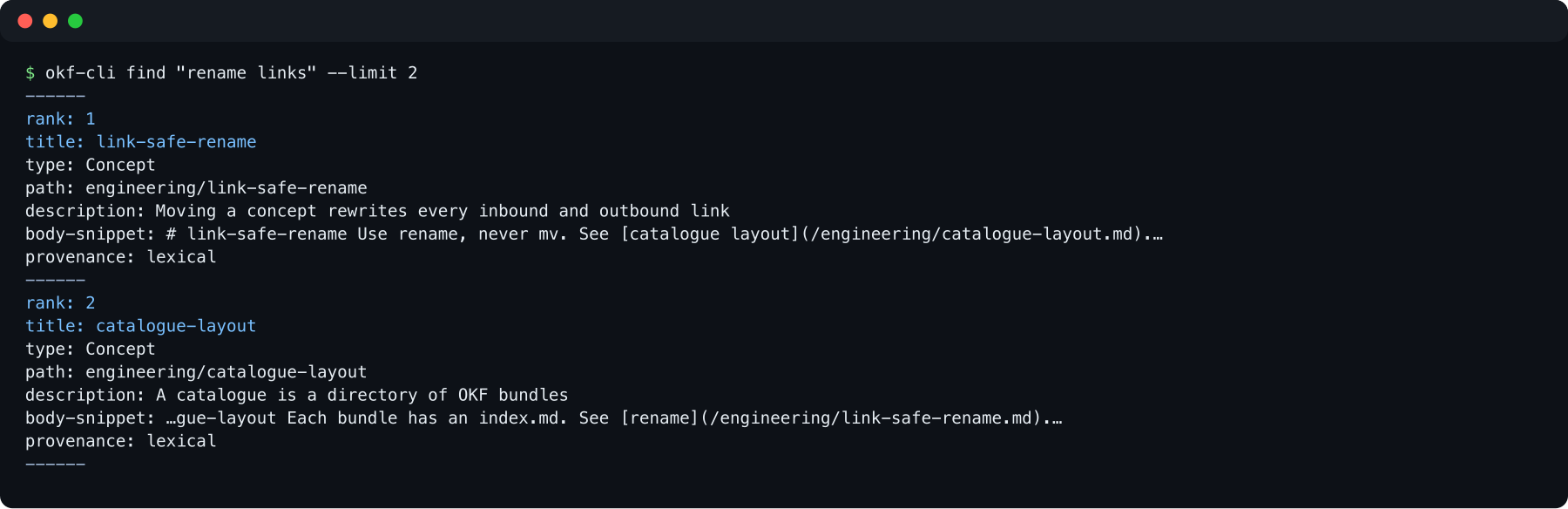
Ranked search over a catalogue:
Link-safe rename (dry-run) shows one unified diff per rewritten file, then the plan:
$ okf rename notes/ref.md notes/reference.md
--- a/_ctx/demo.md
+++ b/_ctx/demo.md
@@ -10,4 +10,4 @@
 | 1 | pflicht | [notes (draft)](/b/notes (draft).md) |  |
 | 2 | pflicht | [intro](/intro.md) |  |
 | 3 | pflicht | [design](/notes/design.md) |  |
-| - | nachschlag | [ref](/notes/ref.md) | nur bei Bedarf |
+| - | nachschlag | [reference](/notes/reference.md) | nur bei Bedarf |
rename from notes/ref.md
rename to notes/reference.md
would move   notes/ref.md  ->  notes/reference.md
  inbound    _ctx/demo.md   /notes/ref.md  ->  /notes/reference.md
  ctx        demo (reference)
  reindex    notes
rename (dry-run): 1 inbound, 0 outbound link(s), 0 wikilink(s) (0 skipped-ambiguous), 1 bundle(s), 0 sync source(s). Re-run with --apply.
How it differs
| okf | single-bundle tools | |
|---|---|---|
| scope | catalogue of many bundles | one bundle |
| dependencies | declared inline (PEP 723), installed by uv run --script |
varies |
| link-safe move/rename | yes | rarely |
| search | BM25 + semantic, local index | varies |
Catalogue-aware fork inspired by Cole Medin's single-bundle okf-cli.py. Related OKF projects: open-knowledge-format (spec), openknowledge-sh/openknowledge, okf-enforcer (Obsidian).
Differences from the Python CLI
As of this release. The behaviour decisions below are still open for the product owner; the evidence is in Known limitations.
Same: the 33 commands, the 14 ctx verbs, their options, the --json envelope, the exit codes, the --where grammar, the output formats and the dry-run defaults. The golden suite of 314 cases runs both CLIs: the Go binary matches the Python CLI byte for byte in 293 cases; the 21 others differ only in the wording of one YAML parse error (see below). --root and --global go before the command in both CLIs (okf --root /path find git).
Different:
- No Python. The binary needs no Python and no
uv;okf findruns with an emptyPATH. Only the MCP server (mcp/okf_mcp.py) still runs throughuv; it now calls the Go binary ($OKF_BIN, else the binary next tomcp/, elseokfonPATH). - Speed. Median over 30 runs, Linux amd64, Knowledge-Catalogue with a 26 MB tag-vector file:
okf --help1.3 ms (Python: 47 ms),okf find git17 ms (Python: 146 ms); peak memory offind55 MiB (Python: 212 MiB). - YAML parse errors read differently.
check, the tag verbs andverifyname the same file under the same rule and exit with the same code, but the parser's own sentence and position differ: Pythonexpected ',' or ']', but got ':' (line 4, column 12), Godid not find expected ',' or ']' (line 3, column 9). - Frontmatter writes keep your formatting. The Python CLI re-serialised the frontmatter it edited; the Go binary patches only the edited lines, so comments, quoting and indentation stay and the diff is minimal.
- Some frontmatter is refused instead of rewritten. When the line patcher cannot patch a shape safely, the command exits 2 with
<path>: <reason>and leaves the file untouched; the Python CLI writes such files. The shapes: a lone CR as line ending inside an LF frontmatter, a flow mapping ornullas the frontmatter root, an anchor, alias or explicit tag on the edited value, a comment inside a multi-line flow list, and a few list layouts (null or folded item, value after the dash, complex key). One refused file ends the whole run ofmerge-tags,remove-tags,normalize-tagsandmigrate(a dry run too), and also actxedit of such a file.verifyandnormalize-tagsstop on a frontmatter key that is not a scalar. - Rare YAML and TOML edge cases are validated differently. The Python parser reads some frontmatter that Go refuses (a
\/escape, odd anchor names, empty keys) and the other way round (impossible dates in a custom key). The report lists them as D-26 to D-30; they are open for the product owner. - Shell completion is answered by the binary itself, without Python or
argcomplete.
The same report has the full list of 77 entries, each with a reproduction line.
Learn more
- Google Cloud blog: How the Open Knowledge Format can improve data sharing — the original announcement
- OKF v0.2 specification and reference repository
- okf.md — community guide: spec walkthrough, FAQ, tools, ecosystem map
- Karpathy's LLM Wiki gist — the idea that inspired much of the ecosystem
Development
just test     # builds the Go binary (`just go-build`, needed by the MCP boundary tests), then unittest discovery over tests/test_*.py
just golden   # golden-output comparison; --update rewrites the goldens, --cmd <binary> checks another implementation
just golden-go          # builds go/bin/okf and runs the golden suite against it (CI runs this on Linux and macOS)
just go-find-smoke      # `okf find` with a PATH that holds no python3 and no uv
just completion-check   # zsh TAB completion end to end in a PTY: Go binary against the Python CLI, throwaway HOME
just brew-local-check   # builds packaging/homebrew/okf-cli.rb from source in a throwaway local tap and runs `brew test`
just install-parity     # `okf install` of the Python CLI and the Go binary side by side in throwaway HOMEs
just build    # wheel and sdist into dist/ (uv build)
just check    # conformance scan against a real catalogue
just prime
just setup    # the okf install plan; add --apply to perform it
just test must be green before anything in cli/, tests/ or mcp/ is committed. Tests never write into a real catalogue. just check and just prime take a catalogue root as argument; their default is a personal catalogue path set at the top of the justfile.
The golden suite (tests/okf_golden.py, driven by tests/test_golden.py inside just test) runs every line of tests/golden/cases.txt against a fresh git copy of the fixture catalogue tests/golden/catalogue/ and compares stdout, stderr, exit code and the changed files with tests/golden/expected/<case>.out. It treats the CLI as a black box, so a port of the CLI passes when just golden --cmd <binary> is green. Two parts are masked: an instant of the current day becomes <NOW>, and a usage error (stderr starting with usage: okf) pins only as <usage error> plus exit code 2, because argparse's wording changes between Python releases; a port must start such stderr with usage: okf. After an intended output change, run just golden --update and review the diff of tests/golden/expected/.
The Go module is go/ (own go.mod, pure Go, no cgo; dependencies in go/go.mod). go/cmd/okf/main.go is the entry point and the one place that wires the commands together. The shared core lives in go/internal/ (okferr exit codes, envelope the --json envelope, catalogue, frontmatter, where the --where grammar, spec, linkscan, history, sqlstore, tagvec, stdio, complete shell completion, cli the command table). Each command area owns one package there with one Register function, for example find, check, ctx, move (rename, archive), indexwrite (reindex), tagwrite, wikisync, install and buildtagvec. yamlpatch is the one writer of frontmatter: it patches the lines of the edited value and keeps everything else byte for byte. Run the Go unit tests with go test ./... in go/; the black-box proof is just golden-go. okf install writes the completion scripts embedded in the binary (go/internal/complete/okf.{zsh,bash,fish}); just go-completion-scripts regenerates them from the Python completion glue.
The Python CLI is still in the repository, and the golden suite runs it as the reference. cli/okf-cli.py is only its entry point: it carries the PEP 723 header, builds the parser, resolves the catalogue root and dispatches. The commands live in the cli/okf/ package; tests live in tests/, and tests/test_okf_cli.py covers the entry itself. The cli/_okf file is the zsh completion glue of the Python CLI; it stays beside the entry payload because packaging and installer tests verify that path.
- Shared foundation:
catalogue(root, bundles, concepts, tags, configuration),linkscan(link and reference scan),parser_support(command registration helpers),errors(the exit-code classes),output(the--jsonenvelope),diffs(unified-diff previews),history(git lookups forrecent,migrateand the drift rule),spec(trust tier and staleness). - Commands, each module defining its
COMMANDS:navigation(list, read, info, toc, visualize, refs),prime,index(index, reindex),ctx,recent,find(withfind_filters, the--wheregrammar),fts(build-index),semantic(build-semantic-index),tags,check(check, fix-crosslinks, fix-xml-tags; the v0.2 rules are inspec_check),verify,migrate,wikilinks,sync,rename(rename, archive, rewrite-path) andinstall. parsermerges theCOMMANDSof every command module into the argparse parser;entry_supportholds the BrokenPipe helper of the entry.
Contributing
See CONTRIBUTING.md. Spec changes go upstream to open-knowledge-format.
License
okf-cli MCP questions
Does it support semantic search?
Yes, it provides hybrid search using local SQLite FTS5/BM25 and an optional semantic arm using Voyage embeddings.
How does it handle renaming files?
The rename command moves a concept and automatically rewrites every inbound and outbound link, providing a unified diff preview before applying changes.
Is it compatible with AI agents?
Yes, it is agent-ready and can register an MCP server and agent skills with clients like Claude Code, Codex, and others.