
Recall MCP server
Commit Nov 9, 2026Provides AI agents with persistent memory and state that survives process crashes and conversation history.
Also known as Polign/recall
- Stars
- 15
- Tools
- —
- Downloads, 30 days
- —
- Latest version
- 0.25.0
- Last commit
- Nov 9, 2026
- License
- Apache-2.0
What is Recall MCP?
Recall provides AI agents with persistent memory and state that survives process crashes and conversation history.
Summary generated from the project's README
About Recall MCP server
Recall provides AI agents with persistent memory and operational state that survives process crashes or machine migrations. It distinguishes between memory, which tracks facts and their historical corrections, and state, which tracks an agent's current progress, plans, and unfinished tool calls. This allows an agent to resume work from its own records rather than relying on a simple snapshot.
Developers can use this as a Go library, a Python client, or a standalone binary. It functions as an MCP server via the command `recall mcp -write` and can be integrated into hosts like Claude Code, Cursor, or VS Code. The system stores data in a database of your choice, including PostgreSQL with pgvector, MongoDB, Qdrant, or a local directory. No initial API keys or models are required to start, though you can configure models like Claude Haiku to automate fact extraction from plain text.
What you can do with it
- 1Resume interrupted agent tasksIf a process is killed mid-task, a new instance can use the recorded working state and tool calls to continue the plan.
Written from the project's README. Every use case is checked against a quote from it.
Configuration
RECALL_BACKEND
| Name | Description | |
|---|---|---|
| RECALL_BACKEND | — |
Automated checks
Ran Nov 13, 2026Full report →Not verified yet. A server needs a score of 80, no serious finding, and enough data for us to check. How checks work

- Source repository linked and reachablepolign/recall is public and reachablegithub.com/polign/recall ↗Pass
- Package names this repository as its sourceNot checked
- Build provenance (Sigstore attestation)Not checked
- Open source license (OSI)Apache-2.0spdx.org/licenses/Apache-2.0.html ↗Pass
- Commit or release in the last yearLast commit or release 2026-11-09github.com/polign/recall ↗Pass
- OpenSSF ScorecardNot checked
- Package name not close to a popular packageNot checked
- No critical advisory in the package or its dependenciesNot checked
- No hidden instructions to the model0 tool descriptions and the README read; no override phrases, credential paths or hidden charactersPass
- Destructive tools are labelledNot checked
- Remote endpoint answers the MCP handshakeNot checked
README
View on GitHubPolign Recall
Recall gives an agent memory and state that survive the conversation and the process. Memory is what the agent knows: facts a user stated, with every correction kept, so the agent can say what it believes now, what it believed before, and why. State is where the agent is: its progress, its notes to its next instance, and the tool calls it had in flight, so a run that crashes or moves machines resumes from its own records.
Recall is a Go library, a recall binary that serves the same operations as
MCP tools and as HTTP, and a Python client. It stores everything in a
database you run: polign_db, PostgreSQL, MongoDB or Qdrant. Apache 2.0.
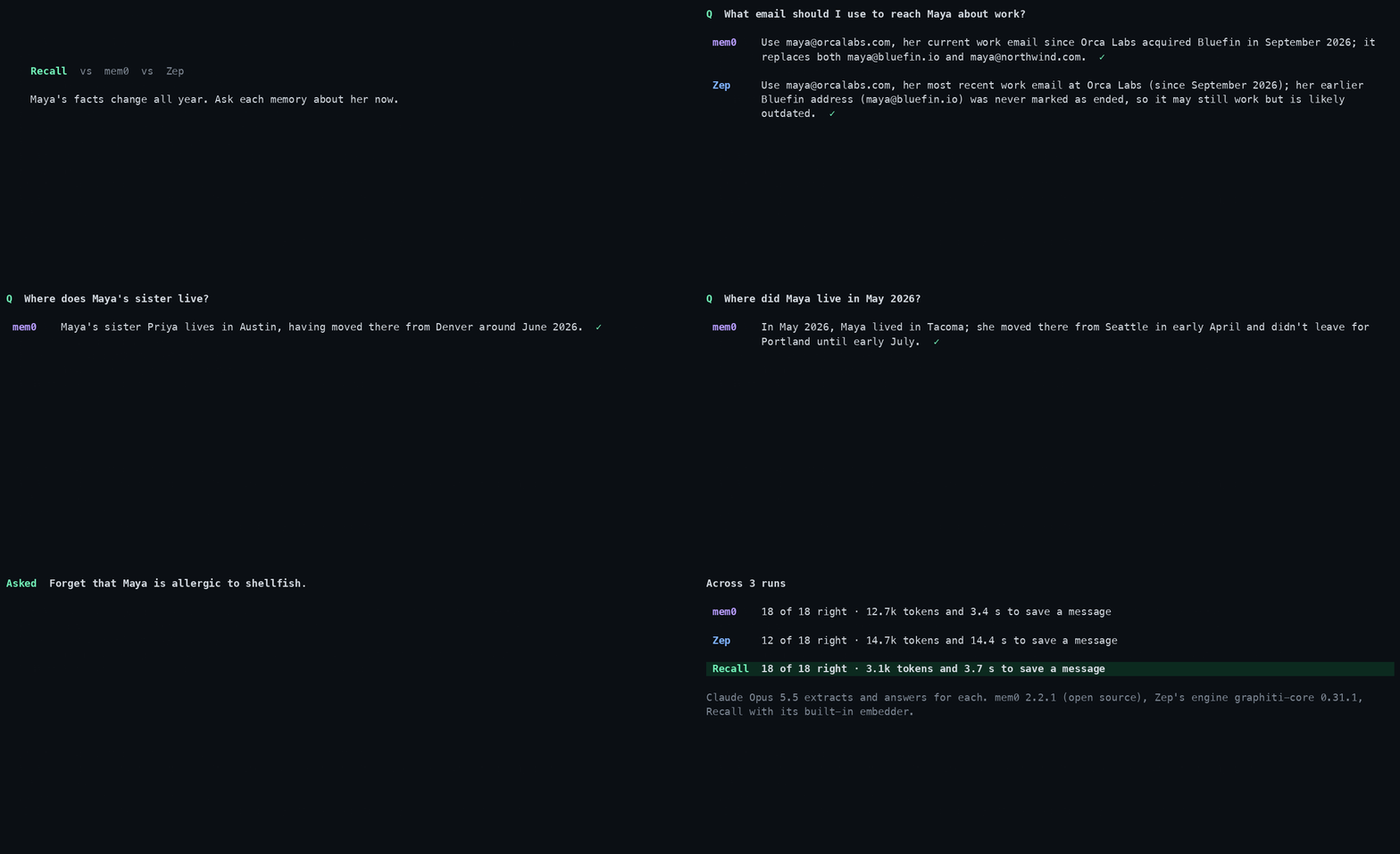
One user over nine months, three homes, three employers, three work emails, six questions, Claude Opus 5.5 extracting, answering and judging for all three systems: Recall 18/18, mem0 18/18, Zep 12/18. Tokens to save one message: Recall 3.0k, mem0 12.7k, Zep 14.7k.
The code to the Recall repository.
Install
pip install polign-recall          # the Python client, the recall binary, and the database it runs
brew install polign/tap/recall     # the same for Homebrew
go install github.com/Polign/recall/cmd/recall@latest   # the binary alone; it fetches the database on first use
Then give it to the agent you use:
claude mcp add recall -- recall mcp -write # Claude Code
Add to Cursor ·
Add to VS Code ·
any other MCP host: command recall, arguments mcp -write (details).
With nothing configured, memory lives in a local database in
~/.local/share/recall, started on first use and shared by every agent on the
machine. No model and no API key are needed to start. To keep memory in a
database you already run, see Backends.
What a correction looks like
Every change is kept. Three commands read the record:
$ recall history "which editor do I use"
user preferred editor
  believed now: user preferred editor: zed
  2026-09-01 10:00  stated, user_stated
      + user preferred editor: vim
  2026-09-20 10:00  replaced, user_stated
      - user preferred editor: vim
      + user preferred editor: emacs
  2026-10-05 10:00  replaced, user_stated
      - user preferred editor: emacs
      + user preferred editor: zed

$ recall ask -as-of 2026-09-25 "which editor do I use"
Believed as of 2026-09-25 00:00:
user preferred editor: emacs  (since 2026-09-20)
  replaced: vim  (since 2026-09-01)

$ recall diff -from 2026-09-15 -to 2026-10-31
Changed between 2026-09-15 00:00 and 2026-10-31 00:00:
- user home city: Lisbon
+ user home city: Porto
- user preferred editor: vim
+ user preferred editor: zed
Why Recall
- Corrections are records, not overwrites. A new value replaces the old one by a rule you can read, and every answer arrives with what it replaced.
- Any moment is readable.
as_of,historyanddiffsay what the agent believed then and when that changed. - Every answer has a source.
recall explainshows the message a fact came from, the rule that decided it, and its history. - Agents resume from records. A crashed or moved agent gets its working state, recent turns and unfinished tool calls back, not a snapshot.
- Your storage, your rules. Memory lives in a database you already run, and the vocabulary of what gets remembered is yours to define or leave open.
Quickstart
Python 3.10 or later. Save a preference, then correct it:
pip install polign-recall
python - <<'PY'
from polign_recall import Client

with Client(local_dir="./recall-data", typed=True) as memory:
    memory.remember("user", "prefers_editor", "vim")
    memory.remember("user", "prefers_editor", "neovim")
PY
A second process reads the current value, the history, and what was believed before the correction:
python - <<'PY'
from polign_recall import Client

with Client(local_dir="./recall-data", typed=True) as memory:
    print(memory.recall("user", "prefers_editor")[0].value)   # neovim

    events = memory.history("user", "prefers_editor")
    print([e.value for e in events])                           # ['vim', 'neovim']

    before = memory.recall("user", "prefers_editor", as_of=events[0].observed_at)
    print(before[0].value)                                      # vim
PY
The first client to open ./recall-data starts a local database for it and
later clients share it; the memories stay there after the program exits. A
bare Client() uses ~/.local/share/recall, the memory every agent on the
machine shares. The Python client guide covers the rest:
plain-text memory with a model, forgetting, history, and resuming an agent.
How memory works
A memory is a subject, a predicate and a typed value: user,
prefers_editor, neovim. Predicates live in a registry that says what type
a value has, whether the predicate holds one value or many, and which
predicates it contradicts: dislikes excludes likes, gave_away excludes
owns. A single-valued predicate replaces its value on a new statement; a
multi-valued one accumulates. Forgetting records a withdrawal; nothing is
deleted. Recall ships starter registries
for coding, personal assistant, support, sales and voice agents, and you can
change a registry later without
touching what was already remembered.
You do not have to define predicates. With an open vocabulary the first use of a predicate defines it, and with a model configured the MCP tools take plain text and no predicates appear anywhere:
recall setup -extract-model anthropic:claude-haiku-4-5-20251001
remember("I switched from helix to zed last week")
recall("which editor do I use?")  ->  "user prefers editor: zed" (before: helix)
forget("my editor")
The model decides how each statement is filed. Once filed, replacement follows
the predicate's rule, every filing is recorded, and a wrong filing is corrected
with one event that every later answer follows. No model reconciles memory on
its own: Recall applies the registry's rules, shows what may conflict, and
lets the agent confirm the rest, so every correction reads back to the rule or
statement that made it. recall mcp -typed serves the typed tools
(remember(subject, predicate, value)) instead. The
developer reference has the details and the
Memory API is the contract.
State
The second half of Recall, with its own contract, docs/state-api-v1.md. An agent writes down where it is as it works, and a new process resumes from those records instead of from a snapshot:
- Working state: goal, plan, progress, focus, decisions, open questions.
- Turns, verbatim, and large tool outputs stored by reference.
- Pointers to where the work lives: a branch, an object key, a process.
- Actions: each tool call that touches the world, recorded before it runs and closed with its result, so a crash between the two is visible and the next resume lists the call as unconfirmed instead of repeating it.
Resume takes a lease on the agent id, so one process acts for an agent at a
time, rebuilds the context within a token budget, and renders it as one
briefing for the model:
agent, err := client.Resume(ctx, recall.ResumeRequest{AgentID: "coder-1", TokenBudget: 8000})
if err != nil {
    return err
}
defer agent.Release(context.Background())

briefing := agent.Resumed().Briefing // hand this to the model
In Python, an agent remembers a fact and records where it is, the process is killed, and a new process resumes from the records:
import os, signal
from polign_recall import Client

with Client(local_dir="./recall-data", agent=True, typed=True) as client:
    client.remember("user", "project_constraint", "deploy only on weekdays after 18:00 UTC")
    with client.resume("coder-1") as agent:
        agent.update_working_state(goal="Move billing to the v2 API",
                                   plan=["find call sites", "migrate them", "run the tests"])
        agent.record_turn("user", "Start with the charge endpoint.")
        agent.milestone("call sites found", progress="12 call sites listed")
        os.kill(os.getpid(), signal.SIGKILL)   # dies here, lease unreleased
import time
from polign_recall import Client

with Client(local_dir="./recall-data", agent=True, typed=True) as client:
    agent = client.resume("coder-1", token_budget=8000, defer_lease=True)
    print(agent.context.briefing)   # at once: the goal, plan, milestone, turn, and constraint
    while not agent.acquire():      # False until the dead process's lease expires
        time.sleep(1)
    agent.record_turn("assistant", "Picking up at the charge endpoint.")
Without defer_lease=True, resume raises lease_held until the crashed
process's lease expires (Python client guide).
The same operations are MCP tools (agent_resume, update_working_state,
record_turn, begin_action, ...) and, on recall serve, HTTP routes at
POST /v1/agent/<verb>. Over HTTP the server holds the lease between
requests: resume returns an epoch and every write carries it, so a stale
process cannot write over its successor. The State API is beta; the records it
writes are stable (STABILITY.md). The
resume example kills an agent mid-task and continues it in
a new process.
Serving many agents
recall mcp is one agent, one process. recall serve is the same memory and
state for many agents over HTTP, each inside the namespace its key names. The
server holds the database credentials; agents hold Recall keys.
recall serve -backend polign -url http://polign:23000 -bootstrap-key-file admin.key
recall key create -backend polign -url http://polign:23000 -namespace acme:agent-7 -expires 168h
Each namespace gets its own collection, so nothing a caller sends can reach
another namespace's records. POST /mcp is MCP over streamable HTTP;
POST /v1/<tool> takes a memory tool's arguments as the body, and
POST /v1/agent/<verb> a state tool's. Any stdio MCP client reaches the
server through recall connect with RECALL_URL and RECALL_API_KEY set.
On Kubernetes a pod needs no key at all. With recall serve -kubernetes, it
posts its projected service account token and gets a short-lived key fixed to
its own agent id, which recall connect and the Python client obtain and
renew by themselves. The Helm chart is charts/recall in
Polign/polign; the
agent-sandbox demo runs it on kind.
On Agent Substrate an actor
needs no key either. With recall serve -substrate-issuer, the actor's egress
policy has Substrate's gateway put a short-lived token for that actor in the
Authorization header, and the server gives each actor its own memory. The
agent-substrate example runs it on kind.
Backends
| local (default) | polign_db | PostgreSQL + pgvector | MongoDB | Qdrant | |
|---|---|---|---|---|---|
RECALL_BACKEND |
local |
polign |
pgvector |
mongodb |
qdrant |
RECALL_BACKEND_URL |
a directory | http://host:23000 |
postgres://user:pw@host/db |
mongodb://user:pw@host/db |
http://host:6333 |
| Memory, history, as-of | yes | yes | yes | yes | yes |
| Keyword search | yes | yes | yes | yes | no |
| Cached reads | yes | yes | yes | yes | no |
| State API (leases) | yes | yes | yes | yes | no |
export RECALL_BACKEND=pgvector RECALL_BACKEND_URL=postgres://user:password@localhost:5432/mydb
recall mcp -write
Three settings name the database for every command: -backend, -url and
-key, or the variables above. Everything else, including what each backend
needs and how to add one, is in docs/backends.md.
Benchmark
LongMemEval user-facts subset, 267 questions about a user's own facts, preferences, updates and dates, with Claude Sonnet 5.5 as reader and judge and the upstream prompts:
| What the reader is given | Score |
|---|---|
| Nothing | 6.0 |
| The full chat history | 88.0 |
| BM25 over sessions, top 10 | 89.9 |
| Recall, built-in word search | 88.8 |
| Recall with a model embedder (OpenAI text-embedding-3-small, 512 dims) | 92.9 |
| Only the sessions that hold the answer | 96.6 |
With word search Recall is even with BM25 overall and behind it on preference
questions (70.0 against 83.3); a model embedder puts it ahead. Recall handed
the reader about 28k tokens per question, against 44k for BM25 and 168k for
the full history. The harness is in eval/longmemeval.
Integrations
| Python | pip install polign-recall, then the client guide. |
| Go | go get github.com/Polign/recall, then the Go library guide. |
| MCP | Connect any agent to remember, recall and forget. |
| Claude Code | The Recall plugin: memory across coding sessions. |
| LangGraph | pip install recall-langgraph to resume LangGraph agents. |
| LiveKit, Vapi | recall-livekit and recall-vapi for caller memory in voice agents. |
| Pydantic AI | pip install recall-pydantic-ai for memory tools in Pydantic AI agents. |
| Vercel AI SDK | The Next.js chat example, one click to deploy. |
| OpenClaw | @polign/openclaw-recall on npm, the OpenClaw plugin. |
Documentation
Developer reference · Memory API contract · State API contract · Backends · Connecting through MCP · Caching memory reads · Exporting and replaying history · What is stable and what is beta · Development guide
Support the project
If Recall kept your agent from acting on a stale fact, a star on this repository helps other people find it. Bugs, questions and ideas go in issues.
License
Recall MCP questions
How does Recall handle corrections to information?
Every change is kept as a record rather than an overwrite, allowing agents to see what was believed before and why it changed.
Can an agent resume its work after a crash?
Yes, Recall stores working state, progress, and unfinished tool calls so an agent can resume from its own records.
What databases can Recall use for storage?
Recall supports local storage, polign_db, PostgreSQL (with pgvector), MongoDB, and Qdrant.
Do I need an API key to start using Recall?
No, you can start without a model or an API key using a local database.