
Urban Game Theory MCP server
Commit Nov 13, 2026Allows an AI client to inspect real land parcels, design urban infrastructure, and compare 2D/3D architectural alternatives.
Also known as Poglavar/consensus-builder, consensus-builder
- Stars
- 1
- Tools
- —
- Downloads, 30 days
- —
- Latest version
- 0.3.0
- Last commit
- Nov 13, 2026
- License
- MIT
What is Urban Game Theory MCP?
Urban Game Theory allows an AI client to inspect real land parcels, design urban infrastructure, and compare 2D/3D architectural alternatives.
Summary generated from the project's README
About Urban Game Theory MCP server
Designing urban infrastructure and inspecting real land parcels is possible through this tool for planners, designers, and agents. Users can select specific locations on a globe to propose buildings, streets, and public spaces on actual land. The platform allows for the creation of various structures including row houses, parks with ponds, and transit stations with editable lane profiles.
Developers and AI agents can interact with the system via an API to manage proposals and explore land readjustment options like new plot boundaries or owner allocations. While drawing and exploring do not require a crypto wallet, the Hyperstition build connects proposals to funding and prediction markets using Solana Devnet. The interface provides 2D and 3D views to compare architectural alternatives and fork counterproposals for community discussion.
What you can do with it
- 1Compare architectural alternativesEvaluate different building footprints and public space designs using 2D and 3D inspections.
- 2Manage land readjustmentPropose new plot boundaries and handle owner allocations or cash balancing.
- 3Coordinate community votingFacilitate owner deals and community voting on shared urban proposals.
Written from the project's README. Every use case is checked against a quote from it.
How to install Urban Game Theory MCP
Formats verified 10 Nov 2026Add to CursorAdd to GooseInstall Urban Game Theory MCP in Claude Code
$ claude mcp add --transport http consensus-builder https://urbangametheory.xyz/mcpInstall Urban Game Theory MCP in Cursor
~/.cursor/mcp.json
{
  "mcpServers": {
    "consensus-builder": {
      "url": "https://urbangametheory.xyz/mcp"
    }
  }
}Install Urban Game Theory MCP in VS Code
.vscode/mcp.json
{
  "servers": {
    "consensus-builder": {
      "type": "http",
      "url": "https://urbangametheory.xyz/mcp"
    }
  }
}Install Urban Game Theory MCP in VS Code CLI
$ code --add-mcp '{"name":"consensus-builder","type":"http","url":"https://urbangametheory.xyz/mcp"}'Install Urban Game Theory MCP in Codex
$ codex mcp add consensus-builder --url https://urbangametheory.xyz/mcpInstall Urban Game Theory MCP in Codex config.toml
~/.codex/config.toml
[mcp_servers.consensus-builder]
url = "https://urbangametheory.xyz/mcp"
Install Urban Game Theory MCP in Gemini CLI
$ gemini mcp add -s user --transport http consensus-builder https://urbangametheory.xyz/mcpInstall Urban Game Theory MCP in Gemini settings.json
~/.gemini/settings.json
{
  "mcpServers": {
    "consensus-builder": {
      "url": "https://urbangametheory.xyz/mcp",
      "type": "http"
    }
  }
}Automated checks
Ran Nov 14, 2026Full report →Not verified yet. A server needs a score of 80, no serious finding, and enough data for us to check. How checks work · What to fix for more points

- Source repository linked and reachablepoglavar/consensus-builder is public and reachablegithub.com/poglavar/consensus-builder ↗Pass
- Package names this repository as its sourceNot checked
- Build provenance (Sigstore attestation)Not checked
- Open source license (OSI)MITspdx.org/licenses/MIT.html ↗Pass
- Commit or release in the last yearLast commit or release 2026-11-13github.com/poglavar/consensus-builder ↗Pass
- OpenSSF ScorecardNot checked
- Package name not close to a popular packageNot checked
- No critical advisory in the package or its dependenciesNot checked
- No hidden instructions to the model0 tool descriptions and the README read; no override phrases, credential paths or hidden charactersPass
- Destructive tools are labelledNot checked
- Remote endpoint answers the MCP handshakeinitialize answered with protocol 2025-06-18 in 698 msPass
README
View on GitHubConsensus Builder · Urban Game Theory
Explore real land. Design a possible future. Build support for it.
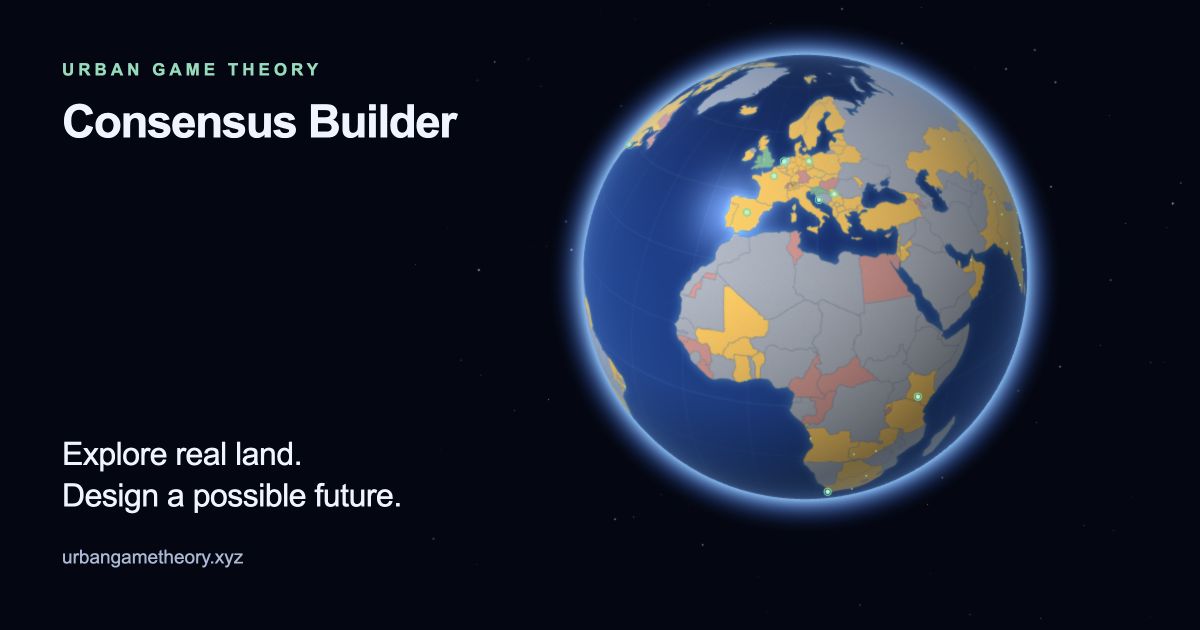
A free browser-based planning tool for people and agents. Start from the globe, choose a place, and design buildings, streets and public spaces on real land. Inspect alternatives in 2D and 3D, share a proposal or a whole plan, and explore how ownership, funding and forecasts shape what happens next.
Open the app · Watch the walkthroughs · Pitch deck · Demo
Try it
- Pick a city on the globe, or explore a place beyond the available parcel coverage.
- Click land and choose Propose here, select several parcels, or draw a site.
- Design the change, finish it, and inspect the result in 3D.
- Compare alternatives, fork a counterproposal, and share the design for discussion.
Drawing and exploring need no crypto wallet. Applying a draft on your map is separate from sharing, owner consent and execution. Coverage and ownership detail depend on the local source; the globe and map show what is available.
What you can make
- Buildings: blocks, row houses, detached houses and editable freeform footprints.
- Public space: parks with planting, paths and ponds; squares with furniture; lakes.
- Transport: roads with editable lane profiles, rail alignments and transit stations.
- Land readjustment: new plot boundaries, owner allocations, shares and cash balancing.
- Alternatives: local drafts, 2D/3D inspection, before/after views, parcel comparisons and forks.
- Coordination: owner deals, owner or community voting, shareable proposals and plans.
The experimental Hyperstition: Markets for Possible Cities build also connects proposals to funding, pledges, prediction markets, public-record evidence and agent APIs. Its public demo uses Solana Devnet. See the protocol and trust assumptions before using those integrations.
Learn more
| For | Start here |
|---|---|
| New users | How to use · Hrvatske upute |
| Designers and workshops | Buildings · Public space · Land readjustment · Roads, rail and stations |
| Reviewers | Views and counterproposals · Roadmap |
| Developers and agents | Documentation index · Local development · API and agent quickstart |
| Protocol contributors | Protocol build · Architecture · Build and verification |
The walkthrough library contains twelve concise narrated demonstrations of the current map workflow, with English captions and transcripts. Written instructions are available in English and Croatian; the app also supports Serbian and Spanish.
Code and contributions
The frontend uses JavaScript, Leaflet and Three.js. The API uses Node.js, Express and PostgreSQL/PostGIS; optional chain integrations live separately under blockchain/.
| Directory | Purpose |
|---|---|
frontend/ |
Globe, maps, proposal tools, 3D views and public guides |
backend/ |
API, shared proposal records, monitoring and agent services |
blockchain/ |
Smart contracts and chain integrations |
restatements/ |
Existing situations and plans restated in the app, with sources |
world-parcels/ |
Parcel-source research and coverage evidence |
Start with the development guide, check test scope, and open a focused issue or pull request with a reproducible example. For a planning workshop, a city integration or a research collaboration, contact the project on Telegram.
Follow @UrbanGameTheory · Telegram community
License
This branch is released under the MIT License. Third-party code, imagery and datasets retain their own licences and attribution requirements.
Urban Game Theory MCP questions
How do I add Urban Game Theory MCP to Claude Code?
Run claude mcp add --transport http consensus-builder https://urbangametheory.xyz/mcp in your terminal. Add --scope user to make it available in every project.
How do I add Urban Game Theory MCP to Cursor?
Open ~/.cursor/mcp.json and add the server under mcpServers, using the Cursor config shown in the install section above.
Do I need a crypto wallet to use the design tools?
No, drawing and exploring the map does not require a crypto wallet.
What kind of urban elements can be designed?
You can design buildings, public spaces like parks and squares, and transport infrastructure including roads and rail.
Can I compare different urban proposals?
Yes, the tool allows you to compare alternatives, fork counterproposals, and view before/after comparisons.