
GABS MCP server
Commit Sep 30, 2026Starts and supervises local game processes, then mirrors each game's bridge tools into MCP so an AI agent can discover and control the running game.
Also known as pardeike/GABS
- Stars
- 37
- Tools
- 10
- Downloads, 30 days
- —
- Latest version
- —
- Last commit
- Sep 30, 2026
- License
- MIT
What is GABS MCP?
GABS starts and supervises local game processes, then mirrors each game's bridge tools into MCP so an AI agent can discover and control the running game. It exposes 10 tools, such as games_list, games_show, games_start.
Summary generated from the project's README
About GABS MCP server
Managing and controlling local game processes through an AI agent is what GABS enables. This configuration-first MCP server allows developers to declare games in a JSON config file and then supervises their lifecycle. Once a game connects via a GABP bridge, the server mirrors those specific game tools into a stable MCP interface, allowing an AI client to discover and execute game-specific commands directly.
Users interact with the system via an MCP server for AI agents or a CLI for manual control. The setup requires a local installation of the GABS binary on Windows, macOS, or Linux. To connect to an AI client like Claude Desktop, you must add the server to your MCP configuration. The server supports various launch modes including direct paths, SteamAppId, and EpicAppId, and it provides tools like games_start, games_stop, and games_call_tool to manage the workload.
What you can do with it
- 1Automated game process managementAn AI agent can start, stop, or force kill a specific game process based on user requests.
- 2Dynamic tool discovery for gamesAn AI client can query the server to find all available game-specific tools once a bridge is active.
- 3Configurable game launch profilesDevelopers can define repeatable launch contexts with specific arguments and environment variables using profiles.
- 4Direct game control via AIAn agent can execute specific in-game actions by calling mirrored tools like inventory management.
Written from the project's README. Every use case is checked against a quote from it.
GABS MCP tools 10
Detected from the READMEgames_listgames_showgames_startgames_stopgames_killgames_statusgames_connectgames_tool_namesgames_tool_detailgames_call_tool
| games_list | — | |
| games_show | — | |
| games_start | — | |
| games_stop | — | |
| games_kill | — | |
| games_status | — | |
| games_connect | — | |
| games_tool_names | — | |
| games_tool_detail | — | |
| games_call_tool | — |
Automated checks
Ran Nov 14, 2026Full report →Not verified yet. A server needs a score of 80, no serious finding, and enough data for us to check. How checks work · What to fix for more points

- Source repository linked and reachablepardeike/gabs is public and reachablegithub.com/pardeike/gabs ↗Pass
- Package names this repository as its sourceNot checked
- Build provenance (Sigstore attestation)Not checked
- Open source license (OSI)MITspdx.org/licenses/MIT.html ↗Pass
- Commit or release in the last yearLast commit or release 2026-09-30github.com/pardeike/gabs ↗Pass
- OpenSSF ScorecardNot checked
- Package name not close to a popular packageNot checked
- No critical advisory in the package or its dependenciesNot checked
- No hidden instructions to the model10 tool descriptions and the README read; no override phrases, credential paths or hidden charactersPass
- Destructive tools are labelledNo tool named like delete, drop or execPass
- Remote endpoint answers the MCP handshakeNot checked
README
View on GitHubGABS - Game Agent Bridge Server
Compatible with GABP v1.1 on wire major gabp/1.
GABS is a configuration-first MCP server that manages local game processes and mirrors each game's GABP bridge tools into a stable MCP surface. You declare your games once in a config file; GABS starts and supervises those processes, and when a game's GABP bridge connects, GABS mirrors that bridge's tools into MCP. An AI agent then discovers and controls a running game entirely through GABS.
If you are installing GABS from a release archive, start with Quick Start below. For the full copy-paste setup guide, read the AI Client Setup Guide.
How GABS works
Each launch resolves along one axis:
stable game identity → optional named profile → optional declared, typed launch inputs
- Games are declared in a config file. GABS re-reads it on the next call —
edits to game entries apply automatically, with no GABS or MCP-client
restart. After an edit,
games_show <id>shows the new profiles, inputs, warnings, or the exact error. Top-level settings (apiKey,toolNormalization,portRanges,timeouts,stripOutputSchema) are read at startup only and still require a GABS restart. - Profiles select a repeatable launch context (args, env, working directory,
lifecycle overrides) without changing the game's identity or transport. A bare
start uses the
defaultProfile. - Launch inputs add bounded, declared per-launch variation: the config
author declares named, typed inputs (
boolean/string/integer), and callers may supply only those. GABS never exposes raw argument/environment passthrough on MCP. - Lifecycle hooks (
status,stop,kill) let you integrate wrapped or containerized process management — GABS runs your commands to observe and control the workload.
Two frontends share one implementation:
- MCP server (
gabs server) — for AI agents. - CLI (
gabs games ...) — for humans and scripts.
The mental model most users need:
- Your AI client starts
gabs server - GABS starts or attaches to your game
- If the game-side bridge speaks GABP, GABS mirrors that bridge's tools into MCP
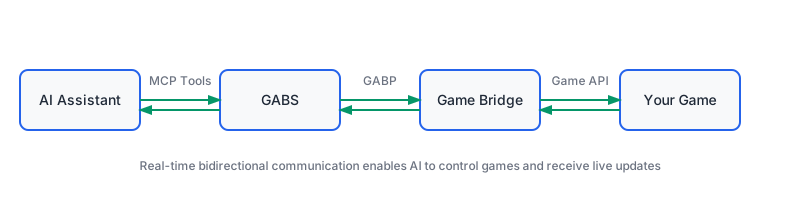
AI Agent ← MCP → GABS ← GABP Client → GABP Server (Game Bridge) ← Game API → Game
In the GABP layer, your game-side bridge is the server and GABS is the client.
Quick Start
1. Download and verify the binary
Download the latest release bundle for your system from GitHub Releases.
Available archives are named like:
- Windows x64:
gabs-<version>-windows-amd64.zip - macOS Apple Silicon:
gabs-<version>-darwin-arm64.zip - macOS Intel:
gabs-<version>-darwin-amd64.zip - Linux x64:
gabs-<version>-linux-amd64.zip - Linux ARM64:
gabs-<version>-linux-arm64.zip
Each archive contains the gabs binary (gabs.exe on Windows), README.md,
the full docs/ folder, example-config.json, and LICENSE.
After unzipping:
Windows
.\gabs.exe version
macOS / Linux
chmod +x gabs
./gabs version
2. Configure a game
Games live in your config file (~/.gabs/config.json by default). You can write
entries by hand or let the interactive setup do it for you:
gabs games add mygame
A minimal entry looks like this — see example-config.json for a fully profiled
game with launch inputs and lifecycle hooks:
{
  "version": "1.0",
  "games": {
    "mygame": {
      "id": "mygame",
      "name": "My Game",
      "launchMode": "DirectPath",
      "target": "/opt/mygame/bin/server",
      "stopProcessName": "server",
      "defaultProfile": "dev",
      "profiles": {
        "dev": { "description": "Fast local iteration" }
      }
    }
  }
}
launchMode may be a direct path, a managed Steam game, an Epic App ID, or a
custom command. For launcher URL modes such as SteamAppId and EpicAppId,
games_stop and games_kill need a way to reach the real game process:
declare stopProcessName, or a game-level status hook plus a stop or
kill hook — either satisfies the requirement. Because game-entry edits apply
automatically, gabs games show mygame always reflects what an edit would
launch.
3. Add GABS to your AI client
Paste one of these into your AI client's MCP config.
Claude Desktop:
{
  "mcpServers": {
    "gabs": {
      "command": "/path/to/gabs",
      "args": ["server"]
    }
  }
}
Codex CLI:
[mcp_servers.gabs]
command = "/absolute/path/to/gabs"
args = ["server"]
Generic MCP client:
{
  "command": "/absolute/path/to/gabs",
  "args": ["server"]
}
If your client uses strict OpenAI-style tool naming, enable toolNormalization
in ~/.gabs/config.json. See
OpenAI Tool Normalization. If your client
disconnects after tools/list because it rejects a public tool's outputSchema
fields, set stripOutputSchema to true (see the
Configuration Guide). If a game or bridge starts slowly,
tune the background connection budget with timeouts.startup; games_start
still returns after a bounded initial wait so MCP clients do not time out while
the game keeps loading.
From a configured game to a tool call
One end-to-end flow, from a declared game to calling a game-specific tool:
1. See what's configured (CLI or the games_list MCP tool):
gabs games list
2. Start the game. From the CLI:
gabs games start mygame --profile dev
Pass --input NAME=VALUE (repeatable) to supply declared launch inputs — see the
fully profiled world input in example-config.json. The CLI verifies the
launch and then exits without holding a bridge connection
(outcome started_attachment_deferred). From an agent session, games_start
starts the game and keeps the bridge attached; if the game was started from the
CLI, an agent picks it up with games_connect.
3. Discover and call the game's mirrored tools (agent / MCP session). Once
the bridge connects, GABS mirrors its GABP tools into strict-safe MCP names.
The public tools/list stays core-only, so discovery goes through the core
surface:
games_connect     {"gameId": "mygame"}
games_tool_names  {"gameId": "mygame", "brief": true}
games_tool_detail {"tool": "mygame_inventory_get"}
games_call_tool   {"tool": "mygame_inventory_get", "arguments": {...}}
Discovery entries contain the callable name, optional tags, and a summary
when brief: true. A single-game response carries gameId once at the top
level; discovery across games includes gameId per entry. Pass name unchanged
to detail or call. See the discovery response contract and migration note
if your client previously read name aliases from the list.
games_tool_names may be empty right after start while the bridge is still
connecting (started_bridge_pending) — retry rather than assuming a tool is
missing.
In an agent chat this is just: "Start mygame, then show me its game-specific tools."
Core MCP tools
Release builds expose strict-safe MCP tool names by default because some clients reject dots in tool names:
games_list- List configured game IDs (with profiles + warning counts)games_show- Show one saved game config, profiles, and launch inputsgames_start- Start a game (profile,launchInputsoptional)games_stop- Stop a game gracefullygames_kill- Force stop a gamegames_status- Check whether a game is runninggames_connect- Reconnect to a running game's bridgegames_tool_names- List mirrored game-specific tools after a bridge connectsgames_tool_detail- Show the schema for one mirrored toolgames_call_tool- Call a connected game tool through the stable core surface
Mirrored game tools are named like mygame_inventory_get (the bridge's
canonical inventory/get in strict-safe form); profile names never appear in
mirrored tool names. Older dotted names such as games.list remain accepted as
call aliases, but tools/list advertises strict-safe names unless you disable
normalization. For the full MCP surface, see the
AI Integration Guide.
Common Setup Notes
- Steam/Epic stopping: use the real game process name, not the launcher name.
- Steam bridge games: prefer
SteamManagedlaunch. It resolves the Steam app manifest to the installed executable, starts Steam if needed, and launches with GABP environment variables. On macOS, GABS first proves that Steam's IPC/global-user interface, the configured app's subscription/install state, and a process-local Steamworks API initialization are ready; a merely running Steam process or connected global user is not enough.store_client_not_readymeans no game process was started: retry the same request after Steam settles (a largertimeoutcan help when the reason isreadiness_timeout). Some managed apps can still relaunch the final process without those variables;games_statusreports that asprocess-bridge-environment-missing. Usegabs games doctor <id>to inspect a config,gabs games repair <id>to convert an olderSteamAppIdlauncher-URL config, andDirectPathorCustomCommandwhen the final process does not inherit the bridge environment. - More than one AI session: that is fine. GABS coordinates ownership per game
with a short active-owner lease.
games_connecttakes over naturally after the previous session goes idle, while active game-bound calls are still protected. - Game bridge cannot find GABP configuration: the game-side bridge should
read
GABP_SERVER_PORT,GABP_TOKEN, andGABS_GAME_IDfrom its process environment. Thebridge.jsonfile is GABS' endpoint cache/debug artifact, not runtime input for game-side bridge code. - Start says the endpoint cache port is already in use: use
games_connectif an existing game-side bridge owns that endpoint. Usegames_startwithresetEndpoint: trueonly after confirming the cache should be rotated. - Confusing bridge state: start with
games_status. Ifdiagnostics.codeisprocess-bridge-environment-missing, the running process is visible but not attachable through the expected GABP environment; adjust the launch mode instead of retryinggames_connect.
Documentation
- AI Client Setup Guide - Install a release bundle and connect Claude Desktop, Codex CLI, or generic MCP clients
- v1.1.0 Release Notes - Upgrade order, compatibility changes, and profile-migration guidance
- Configuration Guide - Config schema, profiles, launch inputs, lifecycle hooks, and tool normalization
- AI Integration Guide - Connect GABS to different AI tools and deployment scenarios
- GABP Bridge Development Guide - Add GABP support to your game integrations
- Advanced Usage Guide - Multiple instances, HTTP mode, scripting, and more
- Deployment Guide - Production deployments and cloud setups
- OpenAI Tool Normalization - Configure tool name compatibility for OpenAI API
- Dynamic Tools Guide - How AI agents handle expanding tool sets
- AI Dynamic Tools FAQ - Common questions about dynamic tool discovery
For Bridge Developers
Want your game to work with GABS? Add GABP support to your game-side bridge:
-
Read GABP configuration from environment variables when your game starts:
GABS_GAME_ID- Your game's identifierGABP_SERVER_PORT- Port your game-side bridge should listen onGABP_TOKEN- Authentication token for GABS connections
The
bridge.jsonfile is GABS' endpoint cache/debug artifact. Do not read it as game-side runtime configuration. -
Start a local GABP server to listen for GABS connections (your game-side bridge = server, GABS = client).
-
Implement the current GABP runtime methods (
session/hello,tools/list,tools/call) or use the officialgabp-runtimelibrary so your schemas match what GABS expects.- For GABP v1.1 bridges, advertise optional attention support through capabilities before exposing
attention/current,attention/ack, and the attention lifecycle channels.
- For GABP v1.1 bridges, advertise optional attention support through capabilities before exposing
-
Expose game features as tools, resources, and events using canonical GABP tool names such as
inventory/getorcore/ping.
See the GABP Bridge Development Guide for complete examples in C#, Java, and Python.
Build from Source
Requirements: Go 1.22+
# Simple build
go build ./cmd/gabs

# Build with version information (recommended)
make build

# Build with custom version
go build -ldflags "-X github.com/pardeike/gabs/internal/version.Version=vX.Y.Z" ./cmd/gabs
Contributing & Support
- Issues & Ideas: GitHub Issues
- GABP Protocol: GABP Repository
- Example Configuration: See
example-config.jsonfor sample configurations
License
MIT License - see LICENSE for details.
GABS makes AI-game interaction simple. Configure once, control naturally.
GABS MCP questions
What tools does GABS MCP provide?
It exposes 10 tools, including games_list, games_show, games_start, games_stop, games_kill.
How does an AI agent control a running game through GABS?
GABS starts or attaches to the configured game, and once the game's GABP bridge connects it mirrors that bridge's tools into a stable MCP surface. The agent then lists and calls those mirrored tools through the core tools.
Do I need to restart GABS after editing a game entry in the config?
No. GABS re-reads the config on the next call, so edits to game entries apply automatically without restarting GABS or the MCP client. Top-level settings still require a restart.
How do I add GABS to Claude Desktop?
Add a gabs entry to mcpServers whose command is the path to the gabs binary and whose args are ["server"].
What launch modes can GABS use to start a game?
launchMode can be a direct path, a managed Steam game, an Epic App ID, or a custom command.
Why is games_tool_names empty right after starting a game?
The bridge may still be connecting, so the list can be empty while the game is in the started_bridge_pending state. Retry rather than assuming a tool is missing.