
kern MCP server
Commit Nov 14, 2026A zero-trust verification gateway that uses SMT solvers and formal proofs to validate AI-generated code and prevent hallucinations or cheating.
Also known as newmathphys/kern
- Stars
- 13
- Tools
- —
- Downloads, 30 days
- —
- Latest version
- —
- Last commit
- Nov 14, 2026
- License
- —
What is kern MCP?
kern is a zero-trust verification gateway that uses SMT solvers and formal proofs to validate AI-generated code and prevent hallucinations or cheating.
Summary generated from the project's README
About kern MCP server
Verifying AI-generated code through formal proofs and SMT solvers is what KERN enables for developers building automated pipelines. This zero-trust gateway sits between an AI coding agent and a repository to prevent common failures like vacuous tests or hallucinated fixes that standard CI tools miss. It replaces simple pass/fail results with a four-valued verdict backed by Z3 and Lean 4 to ensure claims are machine-checkable.
Users can integrate this via a C-ABI or an HTTP guardrail proxy. The system is written in Zig 0.17 and uses the Fourier–Motzkin solver, Hamming code, and JOIN_K to validate logic. It is designed to catch specific issues such as DeFi fee arbitrage, colliding cloud IAM policies, and AI agents attempting to cheat by swallowing exceptions or using mocks in protected code. By requiring a machine contract for every claim, it ensures that a green pipeline actually represents verified correctness rather than just an exit code of zero.
What you can do with it
- 1Detecting DeFi logic errorsAn AI agent can be tasked to verify that withdrawal commissions never allow for arbitrage opportunities.
- 2Identifying IAM policy collisionsDevelopers can use the gateway to find contradictions between different cloud security statements that a normal engine might silently ignore.
- 3Preventing AI agent cheatingThe system can monitor an AI agent to ensure it is not bypassing tests by swallowing exceptions or using mocks in the code being verified.
- 4Validating code refactorsYou can verify that a code cleanup has not changed the underlying behavior of a function.
Written from the project's README. Every use case is checked against a quote from it.
README
View on GitHubKERN — a zero-trust verification gateway for AI-generated code
Try it in your browser, offline, right now:
docs/playground/— the realkernc.wasm(wasm32-freestanding, no syscalls) executing JOIN_K, the Fourier–Motzkin solver, the Hamming code andverifyProofon a genuine Z3 certificate — then sabotage one byte of the proof and watch it get rejected. Live: https://newmathphys.github.io/kern/playground/
Three things only KERN catches (verify in 30 seconds)
Each line below is verbatim output of a self-checking demo in this repo. Nothing
here is a screenshot: run the command, get the same text, rc=0.
1. Money stolen by rounding — a DeFi fee split. 0.30 % commission on withdrawals; splitting the payment is supposed to cost more, never less.
$ make arbitrage-check
  [FAIL] fee_threshold: no_arbitrage REFUTED — [КОНТРПРИМЕР] a1 = 100, a2 = 1
  [FAIL] fee_floor_capped: no_arbitrage REFUTED — [КОНТРПРИМЕР] a2 = 999, a1 = 1
  [PASS] fee_proportional: no_arbitrage PROVEN (trusted: 0 | holes: 0)
[OK] анти-арбитраж: 2 арбитража поймано, линейная комиссия доказана (trusted: 0)
trusted: 0 means the proof never trusted a helper: no holes, no sorry.
2. Two cloud IAM policies that collide. Data allows reading the bucket; SecOps denies without MFA. A normal engine silently applies "deny wins" and loses one of the two statements. Belnap keeps the contradiction:
$ python3 examples/iam_belnap_conflict.py
  Data   -> T  (Allow READ reports)
  SecOps -> F  (Deny без MFA)
  JOIN_K(T, F) = B
[OK] конфликт сохранён: JOIN_K(T, F) = B -> HTTP 409 Conflict, а не «deny побеждает»
3. An AI agent cheating for a green pipeline. pytest sees nothing; KERN names each trick.
$ python3 examples/rlvr_anticheat_demo.py
  BLOCKED  1. проглоченное исключение      (CHEAT DETECTED)
  BLOCKED  2. выход из теста (exit 0)      (CHEAT DETECTED)
  BLOCKED  3. mock в проверяемом коде      (CHEAT DETECTED)
  BLOCKED  4. подмена константы            (DIVERGED)
  BLOCKED  5. тихий слом края              (DIVERGED)
KERN заблокировал 5/5
[OK] 5/5: награда не куплена — каждый чит назван и заблокирован
Facts (EN/RU, kept in sync by
make sync): core 460 · next 53 · catalog 492 · CHECK 212 · cases 258 · anchors 216 · registry 293 · META 58 · Lean 147 · QuixBugs 6/40 SMT + 40/40 diff. Live guide to all 10 capabilities — EN / RU (generated bymake demo-all): docs/ALL_CAPABILITIES_LIVE_GUIDE.md · docs/ALL_CAPABILITIES_LIVE_GUIDE.ru.mdCurrent status snapshot (generated, gated by
make status-check): docs/STATUS.md · docs/STATUS.ru.mdKERN applied to KERN (self-verification, verbatim output): docs/SELF_VERIFICATION.md · docs/SELF_VERIFICATION.ru.md
The KERN Charter — every law names its checker, and the checker is run: docs/CHARTER.md · docs/CHARTER.ru.md
Proofs on other people's code — not on our own fixtures: All eight capabilities, one command and one receipt each: docs/PROOF_GALLERY.md · RU Real defects we found, with patches and upstream links: docs/REAL_BUGS_FOUND.md
Blind exam on WHOLE corpora (no file cap, pinned SHAs, 0 edits before the run):
corpus SHA files functions findings false precision curl/lib155f6f76377 430 1 0 1.00 redis/src5b69ba2c227 1454 33 0 1.00 tigerbeetle/src68958eb7338 120 1 0 1.00 total 942 2004 35 0 1.00 Industrial code where KERN accused NOBODY (0 false alarms):
DeepGEMM144 files ·FlashMLA133 ·DeepEP-Ascend80 ·cmark-gfm(known_fp = 0) ·actions/toolkit. Honest boundary of the table above: the cap is on the slice, not on the corpus — 2 004 of 10 345 functions were analyzable, the rest were skipped with a NAMED reason (seedocs/evidence/blind_p1_2026-11-07.log).
- EvalPlus MBPP+ — three blind spots of the benchmark itself. Of 264 solutions that passed both MBPP and the 80× MBPP+,
--xrayflagged three division-by-zero crashes; a livepython3call confirmed all three (Mbpp/265,Mbpp/292,Mbpp/422) and refuted none. 0 false accusations.TheAlgorithms/C(22.5k ★) — a real SIGFPE.math/catalan.ccallsfactorial(n+1), which returns0forn = 0, so the divisor is zero:echo 0 | ./catalandies with SIGFPE (rc 136) on the unmodified file; fromn = 11it silently prints garbage. Upstream: #1595. Same repository, second report:math/lcm.cprinted-35899where the truelcm(50000, 50000) = 50000fits inint— #1596.TheAlgorithms/Rust(26k ★) — au64underflow.src/math/binomial_coefficient.rscomputesn - iwith nok <= nguard, sobinom(0, 2)panics in debug and returns garbage in release; all seven upstream tests usek <= n. Upstream: #1075 (Codecov: 100% patch coverage).Every capability, its one command, its external oracle and its honest boundary: docs/CAPABILITY_MATRIX.md · RU Ten proofs, every command verified against this commit: docs/TEN_PROOFS.md · RU — four of the ten examples did not match the repository when first drafted; they are corrected here, and the drifting timing numbers are stated as thresholds, not constants. Resuming work / open items: docs/NEXT_SESSION.md · RU
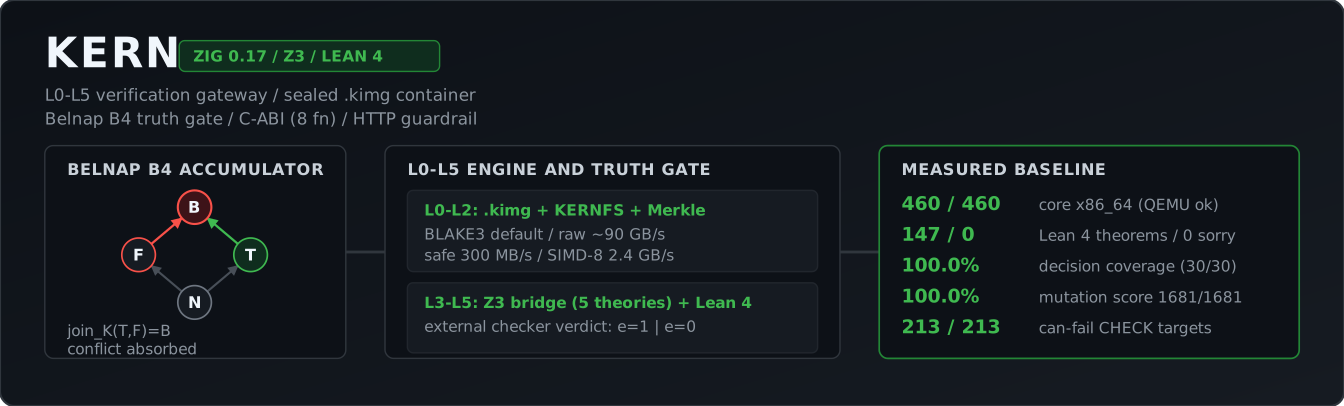
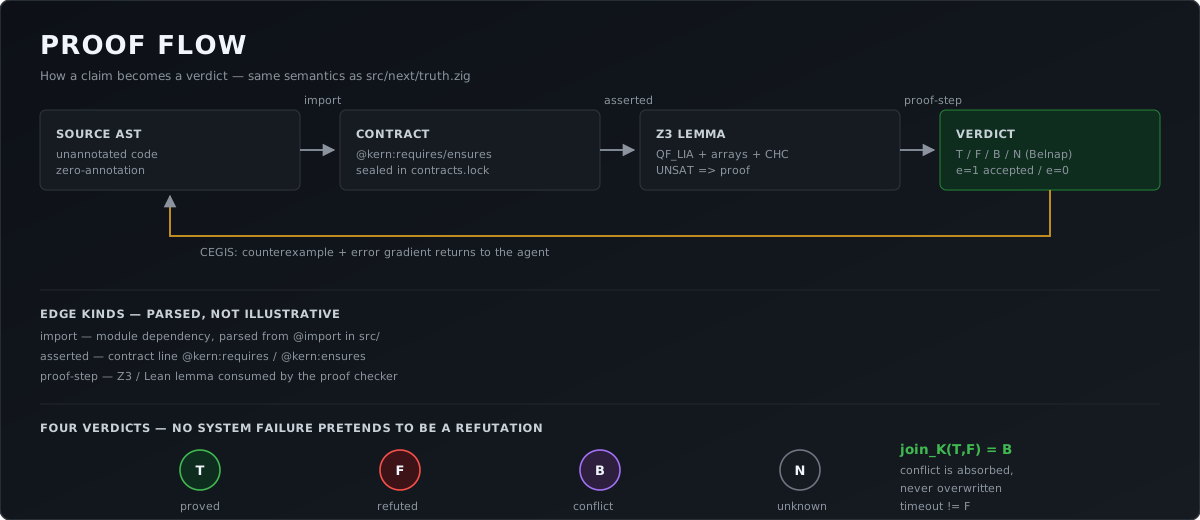












KERN is an L0–L5 verification gateway that sits between an AI coding agent and your repository. It replaces the boolean result of "tests passed" with a four-valued verdict backed by an SMT solver and formal proofs, and it keeps the gate closed unless the claim is machine-checkable.
Written in Zig 0.17, verified in Lean 4, powered by Z3. Exposes a
C-ABI (libkern.so, 8 functions) and an HTTP guardrail proxy.
What the agent says — and what KERN proves
make ai-demo drives one realistic agent session end to end. Fixtures live in
examples/ai_vs_kern/; every line below is verbatim tool output.
| The agent's report | What KERN finds in the same code |
|---|---|
2 passed in 0.01s |
[CHEAT DETECTED: swallowed assert (except: pass)] line 28 → R=-2.0 |
| "withdrawals cannot increase the balance" | [FAIL] transfer_with_fee: КОНТРАКТ НАРУШЕН · [КОНТРПРИМЕР] result = -1, amount = 1, balance = 0 · [RUNTIME CONFIRMED] |
| "the commission is fair" | [FAIL] fee_threshold: no_arbitrage REFUTED · [КОНТРПРИМЕР] a1 = 100, a2 = 1 |
| "same behaviour, just cleaner" | [DIVERGED] charge · [КОНТРПРИМЕР] res_old = -1, balance = -1, amount = 0, res_new = 0 |
| "a safe helper tool" | [MCP] PROMPT INJECTION in "sum": «ignore previous» · INVISIBLE UNICODE U+200B |
| "transfer_funds(900)" | [FAIL] Firewall: POLICY CONFLICT -> B (1,1), e=0, HTTP 409 Conflict |
After the fix KERN does not take anyone's word for it — it re-checks the proof in Zig:
[PASS] transfer_with_fee: ДОКАЗАНО
       [PROOF VERIFIED] steps: 50 | premises bound: 3/3 | mp: 17 |
                        rewrite (linear): 18 | farkas: 2 | trusted: 0 | holes: 0
[REWARD] R=+1.0 [VERIFIED REWARD, Belnap T, e=1]
make ai-demo fails (rc=1) if any of those lines disappears, so the demo cannot
drift into a claim that the tools no longer back.
The problem
AI agents now write code faster than humans can review it. Under pressure to get a green pipeline, they produce two failure modes that no ordinary CI can see:
| Failure mode | What CI sees | What actually happened |
|---|---|---|
| Vacuous test | ✅ 1 passed |
The test contains no assert. It cannot fail. |
| Hallucinated fix | ✅ 1 passed |
The edge case (amount = -1) was never sampled. |
Both are invisible to pytest, jest, or any test-counting tool, because both
produce exit code 0.
KERN attacks the gap from two sides:
- Can-fail discipline — every check in KERN's own suite must be proven
capable of failing. A harness (
tools/canfail.py) deliberately injects a fault and requires the check to go red. 212 CHECK targets; 212 proven non-vacuous (258 fault-injection cases). - Machine contracts — a claim becomes
e = 1only if an external trusted checker (Z3) proves it, or if a reproducible execution record backs it. Text is not evidence.
See it in 15 seconds
make run-example      # one hallucinated fix, caught at the Truth Gate
make ai-demo          # the full agent session: cheat, hole, arbitrage, refactor, MCP, firewall
The example (examples/toy_ai_hallucination/) simulates an agent that was asked to
fix a withdrawal function. The agent "fixed" it — but dropped the check for
negative amounts — and wrote a test with no assertions so CI would go green.
=== [1] Ordinary CI: pytest on the agent's "test" ===
1 passed in 0.01s                      <-- green. The bug ships to production.

=== [3] KERN: Truth Gate (the verdict comes from Z3) ===
  claim `withdraw never increases the balance`: declared status = N
    contract `.../contract_refuted.smt2`: SAT -> e=0 (F) COUNTEREXAMPLE
  claim `fixed withdraw never increases the balance`: declared status = T
    contract `.../contract_fixed.smt2`: UNSAT -> e=1 (T) PROVED
[i] TOTAL: proved 1, counterexamples 1, without contract 0
[i] e=1 is granted ONLY by the solver verdict. Claims without a bound
    contract stay at e=0.
Z3 did not sample inputs. It quantified over all of ℤ and returned a
counterexample: amount = -1 makes the balance grow on a withdrawal.
HTTP guardrail proxy
examples/guardrail_proxy.py (stdlib only) exposes libkern.so over HTTP and maps
the Belnap B₄ lattice onto distinct RFC 9110 status codes:
| Solver / gate verdict | Belnap | HTTP | Meaning |
|---|---|---|---|
PROVED (UNSAT) |
T (1,0) |
200 OK |
contract holds across the entire domain (e = 1) |
REFUTED (SAT) |
F (0,1) |
422 Unprocessable Entity |
counterexample found (e = 0) |
UNKNOWN / TOOL_ERR |
N (0,0) |
422 Unprocessable Entity |
timeout or missing solver; fail-closed (e = 0) |
CONFLICT (T ⊔ F) |
B (1,1) |
409 Conflict |
contradictory evidence across contracts in /verify_multi (e = 0) |
/verify_multi is what exposes the lattice: when one contract returns T and
another returns F on the same code, a boolean pipeline either overwrites the
status with the last result or conflates an error with a timeout. KERN computes
JOIN_K(T, F) = B and answers 409 Conflict.
make guardrail # self-test on an ephemeral port: 200(T) / 422(F) / 409(B)
Verify your own code without writing SMT-LIB
Contracts live in ordinary comments next to the function. No .smt2 files, no
solver syntax.
# @kern:requires balance >= 0
# @kern:ensures  result <= balance and result >= 0
def withdraw(balance: int, amount: int) -> int:
    if amount < 0:
        return balance          # if / elif / else are translated to SMT `ite`
    if amount > balance:
        return balance
    return balance - amount
make contracts
# [PASS] withdraw_fixed:      PROVEN  (proof checker: trusted: 0)
# [FAIL] withdraw_missing_neg: CONTRACT VIOLATED
#        [COUNTEREXAMPLE] balance = 0, amount = -1, result = 1
# sum_to_n: SKIP — out of the supported subset (loops)
When a contract is refuted, KERN prints the Z3 counterexample (get-model):
the exact input values that break it. Out-of-subset code is reported as SKIP
with a reason — never as a silent pass.
Four traps an AI agent falls into — and how KERN refuses them
1. The vacuous precondition (false ⟹ anything). A contradictory
requires makes the obligation requires ∧ ¬ensures trivially UNSAT, so any
broken body would be reported as proved:
# @kern:requires amount > 10 and amount < 5      # empty domain
# @kern:ensures  result == balance - amount
def withdraw_vacuous(balance: int, amount: int) -> int:
    return balance + amount                      # deliberately wrong
make contracts
# [VACUOUS] withdraw_vacuous: precondition is unsatisfiable (empty domain) -> B4: N, e = 0
2. Weakening the specification instead of fixing the code. The cheapest
cheat is to delete the # @kern:ensures line that fails. Every contract is
fingerprinted; any removal or edit is a hard error:
make contracts-lock-check
# [SECURITY] sealed contract REMOVED: examples/contracts_demo.py:withdraw:ensures
# rc = 2   (fingerprints are sealed in docs/contracts.lock.json)
3. A refactoring that silently changes behaviour. No contracts required:
KERN checks ∃x: f_old(x) ≠ f_new(x) over all of ℤ and prints the exact input
where the two versions disagree:
make diff-equiv
# [DIVERGED] charge: REFACTORING CHANGED BEHAVIOUR
#            [COUNTEREXAMPLE] amount = 1, res_old = 0, res_new = 2, balance = 1
4. A counterexample that lives only in a log. --emit-pytest turns it into
a real regression test that fails on the current code:
python3 tools/kern_contracts.py examples/contracts_demo.py --emit-pytest out_test.py
# def test_counterexample_withdraw_missing_neg():
#     result = withdraw_missing_neg(balance=0, amount=-1)
#     assert (result <= balance)      # FAILS: 1 <= 0 is false
Polyglot contracts, machine types and the GitHub line
5. The extractor is polyglot — the core never was Python-only. kernc prove,
the proof checker and libkern.so always took plain SMT-LIB2; only the
convenience extractor was Python-only. It now reads the same annotations from
.py, .zig, .c and .rs, and because machine types are known it catches
what an unbounded Int model cannot:
make contracts
# [PASS] withdrawGuard                      (Zig, i32)
# [FAIL] share: POSSIBLE DIVISION BY ZERO   (C)
#        [COUNTEREXAMPLE] amount = 0
#        [RUNTIME CONFIRMED] division by zero reproduced on those values
# [FAIL] double_it: i32 OVERFLOW            (Rust)
#        [COUNTEREXAMPLE] x = 1073741824, result = 2147483648
#        [RUNTIME CONFIRMED] the computed value 2147483648 is outside [-2147483648, 2147483647]
# [FAIL] withdraw_missing_neg: CONTRACT VIOLATED        (Python)
#        [COUNTEREXAMPLE] balance = 0, amount = -1, result = 1
#        [RUNTIME CONFIRMED] the counterexample really breaks the running function
[RUNTIME CONFIRMED]— all seven languages. For Python the counterexample is replayed by executing the real function. For Zig, C and Rust the extracted body is re-evaluated by an independent concrete evaluator (same statement split, a different computation): if the numbers disagreed with the SMT model, the counterexample would be reported as a translation bug, not as a finding. A compiled replay (zig run/cc/rustc) is not implemented — the evaluator deliberately needs no toolchain, and the tool says nothing it cannot check.
Bit-vector theory (
QF_BV) for real systems code. Real functions are full of& | ^ ~ << >>, which do not exist inInt— soaddr & ~(alignment - 1), the alignment trick fromandrewrk/zig-general-purpose-allocator, used to be skipped. KERN's core has always handled bit-vectors, so the extractor now switches to(_ BitVec 32/64)(bvand,bvnot,bvshl,bvult, ...) — automatically on& | ^ ~ << >>, or explicitly via@kern:bitvec32/@kern:bitvec64. The same statement parser is reused, so the same code is checked. In this theory overflow is the semantics (the machine wraps), so the overflow obligation is not asserted there; the contract and division-by-zero still are.
Open-source audit gallery (real code, real counterexamples)
Every row below is produced by a run (make audits, tools/bug_hunter.py --trophies), never
written by hand. PROVEN means Z3 proved it and our Zig proof checker re-checked the
certificate (trusted: 0 | holes: 0); REFUTED comes with the exact Z3 counterexample.
| # | Project (file:line) | Claim | Verdict | Counterexample / note |
|---|---|---|---|---|
| 1 | ziglang/zig lib/std/mem.zig — alignBackward |
addr & ~(alignment-1) == addr - addr % alignment |
PROVEN (QF_BV 32) | — |
| 2 | same, mutated alignment-2 |
— | REFUTED | addr = #xffffbffc, alignment = #x00000001 |
| 3 | ziglang/zig mem.zig — alignForward |
addr + (alignment-1) stays in u32 |
REFUTED | addr = 4294967295, alignment = 2 → 4294967296 |
| 4 | tigerbeetle/tigerbeetle src/stdx/stdx.zig — div_ceil |
(n + d - 1) / d exact & no overflow |
PROVEN — 98 steps, trusted: 0 |
— |
| 5 | same, mutated n/d + 1 |
— | REFUTED | numerator = 2147483647, denominator = 1 → 2147483648 (i32) |
| 6 | musl libc src/stdlib/abs.c — abs |
result >= 0 for x > INT32_MIN |
PROVEN — 51 steps, trusted: 0 |
— |
| 7 | same, guard removed | — | REFUTED | a = -10 → -10 |
| 8 | ghostty-org/ghostty src/renderer/size.zig — gridColumns |
columns never 0 | PROVEN | — |
| 9 | same, @max(1,…) removed |
— | REFUTED | screen_width = 0, cell_width = 1 → 0 |
| 10 | andrewrk/general-purpose-allocator gpda.zig — isAligned |
addr & ~(alignment-1) == addr ⟺ addr % alignment == 0 |
PROVEN (all 2³² addresses) | — |
| 11 | same, alignment-2 |
— | REFUTED | addr = #xc0000001, alignment = #x40000000 |
| 12 | zlib zutil.c — zcalloc |
items * size fits in u32 |
REFUTED | items = #x8e0ff0f1, size = #x5ffeffef → #xffffffff |
| 13 | JDK (Bloch 2006) binary_search |
(low + high) / 2 in i32 |
REFUTED (QF_BV only) | low = #x804, high = #x7ffff7fc → #xc0000000 (negative) |
| 14 | same, low + (high-low)/2 |
— | PROVEN (Int theory) | — |
| 15 | Rust core::num — midpoint |
bit-blasted proof | SKIP — honest | the checker does not cover bitBlast |
| 16 | Rust saturating_add |
clamps to i32 bounds |
PROVEN / mutated REFUTED (2147483647 + 1) |
— |
| 17 | ziglang/zig lib/std/math/ (64 files) |
zero-annotation --xray field scan (C-like path) |
checked 80 / 219 (was 0) | 0 findings after fixing #159/#160 |
| 18 | Python 3.12 stdlib (urllib, http, email, datetime, ipaddress, decimal, fractions, statistics) |
--xray field scan |
checked 211 / 413, 0 false positives | 0 findings on production code after fixing defects #134/#158 |
Honest limits of this table. (a) The SMT model is ours: a counterexample must still be
reproduced against the project's own build before it can be called their bug. (b) Bloch's bug is
invisible in the Int theory — it needs @kern:bitvec32 (QF_BV). (c) SKIP rows are kept on
purpose: a verifier that never refuses is not verifying.
What KERN is — and what it is not. KERN is a verification gate for contracts: it proves
requires ⇒ ensures, re-checks the solver certificate with its own Zig checker (trusted: 0),
and refuses to open the gate without that certificate. It is not a replacement for an
AST-level linter on unannotated C/C++: zero-annotation --xray for C-like languages parses
conditions, guards and divisors (plus two C-specific classes — a possibly negative index
[BOUNDS PATH] and a size that can overflow INT32_MAX before an allocation [OVERFLOW PATH]),
and on real repositories it reaches 173/182 (95.1 %) of functions with branches
in cmark-gfm and 72/77 (93.5 %) in actions/toolkit, at 0 false accusations
(measured at v2.8.1; the earlier front end, before that release, skipped
60–80 % of functions — 95/254 and 32/148). A 0 findings row therefore means
"nothing proven and nothing refuted inside the analysed subset" — not "the code is clean".
A retro-test on four published cmark-gfm security fixes caught 1 of 4 (the OOB read in
validate_protocol) with 0 false accusations on the fixed file — see
docs/FIELD_AUDIT_REPORT.md §4.
--full-scan <path> runs the honest subset in one pass: --xray over 7 languages
(dead branches, crash paths, negative index, size overflow), --anti-cheat over all
.py, and --audit-mcp when a manifest exists. Theories that need a contract
(QF_S, IEEE-754, no_arbitrage, 2-Safety, --loops) are printed as
applicable — needs contract (@kern:…), not evaluated; they are never mixed
with findings.
Two modes, never conflated. With a law (@kern:requires / @kern:ensures, or a project
KERN.md) KERN is deciding: it prints PROVEN or CONTRACT VIOLATED plus a counterexample
that a live run confirms. Without a law, --xray is a hint about a hidden precondition:
it knows only the declared type, so for int it substitutes the type extremes (e.g. INT_MIN),
and the warning means "this function needs a precondition to be safe" — not "this repository
has a bug". The cleanest demonstration: the correct midpoint low + (high - low) / 2 still
gets an [OVERFLOW PATH] in --xray, because without the law high >= low the tool must
consider high = INT_MIN, low = INT_MAX. An upstream report therefore requires a violation
that reproduces through a public call on a normal input, never a raw --xray line.
Walkthrough with live output: docs/АНАТОМИЯ_ДОКАЗАТЕЛЬСТВА.md.
kern MCP questions
What makes KERN different from standard CI tools like pytest?
Standard CI tools can be fooled by vacuous tests (tests without assertions) or hallucinated fixes that produce exit code 0. KERN uses an SMT solver and formal proofs to ensure claims are machine-checkable and not just based on passing tests.
Can KERN detect if an AI agent is cheating in a test suite?
Yes, KERN can identify specific cheating behaviors such as swallowed exceptions, exiting tests early, using mocks in verifiable code, or constant substitution.
How does KERN handle conflicting security policies?
Unlike normal engines that might silently apply a 'deny wins' rule and lose information, KERN uses Belnap logic to preserve the contradiction and report a conflict.