
PredictorLab MCP server
Commit Nov 4, 2026A self-hosted tabular machine learning platform that provides leakage detection, conformal intervals, and profit-optimized decision thresholds.
Also known as MarkIvor/predictorlab
- Stars
- 8
- Tools
- —
- Downloads, 30 days
- —
- Latest version
- —
- Last commit
- Nov 4, 2026
- License
- MIT
What is PredictorLab MCP?
PredictorLab is a self-hosted tabular machine learning platform that provides leakage detection, conformal intervals, and profit-optimized decision thresholds.
Summary generated from the project's README
About PredictorLab MCP server
Analysts and product managers who need machine learning without a dedicated data science team can use PredictorLab to build honest, actionable models. This self-hosted platform handles the complex parts of the machine learning pipeline, such as detecting target leakage, performing automatic out-of-time splits, and calibrating probabilities. It is designed to be deployed via Docker, ensuring that sensitive data remains on the user's own server rather than a third-party SaaS.
Users provide a dataset in CSV, XLSX, or Parquet format along with business costs to transform raw probabilities into profit-maximizing decisions. The system uses tools like CatBoost and LightGBM to train models and provides conformal intervals to guarantee prediction coverage. Through the MCP server, developers can programmatically access tools for prediction, explanation, counterfactual analysis, and model card generation. This allows for a complete workflow from data upload to a live REST API or web-based prediction form.
What you can do with it
- 1Detect and fix data leakageIdentify columns that contain information from the future to prevent inflated accuracy scores.
- 2Deploy models via APIIntegrate trained models into existing software using a REST API or an MCP server.
Written from the project's README. Every use case is checked against a quote from it.
Automated checks
Ran Nov 14, 2026Full report →Not verified yet. A server needs a score of 80, no serious finding, and enough data for us to check. How checks work · What to fix for more points

- Source repository linked and reachablemarkivor/predictorlab is public and reachablegithub.com/markivor/predictorlab ↗Pass
- Package names this repository as its sourceNot checked
- Build provenance (Sigstore attestation)Not checked
- Open source license (OSI)MITspdx.org/licenses/MIT.html ↗Pass
- Commit or release in the last yearLast commit or release 2026-11-04github.com/markivor/predictorlab ↗Pass
- OpenSSF ScorecardNot checked
- Package name not close to a popular packageNot checked
- No critical advisory in the package or its dependenciesNot checked
- No hidden instructions to the model0 tool descriptions and the README read; no override phrases, credential paths or hidden charactersPass
- Destructive tools are labelledNot checked
- Remote endpoint answers the MCP handshakeNot checked
README
View on GitHubPredictorLab
English | Русский









Upload your data. Say what you want to predict. Get an honest model with a confidence interval, a profit-optimized threshold, and a REST API — in 5 minutes.
PredictorLab is self-hosted tabular ML for analysts who need ML but don't have a DS team. You know your data, you know your business costs — PredictorLab handles the ML: catches leakage, splits correctly, calibrates probabilities, and converts them into decisions in rubles.
Spoiler: the model that shows 99% accuracy on your first upload is almost certainly broken. This tool will tell you exactly why — and fix it for you.
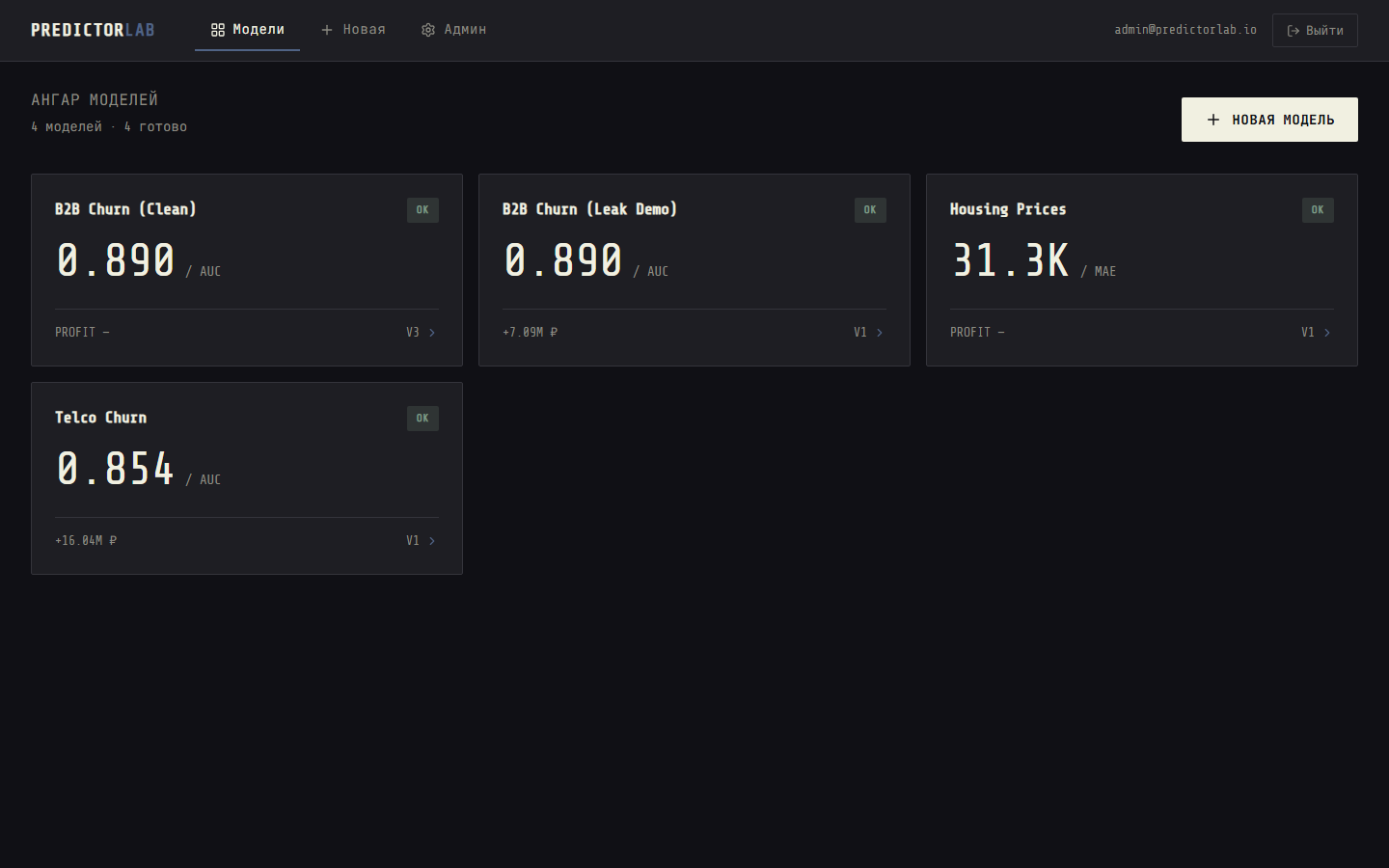
Who this is for
| You are | You have | PredictorLab gives you |
|---|---|---|
| Analyst / product manager | A CSV with historical outcomes, business intuition about costs | A working ML model without learning scikit-learn. The tool asks the right questions (What's a false negative worth? Which features can you actually change?) and turns answers into a decision system |
| Consultant / data engineer | Clients with data, no time to hand-hold | A self-hosted tool you can deploy for a client in 5 minutes, share a prediction form, and hand over an API. No SaaS dependency, no data leaving the client's server |
| Solo DS practitioner | ML knowledge, but no time to build the full pipeline | The boring parts are done: out-of-time splits, conformal intervals, calibration, monitoring, versioning. You focus on features and business logic |
What you need: a dataset with a labeled outcome column, and rough numbers for what a correct prediction earns vs what a wrong one costs. That's it.
What you don't need: Python, scikit-learn, or a DS degree. But if you have them — the REST API and MCP server give you full programmatic control.
The Problem
I've watched this scenario play out dozens of times:
- A business team uploads a customer churn dataset to a mass-market "no-code ML" tool
- They get ROC-AUC 0.98 — everybody celebrates
- The model goes to production, predicts nothing useful, and dies quietly
The 0.98 was never real. The dataset had a cancel_date column — filled in only after a customer
had already churned. The model learned to read the future, not to predict it. Mass-market no-code
tools don't block on this — at best they show a yellow warning that nobody clicks.
Enterprise tools like DataRobot do detect leakage, but they cost $$$ and require an implementation team.
The second problem is even more insidious: even with a "good" model, business people get probabilities — not decisions. "This customer has a 73% churn probability." Great. What do I do with that? Call them? Offer a discount? The tool never says, because the tool doesn't know what a phone call costs or what a saved customer is worth.
PredictorLab solves both — in the gap between "too simple to trust" and "too expensive to buy":
| Problem | Mass-market no-code tools | Enterprise (DataRobot) | PredictorLab |
|---|---|---|---|
| Target leakage | Yellow warning icon (nobody clicks) | Detects it, requires setup | BLOCK verdict with explanation in plain language + one-click "Exclude and retrain" |
| Random split on time-series data | Random split → contamination | Configurable, manual setup | Automatic out-of-time split when a date column exists |
| Bare probability, no uncertainty | "73% churn" (and then what?) | Confidence intervals (model-specific) | Conformal interval with coverage guarantee + OOD flag |
| Threshold at 0.5 or by F1 | "Here's your AUC" | Configurable, manual tuning | Cost matrix → profit-maximizing threshold: "At 0.27, treating top-500 customers nets +84,000₽/month" |
| No actionable next step | SHAP values in a chart | Good, but $$$ | Counterfactuals: "Reduce discount by 5% → probability drops 0.81→0.31, ROI: 21,400₽" |
| Dead model after training | One-and-done | Built-in monitoring | PSI drift + live metrics + webhooks + one-click retrain |
| Price | $99/mo SaaS, data leaves your server | $50k+/year, needs a team | MIT, self-hosted, Docker |
How it looks
Leakage Guard in action — the killer feature. Upload the leaky demo dataset, and the system doesn't just warn — it refuses to show results and tells you what to do:
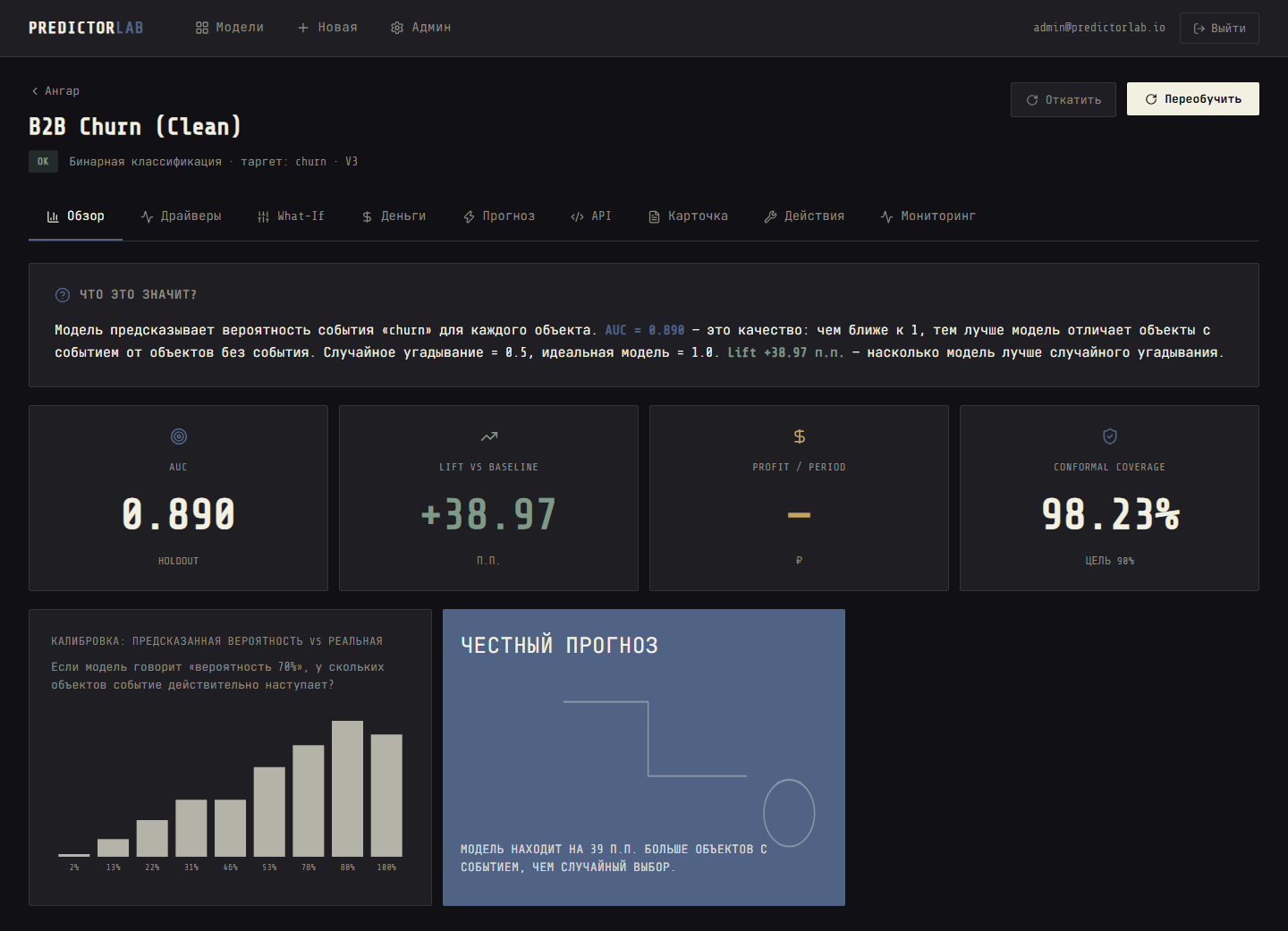
The "What does this mean?" block explains AUC, lift, and conformal coverage in business terms — not jargon.
Training panel — real-time SSE progress, 7 stages with descriptions, live leaderboard, elapsed/remaining time:
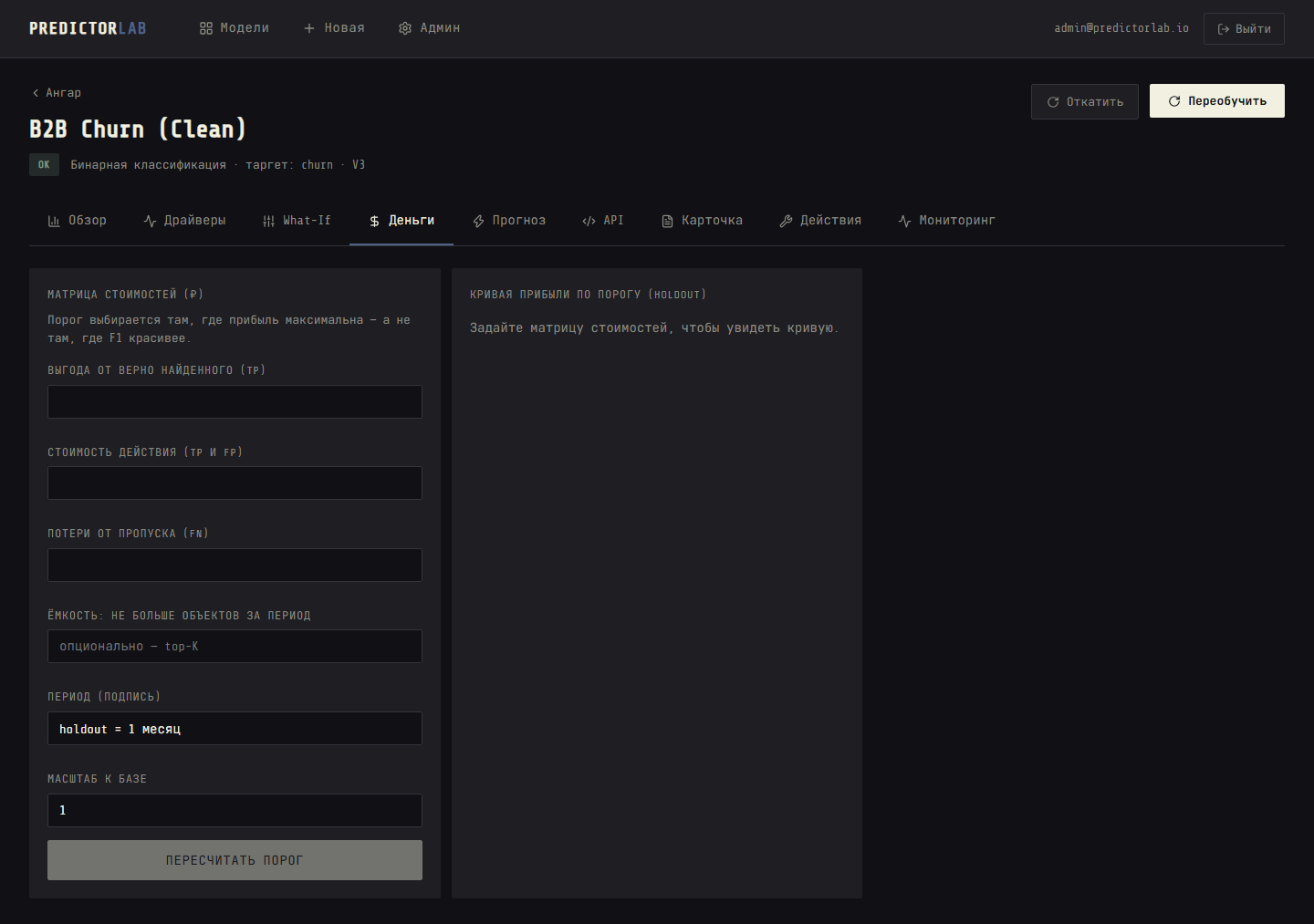
Profit optimization — the threshold is set where your money is maximized, not where F1 looks pretty:
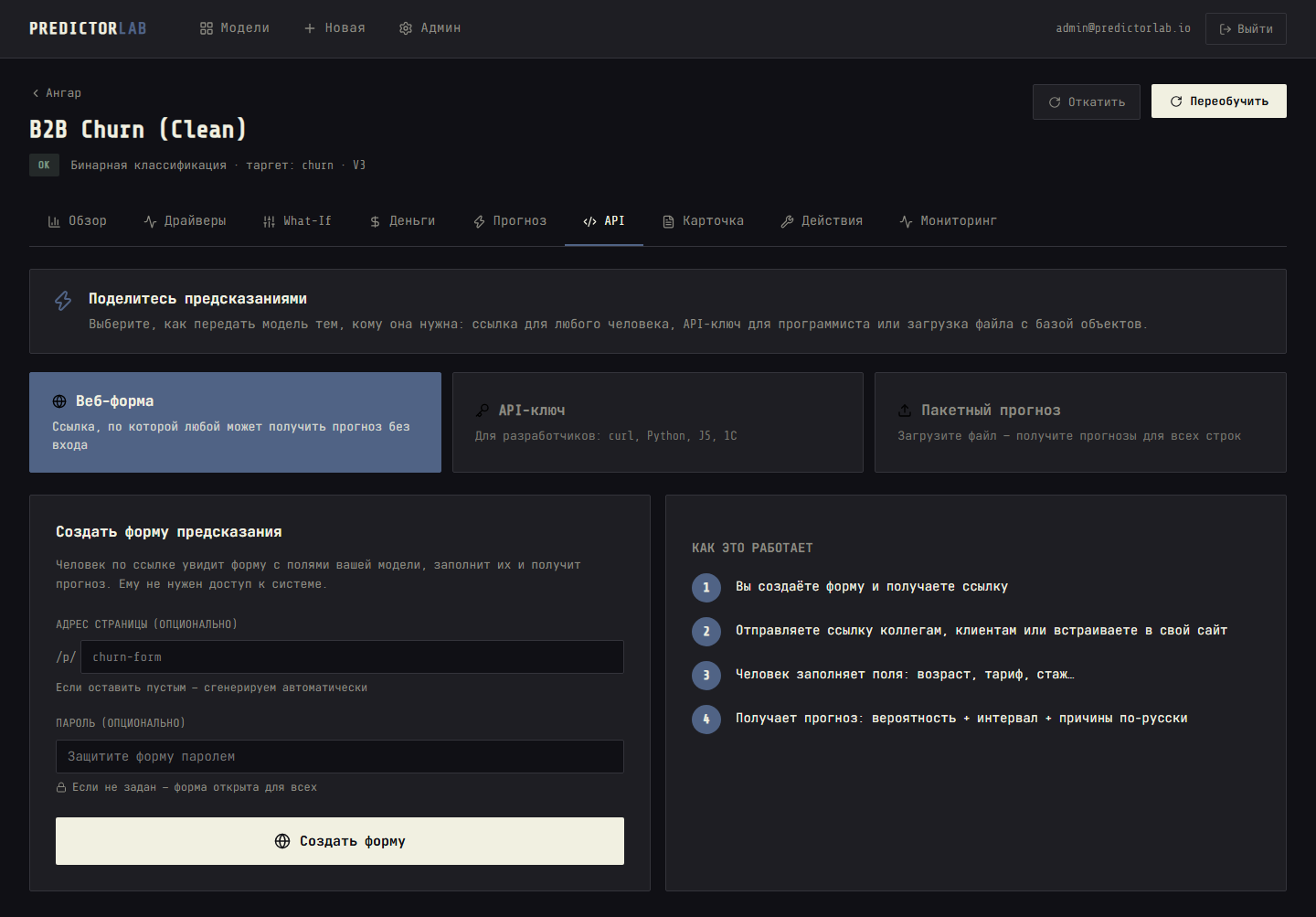
Sharing predictions — three ways, each one click. Web form for non-technical users, API key for developers, batch for processing your entire customer base:
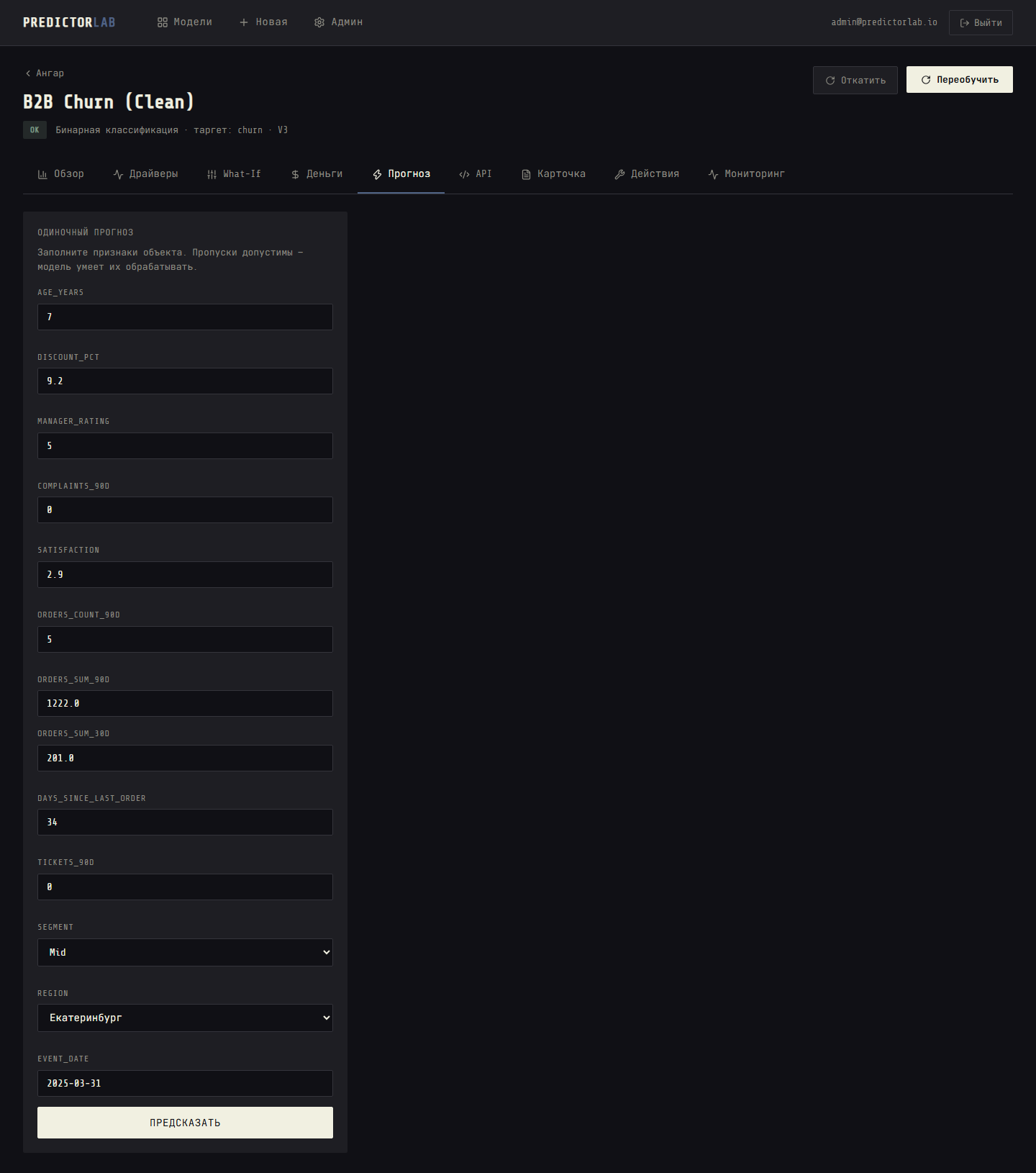
Single prediction — probability, conformal interval, reasons in plain language, OOD flag:
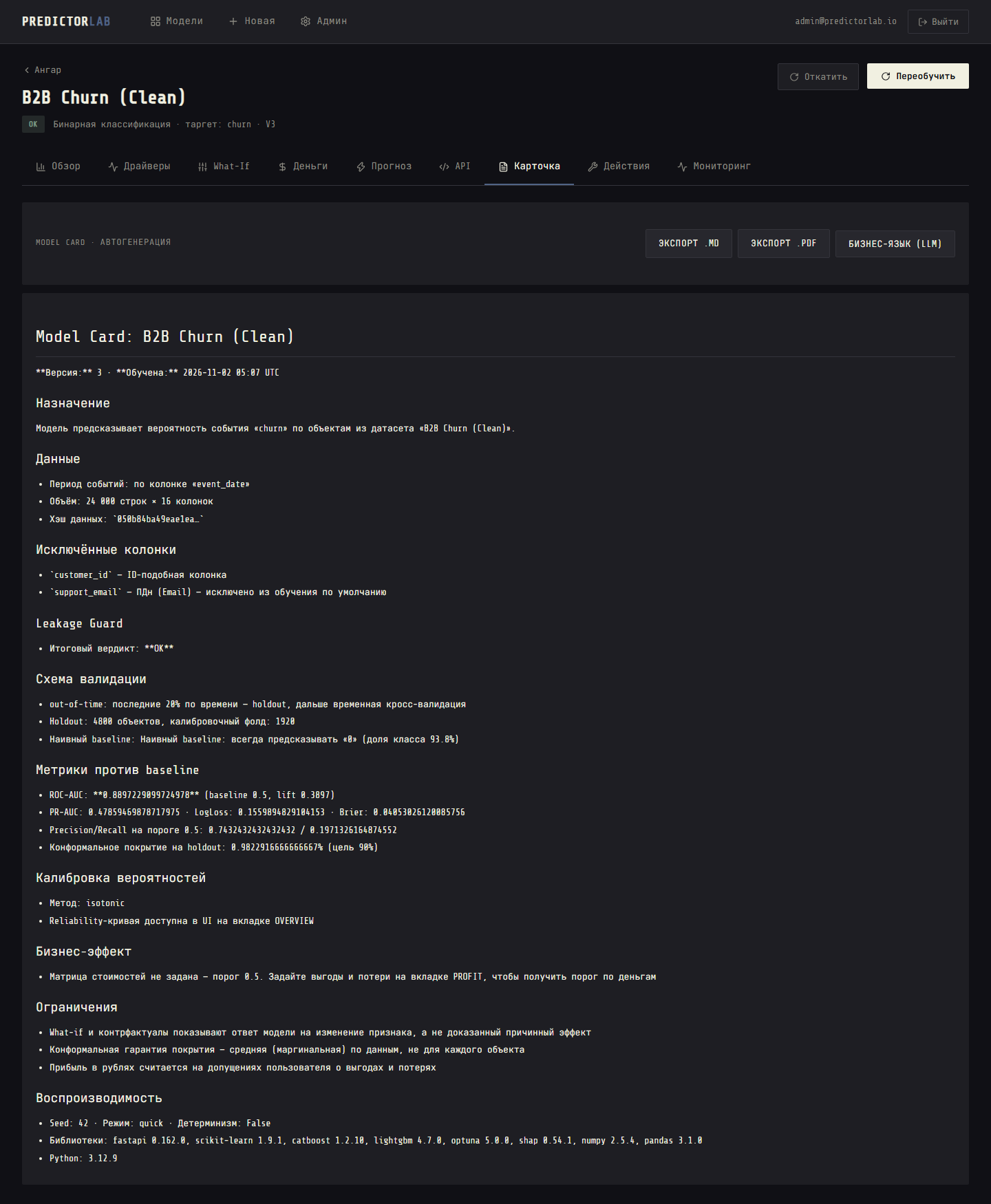
Model Card — auto-generated with leakage report, assumptions, limitations. Exportable to Markdown and PDF:
How it works
  ┌────────────────── Web Interface ──────────────────┐
  │  React UI ←SSE→ FastAPI + asyncio jobs + ProcessPool │
  │         │                                          │
  │         │   ┌─────── REST API :8000 ────────┐      │
  │         │   │  /api/v1/models/{id}/predict  │      │
  │         │   │  /api/v1/models/{id}/whatif   │      │
  │         │   │  /api/v1/jobs/{id}            │      │
  │         │   └───────────────────────────────┘      │
  │         │                                          │
  │         │   ┌─────── MCP Server :8100 ──────┐      │
  │         │   │  predict, explain, what_if,   │      │
  │         │   │  counterfactual, model_card   │      │
  │         │   └───────────────────────────────┘      │
  │         │                                          │
  │         ▼                                          │
  │  ┌─── Core Pipeline ──────────────────────────┐    │
  │  │                                            │    │
  │  │  CSV/XLSX/Parquet ← PII scanner            │    │
  │  │       ↓                                    │    │
  │  │  Feature Builder (point-in-time SQL)       │    │
  │  │       ↓                                    │    │
  │  │  Leakage Guard (9 deterministic checks)    │    │
  │  │       ↓                                    │    │
  │  │  Splits (OOT / group / stratified)         │    │
  │  │       ↓                                    │    │
  │  │  Training (CatBoost + LightGBM + Optuna)    │    │
  │  │       ↓                                    │    │
  │  │  Calibration + Conformal + OOD + SHAP       │    │
  │  │       ↓                                    │    │
  │  │  Profit → Threshold → Counterfactuals       │    │
  │  │       ↓                                    │    │
  │  │  Monitoring (PSI drift + live metrics)      │    │
  │  │                                            │    │
  │  └────────────────────────────────────────────┘    │
  │                                                    │
  │  DuckDB (data) · SQLite (metadata) · joblib       │
  │  PostgreSQL / MySQL / ClickHouse / SQLite (RO)     │
  └────────────────────────────────────────────────────┘
- Upload CSV, XLSX or Parquet — encoding and delimiter detected automatically (including cp1251). PII columns (email, phone, INN, SNILS, passport, card) are detected and excluded from training by default.
- Pick a target — from a dropdown or describe it in words (LLM suggests the column and SQL).
- Leakage Guard runs 9 deterministic checks. If BLOCK — you see exactly which columns leak and why. One click: "Exclude and retrain". Advanced users can override (recorded in Model Card).
- Train — Quick (CatBoost + linear, ~2 min) or Full (Optuna searches CatBoost + LightGBM within a time budget). Watch live progress: stages, candidate leaderboard, elapsed time.
- Result — AUC/MAE vs baseline, conformal coverage, calibration curve, SHAP drivers. Set the cost matrix → profit curve → optimal threshold. Try What-If sliders.
- Share — create a web form link, an API key, or batch-predict an entire file.
- Monitor — PSI drift alerts, live metrics on real outcomes, webhooks, one-click retrain.
Leakage Guard: the demo that sells the product
The demo-data/b2b_leaky.csv dataset contains a deliberate trap:
cancel_date is filled only for customers who already churned. Here's what happens:
Leakage Guard — Verdict: BLOCK

[x] cancel_date almost perfectly predicts the target (AUC 0.998).
    Value appears to be known only after the event has occurred.
[x] final_status: column name resembles a post-event feature.
[x] cancel_date contains dates after the event time (100% of rows) — feature from the future.

Results will not be shown.
[ Exclude (cancel_date, final_status) and retrain ]
After "Exclude and retrain", AUC drops to 0.85. That's the real model. It's still good — but it's honest. The 0.998 was never yours.
Quick Start
git clone https://github.com/MarkIvor/predictorlab.git
cd predictorlab
cp .env.example .env    # change ADMIN_EMAIL / ADMIN_PASSWORD / secrets
docker compose up -d
| UI | http://localhost:3000 |
| API | http://localhost:8000 |
| OpenAPI docs | http://localhost:8000/docs |
Default admin is created from .env on first boot. Password change is required on first login.
Dev without Docker:
python -m venv .venv && .venv/bin/pip install -r backend/requirements.txt
cd backend && uvicorn app.main:app --port 8000
# second terminal:
cd frontend && npm install && npm run dev
Works fully offline and without LLM. When LLM_BASE_URL is empty, all LLM features are hidden.
Training, predictions, intervals, thresholds — everything is deterministic code.
LLM is only for: natural-language target suggestion, semantic column checking, and Model Card text.
Raw data rows never leave the system (enforced by code + tested by a spy test).
Predict in 60 seconds
# Create a key in the UI (API tab) — shown once, stored as SHA-256 hash
export KEY=pl_live_...

# Get the model's input schema
curl http://localhost:8000/api/v1/models/1/schema -H "Authorization: Bearer $KEY"

# Predict with reasons
curl -X POST http://localhost:8000/api/v1/models/1/predict \
  -H "Authorization: Bearer $KEY" -H "Content-Type: application/json" \
  -d '{"data": [{"days_since_last_order": 75, "satisfaction": 2.1}], "include": ["reasons"]}'
Response:
{
  "predictions": [{
    "prediction_id": "prd_01J...",
    "label": "churn",
    "probability": 0.81,
    "decision": true,
    "threshold": 0.27,
    "conformal": {"coverage": 0.9, "prediction_set": ["churn"]},
    "out_of_distribution": false,
    "top_reasons": [
      {"feature": "days_since_last_order", "value": 75,
       "text": "No orders in 75 days: +18pp to risk"}
    ]
  }],
  "latency_ms": 62
}
Snippets for curl, Python, JavaScript, and 1C are auto-generated per model schema — they work without edits.
Share predictions
| Method | What it is | For whom |
|---|---|---|
| Web form | One click → shareable URL. Anyone can predict without login. Optional password. | Colleagues, clients |
| API key | pl_live_... key with per-model access, hash-stored, shown once |
Developers |
| Batch | Upload CSV → background job → download predictions with intervals | Processing the full customer base |
| MCP | predict, explain, what_if, counterfactual, get_model_card, get_drift_status — right in Claude Desktop or Cursor |
AI power users |
What-If and Counterfactuals
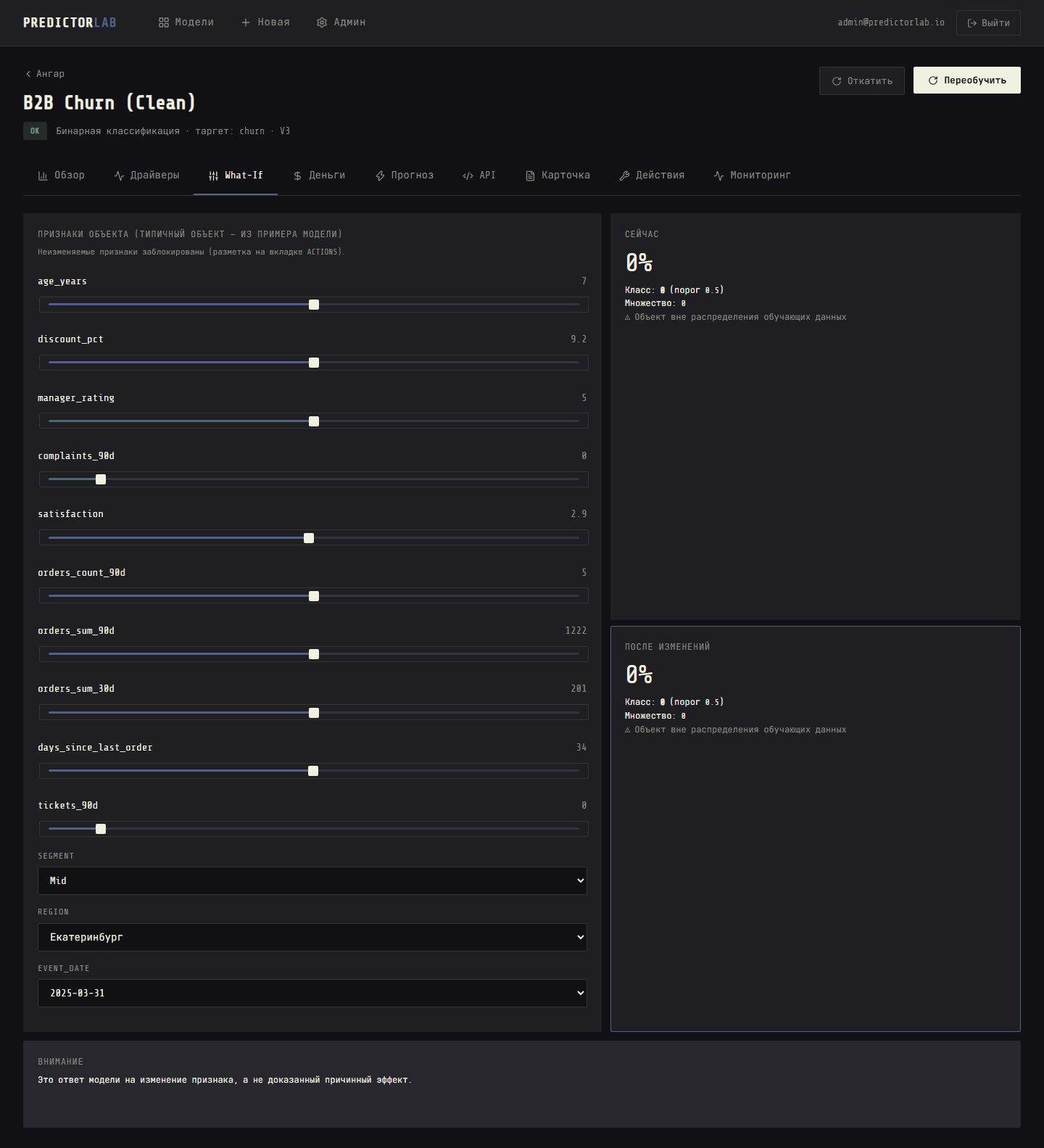
What-If sliders let you change any feature and watch the prediction and interval recalculate in real time (150ms debounce). A permanent disclaimer: "This is the model's response to a feature change, not a proven causal effect."
Counterfactuals go further: they find the minimum-cost change to actionable features that flips the prediction across the threshold. You define: allowed range, direction (only up / only down), and cost per unit of change. The system searches (greedy + random restarts, with a timeout) and returns:
Action: reduce discount_pct from 12% to 5%
Cost: 3,000 ₽
Probability before: 0.81 → after: 0.31
Expected ROI: 21,400 ₽
If the model says "change the customer's age" — it won't, because you marked it as immutable.
Monitoring
After the model is in production:
- Every prediction is logged (PII masked, TTL configurable)
- PSI drift computed per feature and per prediction distribution (7/30-day windows)
- Live metrics: real AUC/MAE from feedback vs validation numbers
- Webhooks fire on DRIFT or live-metric drop
- One-click retrain on fresh data; version comparison and rollback
Benchmarks
| Operation | Budget | Measured |
|---|---|---|
predict, 1 record |
< 300 ms | 62 ms |
predict + SHAP reasons |
< 1 s | 79 ms |
| Batch 10k rows | < 2 min | 14 s |
| Train quick, 50k × 50 | ~2 min | 155 s |
| Counterfactual, 1 object | < 10 s | 6.4 s |
Full results: BENCHMARKS.md · Run: make bench
Tests & CI
make check     # lint + typecheck + unit + property + integration + llm + security + frontend (~2 min)
make test-e2e  # Playwright end-to-end
make test-ml   # ML quality: golden datasets, determinism, invariants
make bench     # performance benchmarks → BENCHMARKS.md
| Layer | Tools |
|---|---|
| Lint + format | ruff (check + format) |
| Typecheck | mypy (strict for core/) |
| Unit tests | pytest — 51 tests: guard, profit, conformal, splits, PII, sql_guard, counterfactuals, signing |
| Property tests | hypothesis — 12 tests: profit monotonicity, conformal coverage, PII masking, CF bounds |
| Integration | TestClient — upload → train → predict → batch → keys → 422 errors |
| LLM contract | mock client, fixtures, spy test ("raw rows don't leave"), number validator, causal-word stop-list |
| Security | key hash, 401/403, sql_guard DML/DDL/CTE injection, PII exclusion + masking |
| Frontend | vitest + eslint + tsc — 10 component tests |
| ML quality | golden datasets (Telco AUC range), leak detection, determinism, robustness, invariance |
| CI | GitHub Actions: ruff → mypy → tsc/eslint → pytest → coverage ≥ 60% → e2e smoke |
Honesty & Limitations
- Counterfactuals ≠ causality. "Reduce discount → probability drops" is the model's response to a feature change, not proof that the discount caused the churn.
- Conformal guarantee is marginal. 90% coverage holds on average across predictions, not for every individual object. For heavily imbalanced classes, set coverage may exceed α — that's a mathematical property of the method (see DECISIONS.md D-12).
- Small datasets give wide intervals. 200 rows → the interval is nearly useless. We show this honestly instead of hiding it behind a single number.
- Profit in rubles is only as good as your assumptions. All formulas and coefficients are expandable in the UI. The "+1.84M ₽" is true exactly to the extent your cost/benefit estimates are true.
- LLM never affects the numbers. Training, probabilities, intervals, thresholds, profit — all deterministic code. LLM writes texts only, and those pass a number validator that rejects any number not present in the computed fields.
- Time-series forecasting (v0.3) is pragmatic: lags + rolling stats + calendar features, one series at a time. Strong exotic seasonality is not modeled (DECISIONS.md D-10).
Tech Stack
| Layer | |
|---|---|
| Backend | Python 3.12, FastAPI, Pydantic v2, SSE, asyncio jobs + ProcessPool |
| ML | scikit-learn, CatBoost, LightGBM, Optuna, SHAP, own split-conformal |
| Data | DuckDB (data), SQLite (metadata), PostgreSQL / MySQL / ClickHouse / SQLite connectors (read-only) |
| Frontend | React 19, TypeScript, Vite, Recharts, CSS custom properties (no UI kits) |
| MCP | FastMCP (stdio + HTTP, Bearer auth) |
| Infra | Docker, docker-compose, GitHub Actions, pre-commit |
| Testing | pytest + hypothesis + vitest + Playwright + ruff + mypy + bandit |
License
MIT — like all Ivor's Lab repositories.
Telco Customer Churn © IBM (Apache 2.0 mirror), California Housing from A. Géron's course —
both included in demo-data/ for offline demos.
PredictorLab MCP questions
What makes PredictorLab different from other no-code ML tools?
It includes a Leakage Guard that blocks training if target leakage is detected and provides profit-maximizing thresholds instead of just probabilities.
Can I run PredictorLab offline?
Yes, the tool works fully offline and without an LLM; all training, predictions, and intervals are handled by deterministic code.
How does the tool handle sensitive data like emails or phone numbers?
It includes a PII scanner that automatically detects and excludes columns like email, phone, and passport from training by default.
What kind of data formats are supported for upload?
You can upload data in CSV, XLSX, or Parquet formats.