
Element Node MCP server
Commit Oct 14, 2026Allows AI agents to build and manage entire websites through a visual CMS that supports manual refinement via an Elementor-style editor.
Also known as LorenzArtik/element-node, element-node-mcp
- Stars
- 0
- Tools
- —
- Downloads, 30 days
- —
- Latest version
- —
- Last commit
- Oct 14, 2026
- License
- AGPL-3.0
What is Element Node MCP?
Element Node allows AI agents to build and manage entire websites through a visual CMS that supports manual refinement via an Elementor-style editor.
Summary generated from the project's README
About Element Node MCP server
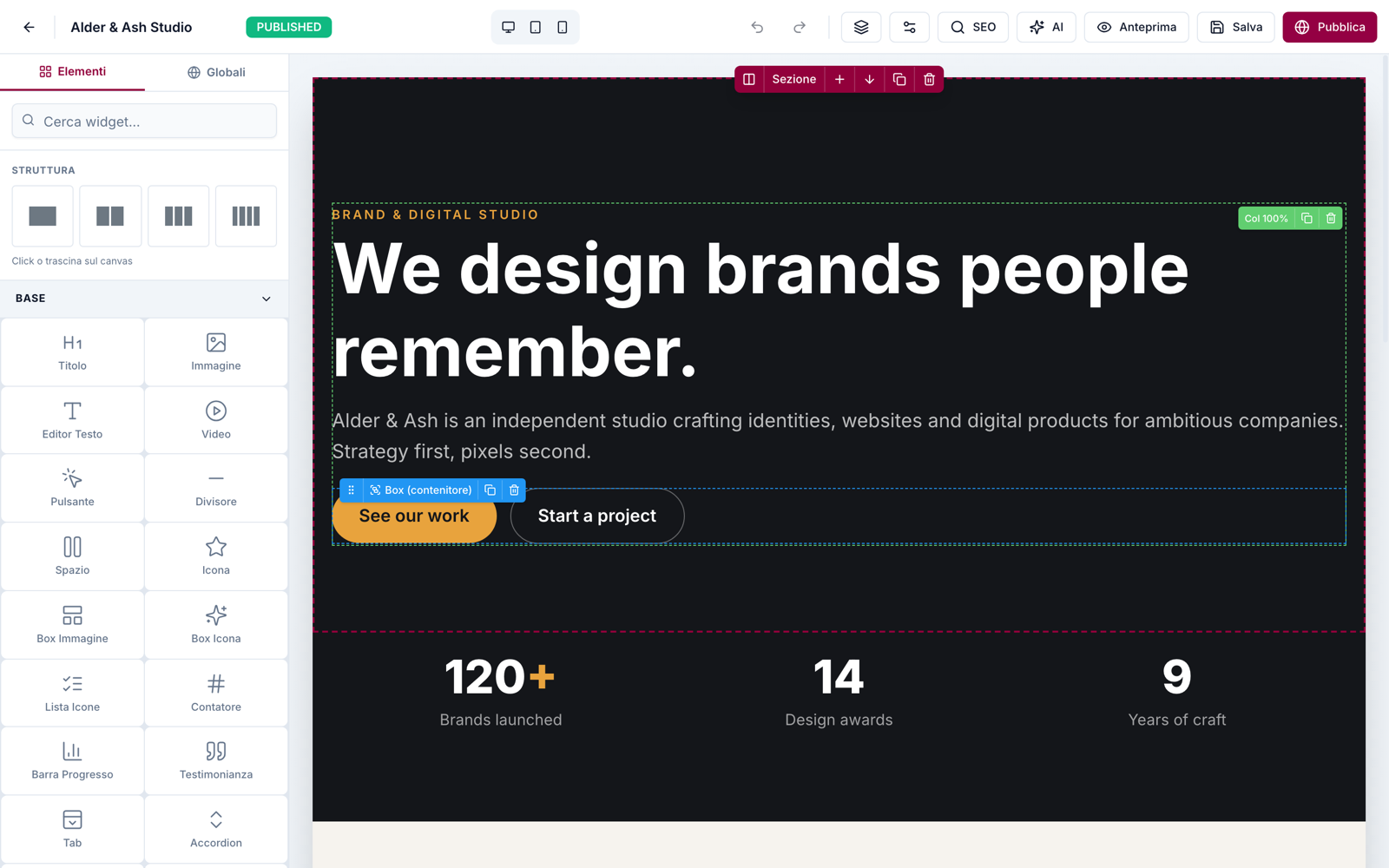
Element Node is a self-hosted visual content management system designed for AI agents to construct and manage websites. It uses a stack of Next.js 15, Prisma, and MySQL to provide a platform where agents can build entire sites from briefs or clones. Once the agent completes the initial build, non-technical users can take over using an Elementor-style visual editor featuring a three-panel interface with drag and drop capabilities.
Developers can connect to the system through an MCP server compatible with clients like Cursor and Windsurf, or by using the official Claude Code skill. The server provides tools for managing pages, themes, media, and full Site Blueprint imports or exports. It requires a local or remote server running Node.js 20 or higher and a MySQL or MariaDB database. Users can also interact with the system via a REST API using Bearer API keys for specific scopes like site import or export.
What you can do with it
- 1Automated website constructionAn AI agent can build a complete website from a simple text brief or by cloning an existing site.
- 2Visual content refinementA non-technical client can manually edit website sections using a drag and drop interface after the agent finishes.
- 3Site blueprint migrationDevelopers can move entire website structures between instances using JSON import and export functions.
- 4Visual fidelity verificationAn agent can perform visual comparisons between a screenshot and a built site to ensure accuracy.
Written from the project's README. Every use case is checked against a quote from it.
How to install Element Node MCP
Formats verified 10 Nov 2026Add to CursorAdd to GooseInstall Element Node MCP in Claude Code
$ claude mcp add element-node -- npx -y element-node-mcpInstall Element Node MCP in Cursor
~/.cursor/mcp.json
{
  "mcpServers": {
    "element-node": {
      "command": "npx",
      "args": [
        "-y",
        "element-node-mcp"
      ]
    }
  }
}Install Element Node MCP in VS Code
.vscode/mcp.json
{
  "servers": {
    "element-node": {
      "type": "stdio",
      "command": "npx",
      "args": [
        "-y",
        "element-node-mcp"
      ]
    }
  }
}Install Element Node MCP in VS Code CLI
$ code --add-mcp '{"name":"element-node","type":"stdio","command":"npx","args":["-y","element-node-mcp"]}'Install Element Node MCP in Claude Desktop
claude_desktop_config.json
{
  "mcpServers": {
    "element-node": {
      "command": "npx",
      "args": [
        "-y",
        "element-node-mcp"
      ]
    }
  }
}Install Element Node MCP in Codex
$ codex mcp add element-node -- npx -y element-node-mcpInstall Element Node MCP in Codex config.toml
~/.codex/config.toml
[mcp_servers.element-node]
command = "npx"
args = ["-y", "element-node-mcp"]
Install Element Node MCP in Gemini CLI
$ gemini mcp add -s user element-node npx -- -y element-node-mcpInstall Element Node MCP in Gemini settings.json
~/.gemini/settings.json
{
  "mcpServers": {
    "element-node": {
      "command": "npx",
      "args": [
        "-y",
        "element-node-mcp"
      ]
    }
  }
}Automated checks
Ran Nov 15, 2026Full report →Not verified yet. A server needs a score of 80, no serious finding, and enough data for us to check. How checks work · What to fix for more points

- Source repository linked and reachablelorenzartik/element-node is public and reachablegithub.com/lorenzartik/element-node ↗Pass
- Package names this repository as its sourceelement-node-mcp names lorenzartik/element-node as sourcenpmjs.com/package/element-node-mcp ↗Pass
- Build provenance (Sigstore attestation)No build attestation published for this releaseNot checked
- Open source license (OSI)AGPL-3.0spdx.org/licenses/AGPL-3.0.html ↗Pass
- Commit or release in the last yearLast commit or release 2026-10-14github.com/lorenzartik/element-node ↗Pass
- OpenSSF ScorecardNot checked
- Package name not close to a popular packageNo popular package one edit away from element-node-mcpPass
- No critical advisory in the package or its dependenciesNot checked
- No hidden instructions to the model0 tool descriptions and the README read; no override phrases, credential paths or hidden charactersPass
- Destructive tools are labelledNot checked
- Remote endpoint answers the MCP handshakeNot checked
README
View on GitHubElement Node
The AI-agent CMS your clients can still edit visually.
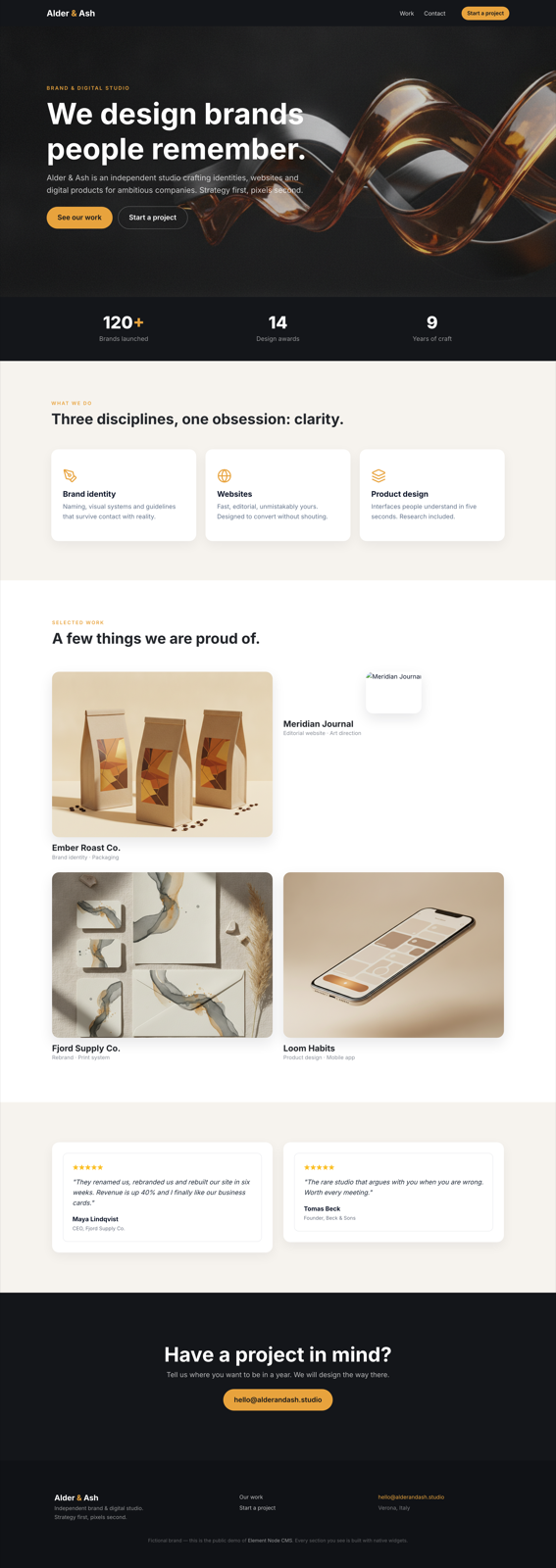
Element Node is an open-source visual CMS built on Next.js 15 + Prisma/MySQL. AI agents build entire sites on it — through the official Claude Code skill or the MCP server (Cursor, Windsurf, any MCP client) — and after the agent is done, the site stays in an Elementor-style visual editor that a non-technical client can safely use. Self-hosted: your server, your data.
🇮🇹 Documentazione in italiano: elementnode.cloud/it/docs
Quickstart
bash <(curl -fsSL https://elementnode.cloud/install.sh)
Requirements: Node.js ≥ 20, MySQL/MariaDB. The installer clones the repo, installs dependencies, creates .env and the DB schema, builds, and leaves you at the /install wizard (admin user, site, AI).
Non-interactive mode (for AI agents / provisioning): export DB_NAME, DB_USER, DB_PASS, SITE_URL (optional DB_HOST, DB_PORT) before running — no prompts. For Plesk see PLESK_DEPLOY.md.
One-prompt setup: the entire path — server, CMS, skill and first site — can be driven by a single prompt pasted into Claude Code. Template: elementnode.cloud/it/docs#prompt
Built for AI agents
| Integration | For | What it does |
|---|---|---|
| Official skill | Claude Code / Codex | Builds entire sites: from a brief, or pixel-perfect clones of existing sites verified by a visual-comparison agent (screenshot → diff → fix, until convergence) |
| MCP server | Cursor, Windsurf, any MCP client | Pages, theme, media, full Site Blueprint import/export, always-fresh widget docs |
| REST API | Anything else | Bearer API keys with scopes (site.import, site.export, …) |
Real production numbers (agent build time, human review on top): a 24-page WordPress migration in ~1 hour · a complete bilingual site in half a day · a React SPA cloned at 95/100 automated visual fidelity in ~2 hours. See showcase.
What's in the box
- Visual editor — 3-panel Elementor-style UI: widget library · canvas · properties. Drag & drop, inline text editing, undo/redo, revisions, responsive preview, style controls (spacing, borders, shadows, gradients)
- 51 native widgets — heading, text, button, image, video, icon-box, counters, tabs, accordion, gallery, contact form, posts grid, marquee, nav drawer, nested boxes…
- Theme blocks — global header/footer with display conditions + priority (per-URL-prefix → native multilingual sites)
- Content — pages (nested slugs), posts, custom post types + taxonomies, redirects, popups
- Forms — reusable form entities, submissions in DB, SMTP/Brevo delivery, GDPR consent fields
- Privacy — native cookie consent banner (variants per language, click-to-load embeds), site access modes (public / password / maintenance) with automatic noindex
- AI built in (bring your own Anthropic key) — editor chat that generates and edits sections, one-click SEO (title/description/keyword in the page's language)
- SEO — per-page meta, OG image, sitemap, robots, SEO score panel
- Media — local uploads, sharp-optimized thumbnails (WebP/AVIF), lazy loading
- Ops — 1-click self-update from the panel (with automatic pre-update DB backup), multi-user roles, API keys, health endpoint
- Performance — React Server Components, standalone output, HTTP cache + ISR. No plugin ecosystem needed: it's all native
Stack
Next.js 15 (App Router, standalone output) · Prisma + MySQL · NextAuth v5 · Tailwind · @dnd-kit · TipTap · sharp · Anthropic Claude (optional, BYO key)
Architecture notes
- Public pages render through
PageRenderer(RSC) with a responsive core (columns stack under 768px, opt-out per column) - Content is a JSON tree: sections → columns → widgets (see skill/element-node-builder/references/widget-reference.md)
- Site Blueprint import/export moves whole sites as JSON (merge or replace)
- License validation is fail-open: the CMS works without a license — a license activates managed updates, security patches and support (pricing)
License
- CMS core: AGPL-3.0 — free to use, self-host and modify. Building and running your own sites (or client sites) carries no obligations; the AGPL kicks in only if you modify the CMS and offer it to others as a service.
- Claude Code skill and MCP server: MIT — integrate freely.
Managed updates, security patches, priority support and the white-label agency tier are commercial: elementnode.cloud/en/pricing. For commercial licensing outside AGPL terms, get in touch.
Element Node MCP questions
How do I add Element Node MCP to Claude Code?
Run claude mcp add element-node -- npx -y element-node-mcp in your terminal. Add --scope user to make it available in every project.
How do I add Element Node MCP to Cursor?
Open ~/.cursor/mcp.json and add the server under mcpServers, using the Cursor config shown in the install section above.
Can I host it myself?
Yes, it is a self-hosted solution where you control your own server and data.
What technologies is it built with?
The CMS is built using Next.js 15, Prisma, MySQL, NextAuth v5, Tailwind, @dnd-kit, TipTap, and sharp.
Does the CMS require a license to function?
The CMS core is AGPL-3.0 and works without a license; a license is only required to activate managed updates, security patches, and support.