
raw-browser MCP server
Commit Nov 16, 2026Automates existing Chrome or Edge browser sessions using a zero-dependency runtime and MCP server for AI agents.
Also known as liutingqiu/raw-browser
- Stars
- 2
- Tools
- —
- Downloads, 30 days
- —
- Latest version
- —
- Last commit
- Nov 16, 2026
- License
- MIT
What is raw-browser MCP?
raw-browser automates existing Chrome or Edge browser sessions using a zero-dependency runtime and MCP server for AI agents.
Summary generated from the project's README
About raw-browser MCP server
Automating your existing Chrome or Edge browser sessions from within an AI agent is what raw-browser enables. Unlike traditional automation tools that require fresh profiles or constant re-logins, this runtime connects to the browser you are already signed into, preserving your active sessions, cookies, and extensions. It is designed for developers who need to perform multi-step tasks through a single JavaScript program rather than individual model round-trips, which reduces costs and state management complexity.
Users can interact with the browser via a CLI or an MCP server that provides 16 specialized tools, including raw_snapshot, raw_click, raw_fill, and raw_screenshot. The setup requires Node.js 22.21 or higher and can be configured using Direct CDP mode for isolated contexts or an extension bridge to drive your primary user profile. The system operates locally on 127.0.0.1 to ensure that page content and cookies remain within your local environment.
What you can do with it
- 1Automate complex multi-step workflowsA developer can write a single script to handle a sequence of actions like searching, selecting, and exporting data in one go.
- 2Access authenticated web applicationsYou can instruct an AI to navigate sites where you are already logged in without needing to provide credentials.
Written from the project's README. Every use case is checked against a quote from it.
How to install raw-browser MCP
Formats verified 10 Nov 2026Add to CursorAdd to GooseInstall raw-browser MCP in Claude Code
$ claude mcp add raw-browser -- npx -y raw-browserInstall raw-browser MCP in Cursor
~/.cursor/mcp.json
{
  "mcpServers": {
    "raw-browser": {
      "command": "npx",
      "args": [
        "-y",
        "raw-browser"
      ]
    }
  }
}Install raw-browser MCP in VS Code
.vscode/mcp.json
{
  "servers": {
    "raw-browser": {
      "type": "stdio",
      "command": "npx",
      "args": [
        "-y",
        "raw-browser"
      ]
    }
  }
}Install raw-browser MCP in VS Code CLI
$ code --add-mcp '{"name":"raw-browser","type":"stdio","command":"npx","args":["-y","raw-browser"]}'Install raw-browser MCP in Claude Desktop
claude_desktop_config.json
{
  "mcpServers": {
    "raw-browser": {
      "command": "npx",
      "args": [
        "-y",
        "raw-browser"
      ]
    }
  }
}Install raw-browser MCP in Codex
$ codex mcp add raw-browser -- npx -y raw-browserInstall raw-browser MCP in Codex config.toml
~/.codex/config.toml
[mcp_servers.raw-browser]
command = "npx"
args = ["-y", "raw-browser"]
Install raw-browser MCP in Gemini CLI
$ gemini mcp add -s user raw-browser npx -- -y raw-browserInstall raw-browser MCP in Gemini settings.json
~/.gemini/settings.json
{
  "mcpServers": {
    "raw-browser": {
      "command": "npx",
      "args": [
        "-y",
        "raw-browser"
      ]
    }
  }
}Configuration
RAW_BRIDGE_BROWSER
Automated checks
Ran Nov 14, 2026Full report →Not verified yet. A server needs a score of 80, no serious finding, and enough data for us to check. How checks work · What to fix for more points

- Source repository linked and reachableliutingqiu/raw-browser is public and reachablegithub.com/liutingqiu/raw-browser ↗Pass
- Package names this repository as its sourceraw-browser names liutingqiu/raw-browser as sourcenpmjs.com/package/raw-browser ↗Pass
- Build provenance (Sigstore attestation)No build attestation published for this releaseNot checked
- Open source license (OSI)MITspdx.org/licenses/MIT.html ↗Pass
- Commit or release in the last yearLast commit or release 2026-10-26github.com/liutingqiu/raw-browser ↗Pass
- OpenSSF ScorecardNot checked
- Package name not close to a popular packageNo popular package one edit away from raw-browserPass
- No critical advisory in the package or its dependenciesNot checked
- No hidden instructions to the model0 tool descriptions and the README read; no override phrases, credential paths or hidden charactersPass
- Destructive tools are labelledNot checked
- Remote endpoint answers the MCP handshakeNot checked
README
View on GitHubraw-browser (raw)
Drive the Chrome or Edge you're already signed into — from one script.
A zero-dependency browser automation runtime, CLI and MCP server for AI agents.
No fresh profile, no re-login, no click → look → click loop.




English | 简体中文
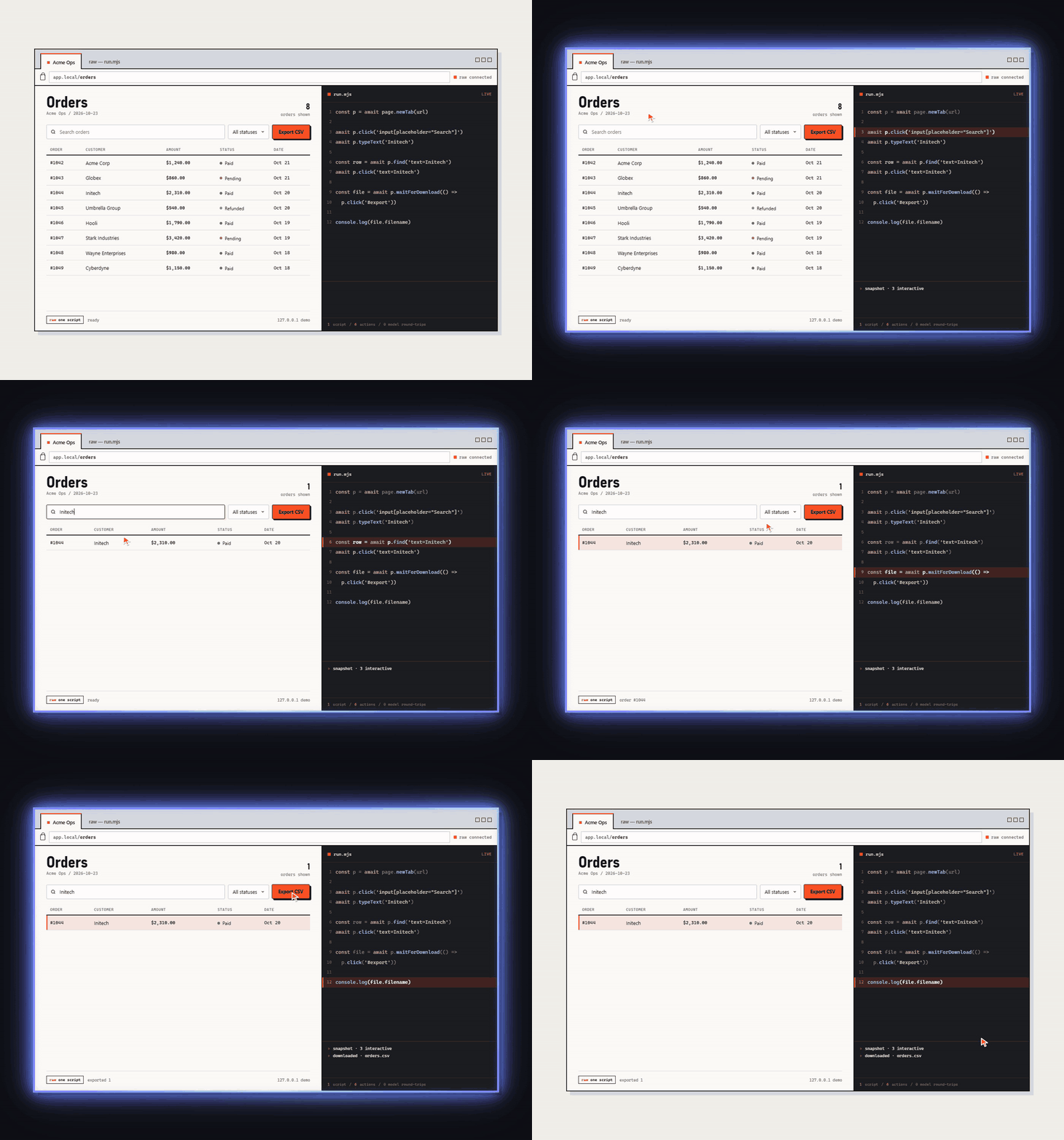
The demo is one script: snapshot, click, type, select, export. MP4 version.
Quick start
Requires Node.js 22.21+ and Chrome or Edge.
npm install -g raw-browser
raw status
raw run -e "const p = await page.newTab('https://example.com'); console.log(await p.title()); await p.closeTab()"
In direct CDP mode the first run launches a dedicated browser profile under
~/.raw/ and keeps it across runs, so logins survive.
From source instead:
git clone https://github.com/liutingqiu/raw-browser.git
cd raw-browser
npm install
npm run build
npm link
raw status
Pinned or offline installs can use the raw-browser.tgz tarball attached to each
release. The
extension bridge installer ships in both the npm package and a clone; a global
install runs it with
node "$(npm root -g)/raw-browser/scripts/install-edge-bridge.mjs".
Why raw-browser
- Your real browser. The extension bridge attaches to the Chrome or Edge profile you already use. Sessions, cookies and extensions are already there.
- One script, one task. A multi-step job is a single JavaScript program with loops, conditions and waits — not one model round-trip per click. Fewer round-trips, lower cost, less state to re-read.
- Zero runtime dependencies. The runtime uses Node's built-in
fetchandWebSocket.npm installonly pulls TypeScript and Node types for development.
One script, one task
const p = await page.newTab('https://app.example.com/orders');

const snapshot = await p.snapshot({ scope: 'viewport' });
console.log(snapshot);                       // numbered elements: [0], [1], …

await p.click('role=button[name="Search"]');
await p.fill('role=textbox', 'Initech');
await p.click('text=Initech');

const file = await p.waitForDownload(() => p.click('text=Export CSV'));
console.log(file.path);                      // orders.csv is on disk
await p.closeTab();
Run it from a file:
node dist/browser-cli.js run < demo/example.mjs
or inline:
raw run -e "const p = await page.newTab('example.com'); console.log(await p.snapshot()); await p.closeTab()"
What's inside
| Area | Capabilities |
|---|---|
| Locators | snapshot indices (#12), CSS, XPath, text=, :has-text(), role=…[name=…]; open shadow DOM and same-origin iframes |
| Input | real CDP mouse/keyboard events, button bitmasks, interpolated drag paths, key chords, file inputs |
| Rich editors | Monaco, CodeMirror 5/6, contenteditable and React-controlled fields, with the strategy reported |
| Waiting | navigation, popups, downloads, file choosers, DOM mutations, network responses, functions and URLs |
| Reading | numbered snapshots, accessibility tree, text/HTML, frames (cross-origin included) |
| Browser surfaces | tabs, cookies, proxy, history, bookmarks, extensions, downloads, notifications, CSS injection |
| Isolation | --space creates a browser context with its own cookies, cache and storage (direct CDP mode) |
| Agent integration | CLI, a JavaScript scripting API, and an MCP server with 16 tools |
See docs/API.md for the full scripting reference.
FAQ
Is this a Playwright replacement?
Playwright is a full test framework with its own browser contexts, runner and
assertions. raw is a small runtime for agents: it can drive the profile you
are already signed into, and it treats one script as one task. They solve
different problems and can coexist.
Does it hide automation or bypass bot detection?
No. There is no stealth patching, no navigator.webdriver override and no
fingerprint spoofing. A site that blocks automation will still see a debugger
attached.
Does it upload cookies or page data?
No. The runtime and bridge are local-only and bind to 127.0.0.1. Page content,
and any cookie values a script explicitly requests, go to the calling agent, so
the agent's permission mode is the boundary.
Which browsers are supported? Chrome and Microsoft Edge (Chromium). Direct CDP mode also works with Chromium builds.
How it works
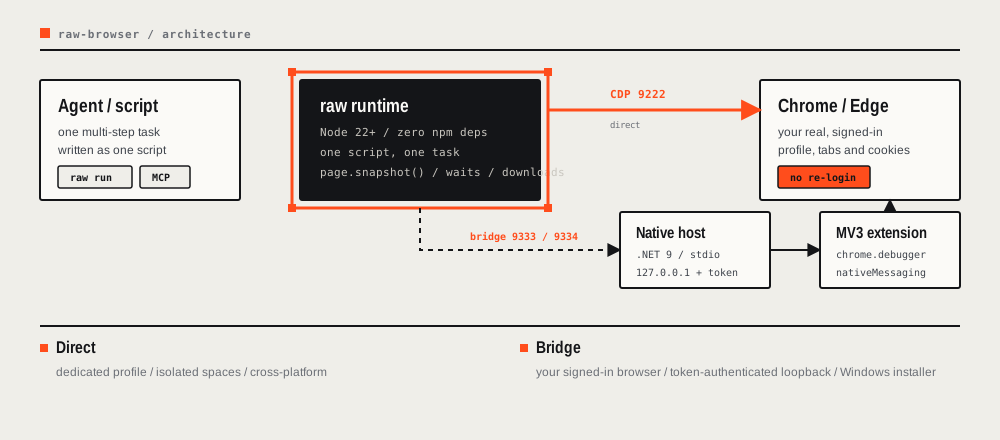
There are two ways to reach a browser:
- Direct CDP —
rawlaunches a dedicated Chromium profile with--remote-debugging-port(default9222). Cross-platform, isolated spaces, no extension required. - Extension bridge — an MV3 extension uses
chrome.debuggeron real tabs, talks to a .NET native-messaging host over stdio, and the host exposes a token-protected CDP facade on loopback. Edge uses9333, Chrome uses9334. This is what drives your signed-in profile.
The bridge listener binds to 127.0.0.1 only, requires a per-browser random
token, validates the Host header, and refuses a debug port it does not own.
The extension does not copy or log cookies on its own; cookie values are
returned only when a script explicitly calls a cookie API.
Drive your signed-in browser
The bridge installer supports Windows, macOS and Linux. Direct CDP mode also works on all three.
# global npm install (macOS / Linux)
node "$(npm root -g)/raw-browser/scripts/install-edge-bridge.mjs" --browser both

# source checkout (any platform)
node scripts/install-edge-bridge.mjs --browser both
On Windows the same Node command delegates to the PowerShell installer. You can also run that script directly:
powershell -ExecutionPolicy Bypass -File "$(npm root -g)\raw-browser\scripts\install-edge-bridge.ps1" -Browser both
The installer publishes a self-contained native host, writes independent tokens
to ~/.raw/edge-bridge.json and ~/.raw/chrome-bridge.json, and registers the
selected native-messaging hosts: HKCU on Windows,
NativeMessagingHosts under ~/Library/Application Support on macOS, and under
~/.config on Linux. If the .NET 9 SDK is missing, it downloads the matching
prebuilt host from Releases
and verifies SHA256SUMS.txt when available. Use --host-path to install a
host you built yourself, or --build-from-source to force a local build.
The host always lives at ~/.raw/edge-bridge/current/ so the native-messaging
manifest does not move between upgrades; the installer replaces the executable
in place and keeps the previous pair for rollback.
The browser and the host must be in the same operating system. A Windows Chrome cannot use a host installed in WSL: use the Windows installer for the Windows browser, or install a Linux Chrome/Edge inside WSL (with WSLg) and run this installer there. Snap- and Flatpak-confined browsers do not read the user-level native-messaging directory the installer writes; use a deb/rpm or app-bundle install for the bridge.
Then load the unpacked extension once per browser:
- Open
edge://extensionsorchrome://extensions. - Enable Developer mode.
- Choose Load unpacked and select the path printed as
ExtensionPath(in a clone it isedge-bridge/extension).
Select the bridge in ~/.raw/browser-profiles/current.json:
{ "mode": "edge-extension" }
or { "mode": "chrome-extension" }. raw status prints the selected bridge,
port and extension version. If the bridge does not connect after an upgrade,
restart the browser once: it caches the native-messaging host path for the life
of the process. Upgrading from an older installer? Restart the browser, then run
the installer once with --clean-legacy-hosts (-CleanLegacyHosts in
PowerShell) to remove the old host-* directories.
CLI
| Command | Description |
|---|---|
raw status |
show the debugger, bridge, profile and browser binary |
raw run |
read a script from stdin |
raw run -e "<code>" |
run an inline script |
| Option | Description |
|---|---|
--timeout-ms N |
script timeout (default 180000) |
--space NAME |
run in an isolated browser context (direct mode) |
--headless |
launch headless when the browser is not already running |
--profile PATH |
override the persistent profile directory |
--port N |
override the CDP port |
--browser PATH |
use a specific Chrome or Edge executable |
--downloads PATH |
override the download directory |
--output-dir PATH |
where inline images are written |
MCP server
npm install -g raw-browser also installs raw-mcp, a stdio MCP server that
exposes the runtime as 16 MCP tools: raw_use, raw_status, raw_tabs,
raw_new, raw_goto, raw_text, raw_html, raw_eval, raw_snapshot,
raw_click, raw_fill, raw_visit, raw_screenshot, raw_cookies,
raw_frames and the raw_call escape hatch.
{
  "mcpServers": {
    "raw-browser": {
      "type": "stdio",
      "command": "raw-mcp",
      "env": { "RAW_BRIDGE_BROWSER": "edge" }
    }
  }
}
From a source checkout, point the client at mcp/raw-browser-mcp.mjs instead:
{
  "mcpServers": {
    "raw-browser": {
      "type": "stdio",
      "command": "node",
      "args": ["C:/path/to/raw-browser/mcp/raw-browser-mcp.mjs"],
      "env": { "RAW_BRIDGE_BROWSER": "edge" }
    }
  }
}
The server remembers the current tab, returns screenshots as image content,
serializes tool calls, and supports cancellation. Set RAW_CLI when
raw-bridge.mjs is not next to the server, and RAW_BRIDGE_BROWSER=edge|chrome
to pick a bridge. The server is registered in the
HOL Guard MCP catalog as
mcp.raw-browser: read-only tools inherit normal policy, navigation, input and
cookie reads are reviewed, and raw_eval / raw_call are blocked.
Security model
- Listeners bind to
127.0.0.1; remote connections are rejected. - Every HTTP and WebSocket request needs the per-browser token; comparison is
constant-time and the
Hostheader is validated. - A debug port that belongs to another process is refused, not reused.
- Scripts run in a worker so a timeout can terminate CPU-bound code. The worker is a timeout boundary, not a security sandbox.
clearBrowsingDataremoves only the data types the caller names.- Page content is untrusted input. Do not feed unvalidated page text into shell commands.
raw executes model-generated scripts with your operating-system permissions.
The calling agent's prompt and permission mode are the authority for what runs.
See SECURITY.md.
Testing
npm run typecheck   # strict TypeScript
npm test            # 55 unit tests
npm run build
npm run smoke:browser
npm run check       # all of the above plus the browser smoke test
CI runs the suite on Ubuntu, Windows and macOS across Node 22, 24 and 26, plus native-host smoke tests on Windows, macOS and Linux and a dependency audit.
Known limitations
- Native messaging needs a desktop browser in the same OS. The installer covers Chrome and Edge stable on Windows, macOS and Linux; snap/Flatpak confined browsers and WSL-to-Windows browser setups are not registered.
- One debugger per tab. Chromium allows a single CDP debugger client per tab; concurrent clients detach each other.
- No
--spacein bridge mode. Extensions cannot create an equivalent ofTarget.createBrowserContext. - Browser updates can move the ground. Major Chromium releases occasionally change debugger behavior or permission prompts; reload the extension or restart the browser after an upgrade.
Contributing
Issues and pull requests are welcome. See CONTRIBUTING.md and the changelog. For security reports, use GitHub's private vulnerability reporting as described in SECURITY.md.
If raw-browser saves you a few model round-trips, a star helps other people find it.
Acknowledgements
raw-browser's API and product ideas were informed by prior work:
- Playwright (Apache-2.0), whose
locator and auto-waiting model shaped the
page.*API. - ego-lite (MIT), whose shared-browser Spaces and signed-in-profile model informed the isolation design.
raw-browser is an independent implementation built directly on the Chrome DevTools Protocol. It does not list either project as a dependency.
License
raw-browser MCP questions
How do I add raw-browser MCP to Claude Code?
Run claude mcp add raw-browser -- npx -y raw-browser in your terminal. Add --scope user to make it available in every project.
How do I add raw-browser MCP to Cursor?
Open ~/.cursor/mcp.json and add the server under mcpServers, using the Cursor config shown in the install section above.
Is this a Playwright replacement?
No, Playwright is a full test framework, whereas raw-browser is a small runtime designed for agents to drive existing signed-in profiles.
Does it bypass bot detection?
No, it does not include stealth patching or fingerprint spoofing; sites will still see a debugger attached.
Does it upload my cookies or page data?
No, the runtime and bridge are local-only and bind to 127.0.0.1.
Which browsers are supported?
It supports Chrome and Microsoft Edge (Chromium), as well as other Chromium builds via direct CDP mode.