
Lets an AI client observe, search, launch, and steer Claude Code and Codex CLI sessions across a self-hosted fleet dashboard.
Also known as jstuart0/agentpulse, @craze0/agentpulse-mcp
- Stars
- 34
- Tools
- —
- Downloads, 30 days
- 692
- Latest version
- —
- Last commit
- Nov 11, 2026
- License
- MIT
What is AgentPulse MCP?
AgentPulse lets an AI client observe, search, launch, and steer Claude Code and Codex CLI sessions across a self-hosted fleet dashboard.
Summary generated from the project's README
About AgentPulse MCP server
Monitoring and managing multiple AI coding sessions from a single dashboard is what AgentPulse enables for developers using Claude Code, Codex CLI, Copilot CLI, or OpenCode. It provides a centralized view to observe active agents across different machines, showing their current status, project context, and a complete chat history of prompts and tool usage.
Users can choose between observability mode to watch sessions in real time or orchestration mode to launch, steer, and manage sessions through a local supervisor. The system supports self-hosting via Docker or Kubernetes with SQLite or PostgreSQL databases. It allows for remote control of sessions, enabling you to prompt, stop, or retry tasks from another computer.
By using the provided MCP server, you can even let one agent manage your entire fleet. This allows a primary agent to list, search, launch, and steer other sessions directly. The platform organizes work into projects and uses session templates to automate the setup of specific agent configurations and host routing.
What you can do with it
- 1Monitor multiple active coding sessionsView a live grid of all running Claude Code and Codex CLI sessions to see which ones are working, waiting, or idle.
- 2Control agents from a remote deviceManage your coding agents from a phone or a different computer by launching or stopping sessions remotely.
- 3Automate agent management via MCPAllow a primary AI agent to orchestrate your entire fleet of coding sessions using the MCP server.
- 4Centralize agent activity across machinesAggregate session data from various laptops, desktops, or servers into one unified dashboard.
Written from the project's README. Every use case is checked against a quote from it.
How to install AgentPulse MCP
Formats verified 10 Nov 2026Add to CursorAdd to GooseInstall AgentPulse MCP in Claude Code
$ claude mcp add agentpulse -- npx -y @craze0/agentpulse-mcpInstall AgentPulse MCP in Cursor
~/.cursor/mcp.json
{
  "mcpServers": {
    "agentpulse": {
      "command": "npx",
      "args": [
        "-y",
        "@craze0/agentpulse-mcp"
      ]
    }
  }
}Install AgentPulse MCP in VS Code
.vscode/mcp.json
{
  "servers": {
    "agentpulse": {
      "type": "stdio",
      "command": "npx",
      "args": [
        "-y",
        "@craze0/agentpulse-mcp"
      ]
    }
  }
}Install AgentPulse MCP in VS Code CLI
$ code --add-mcp '{"name":"agentpulse","type":"stdio","command":"npx","args":["-y","@craze0/agentpulse-mcp"]}'Install AgentPulse MCP in Claude Desktop
claude_desktop_config.json
{
  "mcpServers": {
    "agentpulse": {
      "command": "npx",
      "args": [
        "-y",
        "@craze0/agentpulse-mcp"
      ]
    }
  }
}Install AgentPulse MCP in Codex
$ codex mcp add agentpulse -- npx -y @craze0/agentpulse-mcpInstall AgentPulse MCP in Codex config.toml
~/.codex/config.toml
[mcp_servers.agentpulse]
command = "npx"
args = ["-y", "@craze0/agentpulse-mcp"]
Install AgentPulse MCP in Gemini CLI
$ gemini mcp add -s user agentpulse npx -- -y @craze0/agentpulse-mcpInstall AgentPulse MCP in Gemini settings.json
~/.gemini/settings.json
{
  "mcpServers": {
    "agentpulse": {
      "command": "npx",
      "args": [
        "-y",
        "@craze0/agentpulse-mcp"
      ]
    }
  }
}Configuration
AGENTPULSE_AI_ENABLEDAGENTPULSE_OTEL_ENDPOINTAGENTPULSE_SECRETS_KEYAPI_TOKENTELEGRAM_BOT_TOKENTELEGRAM_WEBHOOK_SECRET
| Name | Description | |
|---|---|---|
| AGENTPULSE_AI_ENABLED | — | |
| AGENTPULSE_OTEL_ENDPOINT | — | |
| AGENTPULSE_SECRETS_KEY | — | |
| API_TOKEN | — | |
| TELEGRAM_BOT_TOKEN | — | |
| TELEGRAM_WEBHOOK_SECRET | — |
Automated checks
Ran Nov 12, 2026Full report →Passed our automated checks. That is not a security audit: read the code and give the server the narrowest access it needs. How checks work

- Source repository linked and reachablePass
- Open source license (OSI)Pass
- Commit or release in the last yearPass
- Package name not close to a popular packagePass
- Remote endpoint uses HTTPSNot checked
- Destructive tools are labelledNot checked
- No hidden instructions to the modelPass
- No critical advisory in the package or its dependenciesNot checked
README
View on GitHubAgentPulse



Open-source, self-hosted dashboard to monitor, orchestrate and remotely control Claude Code and Codex CLI sessions, and observe Copilot CLI and OpenCode, across all your machines.
If you run multiple Claude Code, Codex CLI, Copilot CLI, or OpenCode sessions across different terminal tabs, you know the pain: which tab is doing what? AgentPulse gives you a live dashboard that shows every active session, what it's working on, and a scrollable chat history of everything you've said to each agent.
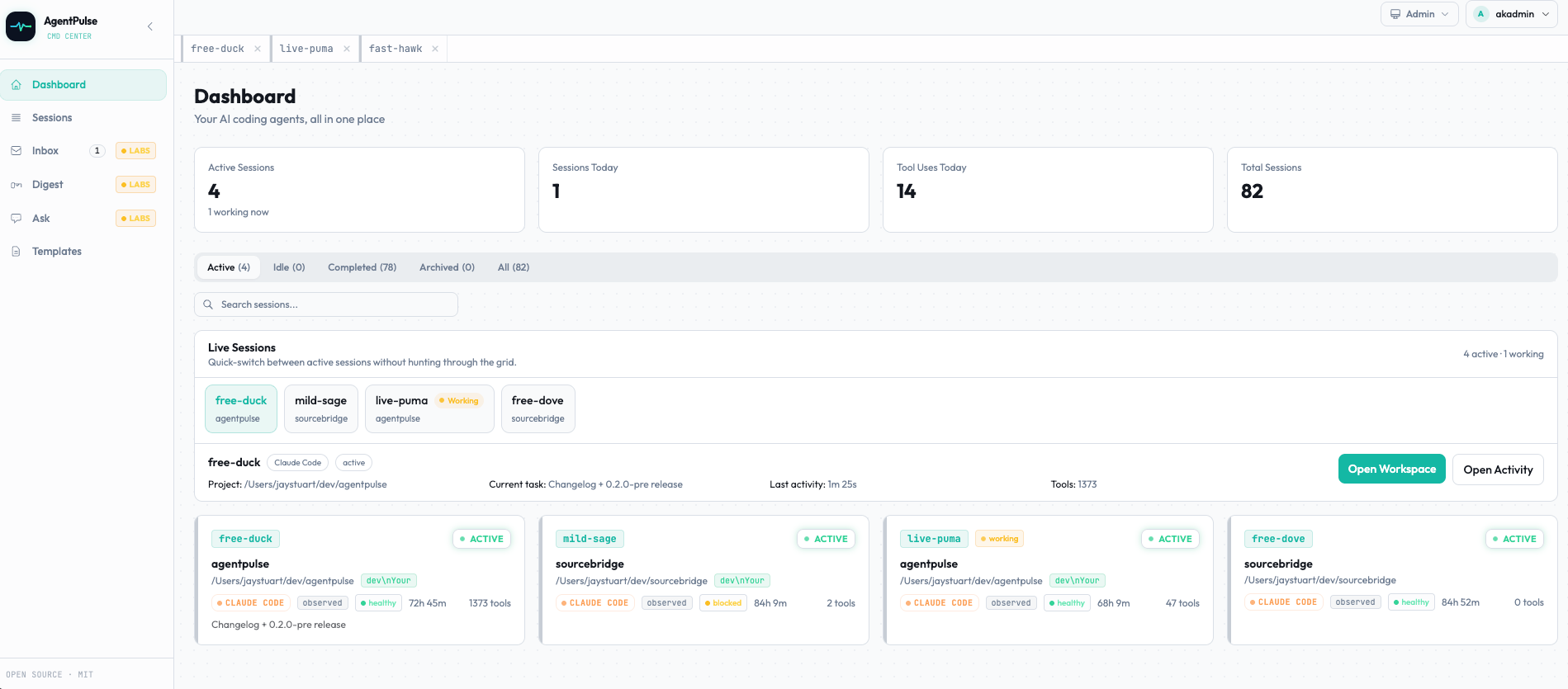
The AgentPulse dashboard: every running Claude Code, Codex CLI, Copilot CLI and OpenCode session in one grid, marked Working, Waiting, Idle or Error.
What AgentPulse is
AgentPulse has two major modes:
- Observability -- watch Claude Code, Codex, Copilot CLI, and OpenCode sessions in real time, with prompts, responses, progress, notes, and session history in one dashboard (Copilot CLI and OpenCode are observed only -- AgentPulse can't launch or steer them)
- Orchestration -- launch and manage sessions from AgentPulse itself with templates, supervisors, headless tasks, interactive sessions, retries, host routing, answering a managed Codex session's command and file-change approvals from the dashboard (see Answering Codex approvals), and continuing a Claude Code session you started by hand as a fork, with its approvals answered the same way (see Continuing a Claude Code session)
Plus an AI Labs layer that's very new and explicitly experimental -- see the Labs section below.
You can run AgentPulse as:
- observability only -- hooks + dashboard, no supervisor/control plane
- full local orchestration -- hooks + dashboard + local supervisor for launch/control on the same machine
- remote dashboard -- relay local events to a remote AgentPulse instance
Use cases
- Monitor multiple Claude Code sessions at once. One live grid instead of a dozen terminal tabs, with each session's state, last prompt and full history. Guide
- See agents on every machine in one place. A relay on each laptop, desktop or server forwards events to one dashboard, with a filter by machine. Guide
- Check on and control Claude Code from your phone or another computer. Watch any session remotely, and launch, prompt, stop or retry the ones AgentPulse started. Guide
- Self-host it for yourself or a team. Docker or Kubernetes, SQLite or PostgreSQL, behind Authentik, Authelia, oauth2-proxy, Pomerium or Cloudflare Access. Guide
- Let your agents manage your other agents over MCP. Claude Code or Codex CLI can list, search, launch and steer sessions through the
@craze0/agentpulse-mcpserver. Guide
Not sure whether you need monitoring or orchestration? See observability vs. orchestration for AI coding agents.
How it works
Your terminal tabs                          AgentPulse dashboard
┌─────────────────┐                        ┌──────────────────────┐
│ Claude Code (1) │──── hook events ──────>│  bold-falcon: active │
│ fixing auth bug │                        │  "fix the auth bug"  │
├─────────────────┤                        ├──────────────────────┤
│ Claude Code (2) │──── hook events ──────>│  zen-owl: active     │
│ writing tests   │                        │  "add unit tests"    │
├─────────────────┤                        ├──────────────────────┤
│ Codex CLI       │──── hook events ──────>│  warm-crane: idle    │
│ (idle)          │                        │  last: 5m ago        │
├─────────────────┤                        ├──────────────────────┤
│ Copilot CLI     │──── hook events ──────>│  quiet-otter: active │
│ (observed only) │                        │  "review the diff"   │
├─────────────────┤                        ├──────────────────────┤
│ OpenCode        │──── plugin events ────>│  calm-heron: idle    │
│ (observed only) │                        │  last: 2m ago        │
└─────────────────┘                        └──────────────────────┘
Each session gets a random memorable name (like bold-falcon) so you can match the dashboard to your terminal tabs at a glance. Click any session to see a live chat-style timeline of your prompts and the agent's tool usage.
Quick start
Easiest local install: 1 command
macOS / Linux:
This installs AgentPulse locally with Bun + SQLite, starts the web app and local supervisor as services, and configures Claude Code + Codex hooks automatically.
curl -fsSL https://raw.githubusercontent.com/jstuart0/agentpulse/main/scripts/install-local.sh | bash
Windows:
irm https://raw.githubusercontent.com/jstuart0/agentpulse/main/scripts/install-local.ps1 | iex
It needs curl and git, plus python3 for the supervisor and hooks. If it can't find a Bun 1.3.12 or newer it installs a pinned one, which also needs unzip and shasum or sha256sum. Anything missing is listed up front with the command to install it, and nothing is installed until it's there. To put Bun somewhere of your choosing (supply it again on a re-run; with a BUN_INSTALL other than ~/.bun, only $BUN_INSTALL/bin/bun is considered, not PATH):
curl -fsSL https://raw.githubusercontent.com/jstuart0/agentpulse/main/scripts/install-local.sh | BUN_INSTALL=/opt/bun bash
When it finishes, open http://localhost:3000 and start a new Claude Code or Codex session.
Docker install: 1 shell line
If you prefer Docker, this starts the container, waits for health, and configures hooks:
docker run -d -p 127.0.0.1:3000:3000 -v agentpulse-data:/app/data -e DISABLE_AUTH=true --restart unless-stopped --name agentpulse ghcr.io/jstuart0/agentpulse && until curl -fsSL http://localhost:3000/api/v1/health >/dev/null 2>&1; do sleep 1; done && curl -fsSL http://localhost:3000/setup.sh | bash
Security note:
-p 127.0.0.1:3000:3000binds the host port to localhost only. The older-p 3000:3000form would publish on all host interfaces, exposing the auth-disabled server to your LAN. Use the127.0.0.1:prefix wheneverDISABLE_AUTH=true.
Done. Open http://localhost:3000 and you have:
- live session observability
- local launch/control via the supervisor
- Claude Code + Codex hooks already configured
Why localhost? Claude Code and Codex block HTTP hooks to remote/private IPs as a security measure. Only
localhost/127.0.0.1is allowed. This keeps things simple -- one Docker container on your machine, no networking to configure. If port 3000 is taken, use any free port:docker run -d -p 127.0.0.1:4000:3000 -v agentpulse-data:/app/data -e DISABLE_AUTH=true -e PUBLIC_URL=http://localhost:4000 --restart unless-stopped --name agentpulse ghcr.io/jstuart0/agentpulse curl -fsSL http://localhost:4000/setup.sh | bash
What you'll see
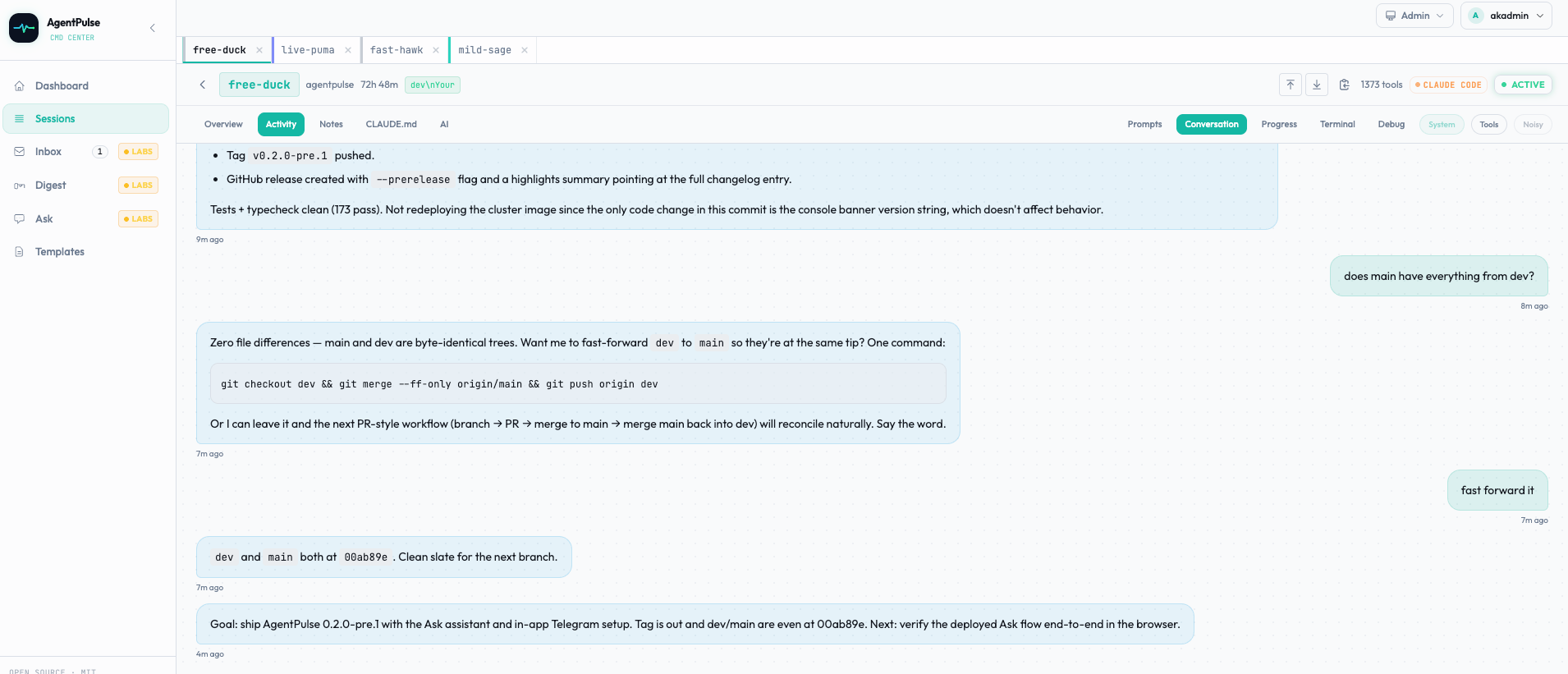
Session detail: a chat-style history of your prompts to one agent, with its tool calls inline.
- Dashboard -- grid of all sessions with status, project name, session name, duration, and tool use count. Each session is in exactly one operational state: Waiting (the agent finished a turn, or has an outstanding permission prompt, and is waiting on you -- "Mark as seen" clears it), Error (the session failed and hasn't been dismissed -- "Dismiss error" clears it), Working (the agent is actively working right now), or Idle (nothing is waiting and the agent isn't working). Status cards above the grid filter by state; a "What do these states mean?" popover repeats this explanation in the UI
- Session detail -- click a session to see a chat-style timeline with your prompts as blue bubbles and tool usage inline
- Unsent prompts -- a prompt you typed in a session's box and haven't sent is kept in your browser (in plain text, in
localStorage) for up to 7 days, per person and per session, so it survives switching sessions and reloading. It says "Unsent draft, saved ..." with a Discard draft button (and an Undo for a few seconds), drafts over 20,000 characters are kept only while the page is open, and Sign out removes every draft this browser holds - Projects -- first-class projects with cwd-based session resolution; sessions stamp themselves with the right project on ingest, templates inherit project defaults (cwd, agentType, model) with per-field overrides, and a
/projectspage lets you create / edit / delete them. Saving a template under a new directory auto-creates the project for you - Session templates -- save reusable Claude Code and Codex session setups, link them to a project for live-inheritance defaults, preview normalized launch specs, and route launches to the right host
- Orchestration -- launch headless or interactive sessions from AgentPulse, track launch status, retry, stop, and manage sessions through the local supervisor
- Search -- full-text across session names, prompts, plans, notes, and event payloads. SQLite uses FTS5 (BM25-ranked); Postgres uses ILIKE. Clicking an event hit jumps to the matching event in the timeline and applies a brief amber flash
- Inbox -- single
/inboxview that aggregates every open approval (HITL, Ask-driven actions, alert-rule firings), stuck / risky session warnings, and recent failures. Approve / decline inline; snooze noisy items - Real-time updates -- everything updates live via WebSocket, no refreshing needed
- Random session names -- each session gets a name like
brave-falconso you can tell them apart - CLAUDE.md editor -- view and edit your agent instruction files from the dashboard
- Setup page -- generates hook config you can copy-paste, or use the one-liner above
- MCP server -- let Claude Code, Codex CLI, or any MCP-compliant agent observe and orchestrate your fleet directly (list/inspect sessions, search, launch agents, steer live sessions, decide inbox items). Ships from a checkout via
agentpulse mcp serve, or standalone via the@craze0/agentpulse-mcpnpm package -- no checkout required. See below. - AI Labs (experimental) -- optional AI layer that watches sessions, classifies health, proposes next steps with human-in-the-loop approval, plus an Ask command surface that lets you launch / edit / search / summarize / alert in natural language. Each feature is behind its own Labs toggle. See below.
MCP server
AgentPulse can be driven by an external AI coding agent over the Model Context Protocol: read tools (sessions, search, digest, AI intelligence) plus orchestration tools (launch agents, prompt/stop live sessions, decide HITL/inbox items), gated behind a scoped API key.
From a checkout:
agentpulse mcp install --mint my-agent          # observe-only (read-only), the safe default
agentpulse mcp install --mint my-agent --orchestrate  # adds launch/steer/decide -- read the security notes first
Without cloning this repo -- the standalone @craze0/agentpulse-mcp npm package:
npx @craze0/agentpulse-mcp install --mint my-agent
Either way, install prints ready-to-paste Claude Code and Codex CLI config. See docs/MCP.md for the full tool catalog, client setup, and a security section covering what a manage-scoped key can do and why Codex CLI does not honor Claude Code's confirmation prompt.
AI Labs (experimental)
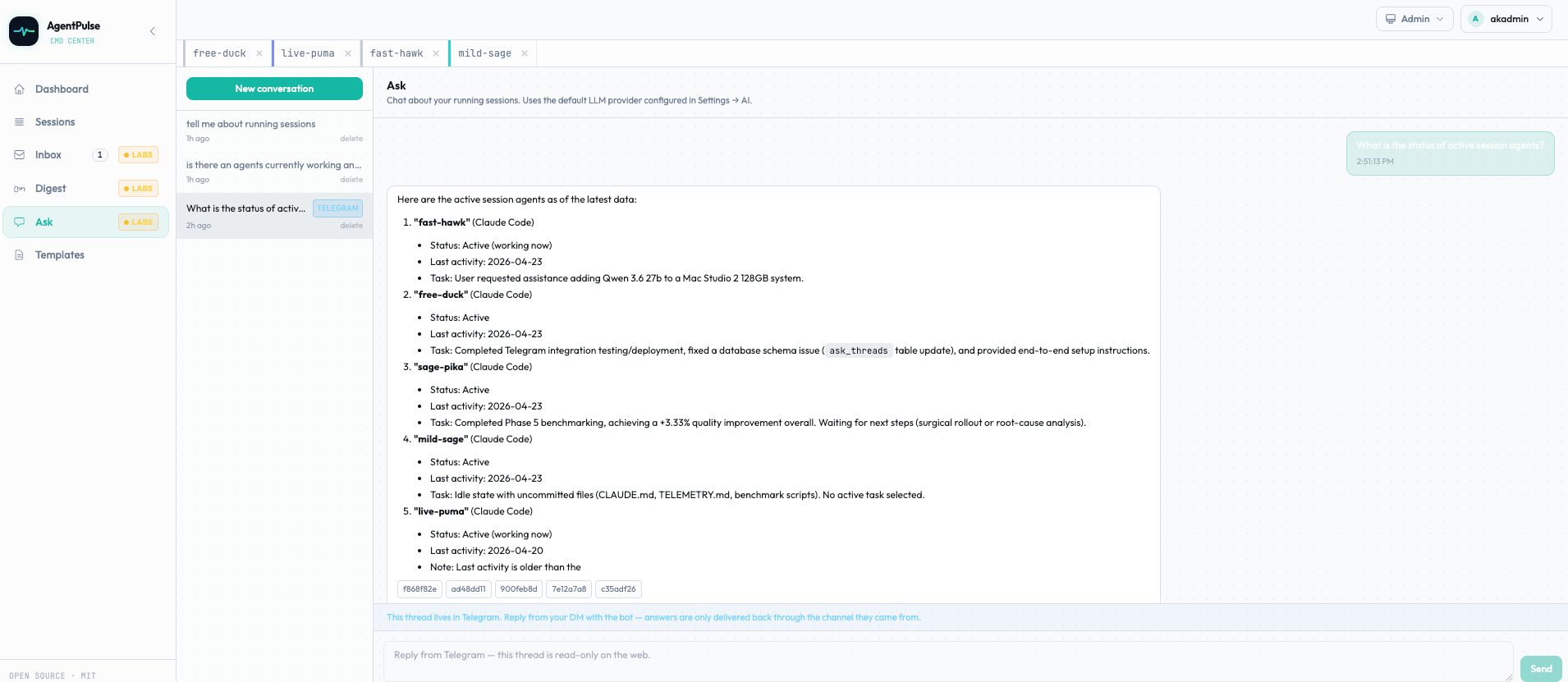
The Ask assistant: ask about, launch or search your agent sessions in plain language.
Heads up: the AI layer is new, shipping under explicit Labs framing. Every feature is toggleable under Settings → Labs. Contracts, UI, and defaults may change. Disable any toggle if it gets in your way -- nothing else in AgentPulse depends on it.
When enabled, AgentPulse can use an LLM provider you choose (Anthropic, OpenAI, OpenRouter, Google, or any OpenAI-compatible endpoint like Ollama / LM Studio / vLLM) to do the following. All AI work is human-in-the-loop by default: the watcher proposes, you approve or decline, and the runtime records every step as an auditable event.
AgentPulse MCP questions
How do I add AgentPulse MCP to Claude Code?
Run claude mcp add agentpulse -- npx -y @craze0/agentpulse-mcp in your terminal. Add --scope user to make it available in every project.
How do I add AgentPulse MCP to Cursor?
Open ~/.cursor/mcp.json and add the server under mcpServers, using the Cursor config shown in the install section above.
What can an AI agent do with the AgentPulse MCP server?
It can list and inspect sessions, search history, launch new agent sessions, steer live ones, and decide inbox items through the MCP server.
How do I install the AgentPulse MCP server without a checkout?
Use the standalone @craze0/agentpulse-mcp npm package; a checkout alternative is the agentpulse mcp serve command.
Which coding agents does AgentPulse support?
It supports Claude Code, Codex CLI, GitHub Copilot CLI, and OpenCode, though Copilot CLI and OpenCode are observation only.
Can AgentPulse run self-hosted?
Yes, it can be self-hosted via Docker or Kubernetes with SQLite or PostgreSQL, optionally behind an auth proxy.
Does AgentPulse show updates in real time?
Yes, sessions and events update live over WebSocket without refreshing the page.