
model-compose MCP server
Commit Nov 13, 2026Build and deploy declarative AI pipelines, autonomous agents, and MCP servers using a single YAML configuration file.
Also known as hanyeol/model-compose
- Stars
- 119
- Tools
- —
- Downloads, 30 days
- —
- Latest version
- —
- Last commit
- Nov 13, 2026
- License
- MIT
What is model-compose MCP?
model-compose builds and deploy declarative AI pipelines, autonomous agents, and MCP servers using a single YAML configuration file.
Summary generated from the project's README
About model-compose MCP server
Building declarative AI pipelines, autonomous agents, and MCP servers using a single YAML configuration file is what model-compose enables for developers. It allows you to define complex workflows involving models, tools, and memory without writing orchestration code. You can mix local models running via llama.cpp or vLLM with cloud APIs like OpenAI or Anthropic within the same system.
Users install the tool via pip or uv and manage their entire setup through a model-compose.yml file. The system supports various runtimes including Docker, virtualenvs, or native processes. It also provides an automatic web UI powered by Gradio for testing inputs and outputs. To turn a workflow into an MCP server for use in clients like Claude or Cursor, you simply change the controller adapter type in your configuration. This approach ensures that your AI definitions remain portable across different environments and deployment scales.
What you can do with it
- 1Deploying an MCP serverConvert any existing AI workflow into an MCP server compatible with Claude or Cursor by changing a single line in the YAML config.
- 2Creating autonomous agentsDefine a ReAct agent that can plan tasks and use tools like web search through a declarative configuration.
- 3Building RAG pipelinesConnect embedding models, vector databases, and generative models into a single cohesive workflow without glue code.
- 4Processing media streamsChain together audio extraction, transcription, and translation tasks into a continuous media pipeline.
Written from the project's README. Every use case is checked against a quote from it.
Configuration
OPENAI_API_KEY
| Name | Description | |
|---|---|---|
| OPENAI_API_KEY | — |
Automated checks
Ran Nov 13, 2026Full report →Not verified yet. A server needs a score of 80, no serious finding, and enough data for us to check. How checks work · What to fix for more points

- Source repository linked and reachablehanyeol/model-compose is public and reachablegithub.com/hanyeol/model-compose ↗Pass
- Package names this repository as its sourceNot checked
- Build provenance (Sigstore attestation)Not checked
- Open source license (OSI)MITspdx.org/licenses/MIT.html ↗Pass
- Commit or release in the last yearLast commit or release 2026-11-13github.com/hanyeol/model-compose ↗Pass
- OpenSSF ScorecardNot checked
- Package name not close to a popular packageNot checked
- No critical advisory in the package or its dependenciesNot checked
- No hidden instructions to the model0 tool descriptions and the README read; no override phrases, credential paths or hidden charactersPass
- Destructive tools are labelledNot checked
- Remote endpoint answers the MCP handshakeNot checked
README
View on GitHub


model-compose
One YAML file. Any model. Any protocol. Any runtime.
Build chat APIs, RAG pipelines, autonomous agents, and MCP servers without writing orchestration code — then run the same definition anywhere, like docker-compose.
AI systems shouldn't be locked into a single provider, runtime, or cloud. model-compose is built on four principles:
- Composable — Models, agents, workflows, tools, memory, and protocols are interchangeable building blocks.
- Portable — Define your AI system once and run it anywhere without re-engineering.
- Model-Agnostic — Mix local models and cloud APIs in the same system.
- Stream-Native — Tokens, audio, video frames, and events flow through workflows as first-class values.
Quick Start · What You Can Build · Documentation · Examples
Quick Start
Install with uv:
uv pip install model-compose
Or with pip:
pip install model-compose
Create model-compose.yml:
controller:
  adapter:
    type: http-server
    port: 8080
  webui:
    port: 8081

workflow:
  job:
    component: chatgpt
    input:
      prompt: ${input.prompt}
    output: ${output as stream/text}

component:
  id: chatgpt
  type: http-client
  base_url: https://api.openai.com/v1
  action:
    path: /chat/completions
    method: POST
    headers:
      Authorization: Bearer ${env.OPENAI_API_KEY}
      Content-Type: application/json
    body:
      model: gpt-4o
      messages:
        - role: user
          content: ${input.prompt}
      stream: true
    stream_format: json
    output: ${response[].choices[0].delta.content}
Run it:
export OPENAI_API_KEY=your-key
model-compose up
That's it. You're serving GPT-4o at http://localhost:8080 with a web UI at http://localhost:8081. No application code. No framework boilerplate. Same file runs locally, in Docker, or in production.
Automatic Web UI
Every workflow gets a browser UI for free — inputs, outputs, streaming, and file uploads are inferred from the schema. Two lines of YAML, no frontend code.
controller:
  webui:
    driver: gradio
    port: 8081
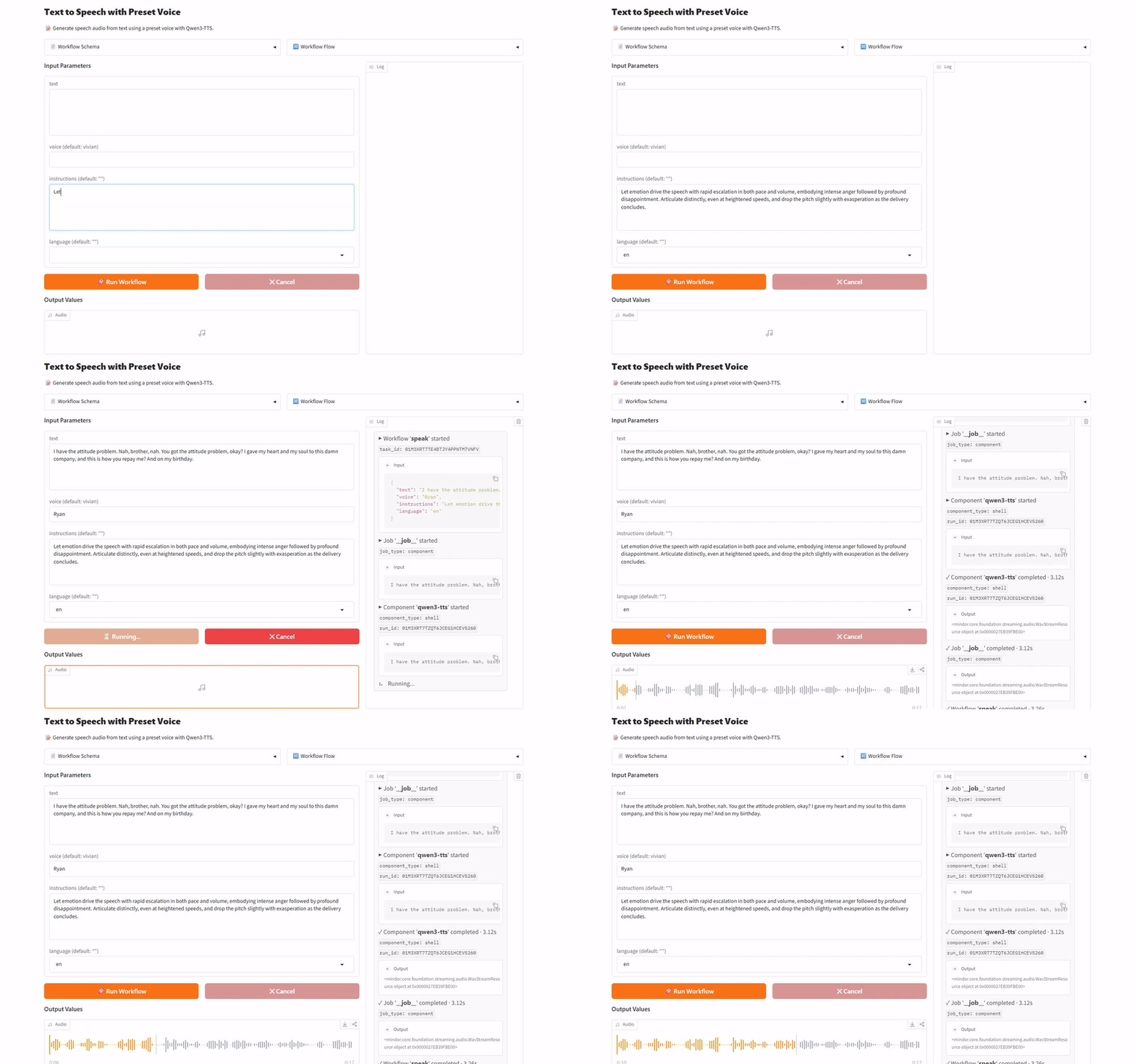
Perfect for iteration, demos, and sharing a workflow with non-engineers before wiring it into production.
What You Can Build
Here's what a single YAML file can serve today — just a few examples.
🤖 Autonomous Agents
Build a ReAct agent that plans, uses tools, and completes multi-step tasks — declaratively.
component:
  id: research-agent
  type: agent
  tools: [search-web, fetch-page]
  max_iteration_count: 10
  action:
    model:
      component: chatgpt
    system_prompt: You are a web research assistant.
    user_prompt: ${input.question}
See simple agents like a code reviewer, a RAG assistant, and a web researcher in agents/.
🧠 Local Models
Run open-weight models on your own hardware with PyTorch, vLLM, or llama.cpp — same YAML surface as cloud APIs, no SDK code.
component:
  type: model
  task: chat-completion
  model: HuggingFaceTB/SmolLM3-3B
  action:
    messages:
      - role: system
        content: ${input.system_prompt}
      - role: user
        content: ${input.user_prompt}
Point model: at any Hugging Face repo, or a local GGUF file via llama.cpp. Browse local chat, embedding, TTS, VLM, image/audio/video tasks under model-tasks/.
🔍 RAG Pipelines
Compose embedding, vector search, and generation into a single workflow — no glue code.
workflow:
  jobs:
    - id: embed
      component: embedder
      input: { text: ${input.query} }

    - id: retrieve
      component: knowledge
      action: search
      input: { vector: ${jobs.embed.output} }

    - id: answer
      component: chatgpt
      input:
        context: ${jobs.retrieve.output}
        question: ${input.query}
Native drivers ship for Chroma, Milvus, Qdrant, FAISS, Neo4j, ArangoDB, and Redis.
🎬 Media Pipelines
Chain audio, video, and image stages across models and native codecs — swap any step without touching the rest.
workflow:
  jobs:
    - id: extract-audio
      component: audio-extractor
      input: { source: ${input.video as video} }

    - id: transcribe
      component: whisper
      input: { audio: ${jobs.extract-audio.output} }

    - id: translate
      component: translator
      input: { text: ${jobs.transcribe.output} }

    - id: dub
      component: tts
      input: { text: ${jobs.translate.output} }

    - id: lip-sync
      component: wav2lip
      input:
        video: ${input.video as video}
        audio: ${jobs.dub.output as audio/wav}
      output: ${output as video/mp4}
See full video dubbing, scene detection, voice cloning, and face mosaic pipelines in media-processing/.
⚡ Streaming Multi-Modal Workflows
Stream tokens, audio chunks, and video frames end-to-end — first-class across every stage.
workflow:
  job:
    component: chatgpt
    output: ${output as sse-text}

component:
  id: chatgpt
  type: http-client
  action:
    body: { stream: true, ... }
    stream_format: json
    output: ${response[].choices[0].delta.content}
Real-time TTS, video-to-frames, and live chat examples live under data-streaming/ and showcase/.
🌐 MCP Servers
Turn any workflow into an MCP server that Claude, ChatGPT, or Cursor can use — one line change.
controller:
  adapter:
    type: mcp-server   # ← was: http-server
    port: 8080
Full examples live in mcp-servers/, including a Slack bot MCP.
From Development to Production
The same YAML that runs on your laptop scales without a rewrite.
1. Develop locally
model-compose up
Runs on your machine with a Gradio web UI at :8081 — perfect for iteration.
2. Deploy as a container
Add a runtime: block. Same file, same behavior:
controller:
  runtime:
    type: docker
    image: my-ai-service:latest
    ports: [ "8080:8080" ]
3. Scale horizontally
Add a queue. Dispatchers accept jobs, subscribers process them across N machines:
controller:
  adapter: { type: http-server, port: 8080 }
  queue:
    driver: redis
    host: redis.internal
    name: my-queue
No shared filesystem. No code changes. Just add more subscribers to scale.
Why model-compose?
| model-compose | Managed APIs (OpenAI, etc.) | Code Frameworks (LangChain, etc.) | |
|---|---|---|---|
| Time to first API | Minutes (one YAML) | Hours (SDK + server code) | Days (framework + integration) |
| Provider Coupling | Multi-provider via config | Single provider per SDK | Multi-provider via abstractions |
| Code Coupling | Declarative YAML — no application code | Application code required | Framework-specific code required |
| Infrastructure Control | Full Sovereignty | Provider-controlled | Heavy Abstraction |
| Runtime Flexibility | Hybrid-First (Local + Cloud) | Cloud Only | Complex to customize |
| Protocol Support | HTTP / WebSocket / MCP | Provider-specific | Limited |
| Data Streaming | First-class across all stages | Response-only (SSE tokens) | Framework-wrapped generators |
| Deployment | Docker / Native / Virtualenv / Process | Provider-managed | Manual integration |
Highlights
- Any model, anywhere — HuggingFace, vLLM, llama.cpp locally, or OpenAI/Anthropic/Google/xAI via HTTP
- Agents in YAML — ReAct loops, tool use, multi-step reasoning — no code
- Human-in-the-loop — pause workflows for approval, resume from CLI/UI/API
- 100+ components — models, agents, HTTP/WebSocket clients, vector/graph stores, shell, browsers, and more
- Any protocol — HTTP REST, WebSocket, or MCP with one line
- Any runtime — Docker, native, virtualenv, process, embedded — switch in one line
- Distributed — Redis queue dispatch for horizontal scaling
- Instant Web UI — Gradio-powered UI in 2 lines of YAML
- Streaming everywhere — SSE, WebSocket, and inter-job streams as first-class values
Examples
Browse examples by category:
| Category | What's inside |
|---|---|
agents/ |
Code reviewer, RAG assistant, Web researcher, Web page analyzer, ... |
showcase/ |
End-to-end pipelines: disk analysis, face-based scene search, real-time TTS |
model-providers/ |
OpenAI, Anthropic, xAI, Google, ElevenLabs, vLLM |
model-tasks/ |
Local chat, embedding, TTS, VLM, face embedding, ... |
media-processing/ |
Audio/video/image processing: extraction, conversion, scene detection |
media-broadcast/ |
Live broadcasting pipelines (e.g. YouTube Live over RTMP) |
web-automation/ |
Web scraping, headless browser automation, page capture |
text-processing/ |
Text chunking and preprocessing |
mcp-servers/ |
Build MCP servers exposed to Claude, Cursor, ChatGPT |
workflow-queue/ |
Redis-backed distributed dispatch (streaming + non-streaming) |
data-streaming/ |
Video-to-frames, YouTube live chat, streaming inputs |
job-flow/ |
Workflow control: conditional routing, hooks, interrupts |
integrations/ |
Vector/graph/KV stores, search engines, channels, tunnels |
runtime/ |
Component execution runtimes: Docker, Apple Container, virtualenv, ... |
Browse the full catalog in examples/README.md.
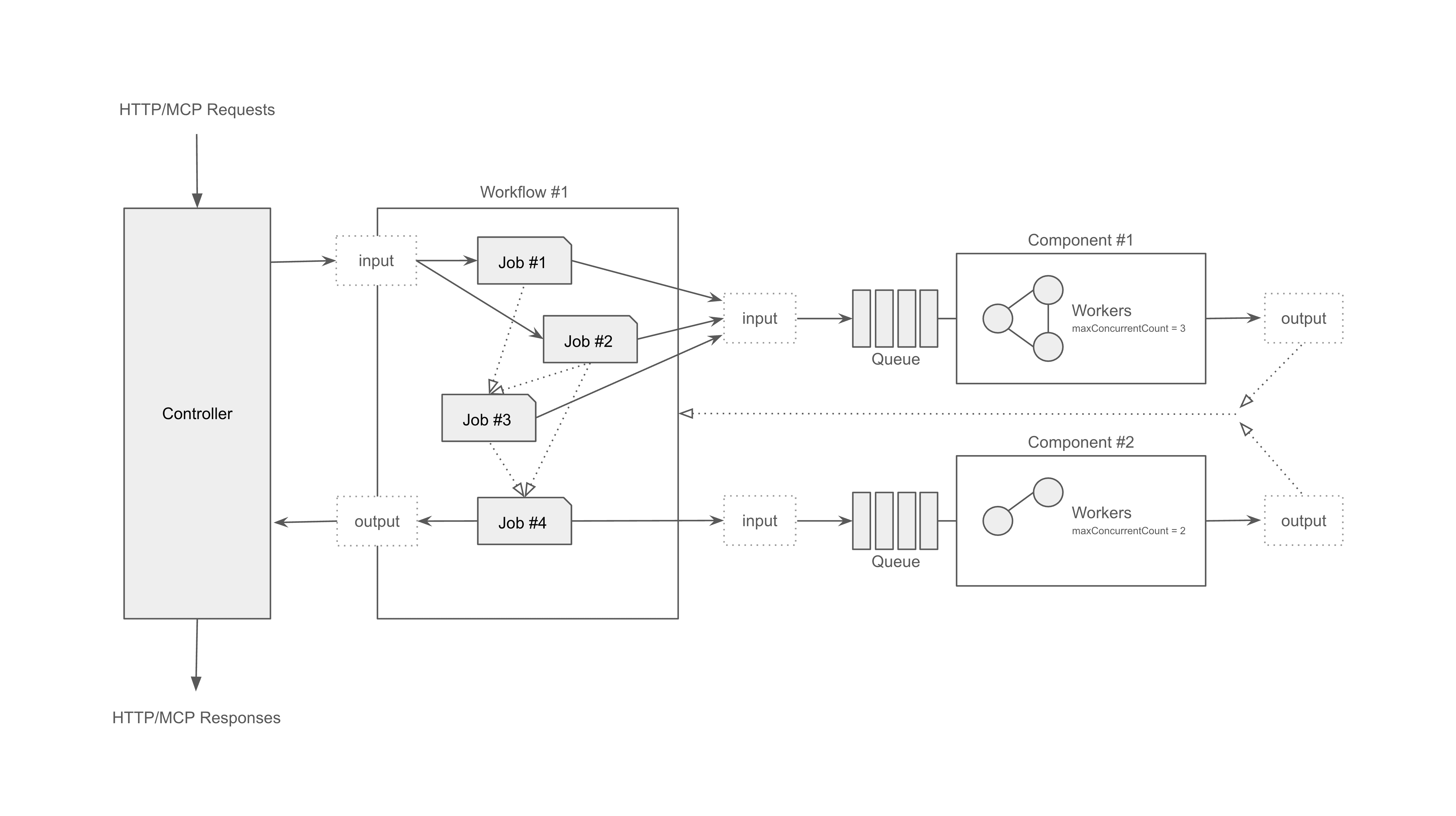
Architecture
Protocol adapters → Composition engine → Runtime executors
Contributing
We welcome all contributions — bug fixes, docs improvements, new examples.
git clone https://github.com/hanyeol/model-compose.git
cd model-compose
pip install -e .
See CONTRIBUTING if available, or open a PR directly.
License
MIT License © 2025-2026 Hanyeol Cho.
Contact
Have questions, ideas, or feedback? Open an issue or start a discussion on GitHub Discussions.
model-compose MCP questions
Can I run local models with model-compose?
Yes, you can run open-weight models on your own hardware using PyTorch, vLLM, or llama.cpp.
How do I turn a workflow into an MCP server?
You can convert any workflow into an MCP server by changing the controller adapter type to mcp-server in your YAML file.
Does it provide a user interface for my workflows?
Yes, every workflow automatically receives a browser-based UI using Gradio, which handles inputs, outputs, and streaming.