
SolFlow MCP server
Commit Nov 10, 2026Provides AI agents with Solidity call-flow analysis, including entry points, call trees, reachability, and interface bindings as plain text.
Also known as fuzious/solflow-mcp
- Stars
- 0
- Tools
- 8
- Downloads, 30 days
- —
- Latest version
- —
- Last commit
- Nov 10, 2026
- License
- AGPL-3.0
What is SolFlow MCP?
SolFlow provides AI agents with Solidity call-flow analysis, including entry points, call trees, reachability, and interface bindings as plain text. It exposes 8 tools, such as analyze_repo, list_entry_points, get_flow.
Summary generated from the project's README
About SolFlow MCP server
Security researchers and smart contract developers can use solflow-mcp to provide AI agents with deep visibility into Solidity codebases. Instead of relying on visual graphs that models cannot interact with, this server translates complex call-flow analysis into structured plain text. This allows agents in environments like Claude Desktop or Cursor to read, quote, and reason over contract logic, including modifiers, inheritance via C3 linearization, and library calls.
The server works locally by compiling repositories with crytic-compile and extracting facts using Slither. It provides specific tools to explore the attack surface, such as list_entry_points to identify mutating and read-only functions, and get_flow to retrieve indented call trees. Users can also resolve ambiguity by using set_interface_bindings to map interfaces to concrete implementations, helping the agent follow logic through external dependencies. This text-based approach is designed to be more token-efficient than JSON while remaining more readable for models than images.
What you can do with it
- 1Map the contract attack surfaceIdentify all external entry points and their associated modifiers to understand how a contract can be interacted with.
- 2Trace end-to-end execution flowsFollow a specific function call through its entire lifecycle, including internal calls and inherited logic.
- 3Resolve interface implementation gapsTell the agent which concrete contract implements a specific interface so it can continue analyzing the call path.
Written from the project's README. Every use case is checked against a quote from it.
SolFlow MCP tools 8
Detected from the READMEanalyze_repolist_entry_pointsget_flowget_function_sourcefind_paths_tolist_unresolvedset_interface_bindingsget_type_definition
Automated checks
Ran Nov 15, 2026Full report →Not verified yet. A server needs a score of 80, no serious finding, and enough data for us to check. How checks work · What to fix for more points

- Source repository linked and reachablefuzious/solflow-mcp is public and reachablegithub.com/fuzious/solflow-mcp ↗Pass
- Package names this repository as its sourceNot checked
- Build provenance (Sigstore attestation)Not checked
- Open source license (OSI)AGPL-3.0spdx.org/licenses/AGPL-3.0.html ↗Pass
- Commit or release in the last yearLast commit or release 2026-11-10github.com/fuzious/solflow-mcp ↗Pass
- OpenSSF ScorecardNot checked
- Package name not close to a popular packageNot checked
- No critical advisory in the package or its dependenciesNot checked
- No hidden instructions to the model8 tool descriptions and the README read; no override phrases, credential paths or hidden charactersPass
- Destructive tools are labelledNo tool named like delete, drop or execPass
- Remote endpoint answers the MCP handshakeNot checked
README
View on GitHubsolflow-mcp
SolFlow for AI agents. An MCP server that gives agents (Claude Code, Claude Desktop, Cursor and others) the same call-flow analysis of a Solidity repository that SolFlow shows developers in the browser, as plain text instead of a web UI.
SolFlow compiles a repo with crytic-compile, extracts facts with Slither, and builds one call tree per external
entry point. Modifiers are folded in, virtual and super calls are resolved through C3 linearization, and calls
it can't follow are explicitly marked. A developer explores the result as an interactive graph. An agent can't
use a canvas, so this server returns the same trees as compact text with line numbers that a model can read, quote and reason over.
Same analysis, two views
Every example below comes from the same small project: a Vault with deposits, withdrawals, an owner check,
a reentrancy guard and a pluggable IStrategy. The project is in tests/fixture.
Each screenshot from SolFlow's web UI is followed by the server's real output for the same contract and function,
so you can compare them side by side.
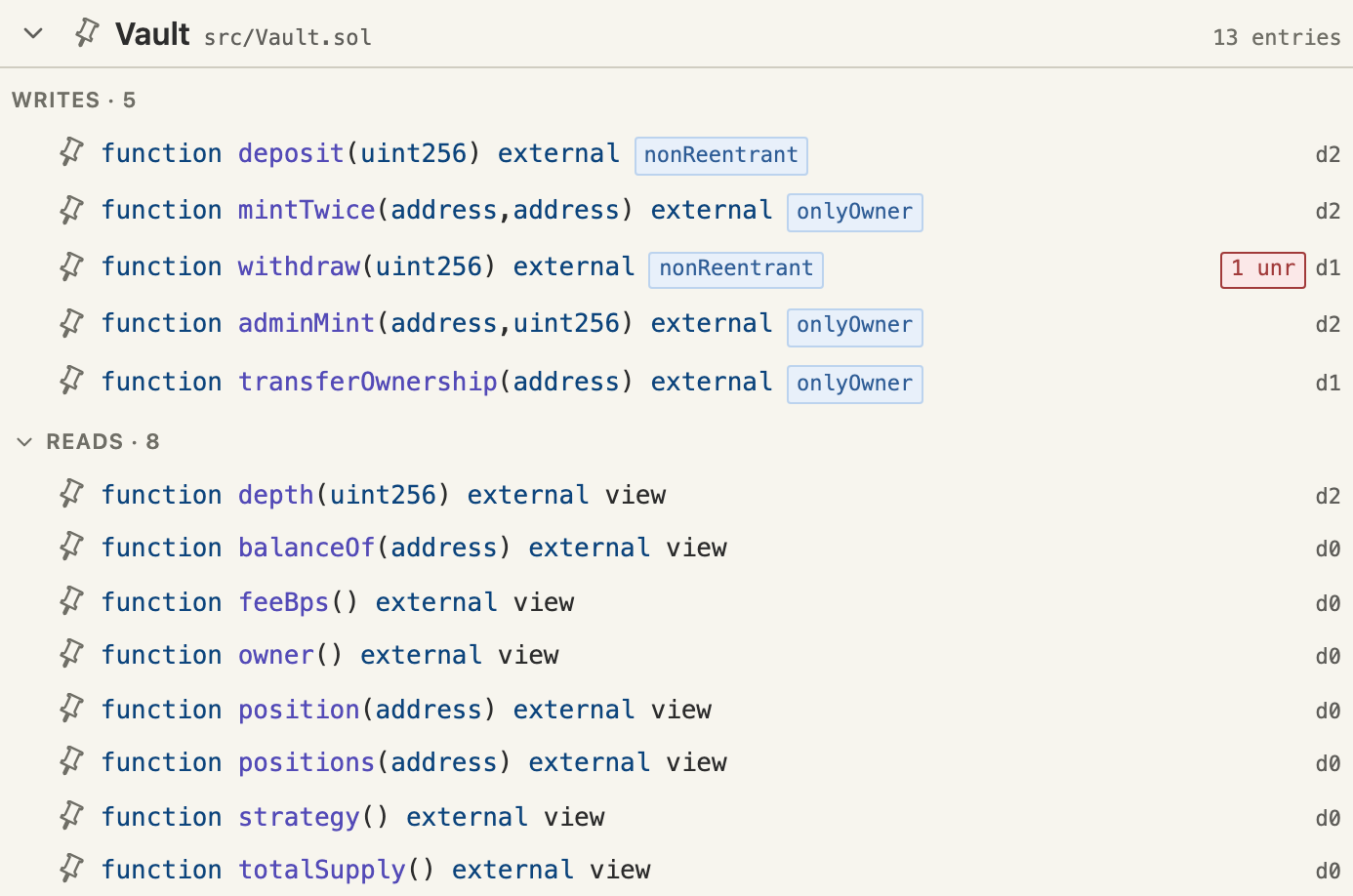
1. The attack surface of Vault
What a developer sees: the Vault section of SolFlow's overview page. Entry points are split into writes and reads,
with modifier badges, call depth (d2), and a red 1 unr badge where a flow contains a call that can't be followed.
What the agent sees: list_entry_points(repo_path), the Vault section
## Vault  (src/Vault.sol)
  mutating:
    adminMint(address,uint256)  mods=[onlyOwner]  depth=2 nodes=4
    deposit(uint256)  payable  mods=[nonReentrant]  depth=2 nodes=6
    mintTwice(address,address)  mods=[onlyOwner]  depth=2 nodes=6
    transferOwnership(address)  mods=[onlyOwner]  depth=1 nodes=2  (from Owned)
    withdraw(uint256)  mods=[nonReentrant]  depth=1 nodes=5  unresolved=1
  read-only:
    balanceOf(address)  depth=0 nodes=1  (from Token)
    depth(uint256)  depth=2 nodes=3
    feeBps()  depth=0 nodes=1
    owner()  depth=0 nodes=1  (from Owned)
    position(address)  depth=0 nodes=1
    positions(address)  depth=0 nodes=1
    strategy()  depth=0 nodes=1
    totalSupply()  depth=0 nodes=1  (from Token)
These are the same 13 entries. The modifier badges become mods=[...], d2 becomes depth=2,
the red 1 unr becomes unresolved=1, and (from Owned) says where an inherited function comes from.
The full output lists every contract the same way, under the header
19 entry points in 4 contracts. Format: signature mods=[...] depth nodes unresolved (inherited-from).
2. One flow, end to end: Vault.withdraw
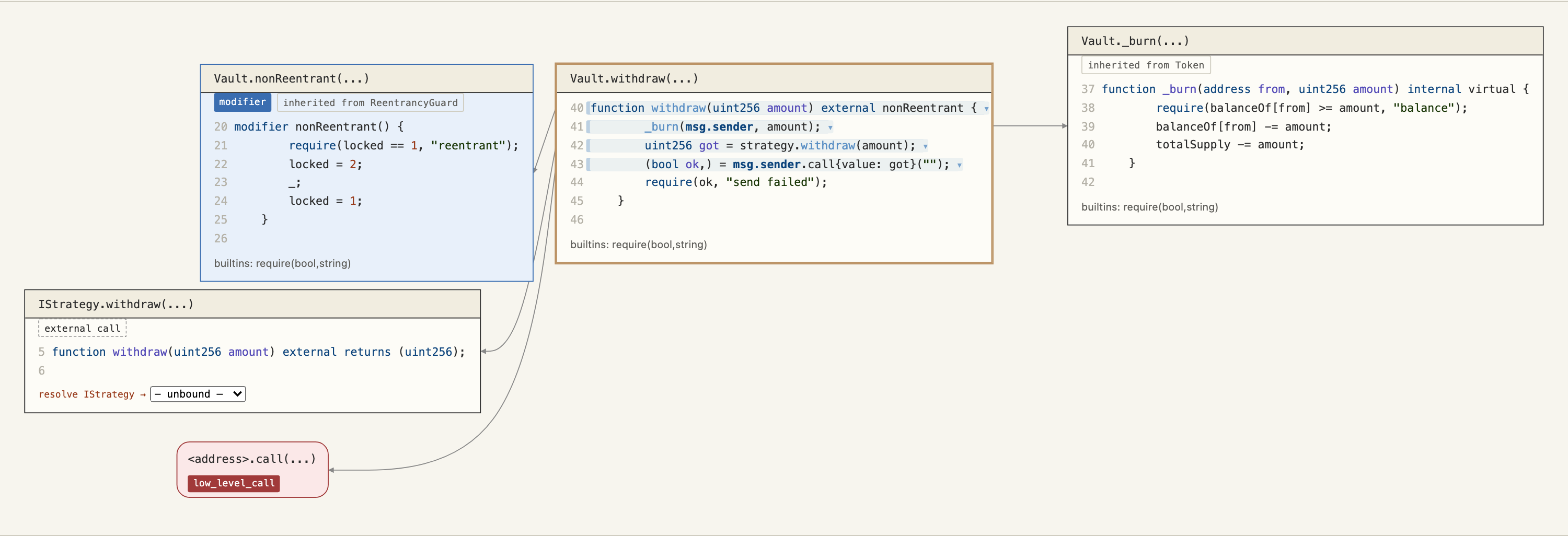
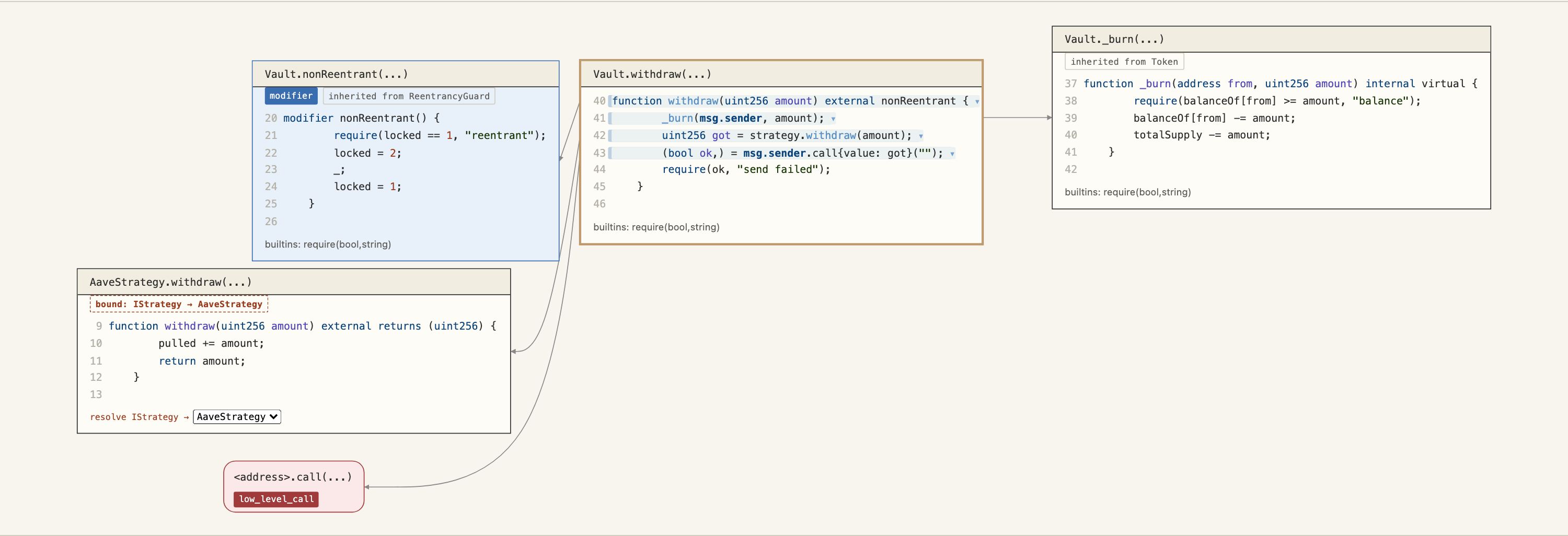
What a developer sees: the expanded graph of Vault.withdraw, with one card of source per call. The modifier is shown
in blue, the interface call has a "resolve IStrategy → unbound" picker, and the low-level .call is shown in red.
What the agent sees: get_flow(repo_path, "Vault.withdraw")
Vault.withdraw(uint256) [external, mutating]  src/Vault.sol:40-45  uses: require(bool,string)
├─ L40 modifier ReentrancyGuard.nonReentrant()  src/Base.sol:20-25  uses: require(bool,string)
├─ L41 internal → Token._burn(address,uint256)  src/Base.sol:37-41  uses: require(bool,string)
├─ L42 external → IStrategy.withdraw(uint256) ⚠ interface call, body unknown (no binding)  src/IStrategy.sol:5
└─ L43 UNRESOLVED [low_level_call] <address>.call(...) @ src/Vault.sol:43 (low_level/call)
Each line is: call-site line, call kind, target, and file:line-range. The order of operations
(burn at L41, then the external call at L42, then ETH sent at L43) can be read straight down the tree, and every node
can be quoted in a finding. Pass include_source=true to see the code cards from the graph, inlined under each node:
├─ L41 internal → Token._burn(address,uint256)  src/Base.sol:37-41  uses: require(bool,string)
│      37 |     function _burn(address from, uint256 amount) internal virtual {
│      38 |         require(balanceOf[from] >= amount, "balance");
│      39 |         balanceOf[from] -= amount;
│      40 |         totalSupply -= amount;
│      41 |     }
Card by card: the blue card is the modifier line, Vault._burn (inherited from Token) is the
internal → Token._burn line, the IStrategy.withdraw card with its unbound picker is the ⚠ interface call line,
and the red <address>.call card is the UNRESOLVED [low_level_call] line.
3. Libraries, super, and dependencies: Vault.deposit
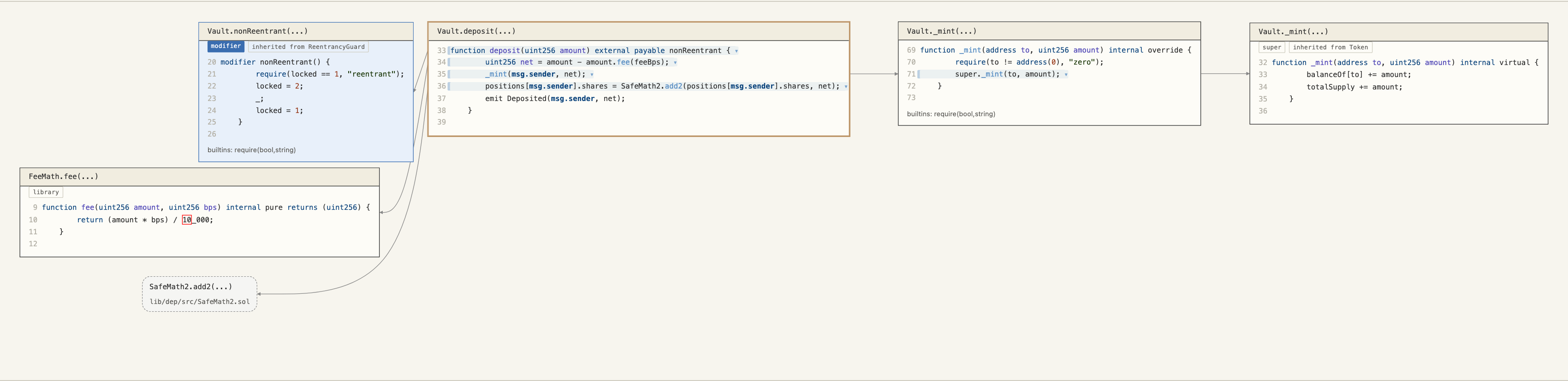
What a developer sees: Vault.deposit calls a library (FeeMath.fee), an override that calls
super._mint, and a dependency under lib/ (the dashed SafeMath2.add2 card) that is shown but not followed.
What the agent sees: get_flow(repo_path, "Vault.deposit")
Vault.deposit(uint256) [external, payable]  src/Vault.sol:33-38
├─ L33 modifier ReentrancyGuard.nonReentrant()  src/Base.sol:20-25  uses: require(bool,string)
├─ L34 library → FeeMath.fee(uint256,uint256)  src/Vault.sol:9-11
├─ L35 internal → Vault._mint(address,uint256)  src/Vault.sol:69-72  uses: require(bool,string)
│  └─ L71 internal → Token._mint(address,uint256) (via super)  src/Base.sol:32-35
└─ L36 external-dep (not followed) → SafeMath2.add2(uint256,uint256) [lib/dep/src/SafeMath2.sol]
4. Following IStrategy into AaveStrategy
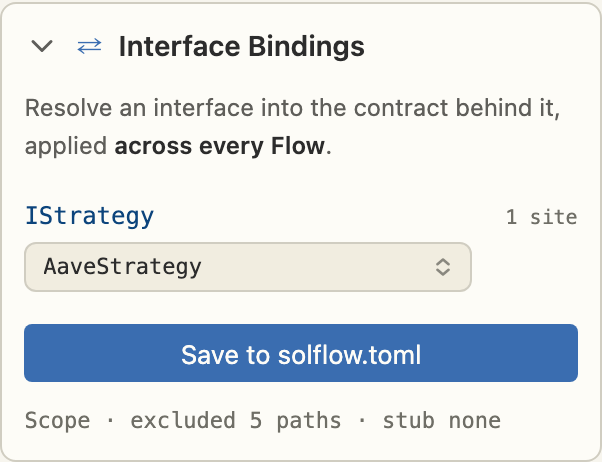
What a developer sees: the Interface Bindings panel on the overview page, with IStrategy set to
AaveStrategy. The same choice can be made from the picker on the interface card, and it re-renders every flow.
After binding, the Vault.withdraw graph replaces the IStrategy.withdraw stub with AaveStrategy.withdraw's real body,
labeled bound: IStrategy → AaveStrategy:
What the agent sees: first, list_unresolved(repo_path) reports what couldn't be followed and suggests candidates:
Unresolved call sites: 1

## low_level_call (1)
  src/Vault.sol:43  <address>.call(...)
     reached from: Vault.withdraw(uint256)

## Interface calls with no known body (bind with set_interface_bindings)
  IStrategy: reached from 1 entry point; candidates (inherit it or match all its methods): AaveStrategy, Vault
Then set_interface_bindings(repo_path, {"IStrategy": "AaveStrategy"}) rebuilds every flow without recompiling:
Active bindings: {'IStrategy': 'AaveStrategy'}
Across all flows (before → after):
  interface calls with no body: 1 → 0
  calls followed via a binding: 0 → 1
  other unresolved nodes: 1 → 1
After that, get_flow(repo_path, "Vault.withdraw") follows the call into the implementation. The node says the
binding was chosen, not proven:
Vault.withdraw(uint256) [external, mutating]  src/Vault.sol:40-45  uses: require(bool,string)
├─ L40 modifier ReentrancyGuard.nonReentrant()  src/Base.sol:20-25  uses: require(bool,string)
├─ L41 internal → Token._burn(address,uint256)  src/Base.sol:37-41  uses: require(bool,string)
├─ L42 external → AaveStrategy.withdraw(uint256) (BOUND IStrategy→AaveStrategy: asserted, not proven)  src/AaveStrategy.sol:9-12
└─ L43 UNRESOLVED [low_level_call] <address>.call(...) @ src/Vault.sol:43 (low_level/call)
5. Questions an agent asks directly
A developer answers these by clicking around the graph and reading code. An agent gets a tool for each.
Who can reach this function? find_paths_to(repo_path, "_mint")
3 entry points reach '_mint' (definitions: Token._mint(address,uint256), Vault._mint(address,uint256)). Shortest path each; [Ln] = call-site line in the caller.

• Vault.adminMint(address,uint256)  mods=[onlyOwner]  (2 matching calls in its tree)
    [L48] Vault._mint(address,uint256)

• Vault.deposit(uint256)  mods=[nonReentrant]  (2 matching calls in its tree)
    [L35] Vault._mint(address,uint256)

• Vault.mintTwice(address,address)  mods=[onlyOwner]  (4 matching calls in its tree)
    [L53] Vault._mint(address,uint256)
Show me this function. get_function_source(repo_path, "Vault._mint")
function Vault._mint(address,uint256)
location: src/Vault.sol:69-72
attributes: internal, mutating
params: address to, uint256 amount

69 |     function _mint(address to, uint256 amount) internal override {
70 |         require(to != address(0), "zero");
71 |         super._mint(to, amount);
72 |     }

outgoing calls (static, before virtual dispatch):
  L71 internal → Token._mint(address,uint256)
What is this type? get_type_definition(repo_path, "Position")
struct Position  (src/Vault.sol:14-17)
14 | struct Position {
15 |     uint256 shares;
16 |     Kind kind;
17 | }
  references: enum Kind
Mistakes come back as instructions, not stack traces:
No entry point 'Vault.withdrw'. Use list_entry_points to see valid names.
How the UI maps to the tools
| In the SolFlow UI | Tool the agent calls |
|---|---|
| Overview page: contracts, writes and reads, badges | list_entry_points |
| Flow graph with code cards | get_flow (include_source=true for code) |
Red unr badges, unbound interface cards |
list_unresolved |
| Interface Bindings panel and Save to solflow.toml | set_interface_bindings (save=true) |
CLI flags --exclude-path, --stub-path, --inline-library |
analyze_repo scope arguments |
| Clicking through cards to read code | get_function_source, get_type_definition |
| Searching flows by hand for a function | find_paths_to |
Why text and not images or JSON?
- Images: reading code from screenshots is slow and lossy for a model, and an image can't be quoted.
- JSON: carries the same information at roughly 1.5–1.9× the tokens. This was measured on real flows from a 35k-line protocol: a 177-node flow is ~5.5k tokens as a text tree and ~10.3k as JSON. Each line of the text tree stands on its own and its depth is visible from the indentation. In deep JSON the model has to track brackets across thousands of tokens to know which list of calls it's in.
Tools
| Tool | Purpose |
|---|---|
analyze_repo |
Compile or recompile (force=true) and set scope (excludes, stubs, inlined libs, bindings). Returns a summary. Optional: other tools compile automatically. |
list_entry_points |
All external entry points, grouped by contract and split into mutating and read-only, with modifiers, depth, node count and unresolved count. |
get_flow |
The call tree for one entry point as an indented text tree. include_source=true inlines line-numbered code. |
get_function_source |
Source and metadata of any function or modifier, plus its outgoing calls. |
find_paths_to |
Reverse reachability: which entry points reach X, and by which chain? |
list_unresolved |
Calls that can't be followed statically (interfaces, .call, Yul) and the entry points that hit them, plus candidate implementations to bind. |
set_interface_bindings |
Bind an interface to a concrete contract and rebuild instantly. Optionally save to solflow.toml. |
get_type_definition |
Struct, enum or user-defined value type definitions. |
Compilation runs once per repo and is cached: a few seconds for a small repo, and about a minute for a 35k-line via_ir protocol. All later calls are instant.
Install
Requirements
- uv. It installs Python 3.12, SolFlow, Slither and the MCP SDK.
- A
solcmatching the target, set up with solc-select:solc-select install 0.8.x && solc-select use 0.8.x. - The target project must build on its own first. Run
forge installornpm installbefore analyzing.
Claude Code
git clone https://github.com/fuzious/solflow-mcp.git
cd solflow-mcp && uv sync
claude mcp add solflow -- uv run --directory "$PWD" solflow-mcp
To make it available in every project, add --scope user.
Other MCP clients (Claude Desktop, Cursor and so on)
{
  "mcpServers": {
    "solflow": {
      "command": "uv",
      "args": ["run", "--directory", "/ABS/PATH/TO/solflow-mcp", "solflow-mcp"]
    }
  }
}
If the client can't find solc, add "env": {"PATH": "<your PATH including solc-select's bin>"}.
Agent skill
skills/solflow-audit/SKILL.md teaches an agent how to use these tools:
- the audit workflow and the order of calls;
- how to read every marker (
⚠,UNRESOLVED,BOUND,external-dep,NO IR); - scope controls;
- playbooks for access control, reentrancy and external-call ordering, and external trust boundaries;
- how to report what the analysis can't see.
Install it for Claude Code:
mkdir -p ~/.claude/skills && cp -R skills/solflow-audit ~/.claude/skills/
A typical agent session:
list_entry_points(repo_path): map the attack surface.get_flow(repo_path, "Vault.withdraw", include_source=true): read one flow end to end.find_paths_to(repo_path, "_mint"): find who can reach a sensitive internal function.list_unresolved(repo_path), thenset_interface_bindings(...): follow calls through interfaces.- After editing
.solfiles, runanalyze_repo(repo_path, force=true).
Notes
- Default scope: excludes
**/*.t.sol,**/test/**,**/tests/**,**/mocks/**,*Mock*contracts and dependency contracts (lib/**,node_modules/**). Project contracts still get the entry points they inherit from dependencies. Passuse_default_excludes=falseto include them all. - Dependencies: code under
lib/andnode_modules/is shown asexternal-depand not followed, unless you passinline_libraries. The same applies to dependency folders outside the project root, such as a monorepo package withlibs = ["../../lib"]. - Monorepos: point
repo_pathat the package that has thefoundry.toml. When its libs or remappings reach outside the package (../../lib), solc sees some files under two names, and Slither then silently drops whole contracts. The server avoids this by passing absolute paths to forge throughFOUNDRY_LIBS/FOUNDRY_REMAPPINGSfor its own build. Yourfoundry.tomlis never modified. - No silent gaps: if Slither still fails on part of a build,
analyze_repoprints⚠ ANALYSIS GAPS,list_entry_pointsnames the missing contracts, and affected tree nodes are markedNO IR. The agent is never shown an incomplete tree as if it were complete. - Not a vulnerability scanner: SolFlow shows structure. Finding bugs is the agent's job.
- Local only: analysis makes no network calls.
Development
uv sync
uv run pytest      # compiles the fixtures with solc and checks every tool
The tests compile tests/fixture, a single-package Foundry project, and
tests/fixture_monorepo, a package whose libraries live outside its root, and check every tool's output against the source.
License and credits
AGPL-3.0-only (see LICENSE), because this package imports SolFlow, which is AGPL-3.0-only. All of the analysis is SolFlow's work. This project is a text interface to it for agents.
SolFlow MCP questions
What tools does SolFlow MCP provide?
It exposes 8 tools, including analyze_repo, list_entry_points, get_flow, get_function_source, find_paths_to.
How does the server handle interface calls that cannot be followed?
The server identifies unresolved calls and allows the agent to bind interfaces to concrete contracts using the set_interface_bindings tool.
Can the agent see the source code of a function?
Yes, the agent can use the get_function_source tool or request inlined code within a call tree using the include_source parameter.