
romana MCP server
Commit Oct 28, 2026Enables AI agents to write, correct, and review Romanian text according to Romanian Academy norms using a local dictionary and grammar rules.
Also known as doITmagic/romana
- Stars
- 3
- Tools
- 3
- Downloads, 30 days
- —
- Latest version
- —
- Last commit
- Oct 28, 2026
- License
- MIT
What is romana MCP?
romana enables AI agents to write, correct, and review Romanian text according to Romanian Academy norms using a local dictionary and grammar rules. It exposes 3 tools, such as cauta_cuvant, verifica_text, doom3.
Summary generated from the project's README
About romana MCP server
Writing and reviewing Romanian text that adheres to Romanian Academy standards is what romana enables for AI agents. It prevents common issues like English calques, incorrect numerals, or missing diacritics by providing agents with 854 specific grammar rules and a local dictionary based on dexonline. This tool is designed for developers using agents like Claude Code, Codex, Cursor, or ChatGPT.
Users can choose between a local setup or a remote public server. The local version requires the romana binary to manage a 300 MB database for dictionary lookups via the cauta_cuvant tool. The public MCP server is a read-only, no-install option that provides the verifica_greseli tool for error checking and cauta_regula for accessing grammar rules. While the public server is free and requires no authentication, it does not include the full dictionary due to licensing restrictions.
What you can do with it
- 1Correcting grammatical errorsAn AI agent can identify and fix specific spelling or punctuation mistakes in Romanian text.
- 2Performing dictionary lookupsAn agent can use the local dictionary to find definitions or variants for rare words.
- 3Automating text reviewsA developer can set up a system to automatically check Romanian text in pull requests.
Written from the project's README. Every use case is checked against a quote from it.
romana MCP tools 3
Detected from the READMEcauta_cuvantverifica_textdoom3
Automated checks
Ran Nov 14, 2026Full report →Not verified yet. A server needs a score of 80, no serious finding, and enough data for us to check. How checks work · What to fix for more points

- Source repository linked and reachabledoitmagic/romana is public and reachablegithub.com/doitmagic/romana ↗Pass
- Package names this repository as its sourceNot checked
- Build provenance (Sigstore attestation)Not checked
- Open source license (OSI)MITspdx.org/licenses/MIT.html ↗Pass
- Commit or release in the last yearLast commit or release 2026-10-28github.com/doitmagic/romana ↗Pass
- OpenSSF ScorecardNot checked
- Package name not close to a popular packageNot checked
- No critical advisory in the package or its dependenciesNot checked
- No hidden instructions to the model3 tool descriptions and the README read; no override phrases, credential paths or hidden charactersPass
- Destructive tools are labelledNo tool named like delete, drop or execPass
- Remote endpoint answers the MCP handshakeNot checked
README
View on GitHub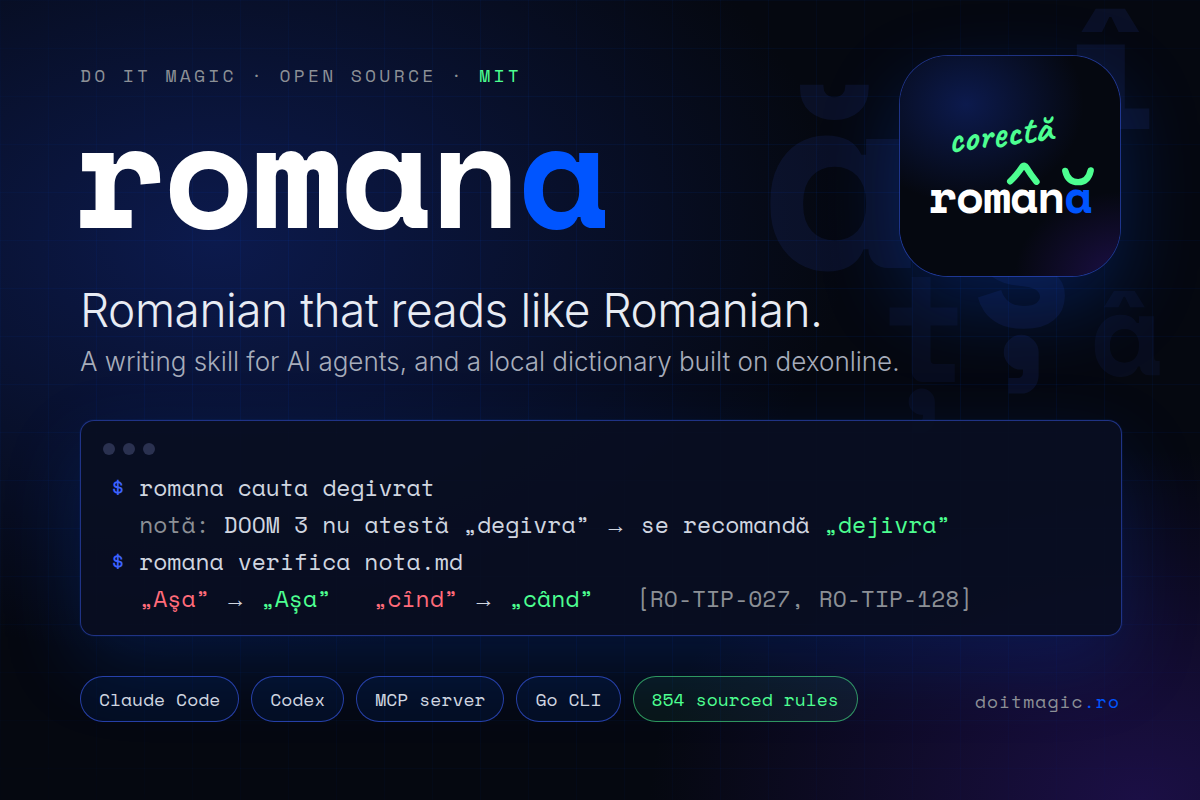



romana: Romanian that reads like Romanian
A writing skill for AI agents, and a local dictionary that backs it up. The agent writes, corrects and reviews Romanian by the norms of the Romanian Academy, and leaves alone the forms that were right all along.
Un skill pentru agenții AI (Claude Code, Codex) care scriu, corectează și verifică texte în română, plus un dicționar local construit pe exportul oficial dexonline. Fără instalare: serverul MCP public https://mcp.doitmagic.ro/mcp.
Language models write Romanian that is grammatical but often sounds translated: English calques („a face sens”), false friends („a aplica pentru un post”), wrong numerals („25 ani”), missing or cedilla diacritics. Asked to fix a text, they also "correct" forms that were right all along, such as „Dați click” or „orice întârzieri”. romana gives the agent the rules, the sources behind them and, just as important, the list of things that are not errors.
Ways to use it
| Use it as | What you get | Where |
|---|---|---|
| Plugin (recommended) | the skill, plus the dictionary as MCP tools, plus a hook that checks every file the agent writes | Claude Code. In Codex the plugin brings the skill and the public MCP server; add the local MCP server by hand. In claude.ai and ChatGPT it brings the skill and the public MCP server |
| Skill only | the 854 rules the agent reads while it writes, corrects or reviews; no binary, no network | any agent that reads Agent Skills (Claude Code, Codex, Cursor, Gemini CLI, Copilot …) |
| MCP server only | dictionary lookups (cauta_cuvant) and text checks (verifica_text), without the rules |
any MCP client |
| Public MCP server | https://mcp.doitmagic.ro/mcp, no install: the safe-error check (verifica_greseli) and the 854 rules (cauta_regula), without the dictionary |
any MCP client that takes a URL (ChatGPT, claude.ai, Cursor …) |
| CLI | romana cauta and romana verifica in a terminal or a script |
people, CI |
The plugin, the MCP server and the CLI use the romana binary: one prebuilt file, no Go needed. On first use it downloads the official dexonline export (~360 MB) and builds a local database (~300 MB) in about a minute.
No install: the public MCP server. Add
https://mcp.doitmagic.ro/mcpas a remote MCP server in ChatGPT, claude.ai, Claude Code, Codex, Cursor or VS Code and the assistant getsverifica_greseli(the sure errors) andcauta_regula(the 854 rules). Free and read-only; it keeps no texts. Setup for each app: Public MCP server.
Which one? In our tests the skill does most of the work. The dictionary adds to it on rare words, neologisms and variants that DOOM 3 does not record. On its own, the MCP server helps only with word lookups (Results).
For an AI agent asked to install this:
- Install the plugin straight from GitHub, no clone needed:
claude plugin marketplace add doITmagic/romana, thenclaude plugin install romana@romana(in Codex:codex plugin marketplace add doITmagic/romana, thencodex plugin add romana@romana).- Install the binary and run
romana cauta casăonce, so the dictionary is built.- In Codex, register the MCP server.
- Go through Check it works and report which steps passed.
Do not send requests to dexonline.ro yourself: the binary downloads the export it needs. Commands and limits for working on this repository: AGENTS.md.
Jump to: Install · How to use it · See it work · Check it works · Results · What it does · The dictionary tool · More from DO IT MAGIC
Install
Pick one: Plugin · Skill only · MCP server only · Public MCP server. The plugin and the MCP server also need the romana binary.
Plugin (recommended)
Claude Code gets the full plugin: the skill, the MCP server and the hook.
claude plugin marketplace add doITmagic/romana
claude plugin install romana@romana
Then install the binary and build the dictionary once with romana cauta casă. The skill appears as romana:romana. The MCP server starts once romana is on PATH; the hook also finds it in ~/.local/bin or ~/go/bin. You can also just give the agent the address of this repository and ask it to install the plugin: it runs the same commands. From a clone, for one session only, without installing: claude --plugin-dir ..
Codex reads the skill from the plugin; the plugin's MCP server entry and its hook are only for Claude Code:
codex plugin marketplace add doITmagic/romana
codex plugin add romana@romana
Then install the binary and add the server by hand to ~/.codex/config.toml, as under MCP server only.
claude.ai (web and desktop app): Customize → Plugins → Add → Add marketplace → Add from a repository → doITmagic/romana → Sync, then Add on Romana. With Sync automatically on, new versions arrive by themselves. You get the skill and the public MCP server (verifica_greseli, cauta_regula); the local dictionary server and the hook need the binary, so they do not run there.
ChatGPT (plugins for Codex): Plugins → Add → Upload plugin archive, with romana-plugin.zip from the latest release, then Install. The archive holds the skill and the public MCP server, without the local dictionary and the hook.
Skill only
No binary and no network.
- Claude Code: copy
skills/romana/from a clone (git clone https://github.com/doITmagic/romana.git) to~/.claude/skills/romana/.- You can also install the plugin without the binary. The skill works; the MCP server then shows as failed in
/mcp, and the hook stays silent.
- You can also install the plugin without the binary. The skill works; the MCP server then shows as failed in
- Codex: the two
codex plugincommands above. - claude.ai and ChatGPT: the plugin brings the skill and the public MCP server, never the local binary; see above.
- Other agents (Cursor, Gemini CLI, Copilot and others): copy
skills/romana/into the directory where your tool looks for Agent Skills (see its documentation). We test Claude Code and Codex.
Public MCP server
https://mcp.doitmagic.ro/mcp (Streamable HTTP), free, read-only, nothing to install, open to any AI assistant. Two tools that need no dictionary:
verifica_greseli: the errors that are wrong anywhere (ș and ț with a cedilla, the old spelling with „î” inside words and „sînt”, „vroiam”, spaces before punctuation and double spaces), each with its rule and source;cauta_regula: the 854 rules of the skill, by ID (RO-TIP-027) or by words („a face sens”), with level, examples and source.
The dexonline dictionary is not on the server: its license does not allow serving it to others, so cauta_cuvant stays with the local binary. For the best results, use the server together with the skill.
ChatGPT: install romana-plugin.zip as above; the archive already includes the server.
claude.ai (web and desktop app): Customize → Connectors → Add custom connector, URL https://mcp.doitmagic.ro/mcp, no authentication.
Claude Code:
claude mcp add --transport http romana-public https://mcp.doitmagic.ro/mcp
Codex: the plugin installed from doITmagic/romana already includes it (mcp.json). By hand, in ~/.codex/config.toml:
[mcp_servers.romana-public]
url = "https://mcp.doitmagic.ro/mcp"
Cursor, in ~/.cursor/mcp.json:
{ "mcpServers": { "romana-public": { "url": "https://mcp.doitmagic.ro/mcp" } } }
VS Code (GitHub Copilot chat and agent mode), in .vscode/mcp.json:
{ "servers": { "romana-public": { "type": "http", "url": "https://mcp.doitmagic.ro/mcp" } } }
GitHub Copilot coding agent, on github.com: the repository's Settings → Copilot → Coding agent → MCP configuration:
{ "mcpServers": { "romana": { "type": "http", "url": "https://mcp.doitmagic.ro/mcp", "tools": ["*"] } } }
The agent can then check the Romanian texts it writes in pull requests. For a check that runs on every pull request without an agent, use the GitHub Action.
Limits, so that the server stays fast for everyone: 10 requests per second from the same address (bursts up to 50), 8 requests processed at once, texts up to 200,000 characters (1 MiB per request), cauta_regula queries up to 200 characters, 10 seconds per request; the container has half a CPU and 128 MB of memory. Per address and per day (UTC): 2,000 tool calls and 600 different rules from cauta_regula; ChatGPT's published addresses are exempt, since all its users share them. Over a limit the server answers 429 or 503 with Retry-After. All the rules are on GitHub anyway, in skills/romana/references/.
Privacy: checked texts stay in memory only while the answer is computed and are never stored. Usage statistics record the tool, the client app, the country, cauta_regula queries and the IDs of the rules found, not the texts; see PRIVACY.md and TERMS.md.
Run your own: the code is cmd/romana-public (Go, Echo v5), and deploy/mcp/ runs it in Docker behind nginx-proxy: docker compose -f deploy/mcp/docker-compose.yml up -d --build.
MCP server only
The dictionary tools in any MCP client, without the skill. Install the binary and run romana cauta casă once, then register the server.
Claude Code:
claude mcp add romana -- romana mcp
Codex, in ~/.codex/config.toml:
[mcp_servers.romana]
command = "romana"
args = ["mcp"]
Clients that read an mcpServers block (Claude Desktop, Cursor and others) take the same entry:
{
  "mcpServers": {
    "romana": { "command": "romana", "args": ["mcp"] }
  }
}
We test Claude Code and Codex. Other clients should work, since the server speaks plain MCP over stdio, but they are not in our test runs.
The romana binary
You do not need Go. On Linux and macOS:
curl -fsSL https://raw.githubusercontent.com/doITmagic/romana/main/install.sh | sh
The script picks the archive for your system from GitHub Releases, checks it against SHA256SUMS, and installs romana into ~/.local/bin. ROMANA_DIR changes the directory and ROMANA_VERSIUNE picks a version. It tells you if the directory is not on PATH.
- Windows: download the
.zipfor your architecture from the Releases page, putromana.exein a folder and add that folder toPATH. The CLI and the MCP server work (use the entry under Other MCP clients); the plugin hook does not run on Windows, because Windows has nosh. - With Go:
go install github.com/doITmagic/romana/cmd/romana@latest. - From source (also before the first release is published), in the clone:
go build -o ~/.local/bin/romana ./cmd/romana. A binary built from source reports its version asromana dev; the release binaries report the tag.
Then build the dictionary once, before the MCP server first starts:
romana cauta casă
The first run downloads the official dexonline export (GPL v2+, about 360 MB) and builds a local SQLite database in about a minute; later lookups answer at once. Nothing is downloaded again until the export changes. The binary also works on its own, as a CLI: see The dictionary tool.
How to use it
Once romana is installed (skill, plugin or public MCP server), you just talk to your assistant in plain words. It picks the right tool by itself; if it does not, name the tool in the request („folosește verifica_greseli”).
| You ask | What the assistant does |
|---|---|
| „Corectează e-mailul de mai jos și spune-mi ce ai schimbat.” | corrects what is objectively wrong, only suggests matters of taste, and lists the changes with their rules (skill; verifica_greseli for the sure errors) |
| „Verifică textul acesta, nu-l rescrie: …” | reports each problem with its level (norm, recommendation, disputed) and reason, without touching the text (skill) |
| „Scrie o descriere de produs pentru magazinul online, în română firească.” | writes directly in Romanian, without calques, then rereads the draft against the rules (skill) |
| „Are diacritice greșite textul acesta? …” | finds ş/ţ with a cedilla, „î” inside words, „sînt”, „vroiam”, bad spacing, and gives the fix for each (verifica_greseli) |
| „E corect «a face sens»? Arată-mi regula.” | finds RO-CAL-063 and answers with the rule, its level and source: „a avea sens” (cauta_regula) |
| „Ce spune regula RO-TIP-027?” | returns the full rule, with examples and source (cauta_regula) |
| „E corect «Prețurile sunt scumpe»?” | says it is correct and leaves it alone, with the rule from the list of things that are not errors (cauta_regula, RO-NUG-127) |
| „Caută «degivrat» în dicționar.” | looks the word up in the local dexonline database: it is not in DOOM 3, use „dejivrat” (cauta_cuvant, local binary only) |
Tips:
- Say what you want done: write („scrie”, „rescrie”, „tradu”), correct („corectează”) or check („verifică”, „e corect?”). Each mode changes the text differently; „verifică” never rewrites it.
- Say who will read it if it matters (press, marketing, an e-mail, an interface, documentation): the register follows.
- Ask for the rules („cu regulile aplicate”) when you want to see why something changed; every rule has an ID you can look up later.
- The public server is not a dictionary. It knows the sure errors and the rules, not every word. For word lookups install the local binary.
See it work
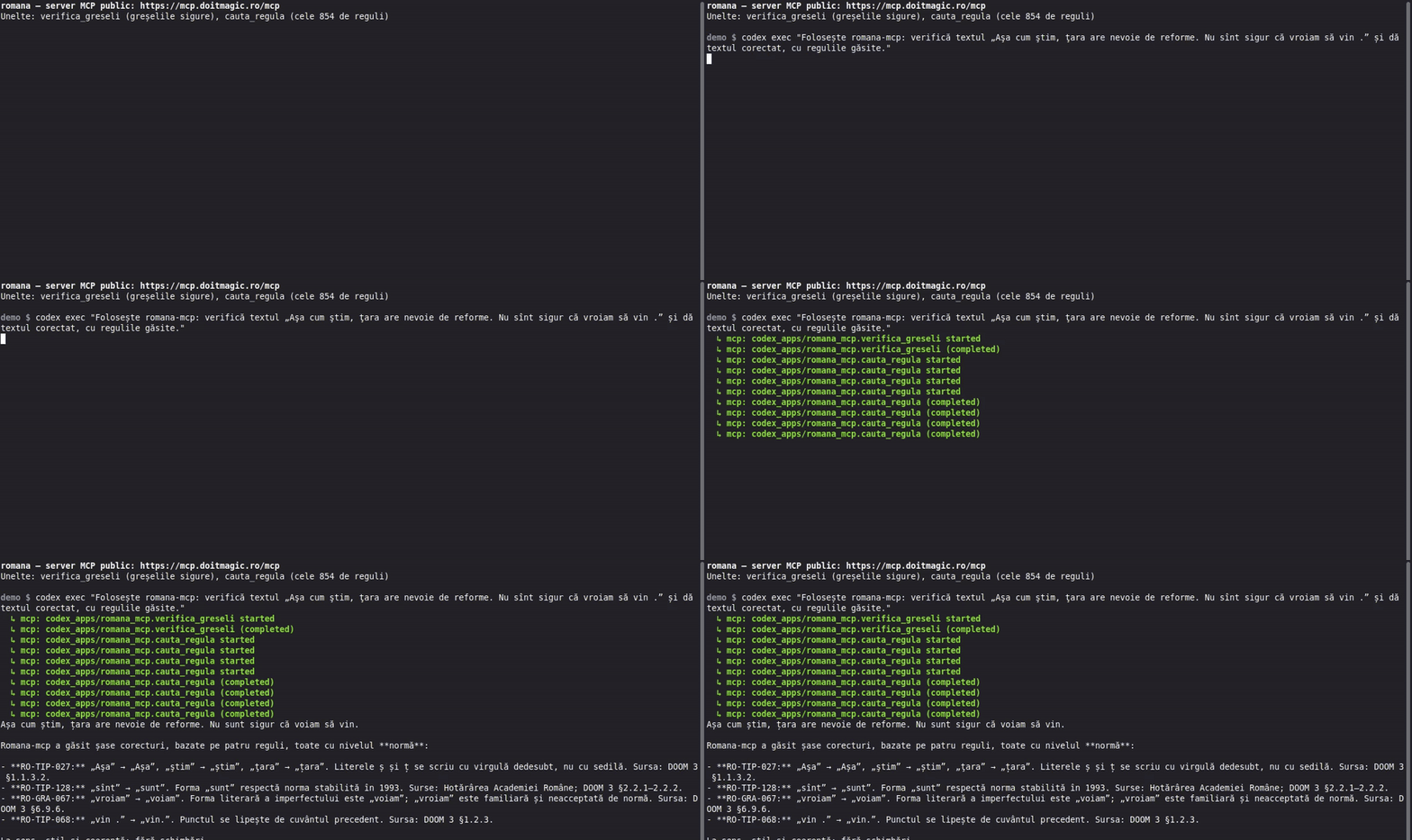
The public MCP server, called from Codex. The assistant checks a text with verifica_greseli, looks up each rule with cauta_regula, and answers with the corrected text and the rules (full video, 2 minutes):
The agent, with and without the skill. The test case hipercorectie-09 asks for a correction of a text that is already correct:
Datele se sincronizează în timp real. Dați click pe pictogramă, apoi dați refresh listei. Nu au fost găsite rezultate pentru căutarea dvs.
Without the skill, both Claude and Codex "fixed" „click” into „clic”, and Codex also rewrote „dați refresh listei”. With the skill, both returned the text unchanged: DOOM 3, the official spelling dictionary, records „click” and „refresh”, and the sentence is grammatical.
The dictionary tool. A form the norm does not record, and what to use instead:
$ romana cauta degivrat
degivra (verb)
  notă: DOOM 3 nu atestă „degivra”, iar definiția trimite la „dejivra”, pe care DOOM 3 o atestă.
        De regulă se recomandă „dejivra”, cu formele ei flexionare; „degivra” e o variantă pe
        care norma nu o înregistrează.
  surse: DEX '98, Ortografic, NODEX, DN, DEX '09, DOR, MDA2
  [DEX '98] DEGIVRA vb. I v. dejivra.
The errors that are wrong in any context, and the words the dictionary does not know (output shortened with „…”):
$ printf 'Aşa e, cînd vine. Sînt aici.\n' | romana verifica -
„Aşa” → „Așa”: ș și ț se scriu cu virgulă dedesubt, nu cu sedilă; … (DOOM 3 §1.1.3.2) [RO-TIP-027]
„cînd” → „când”: Grafia cu „î” în interiorul cuvintelor și „sînt” a fost înlocuită din 1993 … [RO-TIP-128]
„Sînt” → „Sunt”: … [RO-TIP-128]
Verificarea acoperă doar existența fiecărui cuvânt în dicționar și greșelile sigure, …

$ echo "Aplicatia trimite raportul." | romana verifica -
necunoscut: „Aplicatia” – poate: aplicația
The tool speaks Romanian, because so do the texts it checks. Every report ends with what it does not check (agreement, meaning, coherence, punctuation, style), so an empty report is never read as "the text is correct".
Check it works
-
The binary and the dictionary:
romana --version romana cauta casă # lemma, forms, sources, definitions -
The skill is loaded. In Claude Code, type
/romana: the skillromana:romanashows up in the list. In Codex, ask the agent which skills it has. If the skill is missing, repeat the install step for your agent before going on. -
The skill works. Ask the agent, in any language:
Corectează textul: „Dați click pe buton. Avem 25 ani de experiență.”
A working skill keeps „Dați click” (DOOM 3 records it) and changes „25 ani” into „25 de ani” (rule RO-NUM-001), with the level and the reason.
-
The MCP server. In Claude Code,
/mcplistsromanawith two tools,cauta_cuvantandverifica_text; in Codex,codex mcp listshowsromana. Then ask the agent: "Use the cauta_cuvant tool on «degivrat»." The answer must mention the note that recommends „dejivra”. -
The hook (Claude Code, with the plugin). It runs the offline linter, without the dictionary, on
.md,.txtand.htmlfiles right after the agent writes them, when the text is Romanian. Ask the agent to create a.mdfile with its file-writing tool and exactly this content: „Aşa e, cînd vine echipa, iar raportul e gata pentru că sunt aici.” Right after the write, the agent receives the list of sure errors and fixes them. If nothing happens, checkcommand -v romanaorls ~/.local/bin/romana: the hook stays silent when it cannot find the binary.
Results
The skill, with and without
From the full run on 22 October 2026: 161 cases (146 public, 15 private), one run per case and arm. Claude is Claude Sonnet, Codex is gpt-6.1-sol, and the writing judge is Claude Opus (median of 3 judgements). Each cell shows the total over the group, without skill → with skill; lower is better.
| Group | What a good answer does | Claude | Codex |
|---|---|---|---|
| Correct forms that look wrong (17) | leaves them alone | false positives 9 → 0 | 11 → 0 |
| Clean texts (34) | leaves the text unchanged | false positives 1 → 0 | 10 → 6 |
| Corrections (14) | fixes the real errors | missed 14 → 1, false positives 0 → 2 | missed 2 → 1, false positives 22 → 4 |
| Review of a text in context (18) | reports real problems only | false positives 21 → 3, missed 11 → 3 | false positives 27 → 3, missed 10 → 5 |
| Review of real press texts (6) | reports real problems only | false positives 2 → 4, missed 6 → 1 | false positives 1 → 1, missed 7 → 2 |
| Fidelity and preservation (30) | keeps facts, figures and quotations | all faithful; false positives 6 → 0 | all faithful; false positives 14 → 0 |
| Writing, scored by a judge model (23: 20 writing, 3 fidelity cases) | no calques, coherent text | judge-counted problems 7 → 3 | 1 → 2 |
| Starting the skill (22) | starts only for Romanian text work | 11 of 11 relevant, 0 of 11 unrelated | not measurable |
The skill meets every threshold on Claude. Two weak spots remain: on real press texts Claude still flags a little more than the bare model (4 false positives against 2, on 6 texts), and in corrections it makes 2 unnecessary changes where the bare model makes none, while missing far fewer real errors. On Codex it meets every threshold except writing, where the counts are too small to tell: 21 of the 23 cases came out the same, one better and one worse.
The skill, with and without the dictionary tool
From the final run on 23 October 2026: the 42 cases where the dictionary could help or hurt (12 reviews where a form is right or wrong depending on context, 13 corrections, 17 correct forms that look wrong), two runs per case, in four arms. Averages per run; lower is better.
| No skill, no dictionary | Dictionary only | Skill only | Skill + dictionary | |
|---|---|---|---|---|
| Claude: false positives | 23 | 13.5 | 7.5 | 0 |
| Claude: missed | 14.5 | 12.5 | 1 | 1 |
| Codex: false positives | 36 | 41 | 1.5 | 1.5 |
| Codex: missed | 6 | 6.5 | 2.5 | 3 |
On the 20 word cases (variants, wrong forms such as „să continuie”, and words the dictionary does not have, which the agent must leave alone and list as unverified), missed per run: Claude 5.5 / 3.5 / 3.5 / 1.5, Codex 5.5 / 4 / 1 / 0, in the same order. No arm flagged a correct form there.
What it means: the skill does most of the work. The dictionary alone helps little, and on Codex it adds false positives. Together they give the best result on Claude and on words; on Codex they are level with the skill alone on the 42 cases (half a missed error more, on average).
The first measurement with the dictionary was worse than the skill alone: Claude missed 6 problems instead of 0.5. The saved answers showed why: with two tools that "check Romanian text", the skill did not load in 19 of 84 runs, and the dictionary checks words, not meaning. The skill's description now says it applies when dictionary tools are present, and the server's instructions tell the agent to load a Romanian writing skill first. Since then, Claude loads the skill in every run.
What these numbers are not
They come from this project's own test set, with one or two runs per case, and they hold for the models listed above. There is no official benchmark yet for an agent that writes Romanian by the norms and avoids hypercorrection. A run on RONACC (Romanian National Audiovisual Council Corpus), the academic corpus for Romanian grammatical error correction, is in progress. The corpus comes from Coteț, Ruseti and Dascălu, Neural Grammatical Error Correction for Romanian (ICTAI 2020); it has no license file, so its sentences stay outside this repository. In the run, its reference pairs are checked against DOOM 3 first, because some of them are stricter than the norm.
The full tables, per engine and per group, are in evals/RAPORT.md (skill vs no skill), evals/RAPORT-MCP.md (four arms, including 4 of the word cases) and evals/RAPORT-CUVINTE.md (the other 16 word cases).
romana MCP questions
What tools does romana MCP provide?
It exposes 3 tools, including cauta_cuvant, verifica_text, doom3.
What does the romana toolkit do for AI agents?
It allows agents to write, correct, and review Romanian text by applying grammar, style, and coherence rules while avoiding English calques.
Do I need to install anything to use the public MCP server?
No, the public MCP server can be added to any AI assistant that takes a URL, such as ChatGPT, Claude.ai, or Cursor, without installation.
Does the server store the texts I send it?
No, checked texts are only kept in memory while the answer is being computed and are never stored.
What is included in the local dictionary?
The local dictionary is built from the official dexonline export and provides word lookups via the romana binary.