
RIFT-coding-agent MCP server
Commit Nov 14, 2026An open-source AI coding agent for the terminal that verifies its own work by running tests, typecheckers, and linters after every change.
Also known as Datum-Collective/RIFT-coding-agent
- Stars
- 12
- Tools
- —
- Downloads, 30 days
- —
- Latest version
- —
- Last commit
- Nov 14, 2026
- License
- MIT
What is RIFT-coding-agent MCP?
RIFT-coding-agent is an open-source AI coding agent for the terminal that verifies its own work by running tests, typecheckers, and linters after every change.
Summary generated from the project's README
About RIFT-coding-agent MCP server
Developers looking for a terminal-based AI pair programmer can use RIFT to automate code changes with built-in verification. Unlike other agents that simply claim a task is complete, this tool runs your existing project tests, typecheckers, and linters to provide actual output and proof of success. It works locally on macOS, Linux, and Windows, supporting a wide range of models including Claude, GPT, Gemini, Llama, Mistral, DeepSeek, and local providers.
RIFT functions as a fork of OpenCode and manages complex workflows by comparing its written summaries against the actual git diff to ensure accuracy. It can also drive a real browser to perform UI testing, including clicking and taking screenshots. Users can manage various permission modes, from auto-approving requests to asking for permission before every shell command or edit, ensuring control over the agent's actions within the local environment.
What you can do with it
- 1Verify code changes with testsAsk the agent to implement a feature and ensure it passes all existing project tests and linters.
- 2Audit AI claims against codeUse the agent to check if the actual file changes match the summary it provided.
- 3Perform automated UI testingInstruct the agent to navigate a web interface, fill out forms, and verify the visual and console results.
Written from the project's README. Every use case is checked against a quote from it.
Configuration
RIFT_INSTALL_DIR
Automated checks
Ran Nov 15, 2026Full report →Not verified yet. A server needs a score of 80, no serious finding, and enough data for us to check. How checks work · What to fix for more points

- Source repository linked and reachabledatum-collective/rift-coding-agent is public and reachablegithub.com/datum-collective/rift-coding-agent ↗Pass
- Package names this repository as its sourceNot checked
- Build provenance (Sigstore attestation)Not checked
- Open source license (OSI)MITspdx.org/licenses/MIT.html ↗Pass
- Commit or release in the last yearLast commit or release 2026-11-14github.com/datum-collective/rift-coding-agent ↗Pass
- OpenSSF ScorecardNot checked
- Package name not close to a popular packageNot checked
- No critical advisory in the package or its dependenciesNot checked
- No hidden instructions to the model0 tool descriptions and the README read; no override phrases, credential paths or hidden charactersPass
- Destructive tools are labelledNot checked
- Remote endpoint answers the MCP handshakeNot checked
README
View on GitHubv0.5.0 note. RIFT now runs on OpenCode v2.2.5. Several v0.4 features (
/cad,/background, permission modes, task memory, the browser tool, session share, Vibe Mode, Remotion, Mission Control) are not ported yet and the sections below that describe them are out of date. See the changelog.
RIFT: an open-source AI coding agent for the terminal
RIFT is a free, MIT-licensed AI coding agent. You run rift inside a project, describe a change in
plain English, and it reads the code, plans the work, edits the files, and then does the part most
coding agents leave to you: it runs the project's own tests, typechecker and linter and shows you
the real output.
Most AI coding tools end a task by saying it worked. RIFT ends it by showing you, or by saying
plainly that it could not check. It also compares what it said it did with the actual git diff
and flags any claim the diff does not back up.
It works with Claude, GPT, Gemini, Llama, Mistral, DeepSeek and local models through one command, and runs on macOS, Linux and Windows. RIFT is a fork of OpenCode, and most of the code here is theirs (see Credits).
Use RIFT if you want:
- an AI pair programmer in the terminal that you can read, audit and change, because it is open source
- a coding agent that proves a change works before you review it
- your choice of model and provider, with no subscription tied to the tool
- a record of what the agent did, with diffs and check results, that you can share as a link
Install RIFT
macOS, Linux, WSL, Git Bash
curl -fsSL https://raw.githubusercontent.com/Datum-Collective/RIFT-coding-agent/main/opencode/install | bash
Windows (PowerShell)
irm https://raw.githubusercontent.com/Datum-Collective/RIFT-coding-agent/main/opencode/install.ps1 | iex
If a folder such as ~/.local/bin or /opt/homebrew/bin is already on your PATH, the installer
links rift there and it works straight away. If not, it adds itself to your shell config and
tells you the one command to run (source ~/.zshrc) or to open a new terminal. Then point it at a
project:
cd your-project
rift
There is nothing else to install: no Node, no Python, no build step. The installer downloads one
self-contained binary (31 to 47 MB depending on your platform) from
Releases. opencode starts it
too, so either command works.
# a specific release
curl -fsSL https://raw.githubusercontent.com/Datum-Collective/RIFT-coding-agent/main/opencode/install | bash -s -- --version 0.2.0

# somewhere other than ~/.rift/bin
RIFT_INSTALL_DIR=/usr/local/bin curl -fsSL .../install | bash

# leave shell config files alone
curl -fsSL .../install | bash -s -- --no-modify-path
# irm | iex takes no arguments, so pin a version like this
& ([scriptblock]::Create((irm https://raw.githubusercontent.com/Datum-Collective/RIFT-coding-agent/main/opencode/install.ps1))) -Version 0.2.0
Update with rift upgrade, remove with rift uninstall.
macOS: a binary downloaded through a browser is quarantined by Gatekeeper, because these builds
are not notarized. Clear it with xattr -dr com.apple.quarantine ~/.rift/bin/rift. The curl
command above avoids the problem.
What RIFT does
Everything in this section is what RIFT adds on top of OpenCode.
It verifies its own work
When the agent finishes editing, RIFT runs the checks your project already has (test,
typecheck, lint, go test, cargo check, pytest) and puts the results in front of you:
VERIFICATION ─────────────────────────────────────────
  ✓ bun run typecheck                              1.2s
  ✗ bun test                                     failed
  ○ bun run lint                      permission denied
  ⚠ summary does not match the diff (1)
A check that could not run says so. It is never counted as a pass.
It checks its own summary against the diff
A second model reads what the agent claimed and compares it with the changes that were made:
⚠ Summary does not match the diff (1):
- Claimed: added exponential backoff
  Actually: the diff only adds a fixed 200ms delay
It can open the page and look
For UI work, RIFT drives a real browser. It can navigate, click, type and take screenshots, and it reports the console errors a screenshot never shows. A page that renders perfectly while throwing on every render gets caught. A whole check (open, fill in a form, click, read the result) runs in one call.
The task is the interface, not the chat log
The screen shows the state of the work instead of an endless transcript:
TASK ─────────────────────────────────────────────────
  Add retry logic to the API client
  ● executing · opus-5 → haiku-4.5 · 4 files +82 −11

PLAN ─────────────────────────────────────────────────
  ✓ 1. Add the retry helper                 src/retry.ts
  ● 2. Wire it into the client             src/client.ts
  ○ 3. Cover it with tests            test/retry.test.ts

EXECUTION ────────────────────────────────────────────
  ✓ Analyzing code                                 2.1s
  ✓ Editing 4 files                                8.4s
  ● Running tests
Dozens of tool calls collapse into the few states worth reading, and the full transcript is one
keystroke away (ctrl+l). The sidebar keeps an engineering graph of what is being built, with the
checks RIFT ran under each piece:
Engineering graph
└── ● Product · build
    ├── ● Authentication · build
    │   ├── ✓ Database · build
    │   ├── ○ API · build
    │   │   waiting on: Frontend
    │   └── ○ Frontend · build
    └── ● Tools · build
It remembers the task after compaction
Long sessions get compacted, and a model-written summary can drop the goal, a decision, or which
files were touched. RIFT does not rely on the summary alone. It keeps the engineering context of
each session in .rift/tasks/<session>/, refreshed after every turn:
.rift/tasks/<session>/
├── state.json            goal, plan, decisions, touched files, git, verification
├── plan.md
├── decisions.md
├── touched-files.json
├── verification.json
└── checkpoints/          the handoff written at each compaction
When a session compacts, RIFT writes a checkpoint first and appends a handoff to the summary. The
handoff is built from what RIFT recorded (your requests, the plan, the engineering graph,
git status, the last check results), not written by a model, so the agent resumes with the same
goal, plan and decisions it had before. The folder is git-ignored. Set "task_state": false to
turn it off.
Vibe Mode
A strong model plans and reviews each step while a cheaper one does the work, so you get good decisions without paying frontier prices for every edit. A step that cannot be finished within a fixed number of turns counts as failed and goes back to the planner instead of looping.
MCP, the way other clients do it
RIFT reads your existing .mcp.json, plus ~/.rift/mcp.json and the mcp key in rift.json, in
the usual mcpServers shape with ${VAR} and ${VAR:-default}. A server from a project's
.mcp.json waits for your approval before it runs (once, always or deny), remembered per project.
Servers start on first use, and with many tools RIFT sends only their names plus one search tool,
which keeps requests small. Manage them with rift mcp add, add-json, get, list and
remove, or from the /mcp panel.
Make videos with Remotion
Type /remotion and a sentence, in any project:
/remotion 30-second vertical launch video for this project, for developers
RIFT builds videos with Remotion, using Remotion's official Agent Skills. It writes a storyboard first, builds the composition, checks a still from every scene before rendering, and confirms the MP4's resolution, length and frame rate before calling it done.
rift remotion setupinstalls the skills in the project, or for your user with-g. RIFT also loads skills from Claude Code plugins you have installed.rift remotion new <name>creates a Remotion project andrift remotion studioopens Remotion Studio for hand-tuning.
Rendering needs Node 20 or newer. No paid services are involved.
Permission modes
Press shift+tab to cycle how much RIFT asks, shown next to the agent name under the prompt:
- normal: RIFT works freely and only asks before touching credentials, system folders and other tools' config.
- accept edits: also asks before running shell commands.
- ask first: asks before edits and shell commands.
- auto: approves every request itself, including the ones normal would ask about.
The mode belongs to the session. Plan mode keeps its read-only limits in every mode. tab still switches agents.
Backgrounds
Type /background (or /bg) for one list of everything that animates behind your text:
- Fish: the black hole that opens behind the logo and swallows it when you go quiet or click the
logo, and the koi that swim while you type. Switch them off and on from the list, or type
/disable fishand/enable fish. - Wallpapers: Rift (RIFT's own: a seam of azure light that widens while the agent works and runs green when it finishes), Matrix, City, Megacity, Dome, Rider, Space, 3D Pipes and Mystify, drawn in the terminal's own cells behind the text, dimmed so the text stays readable. They speed up while RIFT is working and bring a visitor when it finishes. Pick None to turn the wallpaper off. The settings below the list set how much happens, the time of day (auto follows your clock) and the brightness.
Wallpapers need a truecolor terminal and are off until you choose one. They stop with animations_enabled off or
RIFT_NO_ANIMATION=1. The engine and scenes are adapted from
opencode-wallpapers (MIT); see
opencode/packages/tui/src/background/NOTICE.md.
Deep research
Type /deep-research and a topic:
/deep-research how well do LLM-as-judge scores agree with human ratings
RIFT drafts a research brief, splits the question into angles and sends a subagent to dig into each one across papers (OpenAlex, Semantic Scholar, arXiv), code and practitioner discussion. Every claim it notes carries a verbatim quote from a source it actually read. It then hunts for what is not already common knowledge (sources that contradict each other, gaps nobody has filled, overlooked work, methods from one field that apply to another) and puts each candidate through a kill test: a search for prior work that already says it. Only what survives goes into the findings.
You get report.md, report.tex and a compiled report.pdf in research/<topic>/. Before it
calls the report done, RIFT checks that every citation matches the bibliography, resolves every
DOI, arXiv id and URL, spot-checks quotes against their sources and builds the PDF.
It needs Python 3, and tectonic (brew install tectonic) for the PDF. The workflow is inspired by
Deep-Research-skills.
Share a session
Type /share and a link is on your clipboard in about two seconds. It opens the session in the
RIFT viewer: your prompts, RIFT's steps, the diffs and the checks RIFT ran, with a pass or fail
count up front.
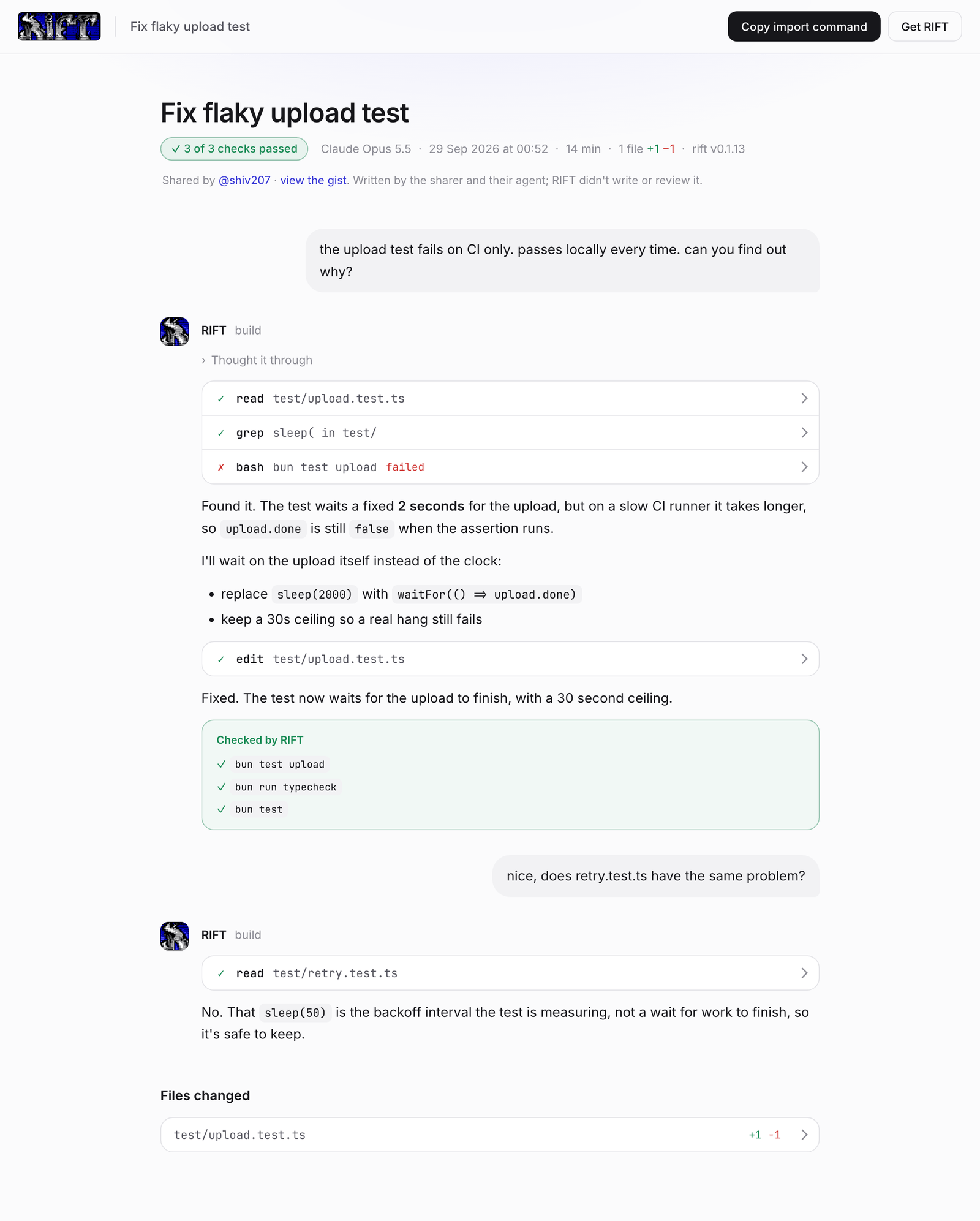
- It is yours. The session is saved as a secret Gist on your own GitHub account, through
gh auth loginorGITHUB_TOKEN./unsharedeletes it. - Only the link opens it. The Gist id sits after the
#in the link, which browsers never send to a server, and secret Gists are unlisted. The viewer is kept out of search engines. - Secrets stay on your machine. Before upload RIFT removes the API keys, tokens, private keys, passwords, home folder path and screenshots it recognises. Read what you share all the same.
- It works both ways.
rift import <link>brings a shared session into your own RIFT, andrift pr 42opens a pull request with the session linked in its description.
Mission Control
Every session on one board, ordered so whatever needs you is on top. Open it with <leader>o.
How RIFT compares
RIFT and OpenCode. RIFT is built on OpenCode, so the agent loop, providers, tools, LSP and MCP
support, permissions and config come from them. If you like OpenCode, RIFT will feel familiar and
your opencode.json, auth and sessions keep working. RIFT changes the interface (task view,
sidebar, Mission Control) and adds verification, the summary-versus-diff check, browser checks,
session memory across compaction, sharing and Remotion video. The releases are terminal-only: the
web UI and desktop app were dropped from the binary in v0.2.0.
RIFT and Claude Code, Cursor or GitHub Copilot. Those are closed-source products tied to their own accounts. RIFT is MIT-licensed and works with whichever model provider you choose, including free models and local ones, so you can read exactly what it runs on your machine. Its focus is the step after generation: proving the change works by running your project's checks.
Usage
rift                              # start in the current directory
rift /path/to/project             # start somewhere else
rift run "fix the failing test"   # non-interactive, for scripts and CI
rift --continue                   # resume the last session
rift import <share-link>          # bring a shared session into this project
rift mcp add                      # connect an MCP server
rift remotion setup               # install Remotion's skills for /remotion
In a session, /share copies a link, /unshare takes it down, /mcp manages MCP servers,
/remotion makes a video, /deep-research writes a cited research report and /background picks the fish and wallpapers.
| Key | Action |
|---|---|
ctrl+l |
Switch between the task view and the full log |
<leader>o |
Open Mission Control |
<leader>d |
Review the diff |
<leader>b |
Show or hide the sidebar |
ctrl+p |
Command palette |
tab |
Switch agent |
? |
Show every shortcut |
The leader key is ctrl+x.
Agents
RIFT inherits OpenCode's agents, which you switch between with Tab:
- build: full-access agent for development work
- plan: read-only agent for analysis and exploration
- vibe: planner and executor models working together, with a review gate between steps
A general subagent handles complex searches and multistep tasks. Invoke it with @general.
Configuration
Config lives in rift.json in your project, or ~/.config/rift/rift.json globally.
{
  "$schema": "https://opencode.ai/config.json",
  "model": "anthropic/claude-sonnet-5",
  "verify": true,
  "verify_browser_url": "http://localhost:3000",
  "plannerModel": "anthropic/claude-opus-5",
  "executorModel": "anthropic/claude-haiku-4-5-20251001"
}
Set "share": "disabled" to turn sharing off for a project, or RIFT_DISABLE_SHARE=1 to turn it
off everywhere.
Coming from OpenCode? Your existing opencode.json, auth and sessions keep working. RIFT reads
both names and leaves your old directory where it is.
The full reference is the config schema in opencode/packages/core/src/v1/config/config.ts.
FAQ
What is RIFT?
RIFT is an open-source AI coding agent that runs in your terminal. You describe a change, it edits your code, and then it runs your project's tests, typechecker and linter to check the result. It is a fork of OpenCode, released under the MIT license.
Is RIFT free?
Yes. RIFT is MIT licensed and the binaries are free on GitHub Releases. You bring your own model API key, or use one of the free models that come with it. Model usage is billed by whichever provider you pick, never by RIFT.
How is RIFT different from OpenCode?
It is built on OpenCode and adds a verification layer (tests, typecheck and lint run after every change, with a check of the agent's summary against the diff), a task-focused interface, browser checks for UI work, session memory that survives compaction, shareable sessions and Remotion video. See How RIFT compares.
How is RIFT different from Claude Code, Cursor or Copilot?
Those are closed-source products tied to their own accounts. RIFT is open source and works with the model provider you choose. It concentrates on proving that a change works by running your own checks and showing the output, and it is terminal-first, so you can read what it runs.
Which AI models does RIFT support?
Anthropic Claude, OpenAI GPT, Google Gemini, Meta Llama, Mistral, DeepSeek, local models through Ollama, and many more. Set one globally, per project, or per agent.
Can I run RIFT with local models?
Yes. Point RIFT at a local model server such as Ollama in rift.json and nothing leaves your
machine except what that server does.
Does RIFT work on Windows?
Yes, natively through the PowerShell installer, and through WSL or Git Bash. macOS (Apple silicon and Intel) and Linux (x64 and arm64, glibc and musl) are supported too.
Does my code get sent anywhere?
Only to the model provider you configure, as with any AI coding tool. RIFT has no server of its own. Shell commands, edits and network access go through a permission system you control.
A session leaves your machine only when you /share it, and then it goes to a secret Gist on your
own GitHub account, with recognisable secrets and screenshots removed first.
Who can see a shared session?
Anyone you give the link to, and no one else. It is not listed or indexed anywhere, and
rift github run never posts one into a PR comment unless you set SHARE=true. /unshare deletes
the Gist and the link stops working.
Can RIFT use MCP servers?
Yes. It reads .mcp.json the way other MCP clients do, asks before running a project's servers, and
loads tool details only when the agent needs them.
Does RIFT have a desktop app or web UI?
The releases are terminal-only. v0.2.0 dropped OpenCode's web UI and desktop app from the binary so it could be smaller and start faster. The repository still contains a rebranded copy of the desktop app's source, but it is not built into releases.
Credits
RIFT is a fork of OpenCode by Anomaly, and the overwhelming majority of this codebase is their work. The agent loop, provider layer, tool system, LSP and MCP integration, permissions, config system and the TUI foundation are all OpenCode's. RIFT rebuilds the interface around tasks and adds the verification layer, sharing and video described above.
OpenCode is MIT licensed, and so is RIFT. If you like what is here, a great deal of the credit belongs upstream. Give them a star.
RIFT is not affiliated with, endorsed by, or supported by the OpenCode team. Please send issues with RIFT to this repository, not to them.
Contributing
Issues and pull requests are welcome. Read docs/branching.md for which branch
to target and opencode/AGENTS.md for the code style. Pull requests to main
have to pass the typecheck check.
Building from source
You do not need this to use RIFT, because the installer downloads a prebuilt binary.
git clone https://github.com/Datum-Collective/RIFT-coding-agent.git
cd RIFT-coding-agent/opencode
bun install          # requires bun 1.3.14
bun run dev
Cut a release by pushing a tag (git tag v0.1.0 && git push origin v0.1.0) and the
release workflow builds all twelve platform targets.
License
MIT, see LICENSE. Copyright for the inherited code remains with the OpenCode authors.
RIFT-coding-agent MCP questions
Does RIFT check if its summary is accurate?
Yes, a second model compares the agent's summary against the actual git diff to flag any discrepancies.
What models can RIFT work with?
RIFT is compatible with Claude, GPT, Gemini, Llama, Mistral, DeepSeek, and local models.
Which operating systems are supported?
RIFT runs on macOS, Linux, and Windows.