
Onlyboxes MCP server
Commit Oct 26, 2026Lets an AI client run Python code, use stateful terminal sessions, and read generated images in a self-hosted sandbox.
Also known as Coooolfan/onlyboxes
- Stars
- 54
- Tools
- —
- Downloads, 30 days
- —
- Latest version
- —
- Last commit
- Oct 26, 2026
- License
- AGPL-3.0
What is Onlyboxes MCP?
Onlyboxes lets an AI client run Python code, use stateful terminal sessions, and read generated images in a self-hosted sandbox.
Summary generated from the project's README
About Onlyboxes MCP server
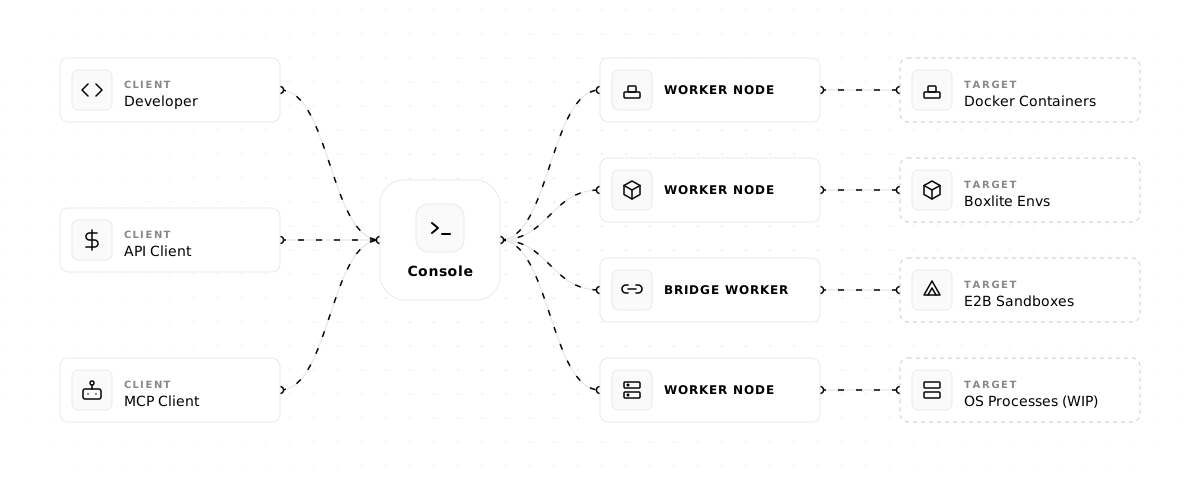
Providing a self-hosted sandbox for code execution is what onlyboxes enables for individuals and small teams. It uses a split architecture consisting of a control-plane console and scalable worker nodes to manage tasks. Users can deploy the system on Linux using Docker and systemd, connecting an AI client to the MCP endpoint to perform complex computational tasks.
Developers use the specific MCP tools pythonExec to run Python code, terminalExec to manage stateful terminal sessions, and readImage to allow models to view generated visual outputs. The platform ensures resource isolation between different accounts through stateful containers. Because the system is self-hosted, you maintain control over the execution environment and the data processed within the worker nodes.
Setting up the environment requires a console node and at least one worker node, such as the worker-docker implementation. To connect an LLM chat client, you must generate an access token from the web dashboard and provide the MCP endpoint URL. For security, it is recommended to place the HTTP and gRPC ports behind a reverse proxy to enforce TLS.
What you can do with it
- 1Scale execution resourcesTeams can expand their computing capacity by adding more worker nodes to the architecture.
Written from the project's README. Every use case is checked against a quote from it.
Configuration
WORKER_CONSOLE_GRPC_TARGETWORKER_CONSOLE_INSECUREWORKER_IDWORKER_SECRET
| Name | Description | |
|---|---|---|
| WORKER_CONSOLE_GRPC_TARGET | — | |
| WORKER_CONSOLE_INSECURE | — | |
| WORKER_ID | — | |
| WORKER_SECRET | — |
Automated checks
Ran Nov 14, 2026Full report →Not verified yet. A server needs a score of 80, no serious finding, and enough data for us to check. How checks work · What to fix for more points

- Source repository linked and reachablecoooolfan/onlyboxes is public and reachablegithub.com/coooolfan/onlyboxes ↗Pass
- Package names this repository as its sourceNot checked
- Build provenance (Sigstore attestation)Not checked
- Open source license (OSI)AGPL-3.0spdx.org/licenses/AGPL-3.0.html ↗Pass
- Commit or release in the last yearLast commit or release 2026-10-26github.com/coooolfan/onlyboxes ↗Pass
- OpenSSF ScorecardNot checked
- Package name not close to a popular packageNot checked
- No critical advisory in the package or its dependenciesNot checked
- No hidden instructions to the model0 tool descriptions and the README read; no override phrases, credential paths or hidden charactersPass
- Destructive tools are labelledNot checked
- Remote endpoint answers the MCP handshakeNot checked
README
View on GitHubOnlyboxes
Onlyboxes is a self-hosted code execution sandbox platform for individuals and small teams.
It uses a control-plane (console) and execution-plane (worker) architecture, and exposes both REST APIs and MCP tools.
Key Features
- Self-hosted all components: control node (
console) + worker nodes (worker) - Separated control and execution planes:
- Workers support horizontal scaling
- Workers support multi-language heterogeneous implementations
- Workers support multiple runtimes
- Full account system: resource isolation (stateful containers, sessions) between accounts
- MCP tools:
pythonExec: Python code executionterminalExec: stateful terminal sessionsreadImage: model-readable images
- REST API: all MCP tools also available via HTTP + async task API
[!WARNING]
In the current release, console (gRPC + HTTP) does not provide built-in TLS/mTLS.
workerrejects insecure console endpoints by default; plaintext is allowed only whenWORKER_CONSOLE_INSECURE=trueis explicitly set.Put both console HTTP (
:8089) and gRPC (:50051) endpoints behind your reverse proxy/gateway and enforce TLS for external traffic.
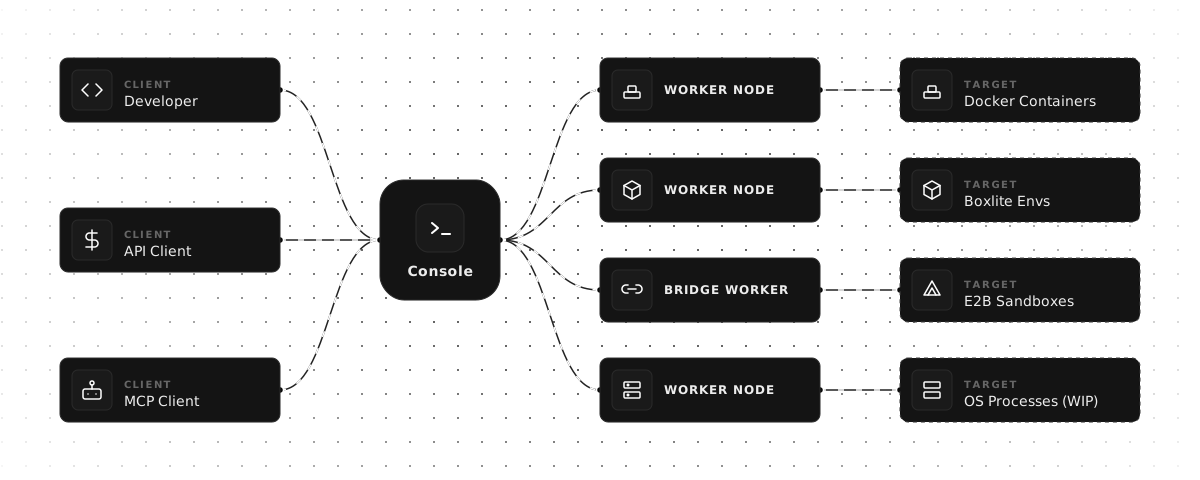
Architecture
One-Click Installer (Linux)
For a single-machine deployment of console + worker-docker, run:
curl -fsSL https://onlybox.es/install.sh | bash
The installer will:
- Check the environment (Linux, Docker, Docker Compose v2, systemd)
- Download and render the compose template with auto-generated credentials
- Start the console via
docker compose up -d - Create a
normalworker - Download the architecture-matched
worker-dockerrelease binary for the default latest version, or your--tagoverride - Generate and enable a systemd service for the worker
- Poll until the worker comes online and print a result summary
Available options:
| Flag | Default | Description |
|---|---|---|
--tag |
latest published release | Optional release version override |
--workdir |
$PWD/onlyboxes |
Working directory |
--yes / -y |
false |
Non-interactive mode, skip confirmations |
--console-http-port |
8089 |
Console HTTP port (host side) |
--console-grpc-port |
50051 |
Console gRPC port (host side) |
--service-name |
onlyboxes-worker-docker |
systemd service name |
Requirements: Linux, systemd, Docker Engine, Docker Compose v2, Python 3.
Quick Start (Manual)
1) Prerequisites
- Control node:
- Docker Engine (binaries are also available in releases — no Docker needed if deploying via binary)
- Worker node:
- Docker Engine (required by
worker-docker)
- Docker Engine (required by
2) Start the console service
-
Create a working directory and a
docker-compose.ymlfile in it:mkdir -p onlyboxes-console && cd onlyboxes-consoleservices: console: image: coolfan1024/onlyboxes:latest container_name: onlyboxes-console restart: unless-stopped environment: CONSOLE_HASH_KEY: "replace-with-long-random-key" CONSOLE_ENABLE_REGISTRATION: "true" CONSOLE_DASHBOARD_USERNAME: "admin" # only for first run CONSOLE_DASHBOARD_PASSWORD: "change-me" # only for first run ports: - "8089:8089" - "50051:50051" volumes: - ./db:/app/db -
Replace at least:
CONSOLE_HASH_KEYCONSOLE_DASHBOARD_PASSWORD
-
Start console:
docker compose up -d
Default endpoints:
- Console Web UI / HTTP REST API / MCP endpoint:
http://127.0.0.1:8089 - gRPC:
127.0.0.1:50051
3) Sign in and create an access token
- Open
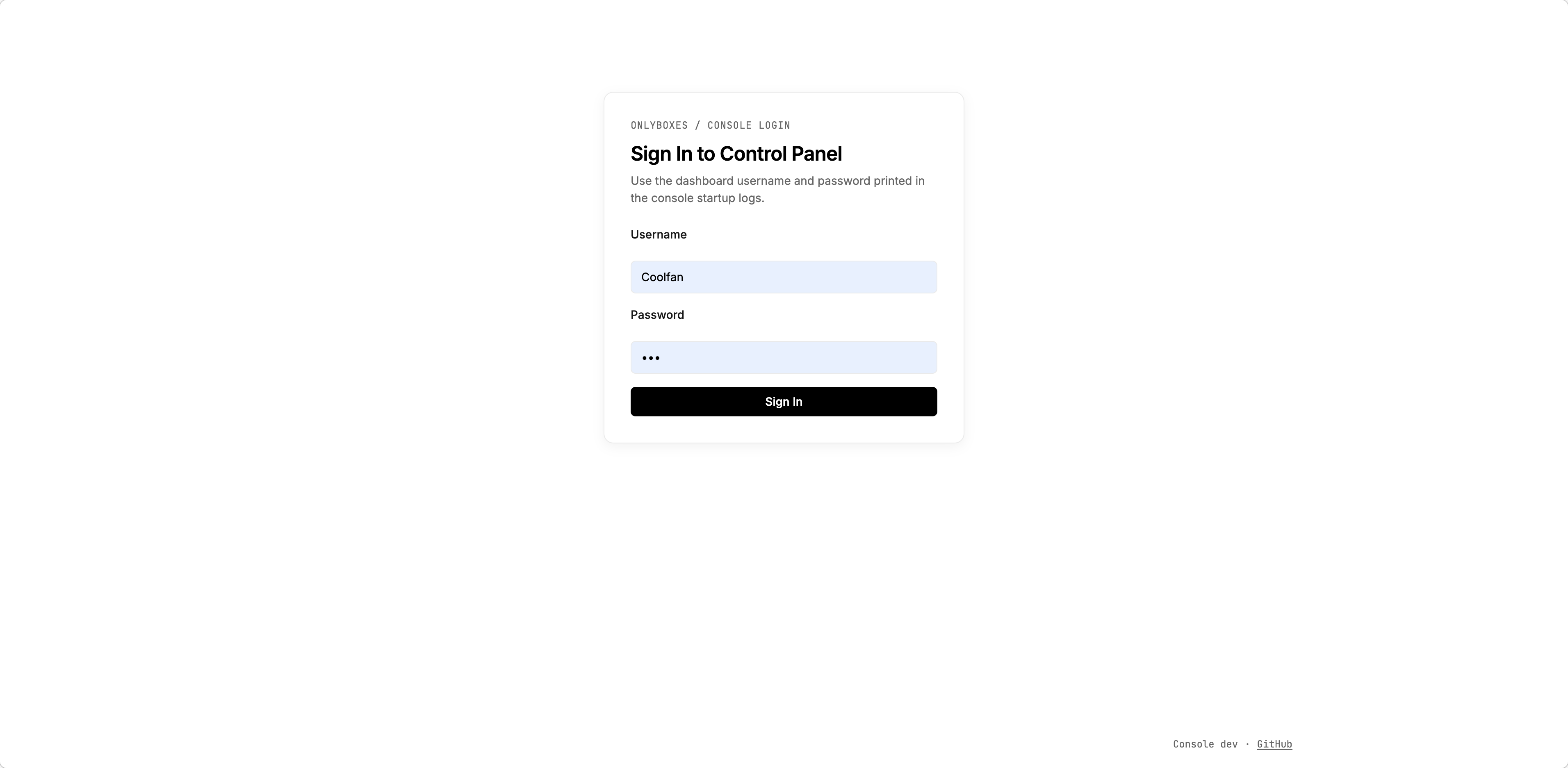
http://127.0.0.1:8089in your browser. - Sign in with the initialized admin account.
- Go to the token management page and create an access token.
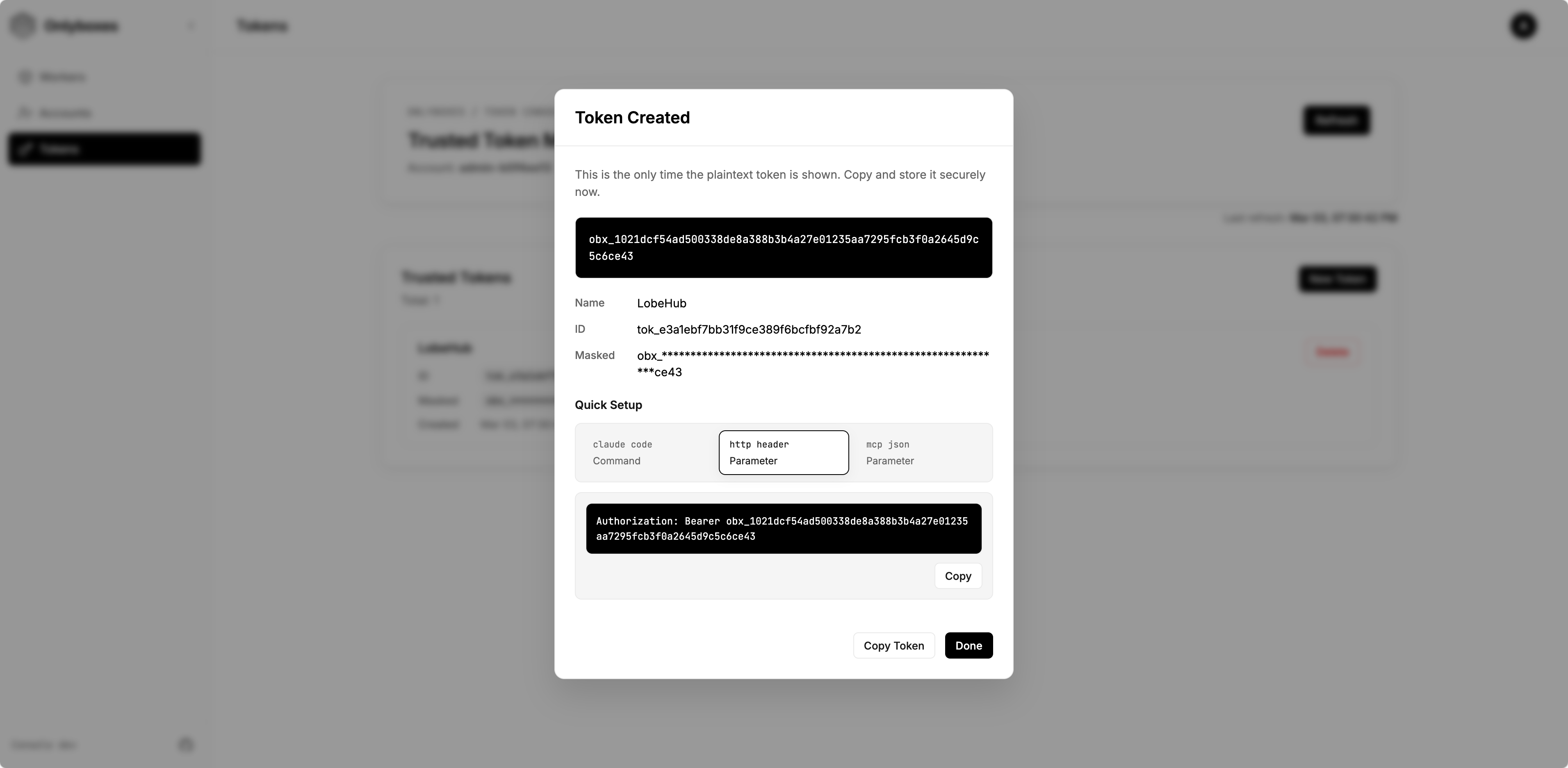
- Save the plaintext token immediately (it is returned only once).
4) Create a worker
- Go to Workers page and create a worker.
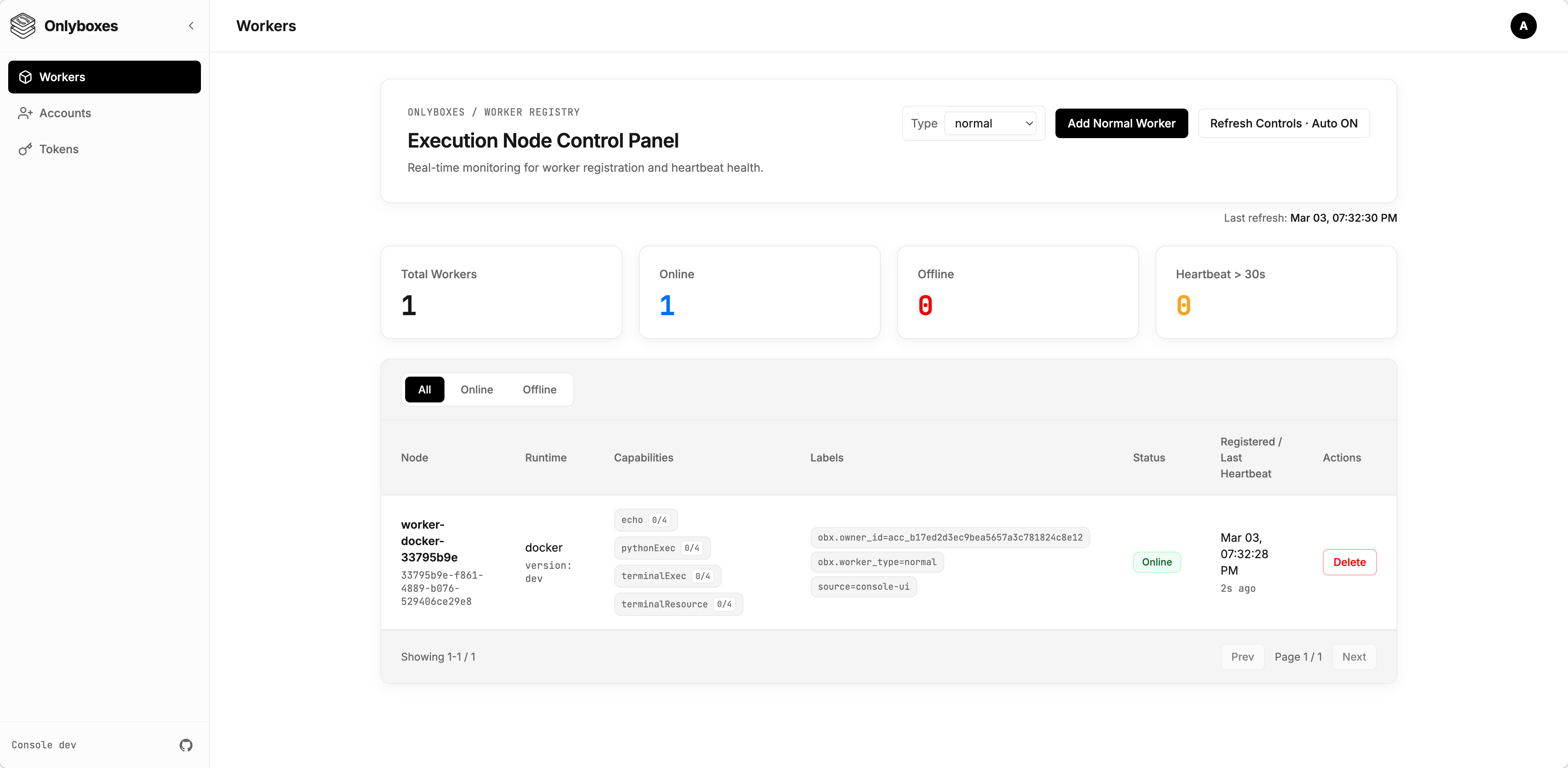
- Copy and securely store the startup command from the creation dialog (
WORKER_SECRETis one-time visible).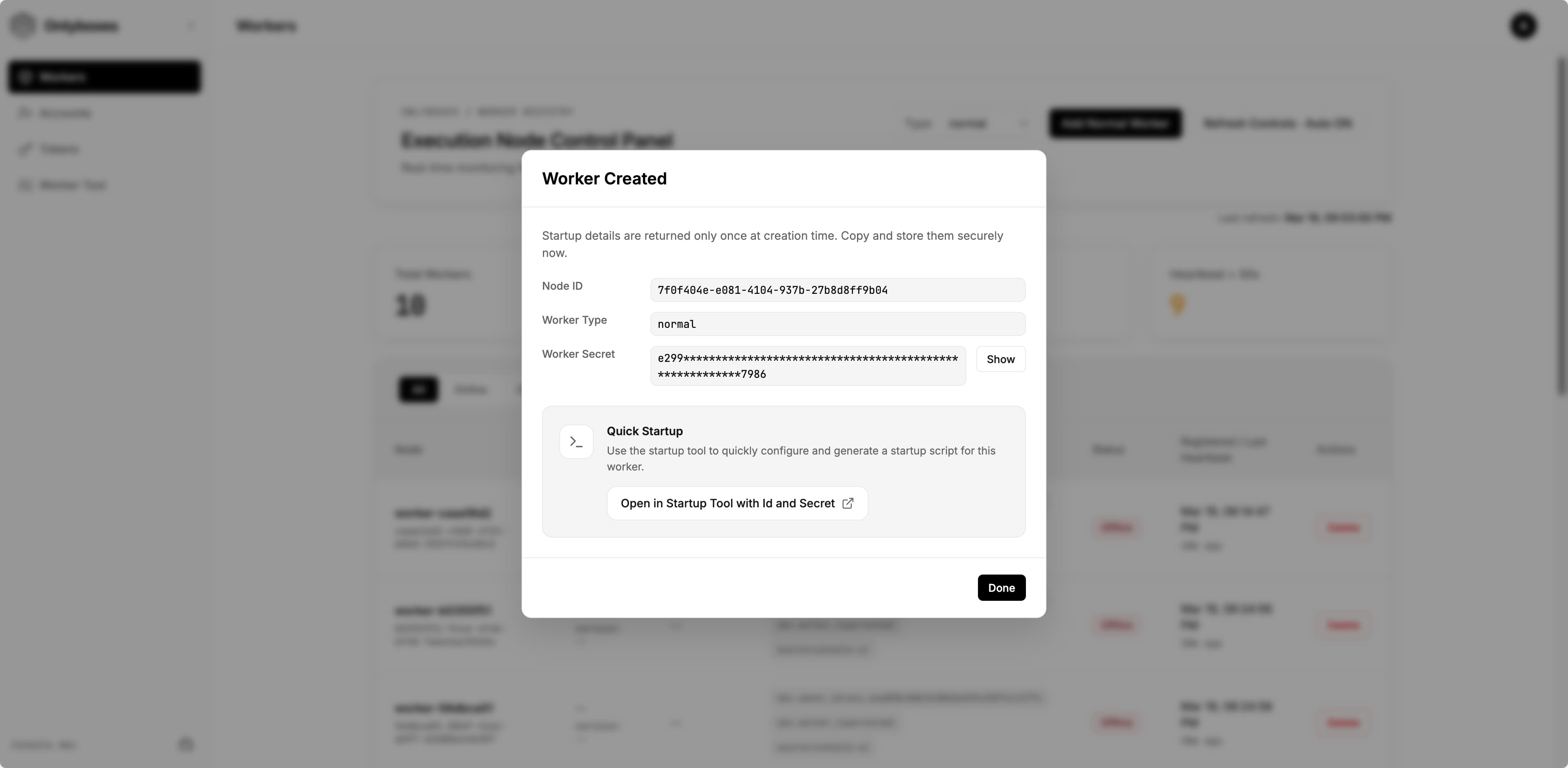
- (Optional) Click
Open in Startup Tool with Id and Secretto open the startup command builder with the worker id and secret pre-filled.- On the opened page, you can edit all available options. The generated startup command appears at the bottom of the page — copy and save it.
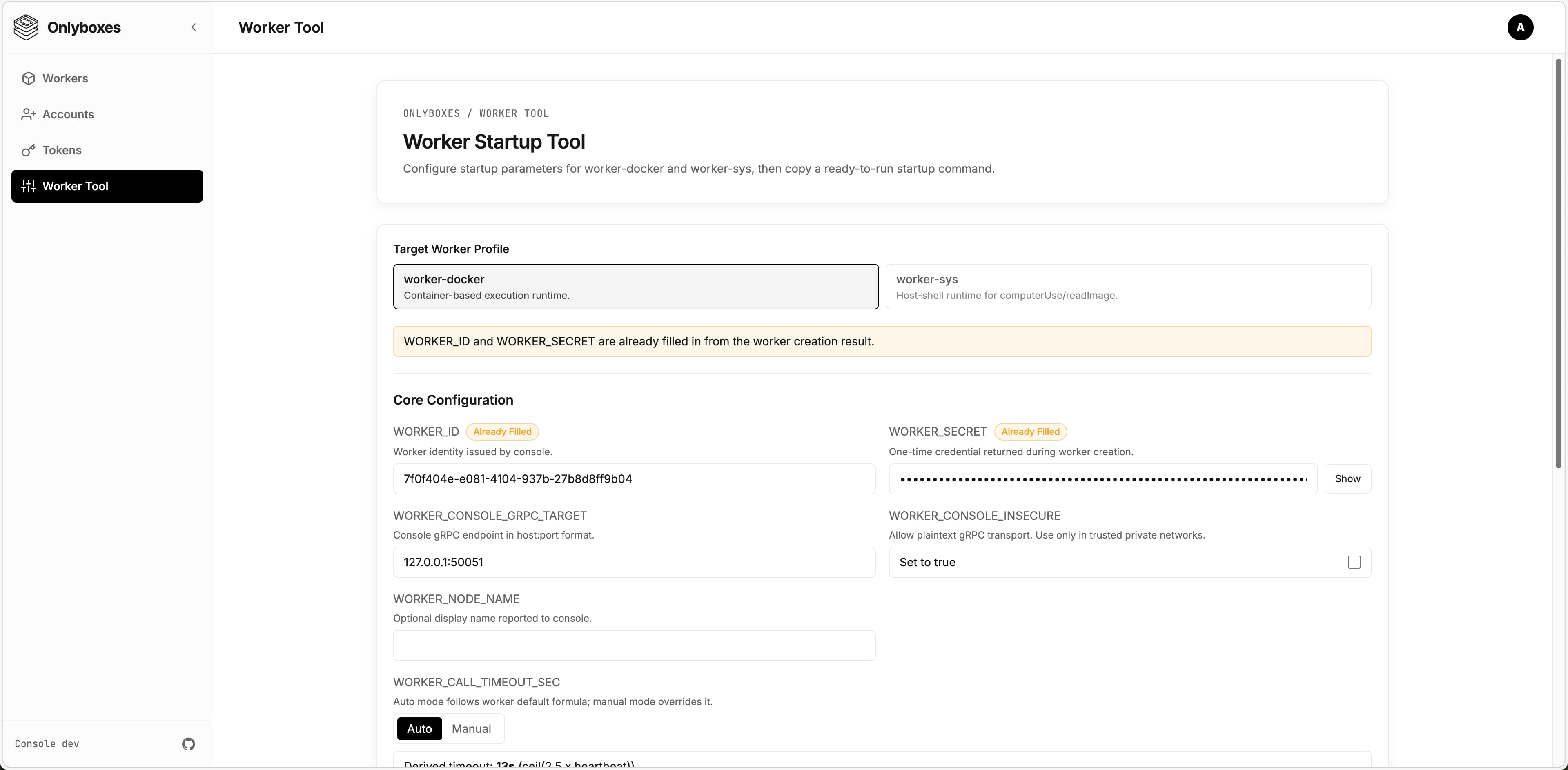
- On the opened page, you can edit all available options. The generated startup command appears at the bottom of the page — copy and save it.
5) Run worker
[!WARNING] Workers support different runtimes and environments. The current release only provides
worker-docker. This section uses the Docker runtime as an example.
-
Log in to the machine where the worker will be deployed.
- Ensure Docker Engine is installed.
- Ensure the worker can reach the console gRPC endpoint.
-
Download the latest
worker-dockerbinary from GitHub Releases:https://github.com/onlyboxes/onlyboxes/releases/latest
-
Use the startup command values from the dashboard, and replace the executable path on the last line with your downloaded binary.
- Workers reject insecure console endpoints by default; set
WORKER_CONSOLE_INSECURE=trueonly to allow plaintext connections.
# Example WORKER_CONSOLE_INSECURE=true \ WORKER_CONSOLE_GRPC_TARGET=127.0.0.1:50051 \ WORKER_ID=<worker_id> \ WORKER_SECRET=<worker_secret> \ /path/to/onlyboxes-worker-docker - Workers reject insecure console endpoints by default; set
6) Verify readiness
- Confirm the worker is
onlineon the dashboard Workers page. - For REST API request examples, see
docs/API.md. - If no tokens are configured,
/mcpand execution APIs return401by design. - Add the MCP endpoint
http://127.0.0.1:8089/mcpin any LLM Chat Client, set the token, and verify it works correctly.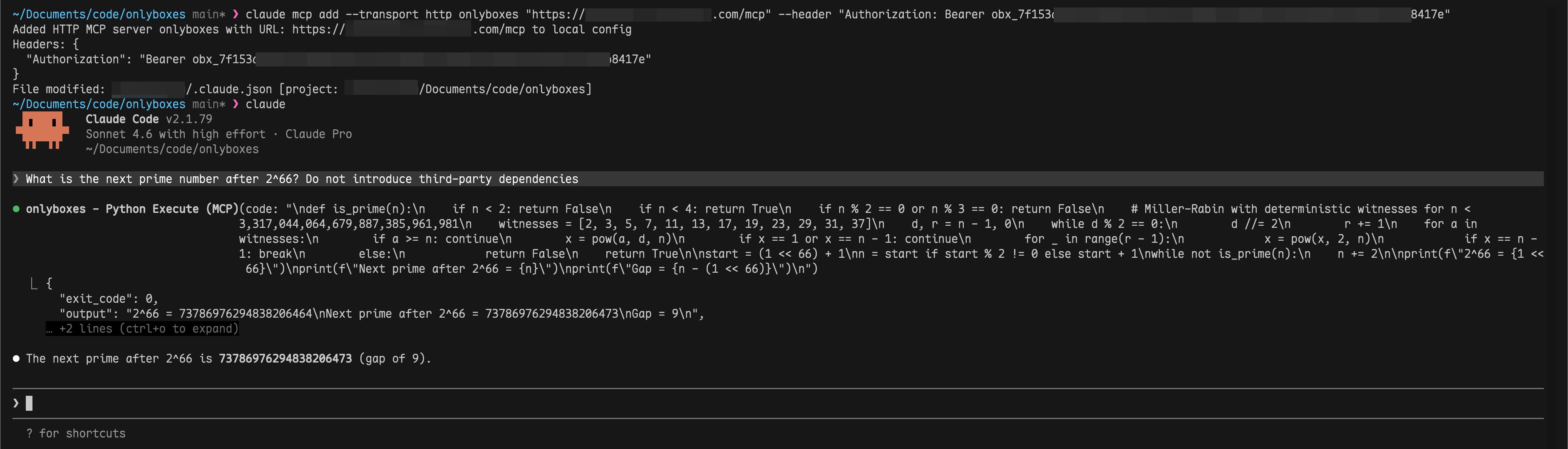
FAQ
-
Q: Worker stays
offlineafter starting? A: Check thatWORKER_CONSOLE_GRPC_TARGETpoints to the correct console gRPC address and verify network connectivity. -
Q: Can a worker be deployed on the same machine as the console? A: Yes.
-
Q: Can a worker run inside Docker? A: In theory, yes. However, it is not recommended because the worker needs access to the host Docker daemon. You would need to handle Docker-in-Docker yourself.
Production Checklist
- Replace all default credentials.
- Use a reverse proxy to enforce TLS for
:8089and:50051. - Persist and back up the SQLite data directory (
CONSOLE_DB_PATH). - Run workers on isolated hosts to avoid sharing the Docker daemon with the console.
- Read the
Configuration Referencebelow for all available options and adjust as needed.
Configuration Reference
Console (console)
| Environment Variable | Default | Notes |
|---|---|---|
CONSOLE_HTTP_ADDR |
:8089 |
Dashboard + REST API listen address |
CONSOLE_GRPC_ADDR |
:50051 |
Worker registry gRPC listen address |
CONSOLE_WORKER_CONNECTION_CONFLICT_POLICY |
REPLACE |
Duplicate Worker connection policy: REPLACE disconnects the existing connection; REJECT rejects the new connection |
CONSOLE_HASH_KEY |
(required) | HMAC key for hashing worker secrets and access tokens |
CONSOLE_DB_PATH |
./db/onlyboxes-console.db |
SQLite database path |
CONSOLE_DB_BUSY_TIMEOUT_MS |
5000 |
SQLite busy timeout |
CONSOLE_TASK_RETENTION_DAYS |
30 |
Retention for completed task records |
CONSOLE_ENABLE_REGISTRATION |
false |
Allow admin to register non-admin accounts |
CONSOLE_DASHBOARD_USERNAME |
(empty) | Used only for first admin initialization |
CONSOLE_DASHBOARD_PASSWORD |
(empty) | Used only for first admin initialization |
Worker (worker-docker)
| Environment Variable | Default | Notes |
|---|---|---|
WORKER_ID |
(required) | Issued by POST /api/v1/workers |
WORKER_SECRET |
(required) | Issued once by POST /api/v1/workers |
WORKER_CONSOLE_GRPC_TARGET |
127.0.0.1:50051 |
Console gRPC target |
WORKER_CONSOLE_INSECURE |
false |
false enforces TLS endpoint; set true only to allow plaintext console gRPC |
WORKER_HEARTBEAT_INTERVAL_SEC |
5 |
Worker heartbeat interval |
WORKER_HEARTBEAT_JITTER_PCT |
20 |
Heartbeat jitter percent |
WORKER_PYTHON_EXEC_DOCKER_IMAGE |
ghcr.io/astral-sh/uv:python3.12-bookworm-slim |
Runtime image for pythonExec |
WORKER_TERMINAL_EXEC_DOCKER_IMAGE |
coolfan1024/onlyboxes-runtime:default |
Runtime image for terminalExec |
WORKER_TERMINAL_OUTPUT_LIMIT_BYTES |
1048576 |
Per-stream output limit |
API Surfaces
- Authentication:
/api/v1/auth/* - Resource management:
/api/v1/accounts*,/api/v1/api-keys*,/api/v1/tokens*,/api/v1/sessions*,/api/v1/workers*,/api/v1/proxy-routes* - Command execution:
/api/v1/commands/* - Task execution:
/api/v1/tasks* - MCP (Streamable HTTP):
POST /mcp
Development
Local dev orchestration
scripts/dev.sh runs console / web / website in a tmux session. Every subcommand returns immediately, and logs land in scripts/.dev/<svc>.log.
scripts/dev.sh start              # start all three
scripts/dev.sh start console web  # console + web only
scripts/dev.sh status             # session, port listeners, window state
scripts/dev.sh logs console       # last 200 log lines
scripts/dev.sh creds              # console admin credentials
scripts/dev.sh stop               # stop everything
Web dev URL defaults to http://127.0.0.1:5178 and proxies /api/* and /mcp to http://127.0.0.1:8089.
Workers are not orchestrated — their startup arguments vary per implementation, so start them manually. Full usage: scripts/README.md.
Useful docs
- Unified API reference:
docs/API.md - Console internals:
console/README.md - Worker internals:
worker/worker-docker/README.md - API/proto guide:
api/README/proto.md - Web app guide:
web/README.md
Release & Images
- GitHub workflow:
.github/workflows/package-release.yml— run it manually from the Actions tab, pick the branch and enter the version (e.g.0.7.2); the tag is created from that branch. Turn offlatestwhen patching an older line so the newest release keeps the label - Website-only deploy:
.github/workflows/deploy-website.yml— manual, independent of a release - Console Docker image:
coolfan1024/onlyboxes:<version>andcoolfan1024/onlyboxes:latest - Terminal runtime images:
coolfan1024/onlyboxes-runtime:<version>-default,<version>-default-cn, and<version>-lobehub; stable aliases aredefault,default-cn,lobehub, andlatest(same asdefault) - Console binary includes embedded web assets
Security and Operational Notes
- Console does not provide built-in TLS/mTLS in this release;
worker-dockerrequires explicitWORKER_CONSOLE_INSECURE=trueto connect over plaintext. - Put console HTTP (
:8089) and gRPC (:50051) behind a reverse proxy/gateway and enforce TLS on public/external links. WORKER_SECRETand access token plaintext values are returned only at creation time.- Dashboard login sessions are in-memory and are invalidated when
consolerestarts.
Links
License
Onlyboxes MCP questions
What MCP tools does Onlyboxes provide?
It exposes pythonExec for Python code execution, terminalExec for stateful terminal sessions, and readImage for model-readable images.
Why does my worker stay offline after starting?
Check that WORKER_CONSOLE_GRPC_TARGET points to the correct console gRPC address and verify network connectivity.
Can a worker be deployed on the same machine as the console?
Yes, a worker can run on the same machine as the console, though production guidance recommends isolated hosts.
Does Onlyboxes provide TLS out of the box?
No, the current release has no built-in TLS/mTLS on the console. Put both console HTTP and gRPC endpoints behind a reverse proxy or gateway and enforce TLS there.