
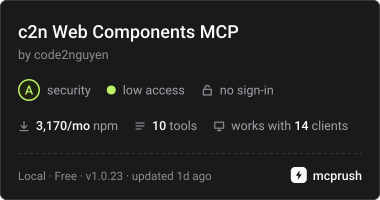
Exposes c2n Lit web component APIs, theme tokens, usage examples, and markup validation to AI agents.
Also known as code2nguyen/web-components, c2n, @c2n/mcp
- Stars
- 5
- Tools
- 10
- Downloads, 30 days
- 3,298
- Latest version
- 1.0.26
- Last commit
- Nov 15, 2026
- License
- MIT
What is c2n Web Components MCP?
c2n Web Components exposes c2n Lit web component APIs, theme tokens, usage examples, and markup validation to AI agents. It exposes 10 tools, such as list_components, search_components, get_component.
Summary generated from the project's README
About c2n Web Components MCP server
Providing technical documentation and validation for Lit web components is what this MCP server enables for AI agents. Developers using Claude Code, Codex, or Google Antigravity can connect to this server via stdio to access a complete registry of component APIs, including attributes, slots, events, and CSS variables. Because the data is bundled in a local registry file, the server functions offline once installed in a project.
Users can interact with specific tools to list components, search for usage examples like glass or pill styles, and retrieve theme tokens from the @c2n/theme package. The server also includes a validation tool that checks HTML, JSX, Vue, Svelte, Astro, Angular, and Lit templates against installed @c2n packages. This ensures that markup uses correct tags and avoids invalid CSS properties like box styling on a component host. It acts as a structured knowledge source rather than an automated editor, though it can be paired with the @c2n/skill package to help agents follow specific application and theming conventions.
Written from the project's README. Every use case is checked against a quote from it.
How to install c2n Web Components MCP
Formats verified 10 Nov 2026Add to CursorAdd to GooseInstall c2n Web Components MCP in Claude Code
$ claude mcp add c2n -- npx -y @c2n/mcpInstall c2n Web Components MCP in Cursor
~/.cursor/mcp.json
{
  "mcpServers": {
    "c2n": {
      "command": "npx",
      "args": [
        "-y",
        "@c2n/mcp"
      ]
    }
  }
}Install c2n Web Components MCP in VS Code
.vscode/mcp.json
{
  "servers": {
    "c2n": {
      "type": "stdio",
      "command": "npx",
      "args": [
        "-y",
        "@c2n/mcp"
      ]
    }
  }
}Install c2n Web Components MCP in VS Code CLI
$ code --add-mcp '{"name":"c2n","type":"stdio","command":"npx","args":["-y","@c2n/mcp"]}'Install c2n Web Components MCP in Claude Desktop
claude_desktop_config.json
{
  "mcpServers": {
    "c2n": {
      "command": "npx",
      "args": [
        "-y",
        "@c2n/mcp"
      ]
    }
  }
}Install c2n Web Components MCP in Codex
$ codex mcp add c2n -- npx -y @c2n/mcpInstall c2n Web Components MCP in Codex config.toml
~/.codex/config.toml
[mcp_servers.c2n]
command = "npx"
args = ["-y", "@c2n/mcp"]
Install c2n Web Components MCP in Gemini CLI
$ gemini mcp add -s user c2n npx -- -y @c2n/mcpInstall c2n Web Components MCP in Gemini settings.json
~/.gemini/settings.json
{
  "mcpServers": {
    "c2n": {
      "command": "npx",
      "args": [
        "-y",
        "@c2n/mcp"
      ]
    }
  }
}c2n Web Components MCP tools 10
Detected from the READMElist_componentssearch_componentsget_componentget_examplessearch_examplesget_presetsget_themegenerate_variantvalidate_markupget_workflow_guide
| list_components | — | |
| search_components | — | |
| get_component | — | |
| get_examples | — | |
| search_examples | — | |
| get_presets | — | |
| get_theme | — | |
| generate_variant | — | |
| validate_markup | — | |
| get_workflow_guide | — |
Configuration
C2N_PROJECT_ROOTProject whose installed @c2n/* packages the server reports. Defaults to the working directory.
| Name | Description | |
|---|---|---|
| C2N_PROJECT_ROOT | Project whose installed @c2n/* packages the server reports. Defaults to the working directory. |
Automated checks
Ran Nov 12, 2026Full report →Passed our automated checks. That is not a security audit: read the code and give the server the narrowest access it needs. How checks work

- Source repository linked and reachablePass
- Open source license (OSI)Pass
- Commit or release in the last yearPass
- Package name not close to a popular packagePass
- Remote endpoint uses HTTPSNot checked
- Destructive tools are labelledPass
- No hidden instructions to the modelPass
- No critical advisory in the package or its dependenciesPass
README
View on GitHub@c2n/mcp
Model Context Protocol server that exposes the c2n web components to AI agents: component APIs (attributes, slots, events, native CSS parts, CSS variables with their theme tokens), usage and gallery examples, curated presets, the @c2n/theme tokens, variant code generation and the application workflow guides. Everything is bundled in data/registry.json, so it works offline in any project.
Use
The server uses stdio and can be launched by any MCP host:
npx -y @c2n/mcp
Claude Code project .mcp.json:
{ "mcpServers": { "c2n": { "type": "stdio", "command": "npx", "args": ["-y", "@c2n/mcp"] } } }
Codex project .codex/config.toml:
[mcp_servers.c2n]
command = "npx"
args = ["-y", "@c2n/mcp"]
Google Antigravity project .agents/mcp_config.json uses the same mcpServers command/args structure as the Claude example. The @c2n/skill package can install the skill and merge these configurations automatically.
Run the server from a project directory: it reports which @c2n/* packages are installed and serves the bundled API when the installed version differs. The registry is packaged locally, so tool calls do not require network access after installation.
Use c2n-mcp --version to inspect the installed server version and c2n-mcp --help for CLI usage.
The MCP server supplies structured component facts; it does not install component packages or edit an application by itself. Pair it with @c2n/skill when you also want the agent to follow c2n's application, theming and variant conventions. See the AI tools guide for the complete setup and example prompts.
Verify the connection
Restart the agent after adding its MCP configuration, then ask it to use the c2n MCP server to list components or inspect c2-button. A connected client should expose the tools below and report @c2n/* packages installed in the current project. If the server cannot start, run npx -y @c2n/mcp --version in that project to distinguish an npm/runtime problem from an MCP client configuration problem.
Tools
| Tool | Purpose |
|---|---|
list_components |
Every component with tag, package, category, description, installed version |
search_components |
Free-text search across names, descriptions, attributes, slots, events, examples, icons |
get_component |
Full API of one component, CSS variables grouped by part/state with their theme token |
get_examples |
Usage rows and gallery cards; view: "index" lists every look (summary, screenshot) |
search_examples |
Find a look across every component's gallery ("glass", "pill", "underline") |
get_presets |
Curated presets as CSS variable values |
get_theme |
The --c2-theme--* tokens, install/mapping snippets; per-component mapping with tag |
generate_variant |
CSS class / HTML + style / Lit subclass / JSON from overrides, a preset or a gallery card |
validate_markup |
Checks markup/CSS you wrote: native controls to replace, unknown tags/attributes/slots/events/variables |
get_workflow_guide |
workflow, theming, variant-components, frameworks |
Gallery cards are served with a generated summary of what they change and CSS whose colours follow the --c2-theme--* tokens wherever a literal equals a token's value (var(--c2-theme--color-outline, #d4d4d8)), so a copied card follows the application's theme and dark mode. Each card also links light and dark PNG captures hosted with the docs site (gallery-shots/<component>/<slug>.<theme>.png, written by apps/ui/scripts/gallery-shots.mjs in the Pages deploy).
Validate from the command line
validate_markup is also a CLI, for CI and editor hooks. It reads HTML, JSX/TSX, Vue, Svelte, Astro, Angular and Lit templates and CSS, and checks them against the API of the @c2n/* packages the project has installed:
npx -y @c2n/mcp validate src            # exit 1 on errors
npx -y @c2n/mcp validate src --strict   # warnings fail too (native controls, box styling on a c2 host)
npx -y @c2n/mcp validate --hook         # Claude Code PostToolUse hook: reads the payload on stdin
It reports native <button>/<input>/<select>/<textarea>/<dialog>/<details>/<progress> elements that a c2-* element replaces, unknown c2-* tags, attributes, slots and --c2-* variables (with "did you mean"), events a c2-* element does not fire (with its event list), a static camelCase attribute the element ignores (rowKey for row-key), and box styling on a c2-* host (border, padding, background, box-shadow, outline; a radius alone is fine). A line holding c2n-ignore, or the line after a comment holding it, is skipped. In hook mode the findings go to stderr with exit code 2, which Claude Code hands back to the agent; npx -y @c2n/skill install registers that hook in .claude/settings.json.
Resources: c2n://components, c2n://components/{tag}, c2n://theme, c2n://guide/{topic}.
Development
data/registry.jsonis an ignored build artifact.npm run build:tools(repo root) regenerates it from the component manifests, docs content, presets and theme, then compilesdist/and refreshes the committed skill fallback.dev,inspect,smokeandnpm packautomatically build the registry when needed.npm run smoke -w packages/tools/mcpspawns the server over stdio and checks every tool.npm run inspect -w packages/tools/mcpopens the MCP Inspector against the source entry (node src/cli.ts, Node 24 type stripping).
c2n Web Components MCP questions
How do I add c2n Web Components MCP to Claude Code?
Run claude mcp add c2n -- npx -y @c2n/mcp in your terminal. Add --scope user to make it available in every project.
How do I add c2n Web Components MCP to Cursor?
Open ~/.cursor/mcp.json and add the server under mcpServers, using the Cursor config shown in the install section above.
What tools does c2n Web Components MCP provide?
It exposes 10 tools, including list_components, search_components, get_component, get_examples, search_examples.
Does the server require an internet connection to work?
No, the registry is bundled locally in data/registry.json, allowing it to work offline in any project.
Can the server validate my code?
Yes, the validate_markup tool checks HTML, JSX/TSX, Vue, Svelte, Astro, Angular, and Lit templates against installed component APIs.
Does this server install the web components for me?
No, the server provides structured component facts but does not perform installations or direct application edits.