
codegraph MCP server
Commit Nov 6, 2026Analyzes code repositories using tree-sitter to build a typed ontology and graph for architectural analysis and impact assessment.
Also known as brn-mwai/codegraph
- Stars
- 2
- Tools
- —
- Downloads, 30 days
- —
- Latest version
- —
- Last commit
- Nov 6, 2026
- License
- MIT
What is codegraph MCP?
codegraph analyzes code repositories using tree-sitter to build a typed ontology and graph for architectural analysis and impact assessment.
Summary generated from the project's README
About codegraph MCP server
Analyzing code repositories to understand architectural structure and impact is what codegraph enables for developers using AI clients. By using tree-sitter to parse languages like Python, TypeScript, Go, and Rust, it builds a typed ontology and a graph of files and symbols. This allows an LLM to answer complex questions about where things are defined, who uses specific symbols, and what the blast radius is before making a change.
Unlike many tools, it operates without embeddings, vector databases, or external API calls, relying instead on a single JSON index and graph algorithms. Users can run it locally via a CLI to index repositories or use the serve command to expose the graph as an MCP server over stdio. It provides specialized tools such as impact analysis, symbol context, and architecture checks to help maintain code quality and understand system wiring.
What you can do with it
- 1Assess code change impactAsk the AI to determine the blast radius of a modification to a specific target.
- 2Identify architectural rolesDetermine the role of different modules within a system based on their dependencies and test markers.
- 3Navigate symbol definitionsFind where a specific symbol is defined and see all its callers and callees.
- 4Enforce architectural contractsUse the tool to check if code changes violate defined layers or dependency rules.
Written from the project's README. Every use case is checked against a quote from it.
README
View on GitHubStart in the terminal
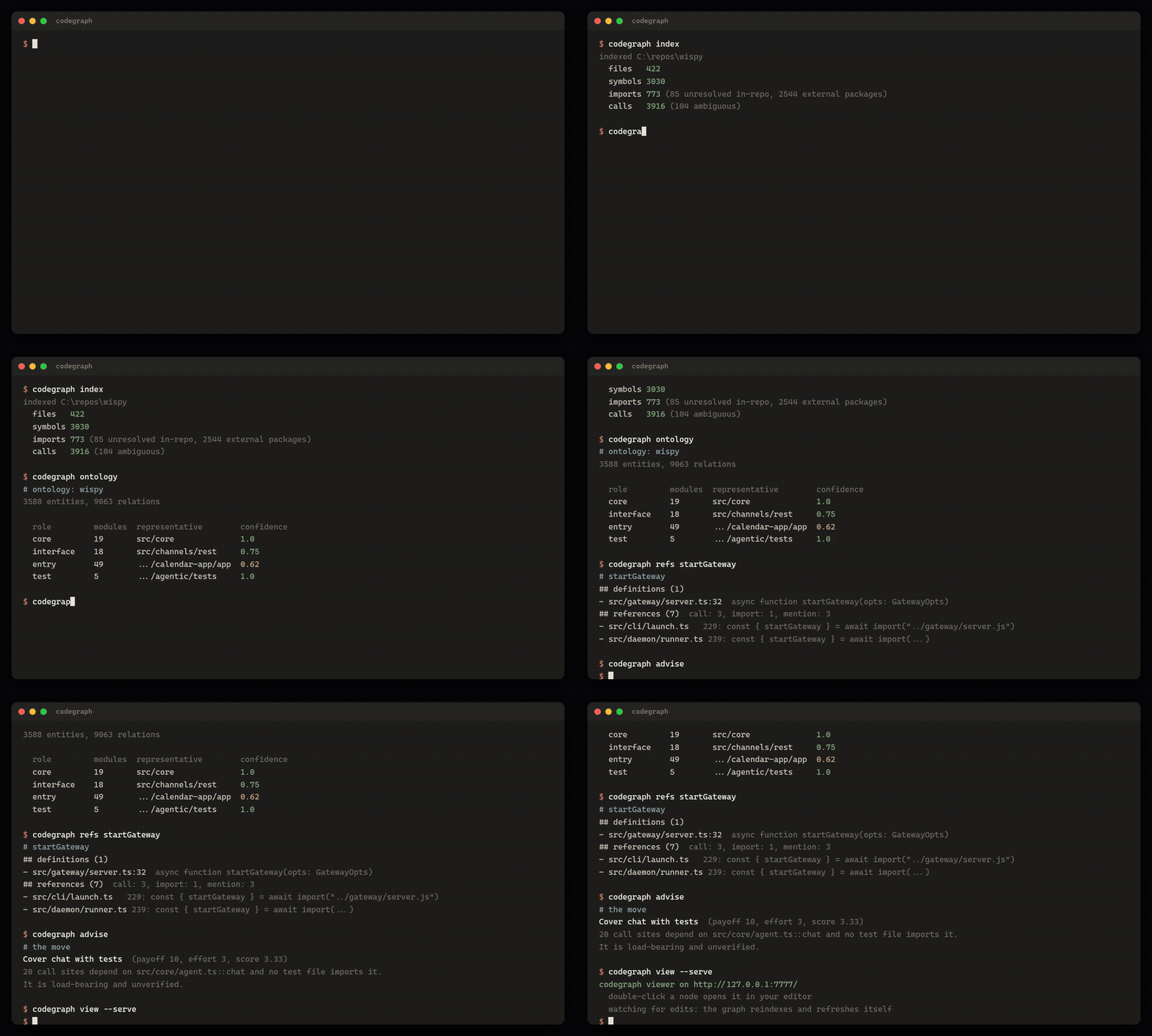
export PYTHONPATH=/path/to/codegraph
python -m codegraph.cli --repo <repo> index
python -m codegraph.cli --repo <repo> ontology
python -m codegraph.cli --repo <repo> advise
python -m codegraph.cli --repo <repo> view --serve
Then look at it
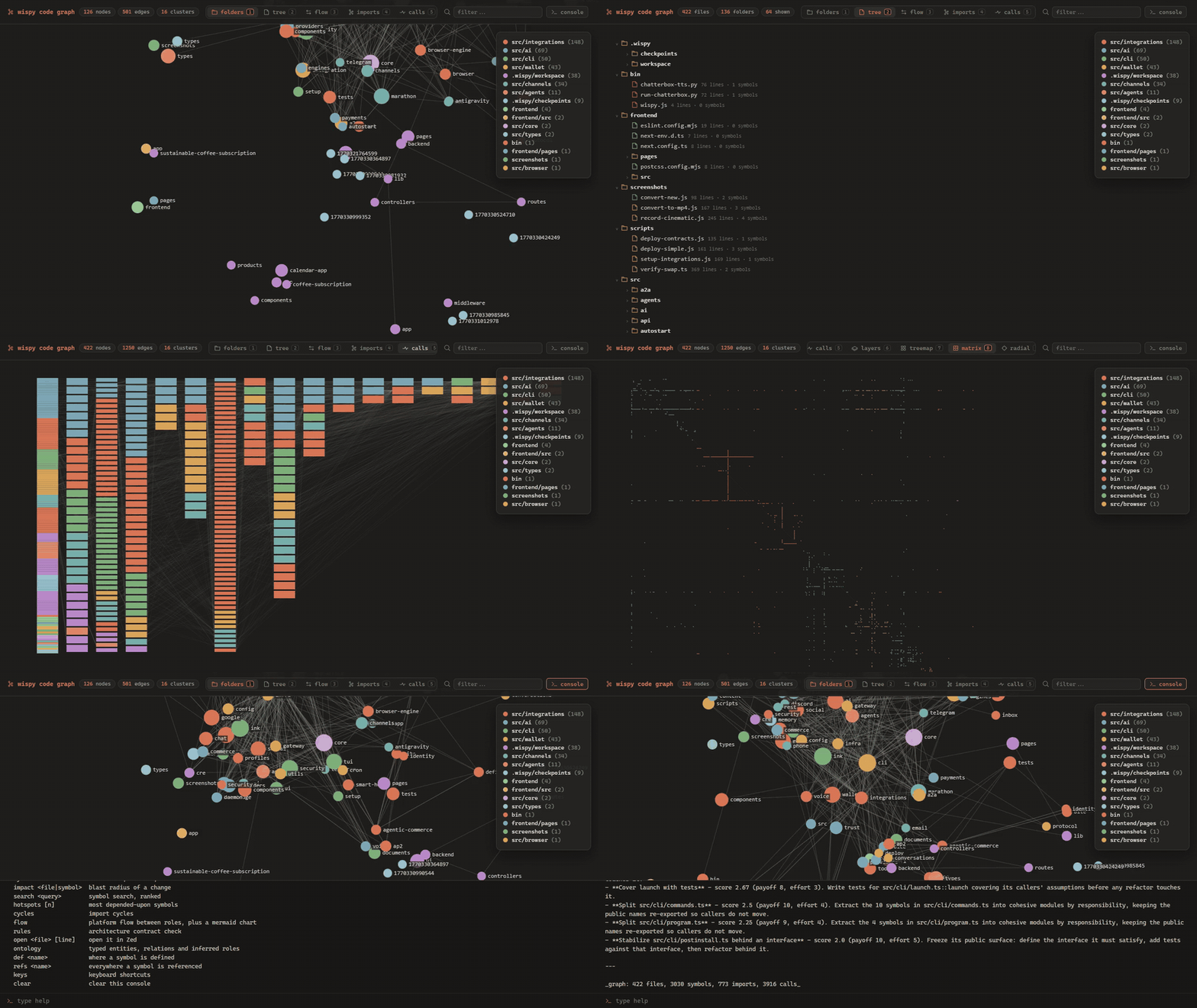
Nine views over the same graph, each on its own number key. Double-click any node to open that
file in your editor at the right line. ~ opens a console with the same commands as the CLI.
What it builds
- Parse — tree-sitter over
.py .js .jsx .mjs .cjs .ts .tsx .go .rs. Patterns compile one at a time, so a grammar that rejects a pattern loses that pattern, not the whole run. - Graph — files and symbols as nodes;
defines,imports,callsas edges. Imports resolve through relative paths, package roots,indexfiles and tsconfigpathsaliases. Unresolvable bare specifiers count as external packages, not as failures. - Ontology — typed entities (Repository, Module, File, Symbol, Role) and typed relations (CONTAINS, DEFINES, IMPORTS, CALLS, DEPENDS_ON, PLAYS, TESTS, ENTRY_OF) with provenance.
- Analysis — PageRank on the reversed graph, Louvain communities, cycles, churn risk, dependency depth.
- Answers — token-budgeted context packs, impact analysis, and a ranked next move.
On a 422-file TypeScript repo: 3030 symbols, 3916 call edges, 3588 ontology entities, 9063 relations, indexed in seconds.
Roles are inferred, not configured
Every module gets an architectural role from three kinds of evidence — path vocabulary,
dependency direction, and test markers — each with a confidence score and the reasons behind
it. A module nothing imports that imports plenty is an entry point. A module with no outgoing
edges that many depend on is support. Unclassifiable modules become component with
confidence 0 rather than being forced into a wrong bucket.
Override the vocabulary per repo in codegraph.rules.json under roles.
Commands
| Command | Answers |
|---|---|
index |
build the graph, write CODEGRAPH.json |
ontology |
what kind of system is this, what plays what role |
advise |
what should I do next, ranked payoff over effort |
map --budget N |
ranked structural overview that fits a prompt |
symbol <name> |
definition, callers, callees, file siblings |
def <name> / refs <name> |
where defined / everywhere referenced |
impact <target> |
blast radius before touching anything |
flow |
role-to-role flow plus a mermaid chart |
rules --init / rules --strict |
declare and enforce an architecture contract |
view --serve |
live viewer in the browser |
tui |
terminal UI |
serve |
MCP server over stdio |
Viewer
view --serve runs a loopback server with nine views, each on its own number key:
1 folders · 2 tree · 3 flow · 4 imports · 5 calls · 6 layers · 7 treemap ·
8 matrix · 9 radial
Double-click any node to open that file in your editor at the right line. Right-click runs
impact on it. ~ opens a console with the same commands as the CLI. The server watches the
repo, re-indexes on change, and pushes updates over SSE, keeping node positions so the layout
does not jump while you read it.
MCP
serve exposes the graph to any MCP client: repo_map, symbol_context, definition,
references, impact, search_symbols, hotspots, cycles, ontology, ontology_entity,
flow, next_move, architecture_check, reindex. Repo resolves from CODEGRAPH_ROOT,
then --repo, then the working directory.
Architecture contract
codegraph.rules.json declares layers, allowed dependencies, size limits and roles.
rules --strict exits non-zero on violations, so it works as a CI gate.
{
  "layers": {"app": ["src/app/**"], "domain": ["src/core/**"], "infra": ["src/db/**"]},
  "allow": {"app": ["domain", "infra"], "domain": ["infra"], "infra": []},
  "forbid_cycles": true,
  "max_file_lines": 500
}
Requirements
Python 3.10+, tree-sitter, tree-sitter-language-pack, networkx. mcp only for serve.
Known limits
- Call resolution is name-based; same-named methods on different classes can merge. The index
reports
ambiguous_callsso the size of that error stays visible. - Dynamic
await import()appears as a reference, not as a call edge. - Role inference is a heuristic. Check
role_confidencebefore treating a role as fact.
codegraph MCP questions
Which programming languages are supported?
It supports Python, JavaScript, JSX, MJS, CJS, TypeScript, TSX, Go, and Rust.
How are architectural roles determined?
Roles are inferred using path vocabulary, dependency direction, and test markers, each provided with a confidence score.
Can I use codegraph in my CI/CD pipeline?
Yes, you can use the rules command to declare an architecture contract and enforce it as a CI gate.