
aipod MCP server
Commit Nov 1, 2026Provides a reference implementation of all MCP features as a server and a pydantic-ai agent that consumes them.
Also known as bigg01/aipod
- Stars
- 1
- Tools
- —
- Downloads, 30 days
- —
- Latest version
- —
- Last commit
- Nov 1, 2026
- License
- MIT
What is aipod MCP?
aipod provides a reference implementation of all MCP features as a server and a pydantic-ai agent that consumes them.
Summary generated from the project's README
About aipod MCP server
Testing and developing Model Context Protocol implementations is possible with aipod, which provides a dual-mode reference program. Developers can run it as a full MCP server to validate clients, gateways, or runtimes against every available protocol feature, or as a pydantic-ai agent that consumes those same features. The server mode supports both streamable HTTP and stdio transports, making it compatible with desktop hosts like Claude Desktop or Cursor.
As a server, it exposes a wide range of tools including SRE application simulations, Marvel hero data, and structured weather reports. It also demonstrates advanced capabilities like sampling, resource subscriptions, and side effects. When running in agent mode, the system requires a model provider key and an environment variable specifying the model to function. The entire package is distributed as a single container and includes built-in OpenTelemetry metrics for monitoring tool calls and request durations.
What you can do with it
- 1Validate MCP client compatibilityUse the server mode to provide a single endpoint that implements every MCP feature for testing new client software.
- 2Test SRE automation workflowsSimulate IT operations by interacting with tools that manage incidents, deployments, and service health.
- 3Verify structured data outputsEnsure your AI client correctly handles Pydantic models and complex content blocks like images or resource links.
Written from the project's README. Every use case is checked against a quote from it.
Configuration
AIPOD_API_KEYSAIPOD_MCP_URLAIPOD_METRICSAIPOD_MODELANTHROPIC_API_KEY
Automated checks
Ran Nov 15, 2026Full report →Not verified yet. A server needs a score of 80, no serious finding, and enough data for us to check. How checks work · What to fix for more points

- Source repository linked and reachablebigg01/aipod is public and reachablegithub.com/bigg01/aipod ↗Pass
- Package names this repository as its sourceNot checked
- Build provenance (Sigstore attestation)Not checked
- Open source license (OSI)MITspdx.org/licenses/MIT.html ↗Pass
- Commit or release in the last yearLast commit or release 2026-11-01github.com/bigg01/aipod ↗Pass
- OpenSSF ScorecardNot checked
- Package name not close to a popular packageNot checked
- No critical advisory in the package or its dependenciesNot checked
- No hidden instructions to the model0 tool descriptions and the README read; no override phrases, credential paths or hidden charactersPass
- Destructive tools are labelledNot checked
- Remote endpoint answers the MCP handshakeNot checked
README
View on GitHubaipod — one binary, two modes
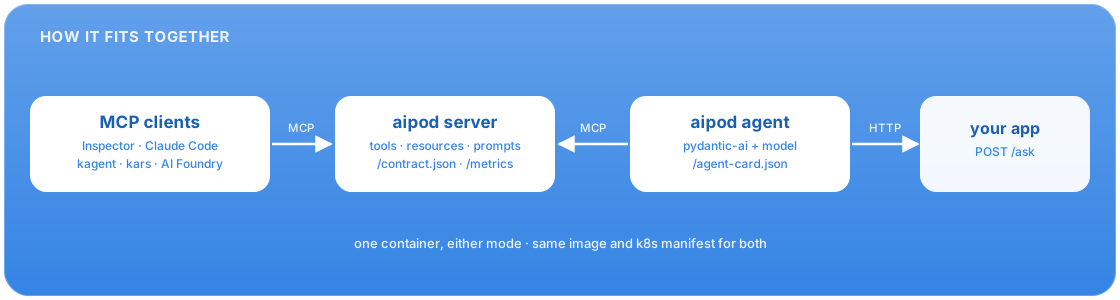
Purpose. aipod is a single program you can start as an MCP server or
as an agent, chosen by a subcommand:
| Command | Mode | What it is | Publishes |
|---|---|---|---|
aipod server |
MCP server | a reference implementation of every MCP feature, so client / gateway / runtime authors have one endpoint to test against | a service contract (GET /contract.json) |
aipod agent |
agent | a pydantic-ai agent that connects to an aipod server over MCP and exposes its tools to a model |
an agent card (GET /.well-known/agent-card.json) |
Built on FastMCP (server
mode) and pydantic-ai's MCP client (agent mode). Packaged as a single
FROM scratch container; the same image runs either mode.
Repo: https://github.com/bigg01/aipod ·
Latest release: v0.1.7 ·
Image: ghcr.io/bigg01/aipod ·
Chart: oci://ghcr.io/bigg01/charts/aipod
Live instance for remote MCP testing: a public aipod server runs at
https://aipod.guggenbuehl.net/ — MCP endpoint https://aipod.guggenbuehl.net/mcp,
contract at /contract.json. Open by default; point any MCP client at it without
installing anything. Shared and best-effort — treat state (incidents,
deployments) as scratch.
Wondering why a reference MCP server and agent are worth having around? See
docs/blog/contracts-and-agent-cards.md.
Server mode — feature surface
| Area | Details |
|---|---|
| Tools | echo, add, get_tiny_image, get_annotated_message, get_structured_weather, get_resource_reference, get_resource_links, trigger_long_running_operation, toggle_simulated_logging, toggle_subscriber_updates |
| Marvel roster | list_heroes, get_hero, find_heroes_by_power, assemble_team — typed Hero / HeroRoster / MissionTeam output over a small fixed dataset |
| SRE / IT-application | list_services, get_service, check_service_health, error_budget, search_logs, list_incidents, open_incident, update_incident, list_deployments, rollback_deployment, get_oncall, get_runbook — a toy service estate with mutable incident / deployment state and deterministic synthetic metrics & logs |
| pydantic-ai tools | poet, summarize (structured output), weather_report, hero_bio, incident_postmortem — model supplied by the client via MCP sampling (no server-side key) |
| Structured output | get_structured_weather / summarize / the roster & SRE tools return typed Pydantic models → output schema + structuredContent |
| Side effects | open_incident, update_incident, rollback_deployment (+ the toggle_* / trigger_* demo tools) are flagged sideEffects: true in the contract |
| Content blocks | text, image, embedded resource, resource links, priority / audience annotations |
| Resources | static docs + templated demo://resource/dynamic/{text,blob}/{resource_id}, hero://roster/{codename}, service://catalog/{name}, runbook://{service} |
| Prompts | simple_prompt, args_prompt, completable_prompt, resource_prompt |
| Auth | open by default; add a key and /mcp becomes an OAuth 2.1 protected resource (bearer token + /.well-known/oauth-protected-resource) |
| Metrics | on by default (Prometheus GET /metrics); OpenTelemetry per-MCP-method + per-tool counters/histograms, sampling count, inventory gauges. AIPOD_METRICS=otlp|console|none to change or disable |
| Also | argument completion, resource subscriptions, progress, logging/setLevel |
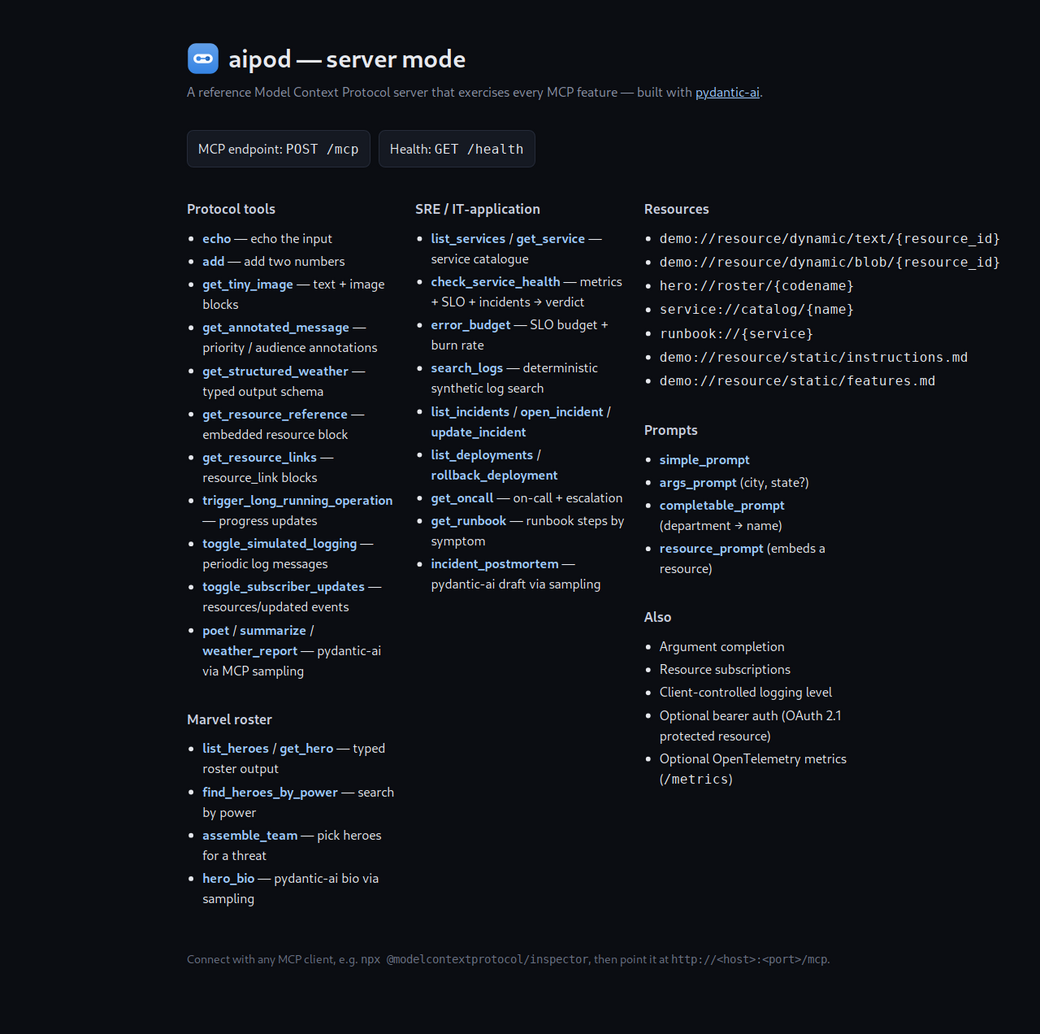
HTTP routes: GET / (landing), GET /health, GET|POST /mcp, GET /contract.json,
GET /metrics (Prometheus, on by default), and — when auth is enabled —
GET /.well-known/oauth-protected-resource.
GET / itself is a plain landing page listing every tool, resource, and
prompt above — open it in a browser once the server is running:
Agent mode
        HTTP + JSON                    MCP (Streamable HTTP)
client ─────────────▶ aipod agent ────────────────────────▶ aipod server
                      pydantic-ai Agent + model provider    tools / resources / prompts
HTTP routes: GET /, GET /health, GET /.well-known/agent-card.json,
POST /ask (legacy {"prompt":"..."} → {"output":"..."} and
Responses-style {"input":"..."} / {"input":[...messages...]} → {"object":"response", ...}).
Agent mode needs a model — AIPOD_MODEL (e.g. anthropic:claude-haiku-4-5) plus
the provider key. Without one it still serves the card and /health; /ask
returns 503.
Requirements
- Python ≥ 3.11, uv
- Docker + a Kubernetes cluster (optional)
Run locally
uv sync

# server mode
uv run aipod server                            # http://127.0.0.1:8000  (MCP at /mcp)
uv run aipod server --transport stdio          # for subprocess clients (Claude Desktop, editors)
uv run aipod server --print contract           # emit the service contract as JSON
uv run aipod server --auth-token s3cret        # require 'Authorization: Bearer s3cret' on /mcp

# agent mode (needs a running server + a model)
export AIPOD_MCP_URL=http://127.0.0.1:8000/mcp
export AIPOD_MODEL=anthropic:claude-haiku-4-5
export ANTHROPIC_API_KEY=...
uv run aipod agent                             # http://127.0.0.1:8080
uv run aipod agent --ask "Write a poem about sockets, then summarise it."
uv run aipod agent --print agent-card          # emit the agent card as JSON
stdio vs. HTTP (server mode)
- Streamable HTTP (default) — a long-running network service; clients connect
to
/mcp, responses and notifications stream back as SSE. Use for anything shared or deployed. - stdio — no network listener. The client launches
aipod serveras a child process and talks to it over that process's stdin/stdout. "Subprocess clients" are desktop / editor MCP hosts (Claude Desktop, Cursor, the VS Code MCP extension) that work this way; you never start the server yourself.
Authentication (optional)
The server runs open by default. Give it a key and the Streamable HTTP
/mcp route becomes an OAuth 2.1 protected resource:
uv run aipod server --auth-token s3cret          # or: AIPOD_API_KEY=s3cret
export AIPOD_API_KEYS="key-a,key-b"              # multiple keys (rotation / per-client)
| Env var | Effect |
|---|---|
AIPOD_API_KEY / AIPOD_API_KEYS |
keys the server accepts (--auth-token wins) |
AIPOD_AUTH_SCOPES |
CSV of scopes a caller must hold (default: none) |
AIPOD_AUTH_ISSUER |
authorization-server URL advertised in metadata (default: this server) |
AIPOD_PUBLIC_URL |
externally reachable base URL when behind a proxy / ingress |
With auth on:
- requests to
/mcpwithoutAuthorization: Bearer <key>get401+ aWWW-Authenticateheader pointing atGET /.well-known/oauth-protected-resource(RFC 9728); - that metadata document lists the authorization server(s) and scopes;
contract.json→securityswitches from{"scheme":"none"}to abearerblock, andclientRequirements.authentication.requiredbecomestrue.
Tokens are checked against the static key list — the resource-server half of the
spec without an identity provider. For full OAuth 2.1, point
AIPOD_AUTH_ISSUER at a real authorization server and replace
StaticTokenVerifier in src/aipod/server/auth.py with a JWT-validating one.
aipod agent reaches a protected server by setting AIPOD_MCP_TOKEN.
curl -s http://127.0.0.1:8000/mcp -X POST ... -H 'Authorization: Bearer s3cret'
curl -s http://127.0.0.1:8000/.well-known/oauth-protected-resource | jq
Full walkthrough in docs/testing-mcp.md.
Observability (OpenTelemetry)
Both modes emit OpenTelemetry metrics, on by default with the Prometheus
exporter — aipod server serves GET /metrics with no configuration. The server
instruments its own MCP internals, not just the Python process:
| Instrument | Type | Attributes |
|---|---|---|
mcp.server.requests |
counter | mcp.method (tools/call, resources/read, prompts/get, completion/complete, resources/subscribe, logging/setLevel, …), outcome |
mcp.server.request.duration |
histogram (s) | same |
mcp.server.tool.calls |
counter | mcp.tool.name, outcome (ok/error), mcp.tool.sampling |
mcp.server.tool.duration |
histogram (s) | per tool name |
mcp.server.sampling.requests |
counter | server → client sampling round-trips |
mcp.server.tools / .resources / .resource_templates / .prompts |
gauges | the registered inventory |
mcp.server.resource_subscriptions.active / mcp.server.background_tasks.active |
gauges | live per-connection state |
aipod.agent.ask.calls / aipod.agent.ask.duration |
counter / histogram | outcome (agent mode) |
# default: Prometheus scrape endpoint on the mode's HTTP port
uv run aipod server
curl -s localhost:8000/metrics | grep mcp_server_

# push to an OTLP/HTTP collector instead
AIPOD_METRICS=otlp OTEL_EXPORTER_OTLP_ENDPOINT=http://localhost:4318 uv run aipod agent

# stdout, for a quick look
AIPOD_METRICS=console uv run aipod server

# turn it off
AIPOD_METRICS=none uv run aipod server
AIPOD_METRICS = prometheus (default) | otlp | console | none;
OTEL_METRICS_EXPORTER=none or OTEL_SDK_DISABLED=true also disable it;
a bare OTEL_EXPORTER_OTLP_ENDPOINT selects otlp. OTEL_SERVICE_NAME /
OTEL_RESOURCE_ATTRIBUTES set the resource. In k8s: metrics.exporter in the
Helm values, or AIPOD_METRICS in k8s/configmap.yaml.
Grafana dashboard — dashboards/aipod.json (import
it directly) covers the inventory gauges, per-method + per-tool rate / errors /
latency, sampling, and the agent /ask. On a kube-prometheus-stack cluster,
kubectl apply -k dashboards ships it as a sidecar-loaded ConfigMap.
The running version shows on the landing page (GET /) and in GET /health
({"status":"ok","version":"…"}).
Test
uv run pytest
Hermetic — server tests drive an in-memory MCP session with a stubbed sampling callback; agent tests need no running server and no API key.
Exercise the server with the MCP Inspector
@modelcontextprotocol/inspector
is the reference MCP client — it speaks the raw protocol, so no model or API key
is needed (except for the sampling-backed tools).
uv run aipod server                      # start a server (MCP at :8000/mcp)

# interactive UI (http://127.0.0.1:6274)
npx -y @modelcontextprotocol/inspector                          # or: make inspect

# scripted / CI — one request per call (transport auto-detected from /mcp)
npx -y @modelcontextprotocol/inspector --cli \
  http://127.0.0.1:8000/mcp --method tools/list                 # or: make inspect-cli
npx -y @modelcontextprotocol/inspector --cli \
  http://127.0.0.1:8000/mcp --method tools/call --tool-name add --tool-arg a=2 --tool-arg b=3

# or skip the local server and hit the live instance
npx -y @modelcontextprotocol/inspector --cli \
  https://aipod.guggenbuehl.net/mcp --method tools/list
Full walkthrough — every feature (structured output, resource templates,
completion, subscriptions, logging, progress, sampling), the --cli vs UI split,
stdio via an mcp.json, and a CI gate example — in
docs/testing-mcp.md.
Container (FROM scratch)
One image, either mode. PyInstaller bundles the app, staticx folds in libc,
the final image is FROM scratch (binary + /tmp + CA certs + /etc/passwd),
~34 MB.
Every release publishes it to the GitHub Container Registry (public, no login):
docker pull ghcr.io/bigg01/aipod:0.1.1        # or :latest, :0.1, :sha-<commit>

docker run --rm -p 8000:8000 ghcr.io/bigg01/aipod:latest       # server (default CMD)
docker run --rm -p 8080:8080 \
  -e AIPOD_MCP_URL=http://host.docker.internal:8000/mcp \
  -e AIPOD_MODEL=anthropic:claude-haiku-4-5 -e ANTHROPIC_API_KEY=... \
  ghcr.io/bigg01/aipod:latest agent --host 0.0.0.0 --port 8080  # agent
Or build it yourself: docker build -t aipod:latest . (same result, make docker).
The binary self-extracts into TMPDIR (/tmp) on start, so the runtime needs a
writable /tmp even with a read-only root filesystem.
Kubernetes
Both modes deploy from the one image, two ways:
Kustomize — k8s/
kubectl apply -k k8s:
Deployment/aipod-server(+Service/aipod-server) —replicas: 1(per-session state + background tasks live in memory)Deployment/aipod-agent(+Service/aipod-agent,Ingress) —replicas: 2, stateless;AIPOD_MCP_URLpoints at the server ServiceConfigMap/aipod-config— governance labels +AIPOD_MODEL; provider key from a Secret you create (kubectl create secret generic aipod-model --from-literal=ANTHROPIC_API_KEY=...)Secret/aipod-auth(optional) —AIPOD_API_KEYturns on bearer auth for the server and is reused by the agent asAIPOD_MCP_TOKEN(kubectl create secret generic aipod-auth --from-literal=AIPOD_API_KEY=$(openssl rand -hex 16))
Helm — charts/aipod/
# from a checkout
helm install aipod ./charts/aipod

# or the published OCI chart
helm install aipod oci://ghcr.io/bigg01/charts/aipod --version 0.1.0 \
  -f examples/helm-values.yaml
Same objects, parameterised: server.enabled / agent.enabled, *.replicas,
*.ingress.*, *.resources, the config map, and auth / model (inline key ⇒
the chart makes the Secret, or point at *.existingSecret). Full list in
charts/aipod/values.yaml;
examples/helm-values.yaml is a TLS-ingress + bearer-auth
override. make helm-lint / helm-template / helm-install.
Both pods run non-root, no capabilities, read-only rootfs, RuntimeDefault
seccomp, with an emptyDir at /tmp.
On Azure Kubernetes Service (AKS)
Same manifests, no Azure-specific changes needed beyond getting the image into a registry AKS can pull from:
az acr create -g my-rg -n myacr --sku Basic
az acr build -r myacr -t aipod:latest .          # builds in ACR, no local push needed

az aks create -g my-rg -n my-aks --attach-acr myacr
az aks get-credentials -g my-rg -n my-aks

# point k8s/kustomization.yaml's `images:` entry at myacr.azurecr.io/aipod, then:
kubectl apply -k k8s/
--attach-acr wires AKS's kubelet identity to pull from that registry
without a separate imagePullSecret.
Agent platforms
Same server, same /mcp endpoint — different runtimes just point at it
differently.
- kagent registers a remote MCP server as its own
CRD — see
examples/kagent-remotemcpserver.yaml. Apply it and kagent discovers every tool the same way it discovers its own built-in tool server (kubectl get remotemcpserver aipod -o yaml→status.discoveredTools). - kars (Microsoft's Kubernetes-native
agent runtime) has its own
McpServerCRD — OAuth, per-tool allow-lists, and sandbox selectors included — seeexamples/kars-mcpserver.yaml. - Azure AI Foundry (and anything else using the same
Responses-API-shaped MCP tool) takes the endpoint straight in the
agent/tool definition, no separate resource — see
examples/azure-ai-foundry-mcp-tool.json.
CI / releases
For Microsoft Foundry Hosted Agents, see the Invocations runtime and deployment guide.
.github/workflows/ci.yml runs on every push / PR:
pytest on Python 3.11–3.13, uv build, uv lock --check, a check that
examples/ is in sync, helm lint + kubeconform on the rendered manifests, and
a FROM scratch image build with a /health + /contract.json smoke test.
.github/workflows/release.yml runs on a
vX.Y.Z tag (which must match the pyproject.toml version) and produces, for
that version:
- Container —
ghcr.io/bigg01/aipodtaggedX.Y.Z+X.Y+latest+sha-<commit>, with an SBOM and build provenance attestation. Public —docker pullneeds no login. - Helm chart —
oci://ghcr.io/bigg01/charts/aipod, version pinned to the tag. - Binary — the static
aipod-linux-x86_64. - GitHub Release — notes plus the binary and chart tarball attached.
Governance
Both modes carry the same labels from AIPOD_* env vars — a governance block in
the server contract, an x-governance block (plus a dependencies link to the
server's contract) in the agent card:
| Env var | Field |
|---|---|
AIPOD_OWNER |
owner / provider.organization |
AIPOD_DOMAIN |
domain |
AIPOD_DATA_CLASSIFICATION |
dataClassification (PUBLIC…RESTRICTED) |
AIPOD_DATA_RESIDENCY |
dataResidency |
AIPOD_REGULATORY_SCOPE |
regulatoryScope (CSV) |
AIPOD_AUTH_SCHEMES |
authenticationSchemes (CSV) |
AIPOD_CONTAINS_PII |
containsPII |
Per-tool the contract also has requiresSampling, sideEffects, and dataEgress
so a router / gateway can gate calls on data movement and state changes rather
than on tool names.
Layout
src/aipod/
  __main__.py          CLI - `aipod server` | `aipod agent`
  governance.py        shared AIPOD_* governance labels
  telemetry.py         OpenTelemetry metrics (both modes)
  server/
    build.py           every MCP feature on one FastMCP instance
    sampling_tools.py   pydantic-ai tools (model via MCP sampling)
    heroes.py          Marvel roster data + models for the roster tools
    sre.py            IT-application / SRE estate: catalogue, incidents, deploys, metrics
    auth.py            optional bearer-token / OAuth 2.1 protected-resource auth
    contract.py         service contract builder
    data.py, landing.py
  agent/
    runtime.py          pydantic-ai Agent + MCP toolset -> the server
    card.py             agent card builder
    http.py             Starlette app: card, /health, /ask, /metrics
    config.py           AIPOD_MCP_URL, AIPOD_MODEL, ...
packaging/  PyInstaller entry + spec
examples/   generated contract.json + agent-card.json + helm-values.yaml
k8s/        both Deployments, Services, Ingress, ConfigMap, kustomization
charts/aipod/  Helm chart (same objects, parameterised)
.github/workflows/  ci.yml (test + build) + release.yml (image + chart + binary)
docs/       testing-mcp.md (Inspector walkthrough) + blog/ (contracts & agent cards)
tests/      test_server.py + test_agent.py