
codegraph MCP server
Commit Nov 4, 2026Analyzes TypeScript, JavaScript, and Python repositories to generate call graphs, impact analysis, and code archaeology via static analysis.
Also known as attnstack/codegraph
- Stars
- 1
- Tools
- —
- Downloads, 30 days
- —
- Latest version
- 1.0.0
- Last commit
- Nov 4, 2026
- License
- MIT
What is codegraph MCP?
codegraph analyzes TypeScript, JavaScript, and Python repositories to generate call graphs, impact analysis, and code archaeology via static analysis.
Summary generated from the project's README
About codegraph MCP server
Analyzing the ripple effects of code changes in TypeScript, JavaScript, or Python repositories is what codegraph enables for developers. By using tree-sitter to parse code into a comprehensive call graph, it provides precise answers regarding function callers, impact analysis, and code lineage. This tool is designed for engineers who need more than simple text searches or single-hop reference lookups when refactoring or debugging complex systems.
Users can interact with the system via a command-line interface or connect it to AI clients like Claude Code or Cursor using the MCP stdio protocol. The server runs locally and can be deployed via Docker to avoid installing the Rust toolchain. It manages data through a local SQLite database and performs incremental updates to ensure that queries remain fast even as files change. Unlike vector-based tools, it relies on deterministic static analysis to provide reproducible results, explicitly labeling dynamic calls that cannot be resolved statically.
What you can do with it
- 1Assess refactoring impactDetermine which parts of a codebase will be affected by changing a specific function.
- 2Trace execution pathsFollow the logic flow from an entry point through various intermediate functions to external calls.
- 3Identify dead codeLocate orphan functions that are no longer being called within the repository.
- 4Perform code archaeologyInvestigate the history of a symbol to see which commits and pull requests introduced specific lines.
Written from the project's README. Every use case is checked against a quote from it.
Automated checks
Ran Nov 15, 2026Full report →Not verified yet. A server needs a score of 80, no serious finding, and enough data for us to check. How checks work · What to fix for more points

- Source repository linked and reachableattnstack/codegraph is public and reachablegithub.com/attnstack/codegraph ↗Pass
- Package names this repository as its sourceNot checked
- Build provenance (Sigstore attestation)Not checked
- Open source license (OSI)MITspdx.org/licenses/MIT.html ↗Pass
- Commit or release in the last yearLast commit or release 2026-11-04github.com/attnstack/codegraph ↗Pass
- OpenSSF ScorecardNot checked
- Package name not close to a popular packageNot checked
- No critical advisory in the package or its dependenciesNot checked
- No hidden instructions to the model0 tool descriptions and the README read; no override phrases, credential paths or hidden charactersPass
- Destructive tools are labelledNot checked
- Remote endpoint answers the MCP handshakeNot checked
README
View on GitHubcodegraph
改一行代码,怎么知道会波及哪些地方?IDE 的"查找引用"只给一跳,全局搜索只会匹配文本。codegraph 用 tree-sitter 把整个 TypeScript/JavaScript(以及 Python)仓库解析成一张调用图(函数 / 类 / 文件 × 调用 / 继承 / 导入),然后直接回答:
- 谁调用了它 —— 每个调用点带源码位置
- 改它影响谁 —— 影响面按风险排序,每条附完整调用链
- 从入口到 DB/外部调用 中间经过了谁
所有结论来自静态解析,每条边都能点回源码。解析不了的地方(动态调用、同名歧义、被局部变量遮蔽)会明确标成 dynamic 列出来,而不是硬塞一个可能错的答案给你。不需要向量库,不需要上传代码,查询结果可复现。


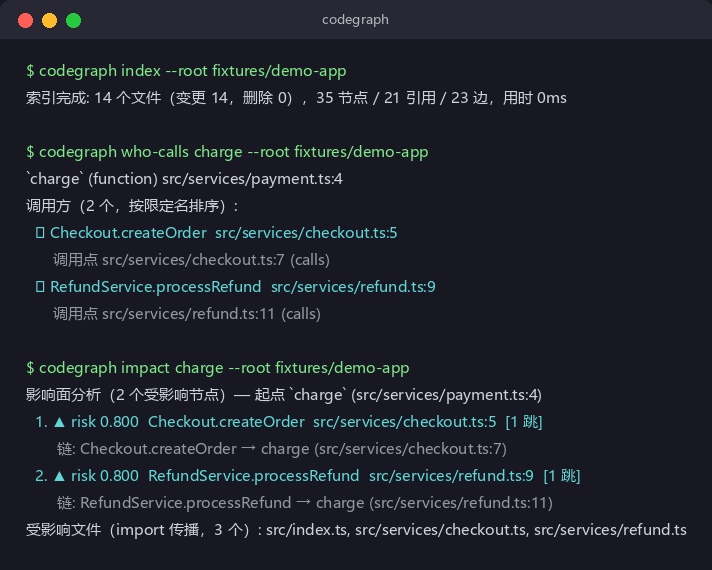
快速上手
git clone https://github.com/attnstack/codegraph.git && cd codegraph
cargo build --release

# 对任意 TS/JS 仓库建图(仓库自带一个演示项目)
./target/release/codegraph index --root fixtures/demo-app

# 问它问题
./target/release/codegraph who-calls charge --root fixtures/demo-app
# 开发态:保存即自动增量重建(可另开一个终端挂着)
./target/release/codegraph watch --root fixtures/demo-app
./target/release/codegraph impact charge --root fixtures/demo-app
./target/release/codegraph trace Checkout.createOrder format --root fixtures/demo-app
./target/release/codegraph callees charge --root fixtures/demo-app      # 它调用了谁
./target/release/codegraph dead-code --root fixtures/demo-app           # 孤儿函数
./target/release/codegraph cycles --root fixtures/demo-py               # import 循环(python 仓库)
./target/release/codegraph hotspots --root fixtures/demo-app
Python 仓库用法完全一样——试试 --root fixtures/demo-py。
impact 的输出长上面截图那样:按风险排序的受影响清单 + 每条的证据链。风险分的算法在架构文档里,一句话版本是"沿调用链每跳衰减 0.8,不同边类型不同权重"。
接入 Claude Code / Cursor
CLI 之外还有一个 MCP stdio 出口,Agent 可以直接调用同一套查询:
{
  "mcpServers": {
    "codegraph": {
      "command": "/path/to/codegraph",
      "args": ["mcp", "--root", "/path/to/your/repo"]
    }
  }
}
不想装 Rust 工具链的话,仓库带了 Dockerfile:
docker build -t codegraph .
docker run -i --rm -v /path/to/your/repo:/repo codegraph        # 起 MCP stdio
docker run --rm -v /path/to/your/repo:/repo codegraph index --root /repo   # 当 CLI 用
提供 9 个工具:who_calls / impact / trace / callees / dead_code / cycles / hotspots / search / archaeology。改完文件不用手动重建——每次工具调用前会做 mtime/size 预筛,发现漂移自动增量更新。协议实现是手写的最小 JSON-RPC 子集,用官方 TypeScript SDK 做了契约测试(这也是 CI 的一部分)。
archaeology 单独说一下:基于 git blame -C 做代码考古,输入一个符号,返回它每行是哪个 commit 引入的、谁写的、关联哪个 PR。接手别人的老模块时挺好用。
为什么不用向量库
语义相似不等于真有调用关系。改代码影响评估需要的是确定的边,不是"感觉相关的前 k 个"。代价也很实在:解析成本(靠增量更新摊薄)和语言覆盖(目前只有 TS/JS)。如果你要的是"帮我找实现某个业务概念的代码",这是另一类问题,embedding 检索更合适,两者不冲突。
工作原理
graph LR
    A[文件发现<br>gitignore 感知] --> B[tree-sitter 解析<br>并行,仅变更文件]
    B --> C[符号解析<br>全量视图重跑]
    C --> D[(SQLite / WAL)]
    D --> E[查询层<br>闭包 / 双向 BFS / PageRank]
    E --> F[CLI]
    E --> G[MCP stdio]
    H[git blame] --> E
几个关键取舍(细节在 docs/ARCHITECTURE.md):
- 节点身份不含行号。span 只是属性,否则每编辑一次全部节点 id 洗牌,增量更新就没法做了。
- 每个调用点单独存一行(refs 表),边表只是聚合缓存。证据链、增量重解析的原材料,都是同一份 refs。
- 增量的正确性靠拆分:tree-sitter 解析(贵)只做变更文件;符号解析(便宜,全是哈希查找)每次对全量视图重跑。所以"增量结果 == 全量重建"能拿 fuzz 测试证明——随机改文件,两边各查一遍全部符号,逐字段断言相等。这个测试在 CI 里跑。
性能
我机器上(Ryzen 7 7735H,Windows 11,release 构建)跑合成语料(700 个文件、10.5 万行、1.5 万节点 / 3.3 万边):
| 操作 | 耗时 |
|---|---|
| 全量重建 | 0.77s |
| 单文件变更增量更新 | 0.87s |
| 各查询命令 | 0.19–0.21s |
查询那 0.2s 基本是进程启动和快照装载,算法本身毫秒级。同目录 grep -rn 一遍要 0.35s,而且它只能给你文本行。
说句实话:这个规模下全量重建本来就不慢,增量并不比它快。增量的价值在于正确性模型(上面说的 fuzz 等式)和更大的语料/更慢的磁盘。数字怎么测的、怎么复现,见 scripts/bench.sh。
已知不足
- JS 没有类型信息,
obj.method()这类调用很多解析不出来,进了 dynamic 桶。要彻底解决得接 tsc 的类型表,暂时没做。 - 装饰器路由、DI 容器、monkey-patch 这类运行时魔法,静态分析原则上无解,全部如实标 dynamic。
- 证据链是调用链,不含数据流。严格的影响面要程序切片(SDG),是后面想做的方向。
- 语言适配器覆盖 TS/JS 和 Python。加一门语言 = 一个 grammar 依赖 + 一份 queries 文件 + 在 parse.rs 注册(见 CONTRIBUTING);python 的 import 环检测也顺带做了,但 barrel 式 re-export 链目前只在 TS 侧支持。
- benchmark 用的是合成语料,真实大型 monorepo(workspace 协议、多层 tsconfig extends)没回归过。
更新日志
版本历史见 CHANGELOG.md。
License
codegraph MCP questions
What programming languages are supported?
The tool currently supports TypeScript, JavaScript, and Python.
How does it handle dynamic calls or ambiguous references?
Unresolvable calls, such as dynamic calls or name ambiguities, are explicitly labeled as 'dynamic' rather than providing potentially incorrect answers.
Can I use it with Claude Code or Cursor?
Yes, it provides an MCP stdio output that allows AI agents to call the same query suite.
Does it require a vector database?
No, it relies on static analysis and does not require a vector database or uploading code to an external service.