
Flare MCP server
Commit Sep 27, 2026A graph-based IDE that provides a live codebase map and a collaborative control panel for managing agentic coding tasks via MCP.
Also known as AlgoNoRhythm/Flare
- Stars
- 310
- Tools
- —
- Downloads, 30 days
- —
- Latest version
- —
- Last commit
- Sep 27, 2026
- License
- MIT
What is Flare MCP?
Flare is a graph-based IDE that provides a live codebase map and a collaborative control panel for managing agentic coding tasks via MCP.
Summary generated from the project's README
About Flare MCP server
Visualizing codebase dependencies and managing agentic coding workflows is what Flare enables through a graph-first IDE. Developers can use this desktop application or serve it to a browser to view a live map where files act as nodes and imports serve as edges. The interface provides three distinct perspectives: a Canvas for dependency depth, a Wheel for seeing global connections via bundled chords, and Districts for a treemap view based on lines of code.
Users manage AI agents by interacting with a collaborative control panel that includes a Kanban board for tasks, a design decisions log, and a question queue. The system works by watching the filesystem and providing tools like tasks_list, task_get, and task_update over MCP, allowing agents to pick up work, log progress, and ask for clarification. It is designed for multi-agent environments where a Channel tab allows different assistants to coordinate by announcing which files they are taking to prevent collisions.
What you can do with it
- 1Analyze codebase blast radiusA developer can hover over a file to see every other file that imports it to understand the impact of a change.
- 2Review architectural changesYou can monitor and approve significant structural changes an agent proposes before they are implemented in the code.
Written from the project's README. Every use case is checked against a quote from it.
Automated checks
Ran Nov 14, 2026Full report →Not verified yet. A server needs a score of 80, no serious finding, and enough data for us to check. How checks work · What to fix for more points

- Source repository linked and reachablealgonorhythm/flare is public and reachablegithub.com/algonorhythm/flare ↗Pass
- Package names this repository as its sourceNot checked
- Build provenance (Sigstore attestation)Not checked
- Open source license (OSI)MITspdx.org/licenses/MIT.html ↗Pass
- Commit or release in the last yearLast commit or release 2026-09-27github.com/algonorhythm/flare ↗Pass
- OpenSSF ScorecardNot checked
- Package name not close to a popular packageNot checked
- No critical advisory in the package or its dependenciesNot checked
- No hidden instructions to the model0 tool descriptions and the README read; no override phrases, credential paths or hidden charactersPass
- Destructive tools are labelledNot checked
- Remote endpoint answers the MCP handshakeNot checked
README
View on GitHubFlare
A graph-first IDE for agentic coding — desktop app, or served to a browser from the machine the agent runs on.
The main surface is a live graph of your codebase — every file is a node,
imports are edges — with a full terminal underneath where you run claude,
codex or opencode. As the agent edits files, the graph updates in real
time; every change burst is snapshotted into a local shadow history you can
diff against and revert to, per file or as a whole tree.

You run the agent in Flare's terminal, and Flare watches: it maps the repo from the source, attributes every write to whoever made it, and pulls you in when something important changes. The agent takes work from the board and asks its questions there, so the two of you are looking at the same project rather than at a chat log.
What you get
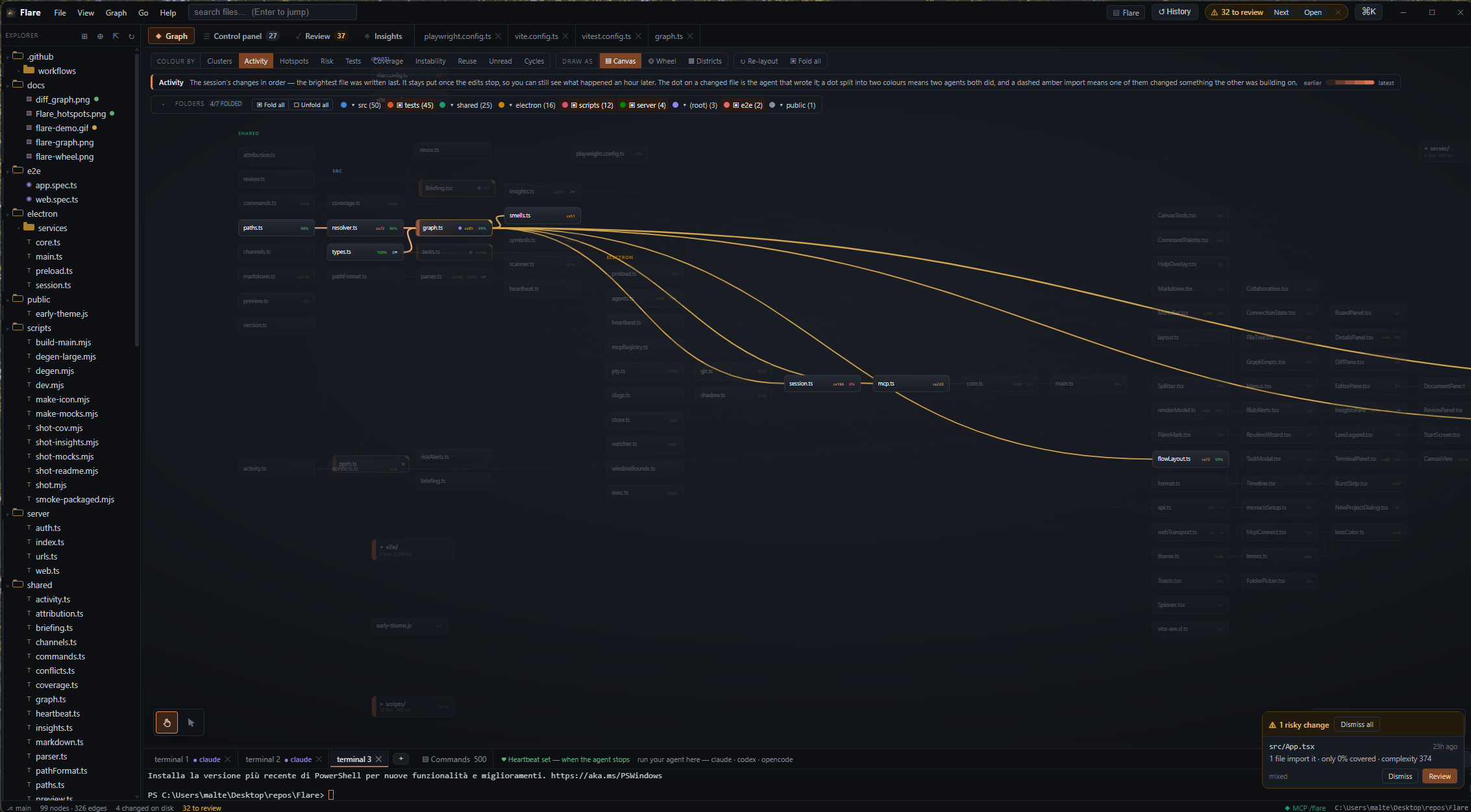
Flare open on its own source — 99 nodes, 326 edges. The Activity lens shades
each file by how recently it changed, and hovering shared/graph.ts lights
every file that imports it in amber: the blast radius of one file, without
reconstructing it from a grep. Bottom right, an alert Flare raised on its own
about src/App.tsx — nothing covers it, and with two agents live it says
mixed rather than guessing which of them wrote it.
Three views of the same graph
Switchable from the toolbar or the command palette. Each honours the active lens, the selection, collapsed directories and the search filter.
- Canvas (default) — dependency cards on a pannable board, ordered left-to-right by dependency depth (SCC-condensed, crossing-reduced, wrapped into bands so a long chain never becomes an unreadable strip): foundations left, entry points right. Cards carry the filename, a lens-coloured rail and badges (complexity, coverage %, untested, TODOs, cycles). Hovering traces imports in blue and importers in amber; shift+click traces the path between two files; cards can be dragged and their positions persist. Zooming out swaps the cards to a plate skin (semantic zoom) so the shape of the repo still reads.
- Wheel — every node sits on one ring ordered by directory, dependencies cross the middle as bundled chords, and cluster bands are labelled around the outside. Drag to spin, alt+wheel to rotate, scroll to zoom, shift+drag to pan, ctrl+drag to box-select. Click a node to pin its dependency directions; hover a cluster band to isolate that directory; click a band to collapse or expand it.
- Districts — a squarified treemap where area is lines of code and shade is the active lens. The fastest read on "how big is this repo and where does the mass sit"; selecting a file outlines everything it touches.
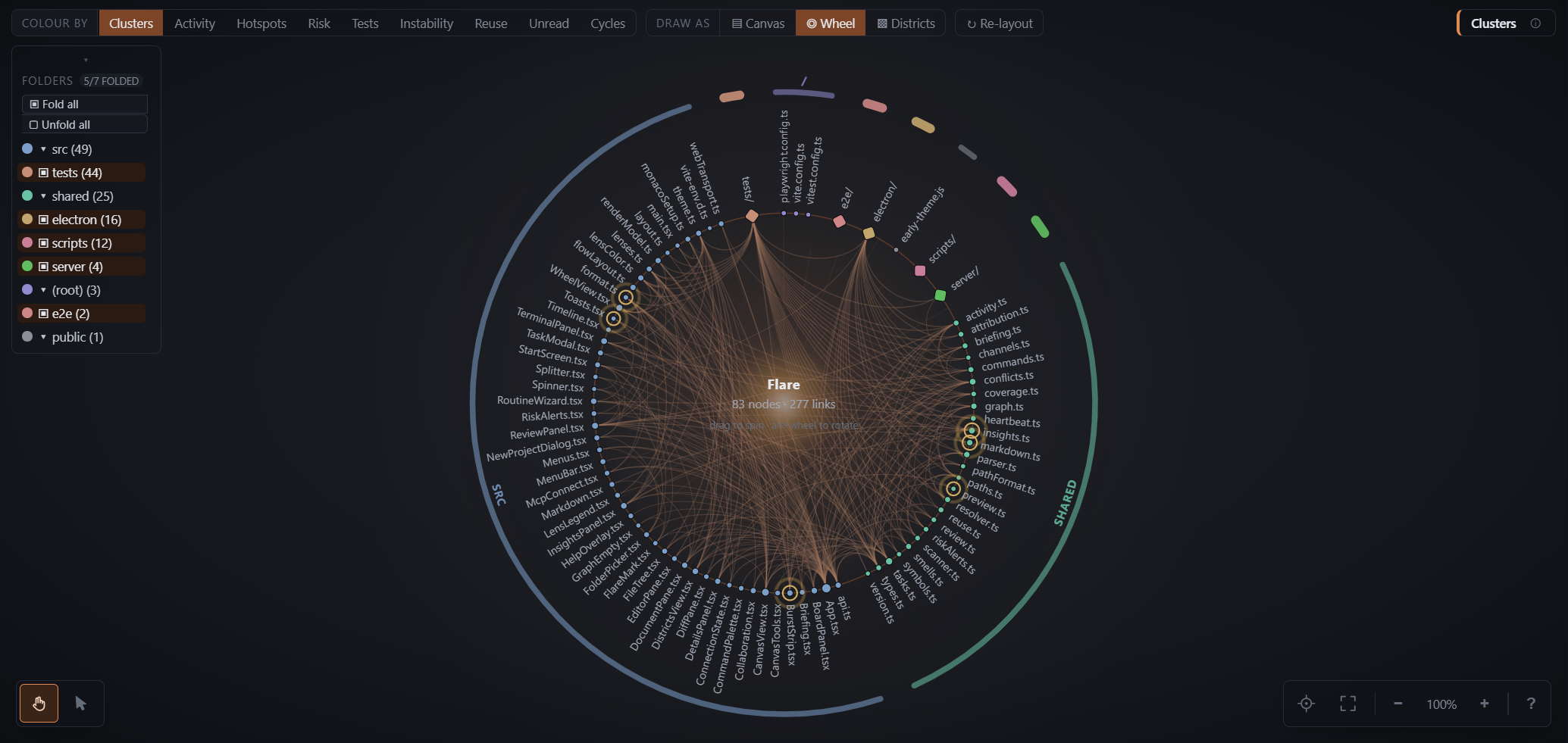
The Wheel answers the one question the canvas cannot: what talks to what across the whole repo at once. A file whose chords fan across the entire disc is load-bearing whether or not anyone documented it that way. Node dots take the active lens, cluster bands are coloured by directory.
Features
-
Folders that open one level at a time — a folder card holding more files than fits on a screen unfolds into its sub-folders, not into four hundred cards. A
src/that is 90% of the repo therefore has a middle state: it opens intosrc/app,src/features,src/libs… with the dependencies between them drawn, and each of those opens again. Folding it back remembers how far you had drilled. -
Lenses — recolour the same layout by Clusters, Activity, Hotspots (churn × complexity), Risk, Tests, Coverage, Instability, Reuse, Unread or Cycles. Whichever is active, a strip under the toolbar explains how to read the colours and shows the matching scale.
-
Everything is discoverable — a VS Code-style File / View / Graph / Go / Help menu bar, a
?cheat sheet listing every click, drag and shortcut for the current view, and a tooltip on every control saying what it does rather than what it is called. What acts on the view — pointer mode bottom-left; centre, fit, zoom and the cheat sheet bottom-right — sits on the canvas corners rather than in a toolbar strip above it. -
Control panel — the collaboration, in three sections. Tasks is a kanban of work written to be handed to an agent: a card's primary action is Copy for agent, which emits the brief plus the files it names plus what the graph knows about them ("29 files downstream, 0% covered, in an import cycle"), so the agent starts from the map instead of spending half its context rediscovering it. File a card straight from a graph selection with right-click → New task with these files. Lanes are yours — add, rename, reorder or remove them; removing one rehomes its tasks rather than dropping them.
Design decisions is for the architectural calls an agent makes without being asked — a module boundary, a dependency taken on, a data shape that will spread, a refactor across several files. It records them with
decision_recordbefore the code that assumes them and they land as proposed, for you to agree or decline with a reason; an agent cannot agree with its own proposal. Whether it then keeps building on one or leaves the work that rests on it is your call, set in the routine.Questions is what it needs from you, parked rather than blocking. Each question names the tasks it holds up, so the rest of the board stays workable; the agent picks up something else and halts only when everything left is waiting on an answer. Answer it in the panel and the agent reads it back over MCP.
All three are queryable over MCP, so an agent can run its own loop:
tasks_list(optionally by lane) to pick up work,task_getfor the exact brief a human would have pasted,task_updateto log progress and move the card to review,task_createto file follow-up work it finds but shouldn't do now,decision_record,question_ask, andworking_agreementwhen it is unsure whether to keep going. Everything shows up in the panel live. -
A routine, so it doesn't stop at the first question — the ⚙︎ Routine wizard sets what the assistant does when it runs out of work: check the board again rather than stopping, record design decisions you have not agreed to — and either keep building on them or park the work that rests on them — and park questions instead of halting on them, plus any house rules you type. It renders the working agreement the agent actually reads — generated from the switches, so turning one off removes its rule, and editable, because the switches cover what every project wants and nothing of what yours wants said in its own words. It stores it with the project, where
working_agreementreturns it along with the state of the board: how many cards are waiting to be picked up, how many are already in progress, how many are blocked, what is waiting on you, and which card to take next.That last part is written for more than one agent at a time. A card is only offered if it is still sitting in the first lane — moving it to in-progress is how an agent claims it, and no agent is ever pointed at a card another one has started.
The last switch is the one that doesn't depend on the agent remembering any of the others: check the board when it tries to stop. Flare answers your assistant's stop hook with the state of the board, so a session that tries to end while a card is still workable is handed that card instead, by name. It adds a
Stophook to.claude/settings.local.json— local to your machine, not committed — and takes it out again when you switch it off. Only ever once per stop, so a session can always end, and never a card someone else has already started.Several agents on one board is the case all of this is built for: the panel and every agent write through one place, and a write made against a board that has moved on since is rebased rather than believed — so a click in the panel cannot delete the card an agent filed a second earlier.
-
Channel — a room the agents talk in — several agents on one repo do not collide because they are careless; they collide because nothing tells them what the others are already inside. Each one sees a clean tree, opens the file its task points at, and finds out about the other when you read a diff where two changes have been folded together with no seam.
Flare cannot lock the file. It watches a filesystem rather than sitting in front of one, so a lock could only be a request an agent is free to ignore — and one that silently fails open is worse than none, because everyone downstream believes it held. What it can do is give them somewhere to talk, and then draw what was said on the map. The Channel tab is that room:
Claude 2  taking   shared/graph.ts, shared/resolver.ts
                   moving the workspace lookup out of the resolver
Codex 1   asking   @Claude 2 — is shared/graph.ts free? I need the edge
                   builder for the cycle fix
Claude 2  done     shared/resolver.ts — all yours
Three habits, and the tool descriptions ask for all three: say what you are taking before you start (
chat_postwithkind: "taking"and the paths — files or whole folders), read the room when you finish something (chat_read, which hands back only what you missed), and ask by name when you want a file someone has spoken for. You are in the room on the same terms: type into it from the panel and the agents read it back over MCP.Nothing is refused. Two agents may both say they are taking the same file — and when they do it is drawn as contention rather than resolved behind their backs, at the top of the tab and as a two-tone mark on the graph, because the two of them settling it is the only thing that actually settles it. An agent that writes a file another agent had spoken for is not blocked either; the crossing lands in the review with both names on it. Everything an agent says lapses on its own, so a session that is killed mid-edit does not hold a folder for the rest of the afternoon.
It reads as a chat, because it is one: bubbles, consecutive lines from one speaker grouped under one name, your own posts on the right, and each agent carrying a geometric mark — ● ◆ ▲ — assigned with its colour and never apart from it, so the ▲ agent is the same amber one on the card, in the review and in the room. The tool descriptions ask the agents to write prose a colleague could read rather than status codes, and the prose is what the bubble leads with.
Every line about files also opens. Everything said here is a claim, and Flare is the only participant that watched what followed — so a turn expands into what actually happened to the files it named: which the speaker went on to write and when, which it never touched, and who else wrote one of them afterwards. That last line cannot be got any other way, and the message it crossed is where you are already looking when you want it.
The tab is also where you find out whether any of it is working. A busy feed is not evidence of coordination, so the header carries the number that is: how many of the files the agents wrote this session had been announced here first, with a button that selects the ones that were not. Beside it, who is in the room, what each said it is taking, and which of them has never once called
chat_read— an agent that posts and never listens looks exactly like coordination right up until two of them collide. The transcript filters by agent, by kind and by text, and every path in it is a click to the graph. -
Claude 1, Claude 2, Codex 1 — the identity everything above rests on. A process list cannot tell two
claudesessions apart (both are equally "running" in every sample) and neither can the board (it attributes by path, so an agent editing a file on someone else's card is recorded as them). The MCP session can: it is minted oninitialize, echoed back on every request, and impossible for another client to answer to. Flare names each one from the tool it says it is plus the next free number, and that name then follows it everywhere — the ring on a node, the author of a change burst, the parties in a crossing, the row in the roster. Numbers are never reused inside a session, because a "Claude 1" that becomes a different agent halfway through would merge two of them in every sentence that mentions it.In the review, that shows up as a chip per agent above the change list — name, files written, how many of its changes nothing has checked — and clicking one narrows the list to that agent's work. One agent leaving all of its changes unverified is a fact about that agent, and it is invisible when its bursts are interleaved with two others' down a scrolling list.
-
Review cockpit — the tab that answers the questions a file-by-file diff can't. Changes are grouped into bursts (one batch of writes by one author), and each burst shows:
-
what actually checked it. The IDE sees both the file writes and the commands run in its terminals, so it can say "the tests ran, then two more files were edited and nothing re-ran" — the states are verified / failed / checked, then edited again / never checked, always quoting the output line the verdict came from.
-
who did it. Not "an agent" — Claude 2, in its own colour, with what it was doing beside the name. With three of them on one repo that is the difference between a list of changes and a list you can act on.
-
what it was trying to do. Agents call the
record_intentMCP tool before editing — or say it in the channel, which counts as the same thing; otherwise the burst says so plainly, because reviewing an agent's diff makes you the first human to see that code with nothing explaining why it exists. -
what the session was about. Everything else in the panel is derived from what Flare watched; this is the one thing it has to be told, because the answer does not exist in any single burst. It exists as a story, and the only participant who knows the story is the agent that lived it — so it is asked for, over MCP, before the session ends.
session_summarytakes a headline and chapters: a line of prose per piece of work and the files each one covers, and they sit at the top of the review, over the diff they are about.Not on trust, though. Flare watched the writes, so it binds every chapter to the bursts underneath it and reports the three ways a story and a session disagree: a chapter naming files that never changed (work described that did not happen — the one kind of wrong you cannot catch from a diff, because there is no diff to catch it in), files that changed and no chapter accounts for, and chapters covering work nothing has verified. That audit goes back to the agent in the tool's reply as well as onto the screen, so the usual outcome is that it fixes its own summary before anyone reads it:
Your chapters account for 2 of the 3 files you changed. "Left the workspace cache alone" names shared/cache.ts, which never changed — say what you actually did to it, or drop it. Not mentioned anywhere: src/components/ReviewPanel.tsx. -
which files deserve attention. Every file is tiered read carefully / read / skim from blast radius, coverage, cycles and complexity, with the reason spelled out ("9 files break if this is wrong", "no test covers it"), so a 30-file change doesn't get 30 equal glances. The tier is a heading over its group rather than a badge on every row, and on a big change the skim group starts folded.
-
agent smells. Rules for the shortcuts agent changes take and human ones don't: a test edited in the same burst as the code it covers, assertions deleted,
.skip/.onlyadded, lint or type suppressions introduced, coverage thresholds lowered, complexity spikes, files left with no importers, abstractions extracted for a single caller. -
one-click undo. Every burst has a snapshot: revert a file, revert the burst, or jump back to the last state whose checks passed.
-
walkthrough — step the graph through a burst's files worst-risk first, approving as you go.
-
-
Risky changes come and find you — the review tab is a tab, so a load- bearing file rewritten while you were reading the graph goes unnoticed until you go and look. Those changes queue behind a chip in the top bar instead, beside the review count: a number you can see from across the room, and the cards one click under it, newest first, staying put until answered. Review opens the change on its row in the review panel, Dismiss stops that card, Dismiss all clears the queue. Dismissing an alert is not approving the change — the file stays flagged, unread and exactly as the agent left it.
It is a chip rather than a floating panel because there is no corner for one. The bottom-right is the terminal, where a card hides the output of the very agent whose change it is reporting on; the top-right is where every tab keeps its own controls, so a panel there sits on
+ Lane, onRe-layout, on the channel's composer, and swallows the clicks meant for them. A queue that is usually non-empty during an agent session cannot be a panel. The transient toasts keep that corner — they have no controls at all, so the whole stack is click-through and can never eat the next thing you press. The bar is the careful tier plus something absolute (real dependents, a cycle, real complexity, no test at all), so a repo where nothing is load-bearing stays quiet rather than popping a card for its least boring file. -
Comprehension debt, measured — the Unread lens paints every file that changed this session and no human has opened since; approving does not clear it, opening the file does. Insights shows the repo-level percentage.
-
Every command classified — the command log labels each observed command read / writes / verify / network / destructive, filterable, with the pass/fail verdict next to verification runs. Destructive commands (
rm -rf,git reset --hard,push --force,npm publish, …) raise an alert and trigger a snapshot. -
Coverage ingestion — drop an
lcov.info(vitest/jest--coverage, nyc, pytest-cov…) incoverage/or the project root and it's picked up live: a Coverage lens appears, per-file percentages land in the details panel and hover cards, and real coverage replaces the test-linkage heuristic inside the review-risk score. -
Drill-downs — collapse any directory into an aggregate meta-node (click its legend chip or double-click the node); expand any file into its functions/classes with symbol-level edges. Shift-click two nodes to highlight the import path between them.
-
Cross-agent tracking — the process tree of every terminal is watched for claude / codex / opencode / aider / …; changes made while an agent runs are attributed to it (coloured node rings, trails on the graph, "changed by" in details), and every shell command run in the terminals lands in the Commands log (▤ button in the terminal bar, persisted per project). That is the terminal half of it — the MCP half, which is what tells two claudes apart and puts a mark on the files each of them is inside, is the room above.
-
Command palette — Ctrl+K: fuzzy-jump to any file,
>for commands, recent projects. Ctrl+B sidebar, Ctrl+W close tab, Ctrl+0 fit graph, Ctrl+=/− zoom, Esc collapses focus/drill-down. Full list under> keyboard shortcuts. -
Insights — a unified metrics + issues view: per-file risk/hotspot/ refactor composites, blast radius, churn (git + session), coverage, TODOs, co-change coupling; severity-ranked rules (regression-risk, god-file, agent-thrash, coverage-gap, cycles, dead code…) with a critical-alert badge and toasts.
-
Reuse — how cleanly each file would come out if you lifted it into a package, 0–100, plus one number for the whole repo. It counts the four things that actually stop you: talking to the host (
fs, sockets, a database), being bound to a framework, dragging a large share of the repo along, and sitting in an import cycle. Being widely imported is not a penalty — a util forty files depend on is the most reusable thing you have, which is the opposite of how risk reads the same number. Unlike the other composites it is an absolute scale rather than a ranking within the repo: if everything importsfs, the least-bad file has not become reusable. Themixed-concernsrule points at the files where logic is trapped behind the plumbing and worth separating. -
MCP server for your agents — one shared, localhost-only endpoint for the whole machine, however many Flare windows are open. Each instance runs a private ephemeral server and registers in a per-pid file registry; whichever instance holds the well-known port (default 7345,
FLARE_MCP_PORT) acts as the gateway and routes…/mcp/<slug>— the same stable per-project slug the browser server uses — to the owning instance, proxying when needed and taking over the port when the holder exits. Bare/mcpworks with a single session; with several it points the agent atlist_projects. Connect agent, in the terminal bar, opens a dialog with the two steps — and they are genuinely two. Registering the server is a config change you make once per machine, and it is different for each of the three: a command for Claude Code, a command for Codex, JSON in a file of its own for opencode.claude mcp add --transport http flare http://127.0.0.1:7345/mcp/<slug>The second step is the one that is easy to skip and shouldn't be: the line you open the agent with. Attaching the tools does not make an agent read them, and everything this project expects — taking a card before starting it, saying in the channel which files it is about to edit, writing the session down before it stops — comes back from one call. So the dialog hands you a message to paste, with the endpoint in it, that says to make that call first:
This project is open in Flare, which is on MCP at http://127.0.0.1:7345/mcp/<slug>.

Start by calling `working_agreement` — it says how this project wants you to
work, what is on the board, and who else is in here. Then take the card it
points you at.
It is deliberately short. A paragraph restating the protocol would be a second copy of it, going stale the moment you change the ⚙︎ Routine — and the agent is about to be handed the current version by the tool itself.
Tools:
graph_overview,file_info,dependents,dependencies,find_path,issues,top_files,search,impact_of(what breaks + which tests to run before changing files),recent_activity,verification_status(did my cha
Flare MCP questions
How does Flare help agents understand the codebase?
Flare provides a live graph of the codebase where files are nodes and imports are edges, allowing agents to see the blast radius of changes and dependency structures.
Can multiple agents work on the same project simultaneously?
Yes, Flare is designed for multiple agents to work on one board, using a Kanban-style task system and a communication channel to coordinate and prevent collisions.
How do agents interact with Flare's task management?
Agents can query and update tasks, record design decisions, and ask questions through MCP, allowing them to operate in a continuous loop.
What happens if two agents try to edit the same file?
Flare does not lock files but instead visualizes contention on the graph and in the channel, allowing users to see when two agents have spoken for or written to the same file.