
Test-Data-Management-Platform MCP server
Commit Nov 15, 2026Enables AI agents to manage test data through format-preserving masking, referential subsetting, and privacy-preserving synthetic data generation.
Also known as abul-lab/Test-Data-Management-Platform
- Stars
- 1
- Tools
- —
- Downloads, 30 days
- —
- Latest version
- —
- Last commit
- Nov 15, 2026
- License
- MIT
What is Test-Data-Management-Platform MCP?
Test-Data-Management-Platform enables AI agents to manage test data through format-preserving masking, referential subsetting, and privacy-preserving synthetic data generation.
Summary generated from the project's README
About Test-Data-Management-Platform MCP server
Quality engineers and developers can manage complex test data environments through this platform, which provides a unified control plane for data masking, subsetting, and synthetic generation. It allows users to create referentially intact datasets using Tarjan Strongly Connected Components for subsetting and a Feistel-inspired format-preserving cipher to maintain data structures during pseudonymization. The system is designed to prevent broken foreign-key joins by unifying parent and child keys through Union-Find equivalence classes.
Running locally with Python 3.11+, the server provides an MCP JSON-RPC 2.0 interface that includes an outbound agentic DLP firewall to prevent sensitive information leakage. Users can interact with the system via a web console on port 4300 or through a CLI for CI/CD integration. The platform supports ephemeral testing using in-memory SQLite snapshots via the SQLite Online Backup API and ensures data quality through IPOG pairwise combinatorial testing and NIST AI RMF-inspired statistical fidelity evaluations.
What you can do with it
- 1Generate referentially intact data subsetsAn AI agent can extract a small, connected portion of a large database without breaking foreign key relationships.
- 2Protect sensitive fields with format preservationDevelopers can mask identifiers while ensuring the resulting values maintain the original length and character type.
- 3Automate quality engineering coverageUsers can generate a test matrix that ensures every possible pair of input combinations is tested.
- 4Secure AI agent interactionsThe platform prevents autonomous agents from accidentally leaking private information during data tasks.
Written from the project's README. Every use case is checked against a quote from it.
Automated checks
Ran Nov 15, 2026Full report →Not verified yet. A server needs a score of 80, no serious finding, and enough data for us to check. How checks work · What to fix for more points

- Source repository linked and reachableabul-lab/test-data-management-platform is public and reachablegithub.com/abul-lab/test-data-management-platform ↗Pass
- Package names this repository as its sourceNot checked
- Build provenance (Sigstore attestation)Not checked
- Open source license (OSI)MITspdx.org/licenses/MIT.html ↗Pass
- Commit or release in the last yearLast commit or release 2026-11-09github.com/abul-lab/test-data-management-platform ↗Pass
- OpenSSF ScorecardNot checked
- Package name not close to a popular packageNot checked
- No critical advisory in the package or its dependenciesNot checked
- No hidden instructions to the model0 tool descriptions and the README read; no override phrases, credential paths or hidden charactersPass
- Destructive tools are labelledNot checked
- Remote endpoint answers the MCP handshakeNot checked
README
View on GitHubTest-Data-Management-Platform
Enterprise Test Data Management & Quality Engineering Control Plane: Feistel Format-Preserving Cipher (FF3-1 Inspired), Tarjan SCC Graph Subsetting, $k$-Anonymity & Privacy Budget Tracking, In-Memory SQLite Snapshots, IPOG Pairwise QE, FinOps, AI Governance & MCP Server





Executive Architecture Summary
Legacy Test Data Management (TDM) models stall enterprise delivery by relying on slow, risk-heavy staging database clones, naive column masking that breaks foreign-key joins, and manual ticket-driven provisioning.
Test-Data-Management-Platformv2.0 shifts TDM and Quality Engineering left into a unified, code-native control plane:
- Tier 1 (Enterprise TDM Core): Automated catalog discovery, Inclusion-Dependency implicit foreign-key inference, Tarjan Strongly Connected Components (SCC) referential subsetting, Educational Feistel-based format-preserving pseudonymization (8 rounds, HMAC-SHA256 PRF; not a vetted FPE, see Security Scope) unified via Union-Find equivalence classes, quantitative $k$-Anonymity / Entropy $\ell$-Diversity / Privacy Budget Accounting (Note: no formal Differential Privacy noise mechanism is currently implemented), Policy-as-Code Guards with Dual-Approval Workflow with HMAC Verification, and Merkle-Backed Audit Log + OpenLineage 1.0 Provenance.
- Tier 2 (Quality Intelligence, Polyglot & FinOps): Ephemeral in-memory SQLite sandboxes with in-memory snapshot restore via the SQLite Online Backup API, synchronized Kafka CloudEvents streams + WireMock REST contract stubs, IPOG $t=2$ Pairwise Combinatorial & Boundary Chaos synthesis, FinOps memory/utilization metering, and an executive Release Readiness evaluator.
- Tier 3 (Next-Gen AI Governance & Agentic QE): Neuro-Symbolic Constraint-Guided Incident Reproduction (Synthetic Incident Twins), NIST AI RMF-inspired statistical fidelity evaluation (KS, TVD, DCR, NNDR), and a native Model Context Protocol (MCP) JSON-RPC 2.0 Server with an Outbound Agentic DLP Firewall.
Security Scope
- Not for protecting production PII or PCI data. The cipher is a custom Feistel construction inspired by FF3-1. It is not NIST-validated and has not been independently reviewed.
- For production format-preserving encryption, use a vetted implementation of NIST FF1 or FF3-1 and manage keys in a KMS or HSM.
- Dual approvals and audit entries use symmetric HMAC-SHA256 tags, not digital signatures.
- Intended use: generating and protecting non-production test data, and demonstrating test data governance patterns.
Engineering Maturity & Capability Status
To maintain transparent technical credibility, the capabilities across this platform are classified into explicit maturity tiers:
| Capability / Subsystem | Status | Implementation Location | Verified Invariant |
|---|---|---|---|
| Feistel FPE (FF3-1 Inspired) | IMPLEMENTED |
src/privacy/privacyEngine.py |
8-round Feistel cipher with HMAC-SHA256 PRF; preserves length and radix across alphanumeric/digits. |
| Tarjan SCC Graph Subsetting & IND Inference | IMPLEMENTED |
src/subsetting/graphSubsetter.py |
Upstream parent closure + child cascade; resolves cycles; zero orphan FKs. |
| Multi-Table Relational Generator | IMPLEMENTED |
src/engine/syntheticGenerator.py |
Seeded deterministic generation across Financial, Healthcare, and Commerce. |
| SQLite Backup Sandboxing | IMPLEMENTED |
src/api/provisioningServer.py |
In-memory SQLite page snapshot & restore via SQLite Online Backup API; read-only query validator. |
| IPOG $t=2$ Pairwise Combinatorial QE | IMPLEMENTED |
src/quality/qualityIntelligence.py |
Greedy $t=2$ covering matrix with boundary chaos mutation; 100% tuple coverage. |
| Merkle Audit Log & OpenLineage 1.0 | IMPLEMENTED |
src/governance/auditLedger.py |
Epoch-anchored SHA-256 Merkle tree, $O(\log N)$ inclusion verification proofs, OpenLineage export. |
| Policy Engine & Dual-Approval Workflow | IMPLEMENTED |
src/governance/policyEngine.py |
Policy-as-code evaluation with dual-approver HMAC verification tags. |
| Model Context Protocol (MCP) Server | IMPLEMENTED |
src/mcp/mcpServer.py |
JSON-RPC 2.0 endpoint (tools/call, resources/read) with outbound DLP firewall. |
| Health Express Multi-System Orchestration | IMPLEMENTED |
src/healthexpress/healthExpressPipeline.py |
4-system diamond FK refresh + synthetic edge case injection into lower QA sandbox. |
| Single-Page Enterprise Web Console | IMPLEMENTED |
src/api/consoleUi.py |
1,700+ line reactive console served on :4300 binding all 10 engine subsystems. |
| Polyglot Event & Contract Synchronization | PARTIALLY IMPLEMENTED |
src/quality/qualityIntelligence.py |
Generates synchronized CloudEvents & WireMock stubs; wire-level streaming is simulated. |
| Neuro-Symbolic Crash Incident Twin | PROTOTYPED |
src/ai/aiGovernance.py |
Constraint solver reproduces crash predicates; automated APM parser on roadmap. |
| Distributed Multi-Engine Sandboxes (K8s) | ROADMAP |
deploy/k8s/datasandbox-crd.yaml |
Kubernetes CRD specification provided; cloud volume branching scheduled for v2.2. |
Quick Start & CLI Usage
Local Python (3.11+)
pip install -e ".[dev]"
tdm-guard serve --port 4300
Open http://localhost:4300 in your browser to explore the v2.0 Enterprise Control Plane.
CI/CD CLI Commands
# 1. Generate a deterministic synthetic dataset to disk
tdm-guard generate --domain financial_ledger --scale 25 --seed 42 --output dataset.json

# 2. Extract a Tarjan-SCC referentially intact graph subset
tdm-guard subset --domain financial_ledger --source-scale 25 --target-rows 4

# 3. Generate a t=2 IPOG pairwise combinatorial & boundary test matrix
tdm-guard pairwise --domain financial_ledger --profile BOUNDARY_HEAVY

# 4. Run the executive Release Readiness evaluator in CI (exits 0 if score >= min-score, 1 otherwise)
tdm-guard release-gate --min-score 90.0

# 5. Verify an exported JSONL SHA-256 audit trail
tdm-guard verify-audit audit_chain.jsonl
Current State vs. Future Vision
What Works Today (Implemented and Runnable)
- Local & CI/CD Operation: The harness runs locally with zero external database dependencies using Python 3.11+ and standard library SQLite with foreign keys enabled.
- Custom Feistel Cipher: Implements an 8-round balanced Feistel network with HMAC-SHA256 as its round PRF. While inspired by FF3-1 design principles, it does not use AES and is not officially NIST-validated.
- Privacy Budget Accounting: Evaluates $k$-anonymity, $\ell$-diversity, and $t$-closeness on tabular data, alongside an epsilon query budget accounting tracker. Note: No formal Differential Privacy noise mechanism (Laplace/Gaussian) is currently implemented.
- In-Memory SQLite Snapshots: Uses Python's
sqlite3.backup()API for in-memory snapshot restoration. Restore latency is not benchmarked in this repository. Does not implement OS/filesystem Copy-on-Write (CoW) page sharing. - HMAC Message Authentication: Dual approvals and audit entries use symmetric HMAC-SHA256 authentication tags, not asymmetric digital signatures (RSA/ECDSA).
- API & Live Web Console: The FastAPI server exposes 35 REST route definitions and serves an interactive single-page dashboard with real-time telemetry, live SQL query execution, and cryptographic audit proofs.
- Enterprise Test Suite: 23 unit and enterprise integration tests pass with 100% success rate across schema validation, masking, lineage, SQLite sandboxing, and policy evaluation.
What is Future Vision (Architectural Roadmap)
- Formal Differential Privacy Noise Mechanisms: Implementing randomized response, Laplace, and Gaussian mechanisms with formal $(\varepsilon, \delta)$-differential privacy properties.
- Distributed Aurora/Spanner Volume Clones: Transitioning ephemeral sandboxing from in-memory SQLite to enterprise storage snapshot drivers (AWS Aurora cloning, GCP Spanner emulators) managed via Kubernetes operators.
- Automated Stack-Trace Predicate Extraction: Ingesting Sentry/Datadog crash dumps to automatically extract symbolic constraints for Incident Twin generation without manual predicate definition.
- Deep Generative Tabular Models: Integrating differential-privacy tabular synthesizers (e.g., CTGAN, DP-WGAN) for complex multivariate continuous distributions.
Why Legacy Test Data Models Fail vs. How v2.0 Solves It
| Legacy Practice | Operational, Privacy & Quality Risk | How Test-Data-Management-Platform v2.0 Solves It |
|---|---|---|
| Raw Staging Database Clones | Copies regulated PII, clinical PHI, and PCI PANs into lower-trust environments as a full database clone per environment. | Synthesizes statistically faithful hierarchies or extracts Tarjan SCC referential subsets (62.5% volume reduction in the Health Express case study, 32 to 12 rows) gated by deterministic zero-leakage and residency policy guards. |
| String-Prefix or Naive Column Masking | Randomizing IDs independently breaks parent_id = child_id joins; replacing fixed-width columns with "TOK_..." breaks application length and Luhn validators. |
Unifies parent/child keys via Union-Find equivalence classes and transforms values with bijective 8-round Feistel format-preserving cipher (FF3-1 inspired) + quantitative $k$-anonymity / $\ell$-diversity evaluation. |
| Database-Only Provisioning & Slow Test Resets | Microservices fail when SQL tables don't match Kafka topics or external API stubs; re-seeding databases between tests takes minutes. | Checkpoints & restores in-memory SQLite state via the SQLite Online Backup API and synchronizes Kafka CloudEvents + WireMock REST stubs with identical foreign keys. |
| Happy-Path Only Data & Blind Releases | Random synthetic data misses boundary defects (leap days, $0.00 floors, hot-key skew), and QE leaders lack empirical data coverage gates. | Computes IPOG $t=2$ pairwise combinatorial matrices (100% pairwise tuple coverage in the test suite, with fewer rows than the naive Cartesian product), tracks SQL table query coverage, and enforces a composite Release Readiness Scorecard. |
| Ungoverned AI Prompts & Unverified Audit Logs | Autonomous coding agents leak raw PII in prompts, generative models memorize training rows, and plain hash chains can be wiped or recomputed. | Provides an MCP Server with Outbound Agentic DLP Redaction, NIST AI RMF (KS/TVD/DCR/NNDR) memorization evaluations, and HMAC-authenticated Merkle Tree + OpenLineage provenance. |
Flagship Enterprise Case Study: "Health Express" 4-System Prod $\to$ Lower QA TDM Journey
To demonstrate realistic enterprise test data complexity beyond isolated single-table masking, Test-Data-Management-Platform includes the Health Express Multi-System Orchestrator (src/healthexpress/healthExpressPipeline.py · POST /v1/healthexpress/journey).
The 4 Interconnected Healthcare Systems & Diamond FK Topology
SYS-1: HE-Member-IAM(he_patients): Master Patient Index holdingmember_id(PK),mrn_number(Unique Key), SSN, email, phone, and benefit plan tier.SYS-2: HE-Clinical-EHR(he_encounters): Telehealth & clinical visits referencinghe_patients.mrn_number(patient_mrn_ref), ICD-10 diagnosis codes, and unstructured free-text clinical intake notes containing embedded PHI.SYS-3: HE-Pharmacy-Rx(he_prescriptions): Mail-order specialty e-prescribing referencing bothhe_patients.member_id(member_ref) andhe_encounters.encounter_id(clinical_visit_ref).SYS-4: HE-Claims-Clearinghouse(he_claims_settlement): EDI 837/835 claims adjudication referencing all three upstream systems simultaneously (subscriber_member_id,encounter_ref,rx_ref) alongside payment card PANs on file.
Note: The HIPAA, GDPR, and similar labels below name example policy templates that this tool can enforce. They are not a certification or legal compliance determination. Operators remain responsible for their own compliance.
Environment 1 (PROD_HIPAA_ENCLAVE) $\to$ Environment 2 (LOWER_QA_SIT_SANDBOX) via 7 Pipeline Steps
When triggered via the Web Console, REST API (POST /v1/healthexpress/journey), or MCP Server (execute_health_express_refresh_journey), the orchestrator executes 7 pipeline steps with live millisecond telemetry:
catalog.discover_health_express_topology(POST /v1/catalog/discover): Scans all 4 systems inPROD_HIPAA_ENCLAVE, classifies PHI/PII/PCI columns, and computes the Tarjan SCC topological load order (he_patients → he_encounters → he_prescriptions → he_claims_settlement).policy.evaluate_hipaa_refresh_guard(POST /v1/policies/evaluate): EvaluatesROLE_HIPAA_CLEARED_QErole clearance, residency policy guards, and $k$-anonymity floors via Policy-as-Code.subset.extract_4system_cohort_slice(POST /v1/subset/extract): Extracts a referentially intact 3-patient cohort slice across all 4 systems (32 prod rows → 12 subset rows,62.5%reduction,0orphan FKs).privacy.deidentify_4system_nist_ff3_1(POST /v1/mask): Applies Union-Find + 8-round Feistel format-preserving cipher (FF3-1 inspired) across all 4 systems and scrubs unstructured clinical EHR notes (78 PHI/PCI leaks → 0 leaks).synthetic.augment_specialty_rx_edge_cases(POST /v1/ai/reproduce-incident): Synthesizes and injects 2 high-acuity specialty biologic / Coordination-of-Benefits (COB_SECONDARY_PAYER_HOLD,billed_cents >= 985000,$0copay boundary) patients (+8 rows) into the lower environment so QA can test rare adjudication edge cases not present in the prod slice.sandbox.provision_and_verify_4system_sql_join(POST /v1/sandboxes/{id}/query): Materializes the hybrid dataset (12 de-identified refreshed rows + 8 synthetic edge-case rows = 20 rows) into an in-memory SQLite database (PRAGMA foreign_keys = ON) and executes a 4-table diamond SQLJOINverifying100%cross-system relational integrity.audit.anchor_worm_merkle_provenance(GET /v1/audit/{id}/merkle-proof): Authenticates and anchors the refresh + synthesis attestation into the Merkle-backed audit log via HMAC verification tag.
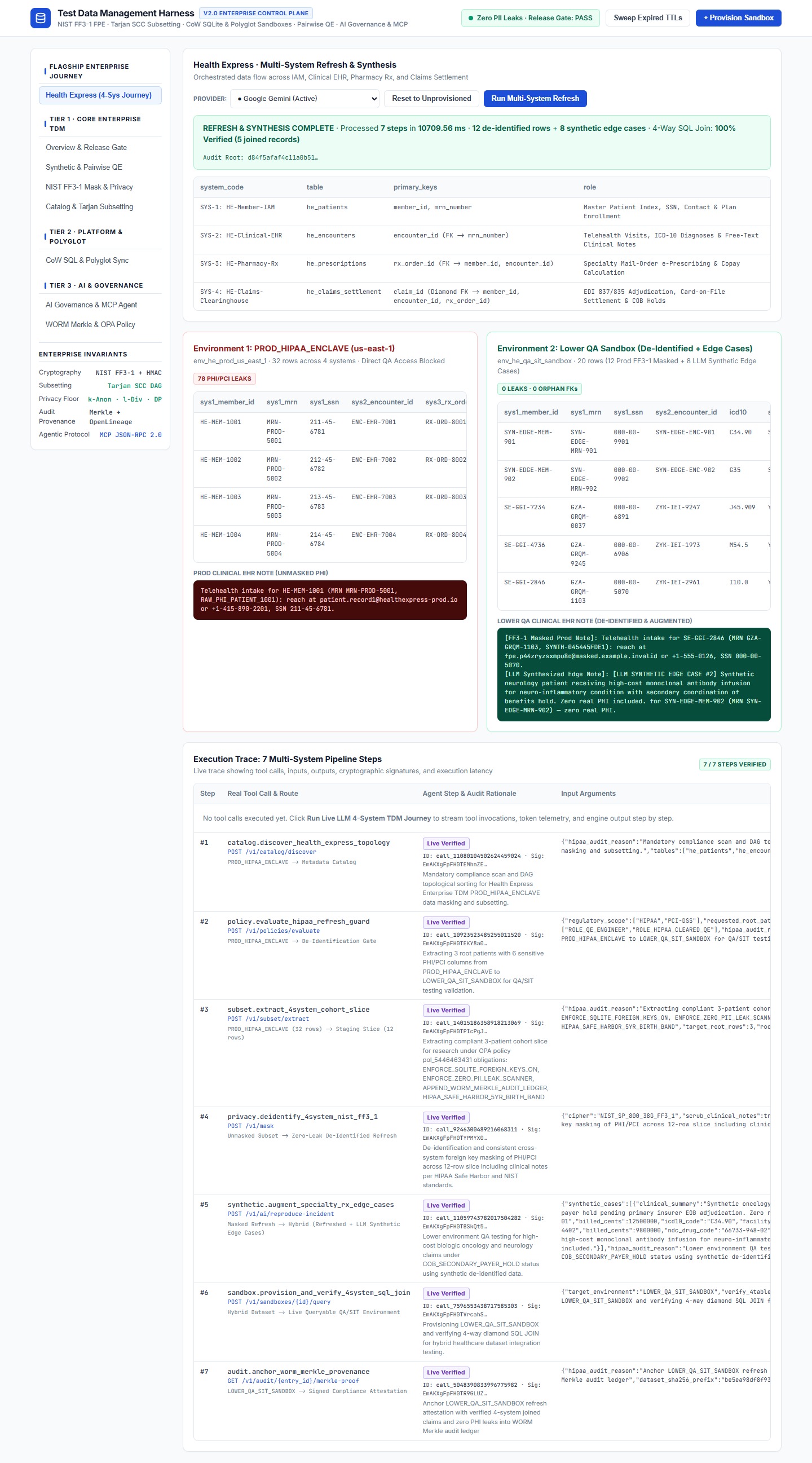 Figure: Live Web Console execution of the 7-step Health Express multi-system refresh and synthesis pipeline.
Enterprise Architecture & Governance Flow
flowchart TB
    subgraph T1["Tier 1: Enterprise TDM & Cryptographic Privacy"]
        CAT["Automated Catalog Scanner<br/>+ Inclusion-Dependency FK Inference"]
        SUB["Tarjan SCC Graph Subsetter<br/>(Upstream Closure + Child Cascade)"]
        FPE["Union-Find + Feistel FPE (FF3-1 Inspired)<br/>+ k-Anonymity / l-Diversity / Budget Tracking"]
        OPA["Policy-as-Code Guards (Residency)<br/>+ Dual-Approval Workflow (HMAC Tags)"]
    end

    subgraph T2["Tier 2: Quality Intelligence, Polyglot & FinOps"]
        PW["IPOG t=2 Pairwise Planner<br/>+ Boundary Chaos Mutator"]
        COW["In-Memory SQLite Snapshots"]
        POLY["Polyglot Entity Synchronizer<br/>(Kafka CloudEvents + WireMock Stubs)"]
        FIN["FinOps Memory/Zombie Meter<br/>+ Release Readiness Evaluator"]
    end

    subgraph T3["Tier 3: AI Governance, Incident Twins & Agentic MCP"]
        TWIN["Neuro-Symbolic Incident Twin<br/>(Synthetic Crash Solver)"]
        AIRMF["NIST AI RMF Evaluator<br/>(KS · TVD · DCR · NNDR)"]
        MCP["MCP JSON-RPC 2.0 Server<br/>+ Outbound Agentic DLP Firewall"]
    end

    subgraph GOV["Merkle Provenance & Lineage"]
        MERKLE["HMAC-Authenticated SHA-256 & Merkle Tree<br/>+ OpenLineage 1.0 RunEvents"]
    end

    CAT --> SUB --> FPE --> OPA
    OPA --> COW
    PW --> COW
    COW --> POLY
    COW --> FIN
    TWIN --> COW
    FPE --> AIRMF
    MCP --> FPE
    COW --> MERKLE
    AIRMF --> MERKLE
    MCP --> MERKLE
Live Enterprise Console & Verification Tour
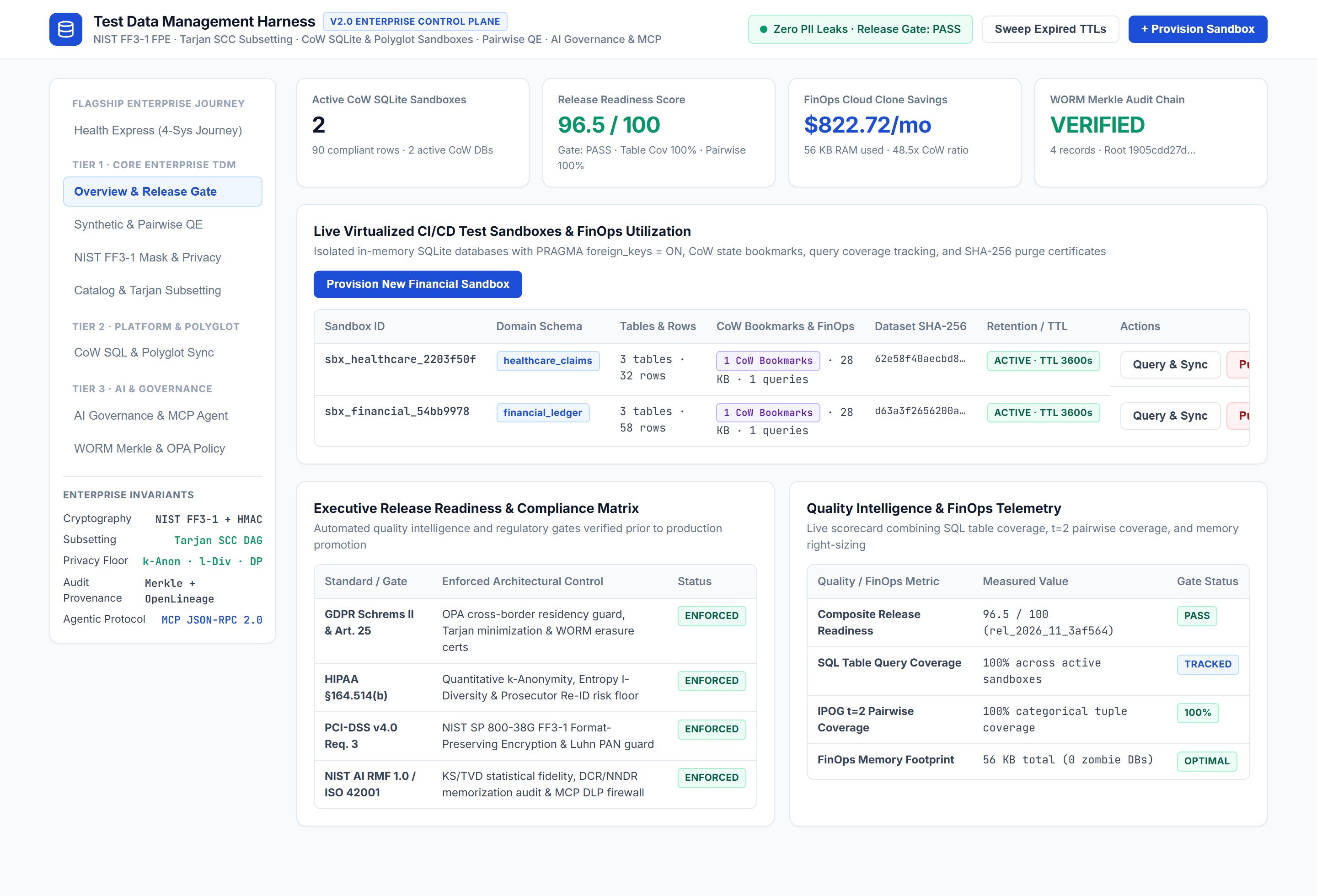
Visual Artifact Verification: The 8 images referenced below and throughout this repository (
docs/images/*.jpg) are authentic screen captures of the live Web Console interface (src/api/consoleUi.pyrunning onhttp://localhost:4300). They display real engine executions, live SQLiteJOINquery outputs, Feistel FPE cipher telemetry, and Merkle root verifications. Conceptual diagrams are maintained separately as Mermaid graphs anddocs/architecture-flow.png.
Every view in the built-in Web Console executes directly against the live Python engines, real in-memory SQLite sandboxes, live Feistel ciphers, and Merkle tree verifiers:
Test-Data-Management-Platform MCP questions
Is this platform suitable for protecting production PII or PCI data?
No, the custom Feistel cipher is not NIST-validated and is intended only for generating and protecting non-production test data.
Does the platform support differential privacy?
Currently, it evaluates k-anonymity and privacy budgets, but it does not yet implement formal differential privacy noise mechanisms like Laplace or Gaussian.