
coding-tools MCP server
Commit Oct 29, 2026Provides an AI agent with a secure coding runtime including file manipulation, command execution, git operations, and interactive sessions.
Also known as xyTom/coding-tools-mcp
- Stars
- 1,223
- Tools
- —
- Downloads, 30 days
- —
- Latest version
- —
- Last commit
- Oct 29, 2026
- License
- Apache-2.0
What is coding-tools MCP?
coding-tools is an MCP server. Provides an AI agent with a secure coding runtime including file manipulation, command execution, git operations, and interactive sessions.
Summary generated from the project's README
About coding-tools MCP server
Coding Tools MCP provides a secure, model-neutral runtime that allows AI agents to interact directly with a codebase. It functions as a bridge for any MCP client, including Claude Desktop, Cursor, VS Code, and Windsurf, enabling them to perform complex engineering tasks. The server operates locally via stdio or remotely through Streamable HTTP, requiring a workspace path to define the boundaries of the agent's access.
The toolset includes 18 to 19 specific capabilities organized into file manipulation, command execution, git operations, and runtime checks. Developers can use tools like apply_patch for atomic file changes, exec_command for running shell processes, and git_status for repository management. Security is a core focus, utilizing permission modes like safe and trusted to gate network access and destructive commands, while Linux users can benefit from Landlock for kernel-level filesystem confinement.
What you can do with it
- 1Automated bug fixingAn AI agent can run a test suite and automatically apply fixes to the code based on the failures.
- 2Remote workstation accessYou can drive your home computer from a mobile device by using an authenticated HTTPS tunnel.
- 3Safe untrusted code analysisDevelopers can run the server inside a Docker container to safely inspect suspicious pull requests.
- 4Interactive debugging sessionsThe server supports long-running processes by allowing an agent to interact with a REPL or debugger.
Written from the project's README. Every use case is checked against a quote from it.
Configuration
CODING_TOOLS_MCP_AUTH_MODE
| Name | Description | |
|---|---|---|
| CODING_TOOLS_MCP_AUTH_MODE | — |
Automated checks
Ran Nov 12, 2026Full report →Not verified yet. A server needs a score of 80, no serious finding, and enough data for us to check. How checks work

- Source repository linked and reachablePass
- Open source license (OSI)Pass
- Commit or release in the last yearPass
- Package name not close to a popular packageNot checked
- Remote endpoint uses HTTPSNot checked
- Destructive tools are labelledNot checked
- No hidden instructions to the modelPass
- No critical advisory in the package or its dependenciesNot checked
README
View on GitHubCoding Tools MCP
English | 简体中文
Give any AI chat or agent a safe pair of hands on your codebase.





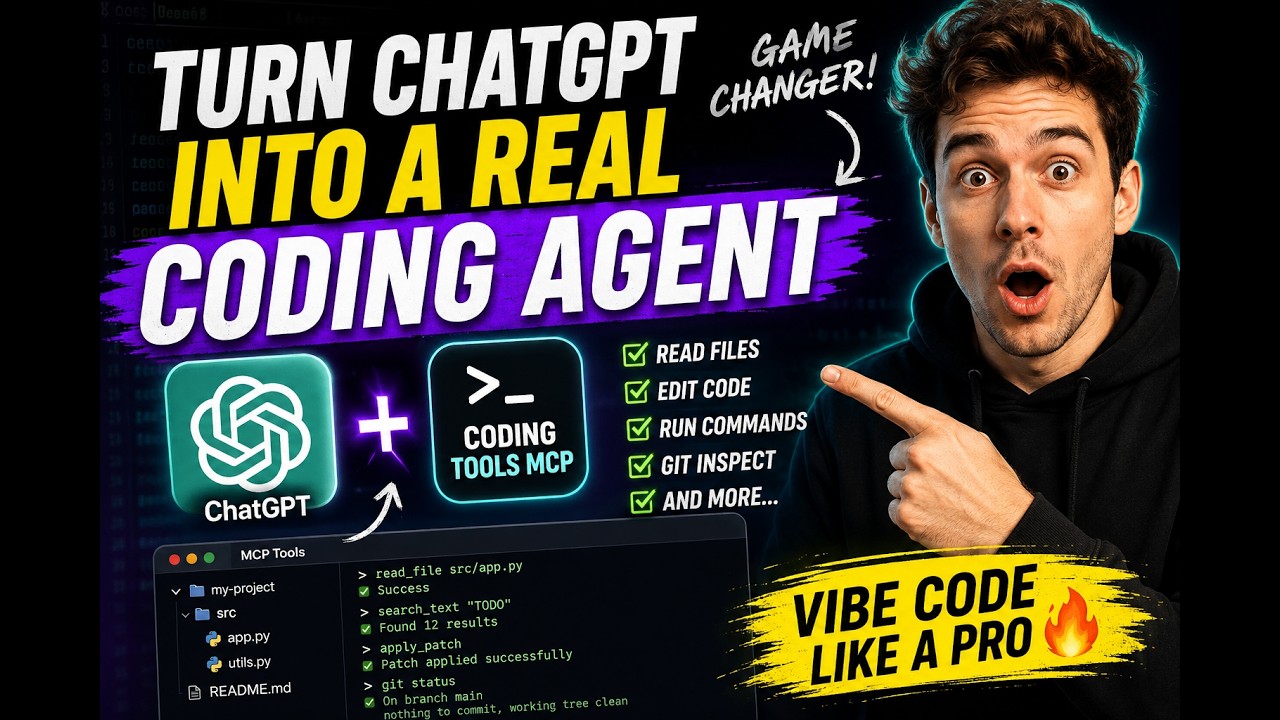
Coding Tools MCP is a model-neutral coding runtime served over the Model Context Protocol: file reading and search, structured multi-file patches, command execution, interactive sessions, and git — one server that any MCP client can drive. Claude Desktop, Claude Code, Codex, Cursor, Cline, VS Code, Windsurf, Gemini CLI, or an agent you build yourself gets the default catalog of 18 battle-tested tools, confined to one workspace and gated by permission modes.
Why people use it
- It turns a chat app into a coding agent. Claude Desktop — or any MCP chat client — gets real repo access with the subscription you already have. No extra product required.
- Safety is the product, not an afterthought. One workspace root per
server. Absolute paths,
..traversal, and symlink escapes are rejected. Permission modes gate network access, shell expansion, inline scripts, and destructive commands. On Linux, Landlock adds kernel-level filesystem confinement. - It is model- and vendor-neutral. A truthfully annotated, mode-aware catalog — no profile switching, no annotation games. Swap models or clients freely; the runtime contract stays put.
- It is engineered for context windows. Results are summarized, paginated, and capped by design; serialized tool-result bytes dropped 37% release-over-release on the deterministic dogfood workload with unchanged task completion.
Quickstart
Run it with whichever toolchain you already have (the server is Python ≥ 3.11
from PyPI; the npm package is a thin launcher that starts it via uv or
pipx):
uvx coding-tools-mcp --stdio --workspace /path/to/repo   # Python toolchain
npx coding-tools-mcp --stdio --workspace /path/to/repo   # Node toolchain
Wire it into Claude Desktop, Claude Code, Codex, Cursor, VS Code, Windsurf,
Gemini CLI, or Cline — the JSON is the same everywhere (swap uvx for npx
if you prefer Node):
{
  "mcpServers": {
    "coding-tools": {
      "command": "uvx",
      "args": ["coding-tools-mcp", "--stdio", "--workspace", "/path/to/repo"]
    }
  }
}
Then ask your client: "run the test suite and fix the first failure."
Prefer HTTP? Drop --stdio and the server speaks Streamable HTTP on
http://127.0.0.1:8765/mcp. Both protocol eras are served on either
transport: MCP 2026-07-28 in full, with tools as the only advertised
capability, and the handshake era 2025-11-25 with 2025-06-18
compatibility. Neither has sessions. A one-line installer, per-client
walkthroughs, and troubleshooting live in
docs/quickstart.md and
docs/mcp-client-config.md.
Seven things to try
1. Make Claude Desktop your coding agent. The config above is all it takes — the chat window you already pay for can now read, patch, test, and commit-review a real repository.
2. Code on your own machine from anywhere.
CODING_TOOLS_MCP_AUTH_MODE=bearer ./integrations/tunnels/tunnel.sh cloudflared /path/to/repo
Loopback bind + authenticated HTTPS tunnel (cloudflared, ngrok, or
Microsoft Dev Tunnel). Point claude.ai on your phone at
https://<tunnel-host>/mcp and drive your home workstation from anywhere.
ChatGPT and Grok connect through their connector settings the same way.
Bearer tokens and OAuth 2.1 + PKCE (with RFC 7591 dynamic registration) are
built in. → docs/remote-mcp.md
3. Let an agent loose on untrusted code — inside a disposable sandbox.
docker build -t coding-tools-mcp-sandbox:local .
docker run --rm --init -it -p 8765:8765 -v "$PWD:/workspace" coding-tools-mcp-sandbox:local
A containerized server with toolchains and caches preconfigured, safe to point at a sketchy PR and destroy afterwards. → docs/docker.md
4. Spin up a cloud sandbox with one MCP call. The bundled
Cloudflare Worker control plane exposes
start_coding_tools_sandbox as an MCP tool: one call dispatches a GitHub
Actions runner that boots the Docker sandbox and publishes it behind an
authenticated Cloudflare Tunnel. Ephemeral compute, no server of your own.
5. Drive it from a GUI.
python -m pip install "coding-tools-mcp[desktop]"
coding-tools-mcp-desktop
Per-workspace profiles, server and tunnel start/stop, credential setup with clipboard helpers, live health checks. English and 简体中文.
6. Keep an interactive command alive. exec_command starts a REPL or
debugger under a real PTY; write_stdin feeds it across turns; read_output
pages long output; kill_command cleans up. Long-running processes are
first-class, with deadline watchdogs and bounded buffers.
7. Give your own agent production-grade hands. Building an agent loop with the Anthropic SDK or anything else? Don't hand-roll file and exec tools — speak MCP to this server and inherit the whole safety boundary. → docs/embedding.md
The tool catalog
The registry contains 19 truthfully annotated tools. The default safe and
trusted modes advertise 18; dangerous also advertises
request_permissions, the only mode in which that tool can grant anything.
apply_patch and apply_changes are the file-mutation primitives: both are
staged, baseline-checked, atomic across files, and support rollback.
| Group | Tools |
|---|---|
| Files & search | read_file · list_dir · list_files · search_text · apply_patch · apply_changes · view_image |
| Execution | exec_command · write_stdin · read_output · kill_command · request_permissions (dangerous only) |
| Git | git_status · git_diff · git_log · git_show · git_blame |
| Runtime | server_info · check_exec_environment |
Root AGENTS.md/CLAUDE.md files load automatically and come back in the
instructions of initialize, or of server/discover for a client that
never handshakes. Tool content is concise agent-facing text;
structuredContent carries the complete machine result. Schemas and result
envelopes: docs/tools-and-schemas.md ·
docs/runtime-contract-v0.3.md.
Safety Boundary
| Mode | Meant for | What it allows |
|---|---|---|
safe (default) |
day-to-day agent work | file tools and vetted commands; network-looking commands, shell expansion, inline scripts, and destructive commands all require explicit permission |
trusted |
local development | opens network, shell expansion, and inline scripts; keeps secret filtering and destructive-command checks |
dangerous |
isolated containers/VMs only | disables exec_command permission gates; workspace path boundaries still apply |
Recursive listing and search exclude .git, node_modules, build outputs,
virtualenvs, and caches. Commands run with workspace-bound cwd, scrubbed
environment, timeouts, and output caps. Linux hosts with Landlock get
kernel-enforced filesystem confinement; other platforms get an explicit
warning — this is still not a complete OS sandbox, so use the Docker image or
a VM for genuinely untrusted work. Details:
SECURITY.md · docs/security-boundary.md ·
docs/permission-modes.md
Telemetry
The server sends anonymous usage telemetry (per-tool success/latency counters
and version/platform dimensions — never paths, arguments, commands, or file
contents) to help prioritize fixes. Disable it with
CODING_TOOLS_MCP_TELEMETRY=off or DO_NOT_TRACK=1; it is automatically off
in CI. CODING_TOOLS_MCP_TELEMETRY=debug prints every event to stderr instead
of sending. The full event list and guarantees are in
docs/telemetry.md.
Evidence, Dogfood and SWE-bench
Every release ships through a tag-triggered pipeline in which the compliance
suite, real-workload benchmark, and SWE-bench harness run from the same commit
that publishes to PyPI and npm — both via trusted publishing, npm with
provenance. Dogfood efficiency metrics are reproducible (make dogfood-smoke)
and checked in under reports/. This repository does not claim a
model-generated SWE-bench leaderboard result — see
docs/swe-bench.md for exactly what is and is not
measured. More: COMPLIANCE.md · BENCHMARK.md ·
docs/dogfood.md
Documentation
| Documentation map | Browse docs by topic |
| Getting started | Quickstart · Client configuration · Troubleshooting |
| Remote & sandboxed | Remote MCP · Docker sandbox · Cloud sandbox worker |
| Tools & contract | Tools and schemas · Runtime contract · Migrating to 0.3 · Permission modes |
| Execution | Exec recipes · Exec troubleshooting |
| Integration | Embedding · npm launcher |
| Security & quality | Security policy · Security boundary · CI and tests · Limitations · Competitive analysis |
Development
python -m pip install -e ".[dev]"
make ci        # lint, typecheck, tests, protocol/integration suites, gates
The full gate matrix is in docs/ci-and-tests.md.
License
This project is licensed under the Apache License 2.0.
If you use code, documentation, substantial implementation details, or derivative work from this project, preserve the copyright notice, license notice, and NOTICE file, and clearly attribute the original project.
Project: Coding Tools MCP
Author: Coding Tools MCP Contributors
Source: https://github.com/xyTom/coding-tools-mcp
Citation metadata is available in CITATION.cff.
coding-tools MCP questions
How can I run this server?
You can run it using the Python toolchain with uvx coding-tools-mcp --stdio --workspace /path/to/repo or the Node toolchain with npx coding-tools-mcp --stdio --workspace /path/to/repo.
Is it safe to let an AI agent use this?
Yes, it features a safety boundary with permission modes like 'safe' and 'trusted' that gate network access and destructive commands, and it supports kernel-level confinement on Linux via Landlock.
Can I use this with Claude Desktop?
Yes, you can wire it into Claude Desktop by adding the server configuration to your MCP settings.
What tools are included in the catalog?
The server provides 19 tools across groups including Files & search, Execution, Git, and Runtime.