
codesurface MCP server
Indexes a codebase's public API and serves compact search, signature, and class-lookup results to AI clients via MCP tools.
Also known as Codeturion/codesurface
- Stars
- 21
- Tools
- 7
- Downloads, 30 days
- 275
- Latest version
- 0.8.0
- Last commit
- Jul 28, 2026
- License
- MIT
What is codesurface MCP?
codesurface indexes a codebase's public API and serves compact search, signature, and class-lookup results to AI clients via MCP tools. It exposes 7 tools, such as search, get_signature, get_class.
Summary generated from the project's README
About codesurface MCP server
Indexing a codebase's public API to provide compact search results for AI agents is what codesurface enables. It parses source files to extract classes, methods, properties, fields, and events, serving this data through specialized tools. This approach helps reduce token usage compared to reading entire source files by providing targeted information like signatures and class members.
Developers can use this server with Claude Code, Cursor, Windsurf, or any MCP-compatible client. It supports multiple languages including C#, C++, Go, Java, Python, and TypeScript/JavaScript. Setup involves pointing the tool at a project directory using the --project argument via uvx or pip. The server automatically detects languages and skips common directories like node_modules or .git to keep the index efficient.
To ensure accuracy, the server provides tools for searching by keyword, retrieving exact signatures, and viewing full class member lists. It also includes a reindex command for incremental updates when files change. By providing specific line numbers for every record, it allows AI clients to perform targeted reads of only the necessary code segments.
What you can do with it
- 1Locate specific API membersAn AI agent can find a specific service or class by searching for a keyword within the codebase.
- 2Retrieve exact method signaturesA developer can ask the AI to find the exact parameters and return types for a specific function.
- 3Inspect class structuresYou can request a full list of all public members belonging to a particular class.
- 4Perform targeted code readsInstead of reading a whole file, the AI can use line numbers from the index to read only the relevant lines.
Written from the project's README. Every use case is checked against a quote from it.
How to install codesurface MCP
Formats verified 10 Nov 2026Install codesurface MCP in Claude Code
$ claude mcp add codesurface -- uvx codesurfaceInstall codesurface MCP in Cursor
~/.cursor/mcp.json
{
  "mcpServers": {
    "codesurface": {
      "command": "uvx",
      "args": [
        "codesurface"
      ]
    }
  }
}Install codesurface MCP in VS Code
.vscode/mcp.json
{
  "servers": {
    "codesurface": {
      "type": "stdio",
      "command": "uvx",
      "args": [
        "codesurface"
      ]
    }
  }
}Install codesurface MCP in Claude Desktop
claude_desktop_config.json
{
  "mcpServers": {
    "codesurface": {
      "command": "uvx",
      "args": [
        "codesurface"
      ]
    }
  }
}Install codesurface MCP in Codex
~/.codex/config.toml
[mcp_servers.codesurface]
command = "uvx"
args = ["codesurface"]
Install codesurface MCP in Gemini CLI
~/.gemini/settings.json
{
  "mcpServers": {
    "codesurface": {
      "command": "uvx",
      "args": [
        "codesurface"
      ]
    }
  }
}codesurface MCP tools 7
Detected from the READMEsearchget_signatureget_classget_statsreindexfile_pathinclude_tests
| search | — | |
| get_signature | — | |
| get_class | — | |
| get_stats | — | |
| reindex | — | |
| file_path | — | |
| include_tests | — |
README
View on GitHubcodesurface







MCP server that indexes your codebase's public API at startup and serves it via compact tool responses, saving tokens vs reading source files.
Parses source files, extracts public classes/methods/properties/fields/events, and serves them through 5 MCP tools. Works with Claude Code, Cursor, Windsurf, or any MCP-compatible AI tool.
Supported languages: C# (.cs), C++ headers (.h, .hpp, .hxx, .h++), Go (.go), Java (.java), Python (.py), TypeScript/JavaScript (.ts, .tsx, .js, .jsx)
Quick Start
Add to your .mcp.json:
{
  "mcpServers": {
    "codesurface": {
      "command": "uvx",
      "args": ["codesurface", "--project", "/path/to/your/src"]
    }
  }
}
Point --project at any directory containing supported source files (a Unity Assets/Scripts folder, a Spring Boot project, a .NET src/ tree, a Node.js/React project, a Python package, etc.). Languages are auto-detected.
Restart your AI tool and ask: "What methods does MyService have?"
CLAUDE.md Snippet
Add this to your project's CLAUDE.md (or equivalent instructions file). This step is important. Without it, the AI has the tools but won't know when to reach for them.
## Codebase API Lookup (codesurface MCP)

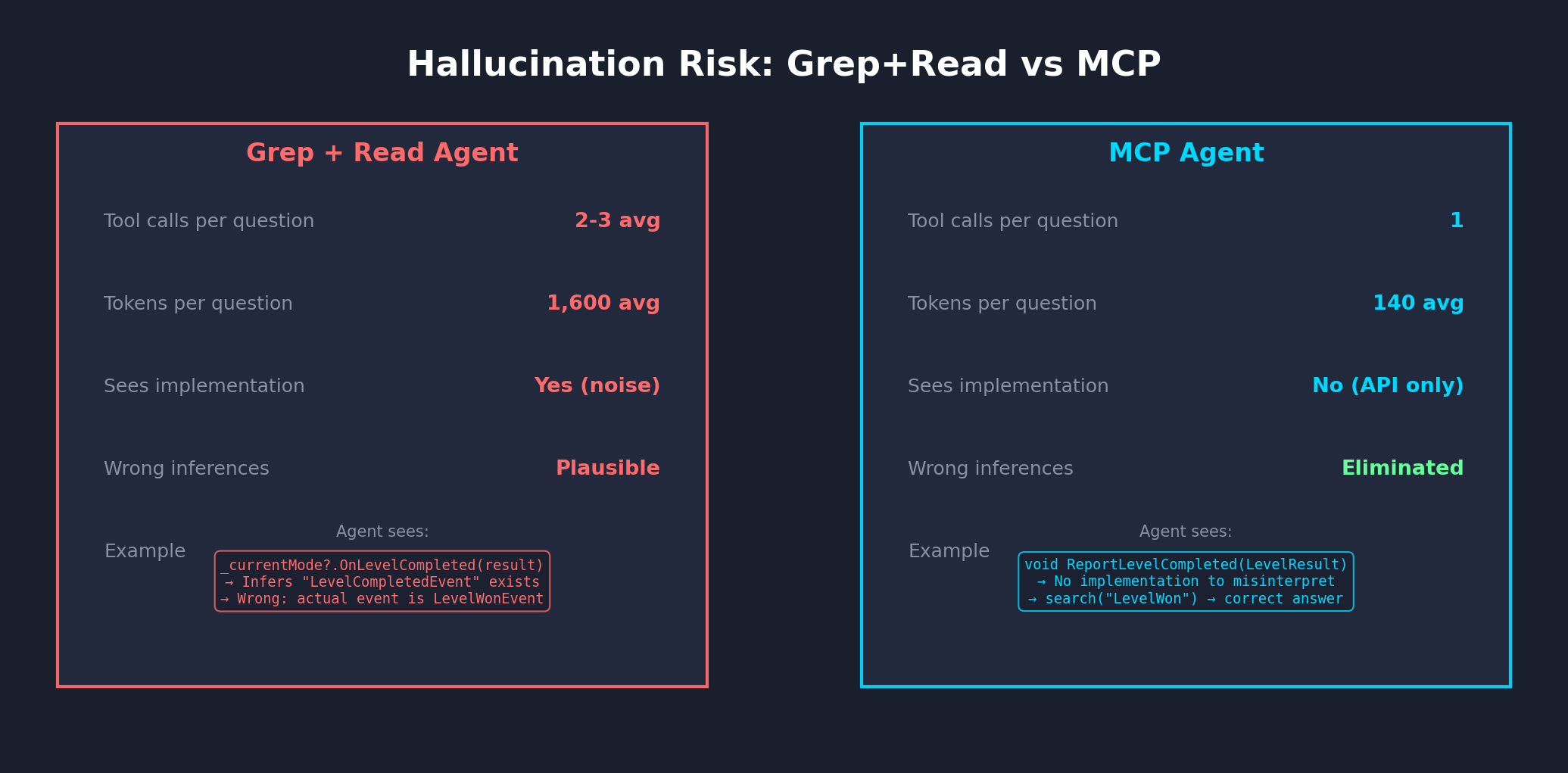
Use codesurface MCP tools BEFORE Grep, Glob, Read, or Task (subagents) for any class/method/field lookup. This applies to you AND any subagents you spawn.

| Tool | Use when | Example |
|------|----------|---------|
| `search` | Find APIs by keyword | `search("MergeService")` |
| `get_signature` | Need exact signature | `get_signature("TryMerge")` |
| `get_class` | See all members on a class | `get_class("BlastBoardModel")` |
| `get_stats` | Codebase overview | `get_stats()` |

Every result includes file path + line numbers. Use them for targeted reads:
- `File: Service.cs:32` → `Read("Service.cs", offset=32, limit=15)`
- `File: Converter.java:504-506` → `Read("Converter.java", offset=504, limit=10)`

Never read a full file when you have a line number. Only fall back to Grep/Read for implementation details (method bodies, control flow).
Tools
| Tool | Purpose | Example |
|---|---|---|
search |
Find APIs by keyword | "MergeService", "BlastBoard", "GridCoord" |
get_signature |
Exact signature by name or FQN | "TryMerge", "CampGame.Services.IMergeService.TryMerge" |
get_class |
Full class reference card with all public members | "BlastBoardModel" → all methods/fields/properties |
get_stats |
Overview of indexed codebase | File count, record counts, namespace breakdown |
reindex |
Incremental index update (mtime-based) | Only re-parses changed/new/deleted files. Also runs automatically on query misses |
search, get_signature, and get_class accept two optional filters:
file_path: scope results to a directory prefix or exact file (e.g."src/services/"or"src/services/MergeService.ts")include_tests: include test files in results (defaultfalse). Detects__tests__/,tests/,test/,*.test.*,*.spec.*,*_test.*,test_*
Tested On
| Project | Language | Files | Records | Time |
|---|---|---|---|---|
| vscode | TypeScript | 6,611 | 88,293 | 9.3s |
| Paper | Java | 2,909 | 33,973 | 2.3s |
| client-go | Go | 219 | 2,760 | 0.4s |
| langchain | Python | 1,880 | 12,418 | 1.1s |
| pydantic | Python | 365 | 9,648 | 0.3s |
| guava | Java | 891 | 8,377 | 2.4s |
| immich | TypeScript | 919 | 7,957 | 0.6s |
| fastapi | Python | 881 | 5,713 | 0.5s |
| ant-design | TypeScript | 2,947 | 5,452 | 0.9s |
| dify | TypeScript | 4,903 | 5,038 | 1.9s |
| crawlee-python | Python | 386 | 2,473 | 0.3s |
| flask | Python | 63 | 872 | <0.1s |
| cobra | Go | 15 | 249 | <0.1s |
| gin | Go | 41 | 574 | <0.1s |
| Unity game (private) | C# | 129 | 1,018 | 0.1s |
Line Numbers for Targeted Reads
Every record includes line_start and line_end (1-indexed). Multi-line declarations span the full signature:
[METHOD] com.google.common.base.Converter.from
  Signature: static Converter<A, B> from(Function<...> forward, Function<...> backward)
  File: Converter.java:504-506          ← multi-line signature

[METHOD] server.AlbumController.createAlbum
  Signature: createAlbum(@Auth() auth: AuthDto, @Body() dto: CreateAlbumDto)
  File: album.controller.ts:46          ← single-line
This lets AI agents do targeted reads instead of reading full files:
# Instead of reading the entire 600-line file:
Read("Converter.java")                     # 600 lines, ~12k tokens

# Read just the method + context:
Read("Converter.java", offset=504, limit=10)  # 10 lines, ~200 tokens
Benchmarks
Measured across 5 real-world projects in 5 languages, each using a 10-step cross-cutting research workflow.
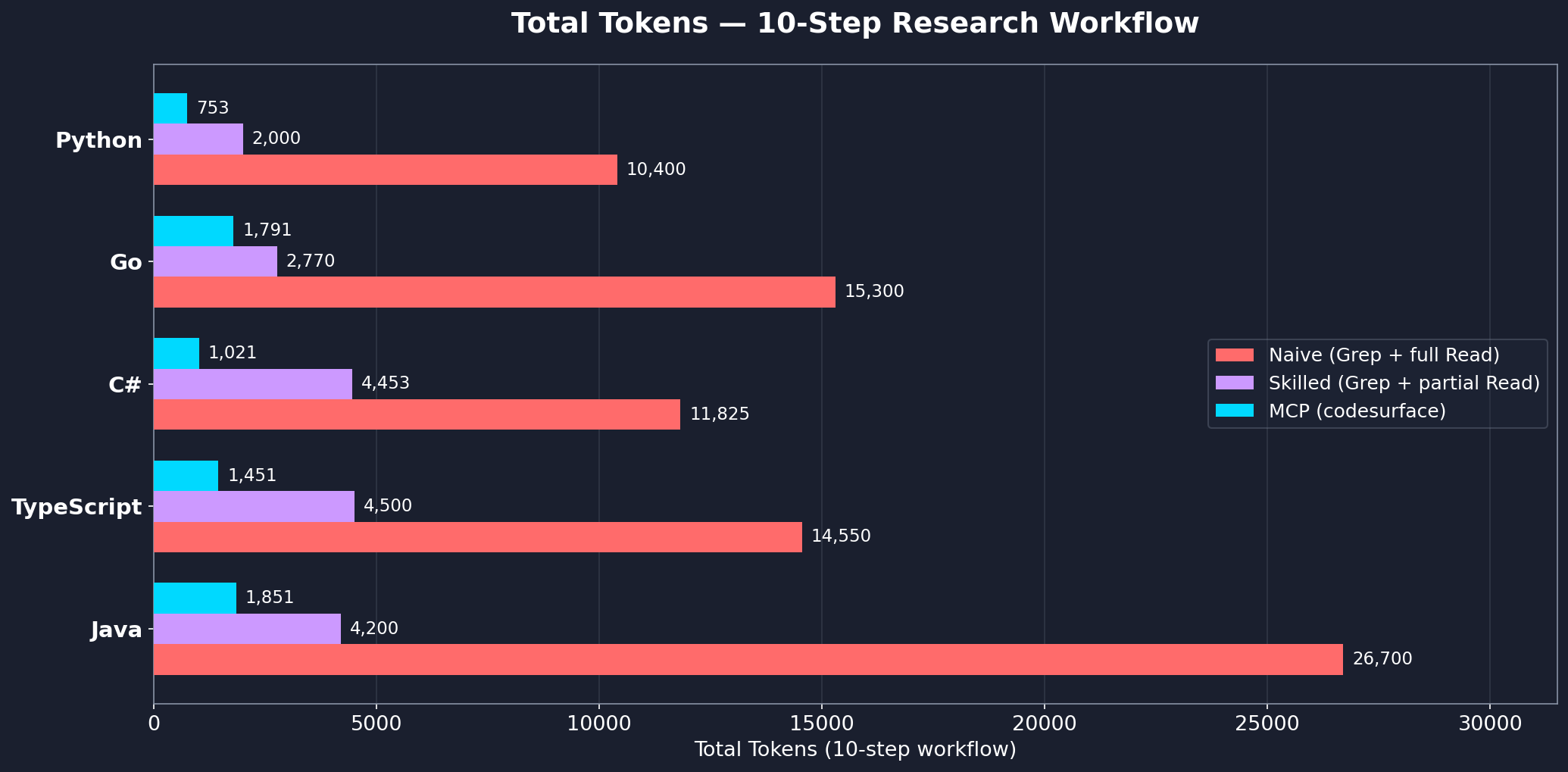
| Language | Project | Files | Records | MCP | Skilled | Naive | MCP vs Skilled |
|---|---|---|---|---|---|---|---|
| C# | Unity game | 129 | 1,034 | 1,021 | 4,453 | 11,825 | 77% fewer |
| TypeScript | immich | 694 | 8,344 | 1,451 | 4,500 | 14,550 | 68% fewer |
| Java | guava | 891 | 8,377 | 1,851 | 4,200 | 26,700 | 56% fewer |
| Go | gin | 38 | 534 | 1,791 | 2,770 | 15,300 | 35% fewer |
| Python | codesurface | 9 | 40 | 753 | 2,000 | 10,400 | 62% fewer |
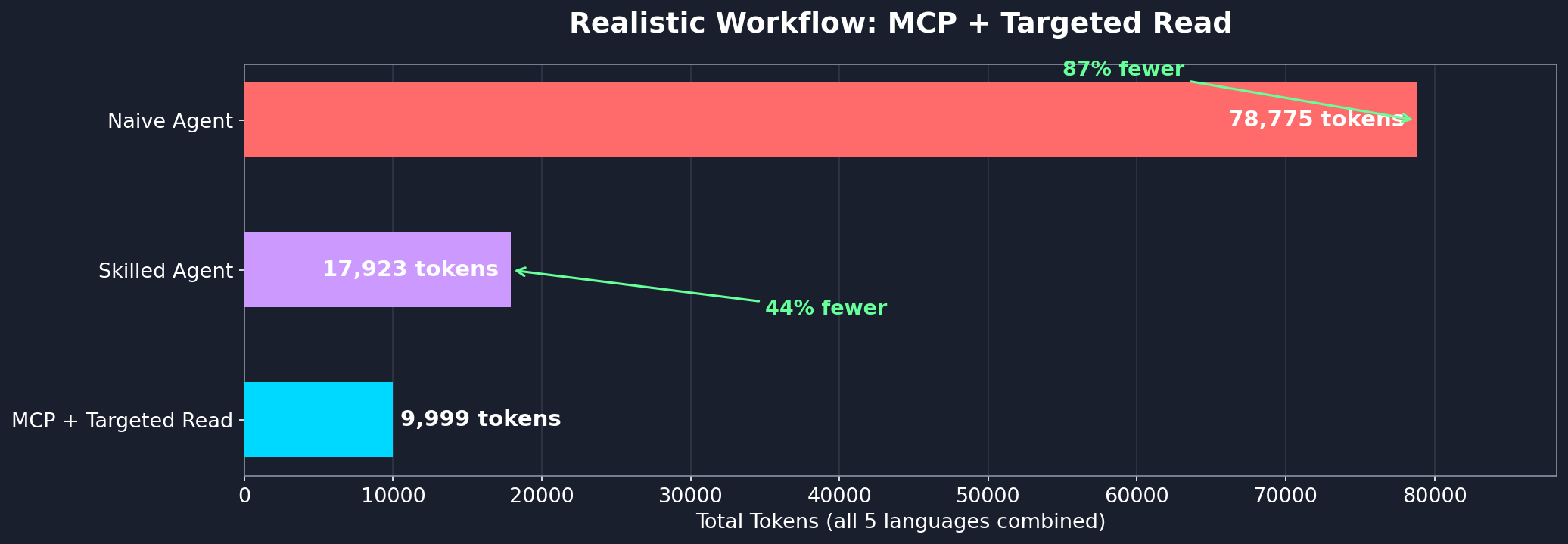
Even with follow-up reads for implementation detail, the hybrid MCP + targeted Read approach uses 44% fewer tokens than a skilled Grep+Read agent and 87% fewer than a naive agent:
Per-question breakdown
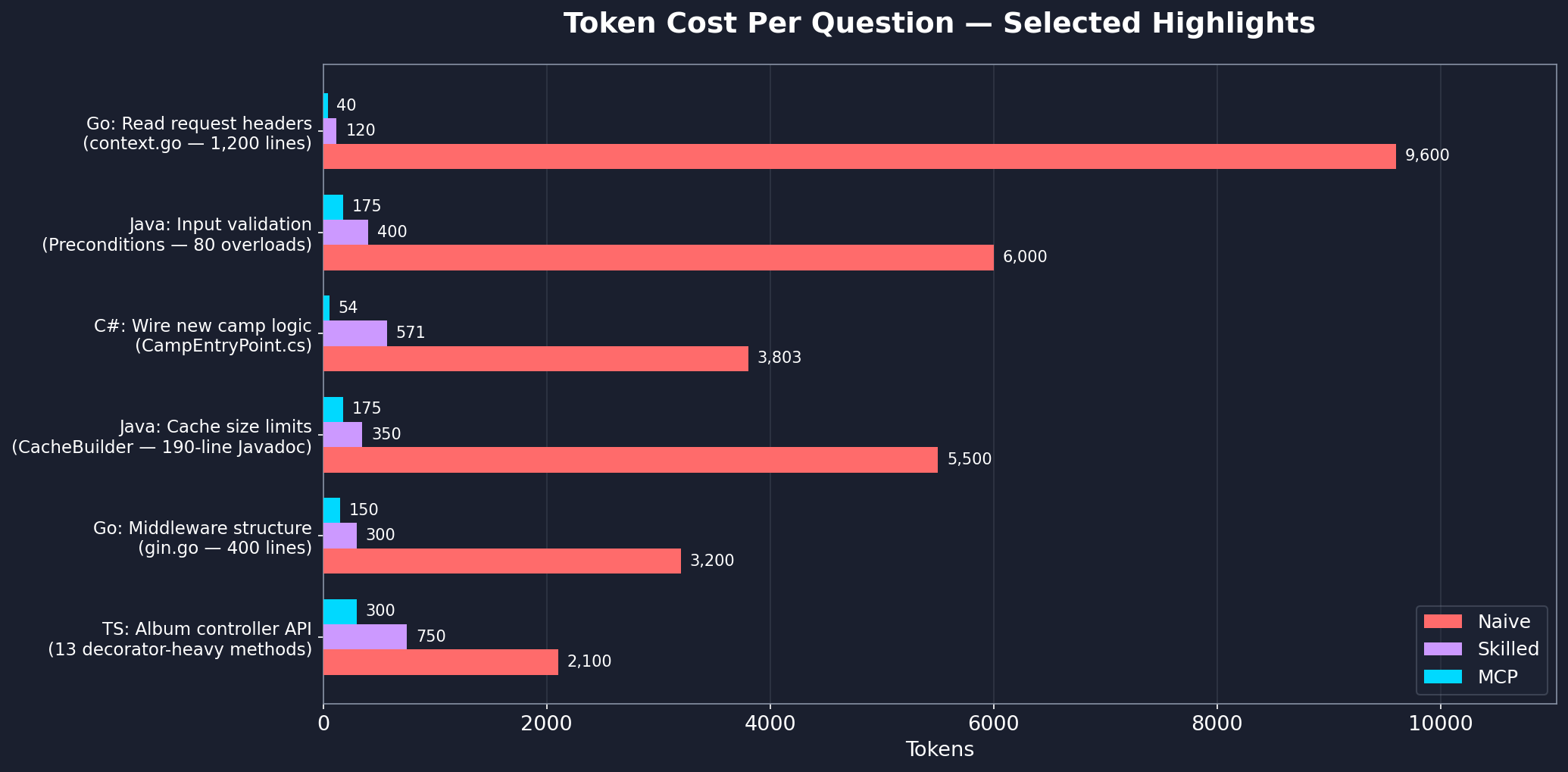
See workflow-benchmark.md for the full step-by-step analysis across all languages.
Filtering What Gets Indexed
By default, codesurface skips common vendored, build, and VCS directories: node_modules, vendor, bin, obj, dist, build, target, .git, .venv, __pycache__, and a few dozen others. Git worktrees and submodules are also skipped.
To exclude additional paths:
Project-level (committed): create a .codesurfaceignore file at your project root with one glob per line.
generated/**
docs/**
**/*.pb.go
Per-instance (CLI): pass --exclude with comma-separated globs.
{
  "command": "uvx",
  "args": ["codesurface", "--project", "src", "--exclude", "generated/**,vendor/**"]
}
Other indexing flags:
--include-submodules: index git submodules (skipped by default)--language <name>: pin to a single parser (e.g.--language cpp) instead of auto-detecting
Multiple Projects
Each --project flag indexes one directory. To index multiple codebases, run separate instances with different server names:
{
  "mcpServers": {
    "codesurface-backend": {
      "command": "uvx",
      "args": ["codesurface", "--project", "/path/to/backend/src"]
    },
    "codesurface-frontend": {
      "command": "uvx",
      "args": ["codesurface", "--project", "/path/to/frontend/src"]
    }
  }
}
Each instance gets its own in-memory index and tools. The AI agent sees both and can query across projects.
Setup Details
Using pip install:
pip install codesurface
{
  "mcpServers": {
    "codesurface": {
      "command": "codesurface",
      "args": ["--project", "/path/to/your/src"]
    }
  }
}
codesurface/
├── src/codesurface/
│   ├── server.py           # MCP server with 5 tools
│   ├── db.py               # SQLite + FTS5 database layer
│   ├── filters.py          # PathFilter (default exclusions, .codesurfaceignore, --exclude)
│   └── parsers/
│       ├── base.py         # BaseParser ABC
│       ├── cpp.py          # C++ header parser
│       ├── csharp.py       # C# parser
│       ├── go.py           # Go parser
│       ├── java.py         # Java parser
│       ├── python_parser.py # Python parser
│       └── typescript.py   # TypeScript/JavaScript parser
├── pyproject.toml
└── README.md
"No codebase indexed"
- Ensure
--projectpoints to a directory containing supported source files (.cs,.h,.hpp,.go,.java,.py,.ts,.tsx,.js,.jsx) - The server indexes at startup. Check stderr for
[codesurface] scanning N files...and[codesurface] done:lines
Server won't start
- Check Python version:
python --version(needs 3.10+) - Check
mcp[cli]is installed:pip install mcp[cli]
Stale results after editing source files
- The index auto-refreshes on query misses. If you add a new class and query it, the server reindexes and retries automatically
- You can also call
reindex()manually to force an incremental update
Contact
License
codesurface MCP questions
How do I add codesurface MCP to Claude Code?
Run claude mcp add codesurface -- uvx codesurface in your terminal. Add --scope user to make it available in every project.
How do I add codesurface MCP to Cursor?
Open ~/.cursor/mcp.json and add the server under mcpServers, using the Cursor config shown in the install section above.
What tools does codesurface MCP provide?
It exposes 7 tools, including search, get_signature, get_class, get_stats, reindex.
Which programming languages does codesurface support?
It supports C#, C++ headers, Go, Java, Python, and TypeScript/JavaScript files, auto-detecting languages in the project directory.
How do I configure codesurface as an MCP server?
Add it to your .mcp.json with the uvx command and point --project at the directory containing your source files.
What MCP tools does codesurface expose?
It provides five tools: search, get_signature, get_class, get_stats, and reindex.
Does codesurface keep the index up to date when files change?
Yes, the index refreshes automatically on query misses, and you can call reindex manually for an mtime-based incremental update.
Can I exclude generated or vendored directories from indexing?
Yes, add globs to a .codesurfaceignore file at the project root or pass comma-separated globs with the --exclude flag.