
Provides a local-first shared memory system for multiple AI agents using Markdown files and git to compound knowledge through usage and validation.
Also known as chinwe/compound-memory
- Stars
- 1
- Tools
- 5
- Downloads, 30 days
- 410
- Latest version
- 0.5.12
- Last commit
- Oct 30, 2026
- License
- MIT
What is compound-memory MCP?
compound-memory is an MCP server. Provides a local-first shared memory system for multiple AI agents using Markdown files and git to compound knowledge through usage and validation. It exposes 5 tools, such as memory_write, memory_search, memory_get.
Summary generated from the project's README
About compound-memory MCP server
Compound-memory provides a local-first shared memory system designed for multiple AI agents to exchange and build upon knowledge. Instead of using an opaque database, it stores information as human-readable Markdown files on your local disk, using git to maintain a history of every write. This system allows different agents to contribute to a shared namespace or maintain private ones, ensuring that preferences and project conventions are preserved across different sessions and hosts.
Developers can integrate this server into MCP-compatible clients like Claude Code, ZCode, or WorkBuddy using five specific tools: memory_write, memory_search, memory_get, memory_link, and memory_feedback. The system features a compounding mechanism where confirmed usage increases the confidence of a memory, and validation from a different host provides additional evidence. It supports optional semantic recall through sqlite-vec and BGE embeddings, with a fallback to lexical search if vector capabilities are unavailable.
What you can do with it
- 1Share project conventions across agentsAn AI agent can save specific coding standards to a shared namespace so that other agents can access them in future sessions.
- 2Validate facts through multi-agent feedbackA developer can have one agent verify a piece of information discovered by another agent to increase its confidence score.
- 3Maintain a searchable knowledge baseUsers can perform semantic or keyword searches to retrieve relevant memories stored in Markdown format.
- 4Track memory reliability and usageDevelopers can monitor the health and confidence levels of their stored knowledge using statistical summaries.
Written from the project's README. Every use case is checked against a quote from it.
How to install compound-memory MCP
Formats verified 10 Nov 2026Install compound-memory MCP in Claude Code
$ claude mcp add compound-memory -- uvx compound-memoryInstall compound-memory MCP in Cursor
~/.cursor/mcp.json
{
  "mcpServers": {
    "compound-memory": {
      "command": "uvx",
      "args": [
        "compound-memory"
      ]
    }
  }
}Install compound-memory MCP in VS Code
.vscode/mcp.json
{
  "servers": {
    "compound-memory": {
      "type": "stdio",
      "command": "uvx",
      "args": [
        "compound-memory"
      ]
    }
  }
}Install compound-memory MCP in Claude Desktop
claude_desktop_config.json
{
  "mcpServers": {
    "compound-memory": {
      "command": "uvx",
      "args": [
        "compound-memory"
      ]
    }
  }
}Install compound-memory MCP in Codex
~/.codex/config.toml
[mcp_servers.compound-memory]
command = "uvx"
args = ["compound-memory"]
Install compound-memory MCP in Gemini CLI
~/.gemini/settings.json
{
  "mcpServers": {
    "compound-memory": {
      "command": "uvx",
      "args": [
        "compound-memory"
      ]
    }
  }
}compound-memory MCP tools 5
Detected from the READMEmemory_writememory_searchmemory_getmemory_linkmemory_feedback
| memory_write | — | |
| memory_search | — | |
| memory_get | — | |
| memory_link | — | |
| memory_feedback | — |
Configuration
COMPOUND_MEMORY_AGENT_IDStable host agent id (e.g. agent-claude). Required for a multi-agent store: process identity wins over a self-reported source. Unset is only for a single trusted caller; stats.attestation.warning and the server log say so
COMPOUND_MEMORY_ROOTStore root directory. A leading ~ or $HOME/${HOME} is expanded; unset or blank falls back to $HOME/.agents/memory
| Name | Description | |
|---|---|---|
| COMPOUND_MEMORY_AGENT_ID | Stable host agent id (e.g. agent-claude). Required for a multi-agent store: process identity wins over a self-reported source. Unset is only for a single trusted caller; stats.attestation.warning and the server log say so | |
| COMPOUND_MEMORY_ROOT | Store root directory. A leading ~ or $HOME/${HOME} is expanded; unset or blank falls back to $HOME/.agents/memory |
Automated checks
Ran Nov 12, 2026Full report →Passed our automated checks. That is not a security audit: read the code and give the server the narrowest access it needs. How checks work

- Source repository linked and reachablePass
- Open source license (OSI)Pass
- Commit or release in the last yearPass
- Package name not close to a popular packagePass
- Remote endpoint uses HTTPSNot checked
- Destructive tools are labelledPass
- No hidden instructions to the modelPass
- No critical advisory in the package or its dependenciesPass
README
View on GitHubcompound-memory




English | 简体中文
Local-first shared memory for multiple AI agents — plain Markdown files that compound in value as they are used. Memory lives on your disk as frontmatter-annotated Markdown, gets stronger with every confirmed use, decays into a revivable archive when neglected, and auto-commits to a local git history on every write.
Why
Every agent session starts from zero: preferences get re-asked, project conventions get re-discovered, the same pitfall gets hit twice. compound-memory gives all your agents one shared store:
- Local-first — nothing leaves your machine; memories are human-readable Markdown files, not rows in an opaque database.
- MCP-native — exactly 5 tools (
memory_write/memory_search/memory_get/memory_link/memory_feedback) as the single read-write boundary; works with any MCP host (Claude Code, ZCode, WorkBuddy, …), plus a full CLI for operations. - Compounding — confirmed usage raises confidence, related memories are recalled as neighbors, validation from a different host counts as independent evidence, and distillation merges many raw memories into fewer, denser ones.
- Multi-agent by design — a
_sharednamespace everyone reads, plusagent-*private namespaces each host owns; cross-host validation is tracked per host. - Optional semantic recall — vector search via sqlite-vec + BGE embeddings, with automatic graceful fallback to pure lexical search when unavailable. Override the model with
COMPOUND_MEMORY_EMBEDDING_MODEL(defaultXenova/bge-small-zh-v1.5) andCOMPOUND_MEMORY_EMBEDDING_DIM(default 512); changing either is an ops action and needs an explicitrebuild-index.
Quick Start
For AI agents
Paste this one-liner into your coding agent (Claude Code, Cursor, ZCode, …) and let it do the rest:
Set up compound-memory (https://github.com/chinwe/compound-memory) — a local-first multi-agent shared memory (MCP server + CLI) — on this machine. Do not clone the repo for a normal install. Initialize the store with `uvx --from compound-memory compound-memory init` (defaults to ~/.agents/memory). Register its stdio MCP server in this host's MCP config: command `uvx`, args `--from compound-memory compound-memory-server`, env `COMPOUND_MEMORY_ROOT=$HOME/.agents/memory` and `COMPOUND_MEMORY_AGENT_ID=agent-<your-host-id>`. Verify by calling `memory_search` and expecting a `{"hits": [...]}` response; if the host needs a restart to load MCP servers, tell me. Use `uv run --directory <repo>` only when developing against a local checkout. Short English setup and the search → feedback → write loop: docs/agent-integration.en.md. Full per-host configs: docs/agent-integration.md.
For humans
1. Install
Python ≥ 3.11. The default does not clone the repo:
# Default: PyPI. Hosts launch the MCP server with
#   uvx --from compound-memory compound-memory-server
# Optional CLI on PATH:
uv tool install compound-memory   # or: pip install compound-memory

# Developer / local checkout only — not the default host launch
git clone https://github.com/chinwe/compound-memory.git
cd compound-memory && uv sync --extra dev
2. Initialize your store
Defaults to ~/.agents/memory; override with the COMPOUND_MEMORY_ROOT env var. A leading ~ or $HOME is expanded; a blank override falls back to the default.
uvx --from compound-memory compound-memory init
# after `uv tool install`: compound-memory init
3. Wire it into your MCP host (recommended)
This lets your everyday agents read/write the shared store automatically. No repo path:
{
  "mcpServers": {
    "compound-memory": {
      "type": "stdio",
      "command": "uvx",
      "args": ["--from", "compound-memory", "compound-memory-server"],
      "env": {
        "COMPOUND_MEMORY_ROOT": "$HOME/.agents/memory",
        "COMPOUND_MEMORY_AGENT_ID": "agent-<your-host-id>"
      }
    }
  }
}
uvx takes the package name; the server console script is compound-memory-server, so --from is required. If uvx is not on PATH, set command to the absolute path ~/.local/bin/uvx. COMPOUND_MEMORY_AGENT_ID is required for any multi-agent store: the process identity wins over whatever the model claims, so a forged source cannot write another host's namespace or inflate cross-host validation. Unset or blank is a hard failure for shared _shared use: stats and doctor exit 1 (the diagnosis is still printed). MCP tools keep running, and the server logs the same warning at startup. Without the id, identity is self-reported and can be forged.
A local checkout is the developer path, not a second default: command uv, args ["run", "--directory", "<absolute-repo-path>", "compound-memory-server"] after uv sync --extra dev.
Verify: ask your agent to call memory_search (any keyword) — a {"hits": [...]} response means you're connected. Or run uvx --from compound-memory compound-memory doctor (exit 0 when COMPOUND_MEMORY_AGENT_ID is set and the store is writable; exit 1 when it is unset or blank).
Claude Code plugin
Requires Claude Code and uv (uvx on PATH). This repository hosts a self-hosted marketplace. Submitting the plugin to Anthropic's official Directory is out of scope.
claude plugin marketplace add chinwe/compound-memory
claude plugin install compound-memory@compound-memory
That installs integrations/claude, which launches uvx --from compound-memory compound-memory-server with COMPOUND_MEMORY_AGENT_ID=agent-claude (override that env var in the host if you need a different id). A SessionStart hook adds a short reminder on new sessions; verify and disable steps are in the plugin README. Those marketplace and plugin files are not in the PyPI sdist or wheel: MANIFEST.in prunes them, and scripts/wheel_smoke.sh checks the built artifacts.
WorkBuddy / CodeBuddy plugin
Requires WorkBuddy or CodeBuddy and uv (uvx on PATH). This repository hosts a self-hosted marketplace at .codebuddy-plugin/marketplace.json.
/plugin marketplace add chinwe/compound-memory
/plugin install compound-memory@compound-memory
That installs integrations/workbuddy, which launches the same PyPI server with COMPOUND_MEMORY_AGENT_ID=agent-workbuddy. A SessionStart hook prints a short hard-rule reminder on new sessions and does not read the store. The Claude marketplace file is unchanged.
ZCode plugin
Requires the ZCode desktop app and uv (uvx on PATH). ZCode reads this repository's .claude-plugin/marketplace.json as its marketplace catalog, so no separate marketplace file is needed.
Clone the repository, then in ZCode: Plugin Marketplace → Add → Add Plugin Marketplace, paste the clone path (the directory containing .claude-plugin/), and install Compound Memory (ZCode) under Personal → compound-memory. That installs integrations/zcode, which launches the same PyPI server with COMPOUND_MEMORY_AGENT_ID=agent-zcode, plus a SessionStart hard-rule reminder and the short skill. The plugin's MCP server is named compound-memory; if ~/.zcode/cli/config.json already registers a server with that name (the hand-written path, §3 of docs/agent-integration.md), keep only one of the two.
4. Next step
Inject the usage protocol from skills/compound-memory/SKILL.md into your host (the search → feedback → write loop). The short English version is docs/agent-integration.en.md; the full protocol is docs/agent-integration.md §6.
Demo
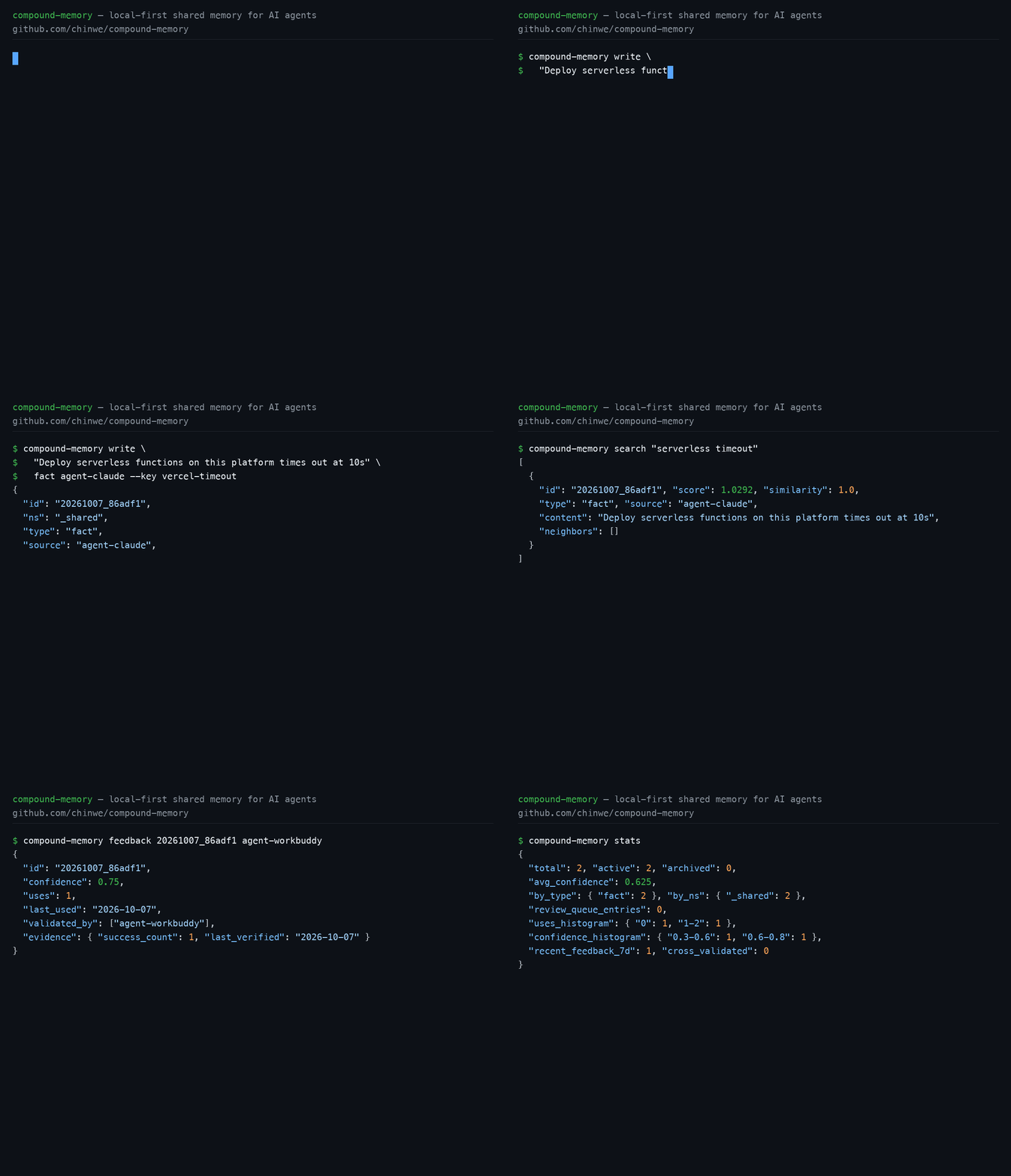
One full loop: write → search → feedback (with cross-host first-validation bonus) → store health. Real output from v0.4.0, long payloads trimmed:
uv run compound-memory init
{ "ok": true, "root": "~/.agents/memory" }
Two different hosts each write one stable fact (new memories start at confidence 0.5, uses 0):
uv run compound-memory write \
  "Deploy serverless functions on this platform times out at 10s — keep handlers under that budget" \
  fact agent-claude --key vercel-timeout
{
  "id": "20261007_86adf1",
  "ns": "_shared",
  "type": "fact",
  "source": "agent-claude",
  "content": "Deploy serverless functions on this platform times out at 10s — keep handlers under that budget",
  "confidence": 0.5,
  "uses": 0,
  "key": "vercel-timeout",
  "validated_by": []
  ...
}
uv run compound-memory write \
  "User prefers concise replies with tables and code examples" \
  fact agent-zcode --key user-style
Search ranks by score (--explain attaches per-hit ranking components for debugging):
uv run compound-memory search "serverless timeout"
[
  {
    "id": "20261007_86adf1", "score": 1.0292, "similarity": 1.0,
    "type": "fact", "source": "agent-claude",
    "content": "Deploy serverless functions on this platform times out at 10s — keep handlers under that budget",
    "neighbors": []
  },
  {
    "id": "20261007_6a0c0c", "score": 0.5211, "similarity": 0.4919,
    "type": "fact", "source": "agent-zcode",
    "content": "User prefers concise replies with tables and code examples",
    "neighbors": []
  }
]
A different host used this memory and reported it back with the default success outcome — uses +1, conf +0.1; and since the reporter agent-workbuddy ≠ source agent-claude, the first cross-host validation adds another +0.15:
uv run compound-memory feedback 20261007_86adf1 agent-workbuddy
{
  "id": "20261007_86adf1",
  "confidence": 0.75,
  "uses": 1,
  "last_used": "2026-10-07",
  "validated_by": ["agent-workbuddy"],
  "evidence": {
    "success_count": 1, "failure_count": 0, "contradiction_count": 0,
    "last_verified": "2026-10-07",
    "recent": [{ "date": "2026-10-07", "agent": "agent-workbuddy", "outcome": "success" }]
  }
  ...
}
Store health at a glance (fixed-bucket histograms, liveness, distillation yield):
uv run compound-memory stats
{
  "total": 2, "archived": 0, "active": 2,
  "avg_confidence": 0.625,
  "by_type": { "fact": 2 },
  "by_ns": { "_shared": 2 },
  "review_queue_entries": 0,
  "uses_histogram": { "0": 1, "1-2": 1, "3-5": 0, "6-9": 0, "10+": 0 },
  "confidence_histogram": { "<0.3": 0, "0.3-0.6": 1, "0.6-0.8": 1, "0.8-1.0": 0 },
  "recent_feedback_7d": 1, "cross_validated": 0,
  "distilled_total": 0, "distilled_recent_7d": 0
}
Current stats also includes retrieval (mode: vector or lexical, plus reason when the vector channel is off), attestation (attested, plus a warning when COMPOUND_MEMORY_AGENT_ID is unset), and expired_active (active-area memories whose valid_until has passed; 0 in this snapshot). cross_validated counts memories whose validated_by lists at least two distinct agents — the single cross-host validation above correctly leaves it at 0. memory_search carries the same retrieval object. CLI search stays a bare array. CLI stats exits 1 when COMPOUND_MEMORY_AGENT_ID is unset or blank; doctor is the one-page check (attestation, retrieval, write lock, git) and uses the same rule, plus root / lock / git failures. MCP tools do not stop for a missing agent id.
Three things to notice:
- New memories start at
confidence0.5 and move on evidence — feedback carries an outcome:successraises it,failurelowers it (floor 0.05),contradictionfreezes it into the review queue,obsoletearchives immediately. Same-hostsuccessbase bumps are recorded inevidence.host_bumpsand cap at 0.3 for that host (a single host tops out at 0.8; ADR-0012). - First validation from a different host earns an independent bonus (once per host per memory), with
validated_by/evidencetrails — confidence is evidence of correctness, not popularity. - Hits embed one-hop neighbors automatically (empty here — no links yet;
memory_linkcreates bidirectional links that get recalled for free).
How compounding works
| Interest source | Mechanism |
|---|---|
| ① Usage reinforcement | Every memory_feedback advances uses and last_used. Confidence moves by outcome. Default success: +0.1, with that host's base bumps stored in evidence.host_bumps and capped at 0.3 (a single host tops out at 0.8; ADR-0012). failure: −0.2 (floor 0.05, repeats stack). contradiction: confidence frozen, a review-queue row is filed. obsolete: archived immediately. unknown: the event is recorded and confidence does not move |
| ② Link value | memory_link creates bidirectional links; memory_get pulls one-hop neighbors; search hits embed up to 3 compact neighbors (active memories only, --no-neighbors to disable) |
| ③ Distillation | distill-plan (CLI, deterministic candidates + suggested_action: merge / promote / review) → agent writes the product → distill-apply atomic commit (product links back to sources; sources archived but revivable) |
| ④ Cross-agent validation | On success only, the first feedback from a host other than source adds +0.15 (once per host per memory; recorded in validated_by; does not consume the same-host host_bumps cap) |
Scoring (weights are the W_* constants in src/compound_memory/scoring.py): 0.70·similarity + 0.15·confidence + 0.10·recency(0.5+0.5·e^(−Δt/τ)) + 0.05·type weight. With the vector channel enabled, ranking switches to RRF fusion with an ε=0.04 prior tie-break (see the spec, "index as cache").
The 5 MCP tools
| Tool | Purpose | Key points |
|---|---|---|
memory_write |
Write a memory | type: episode/fact/insight/skill/decision; source: your agent id; give fact/insight/skill/decision a stable key; optional valid_from/valid_until (ISO dates), project scope, and lesson_role (lesson or avoid; omit for an ordinary memory). content over 262144 characters is rejected and nothing is written |
memory_search |
Retrieve | Returns {"hits": [...], "count", "retrieval"} ranked by score (default top_k=5); embeds up to 3 trimmed one-hop neighbors; dual-channel by default (_shared + caller's own private ns); optional project (fail-closed) and explain. CLI search stays a bare array |
memory_get |
Fetch by id | Always contains a found key; pulls one-hop neighbors with no count cap and keeps archived neighbors (search caps at 3, trims content to 80 characters, and drops archived neighbors). Expired neighbors are omitted on both paths. Private-ns targets require reader |
memory_link |
Link two memories | Bidirectional; both sides must be in the same ns; private-ns links require owner identity |
memory_feedback |
Report how a memory actually behaved | Every outcome advances uses and last_used. Default outcome=success: conf+0.1, same-host base capped at 0.3 via host_bumps (single host tops out at 0.8; ADR-0012); first cross-host validation +0.15 (exempt from the cap). failure −0.2 (floor 0.05); contradiction freezes confidence into the review queue; obsolete archives now; unknown records the event and leaves confidence unchanged. Mandatory after adopting a hit — that's the loop that makes the store compound |
Tool descriptions embed the protocol rules themselves, so agents keep the loop intact even without host-side rules injected. Short English loop: docs/agent-integration.en.md. Full parameter reference: docs/agent-integration.md.
CLI
Checkout commands below (uv run inside a clone). Hosts that did not clone the repo use uvx --from compound-memory compound-memory … instead.
uv sync --extra dev              # first clone: build .venv (later `uv run` reuses it)

uv run compound-memory init               # initialize an empty store
uv run compound-memory write "Vercel Serverless has a 10s timeout" episode agent-workbuddy
uv run compound-memory search "Vercel timeout"   # default top_k=5; hits embed one-hop neighbors (limit 3, --no-neighbors to disable)
uv run compound-memory feedback <id> agent-claude
uv run compound-memory decay          # run from cron
uv run compound-memory revive <id>    # revive an archived memory
uv run compound-memory distill-plan   # distillation candidates: suggested_action is merge / promote / review; also report-only negative_salience and contradiction_pairs
uv run compound-memory dream --ns _shared   # read-only report: distill-plan section (including the negative sections) + decay_signals + equal stats snapshots (no writes, no LLM)
uv run compound-memory maintain            # one ops pass: read-only dream → optional decay → health-snapshot. Decay is off unless --with-decay or RUN_DECAY=1 (DECAY=1). No --propose, no dream-apply
uv run compound-memory dream --ns _shared --propose  # system proposes: qualifying clusters go to <root>/distill/dream-proposals.json; a human runs dream-apply. Default off; empty pack is []
uv run compound-memory dream-apply --proposals apply.json --source agent-workbuddy --dry-run  # gated apply preview; drop --dry-run to run distill-apply on admitted rows
uv run compound-memory distill-apply "the merged insight" insight agent-workbuddy --sources <id1>,<id2>  # atomic: product (links, origin=distillation) + source archival, one commit
uv run compound-memory doctor           # one-page health check; exit 1 if AGENT_ID is unset, root is missing, the lock is broken, or git is unusable
uv run compound-memory stats            # health: uses/confidence buckets + liveness + distillation yield; exit 1 if AGENT_ID is unset
uv run compound-memory rebuild-index  # rebuild the search cache anytime
uv run compound-memory review-queue   # conflict queue (CLI-only entry)
uv run compound-memory git-log        # audit trail
More operations: explain <id> (confidence composition + evidence detail for one memory), forget <id> --agent <id> (terminal removal, ADR-0009), review-resolve (adjudicate conflicts), extract <transcript|dir> (deterministic session-transcript mining).
Architecture
Agent (MCP client / CLI)
  └─ memory_write | memory_search | memory_get | memory_link | memory_feedback
       └─ MemoryStore (~/.agents/memory)
            ├─ namespaces/_shared/{episode,fact,insight,skill,decision}/*.md   shared area
            ├─ namespaces/agent-*/...                                          private areas
            ├─ archive/...                                                     decayed archive (revivable)
            ├─ index/tokens.json                                               rebuildable lexical cache
            ├─ index/vectors.db                                                rebuildable vector cache (optional)
            ├─ review-queue.md                                                 fact/insight/skill/decision conflict queue
            └─ .git/                                                           auto-commit on every write
Scheduled distillation prep (launchd / cron / systemd)
Per ADR 0001, the deterministic prep runs on a schedule while judgment (summarizing / merging) stays with the calling agent. Every day at 09:00 dream writes a read-only report to <root>/distill/last-plan.json (the distill object is the candidate list; nothing is archived or forgotten). Schedulers keep calling dream; dream-apply is the explicit, caller-supplied apply and is not part of the timer. Pick one scheduler — launchd (macOS standard, catches up after sleep), systemd user timer (Persistent=true, same catch-up), or cron (most portable, no catch-up) — all three drive the same platform-neutral scripts/distill-prepare.sh. Ready-made templates: scripts/com.compound-memory.distill-prepare.plist.tmpl (launchd), scripts/compound-memory-distill-prepare.{service,timer}.example (systemd), and scripts/compound-memory-distill-prepare.cron.example (cron). The filled launchd / systemd / cron commands are in the Chinese README. The script runs set -eu: any failure exits non-zero (visible via launchctl list / systemctl --user list-timers / cron mail, log at distill/prepare.log). distill/ is a runtime artifact directory (auto-gitignored) — no commit noise; only distill-apply after agent judgment lands one atomic commit.
Daily maintenance (one timer)
compound-memory maintain is the single daily job: read-only dream (writes <root>/distill/last-plan.json, same report as dream, never --propose) → optional decay → health-snapshot. The snapshot runs after decay, so it records the post-decay store when decay ran. Default is dream + health-snapshot. Decay stays off unless you pass --with-decay or set RUN_DECAY=1 (DECAY=1 is an alias). Any failing step exits non-zero and names that step on stderr; later steps do not run.
scripts/distill-prepare.sh stays the dream-only prep path. Do not point a timer at dream --propose, dream-apply, or distill-apply (ADR-0001 / #72 / #97): proposals and merges stay an explicit human/agent step. scripts/daily-maintain.sh is a thin launchd/cron wrapper (resolves uv on PATH, then execs compound-memory maintain). It does not orchestrate the steps.
From a checkout, one cron line is enough (decay off):
0 9 * * * COMPOUND_MEMORY_ROOT=$HOME/.agents/memory $HOME/.local/bin/uv run --project <repo> compound-memory maintain >> $HOME/.agents/memory/distill/daily-maintain.log 2>&1
Same job with decay: prefix RUN_DECAY=1. A launchd ProgramArguments array can be the same uv, run, --project, <repo>, compound-memory, maintain (set COMPOUND_MEMORY_ROOT and, only if you want decay, RUN_DECAY under EnvironmentVariables). The thin wrapper is the PATH-proof alternative: /bin/sh <repo>/scripts/daily-maintain.sh with UV_BIN set. Keep using distill-prepare.sh when the timer should only refresh the dream report.
Documentation
CHANGELOG.md— release notes (0.5.x Windows support and later)docs/specs/0001-compound-memory-spec.md— design specdocs/agent-integration.en.md— short English setup (uvx, required agent id, 5 tools, search → feedback → write)docs/agent-integration.md— per-host MCP configs + the unified usage protocol (Chinese; full guide)docs/eval/README.md— how to record "can run" versus "did the same task change with memory". A checklist and a small fixed prompt set, not a measured effectiveness claimdocs/adr/— architecture decision recordsCONTEXT.md— glossary (Chinese)skills/compound-memory/SKILL.md— usage rules for hosts (Chinese)
compound-memory MCP questions
How do I add compound-memory MCP to Claude Code?
Run claude mcp add compound-memory -- uvx compound-memory in your terminal. Add --scope user to make it available in every project.
How do I add compound-memory MCP to Cursor?
Open ~/.cursor/mcp.json and add the server under mcpServers, using the Cursor config shown in the install section above.
What tools does compound-memory MCP provide?
It exposes 5 tools, including memory_write, memory_search, memory_get, memory_link, memory_feedback.
How does compound-memory store information?
Memories are stored locally on your disk as human-readable, frontmatter-annotated Markdown files and are automatically committed to a local git history.
Can multiple AI agents use the same memory store?
Yes, it is designed for multi-agent use with a shared namespace for everyone and private namespaces for individual hosts.
What happens if I don't have vector search capabilities?
The system provides automatic graceful fallback to pure lexical search if vector search via sqlite-vec is unavailable.
Is the memory data sent to a cloud provider?
No, the system is local-first and nothing leaves your machine.