
Lore MCP server
Commit Nov 13, 2026Provides a workflow and knowledge layer for teams using Claude Code by managing repo-scoped context and filing facts into issues, PRs, and wikis.
Also known as buchbend/lore
- Stars
- 3
- Tools
- —
- Downloads, 30 days
- —
- Latest version
- —
- Last commit
- Nov 13, 2026
- License
- MIT
What is Lore MCP?
Lore provides a workflow and knowledge layer for teams using Claude Code by managing repo-scoped context and filing facts into issues, PRs, and wikis.
Summary generated from the project's README
About Lore MCP server
Lore provides a structured workflow and knowledge management layer designed specifically for teams using Claude Code. It manages repository-scoped context by injecting essential information like orientation notes and system maps at the start of a session. Instead of relying on a central database, it uses a git-backed approach where facts are filed directly into existing artifacts such as issues, pull requests, ADRs, PRDs, and a markdown wiki. This ensures that all project knowledge remains in the tools that developers already use.
The system operates locally through a CLI and an MCP server, allowing an agent to pull deeper context on demand using tools like lore_search and lore_read. It does not make model calls itself; instead, it provides the framework for the session agent to perform judging and curation. Users can set up specific scopes for their repositories and connect them to a team wiki. The setup process involves the lore CLI and can be integrated with Cursor or Claude Code to maintain a continuous planning-and-build chain from initial ideas to merged code.
What you can do with it
- 1Convert plans into actionable tasksAn AI agent can transform a high-level plan into a formal PRD file and a structured epic tracker issue.
- 2Perform systematic root-cause debuggingDevelopers can use the debug skill to conduct a disciplined investigation into code errors.
- 3Manage session handoversWhen a developer stops working, the system can write a handover note to prepare the next session.
- 4Document experimental resultsYou can run a specific experiment and record the findings in a lab entry.
Written from the project's README. Every use case is checked against a quote from it.
README
View on GitHubLore
A workflow and knowledge layer for teams that code with Claude Code. Each session starts with a small, repo-scoped context. It follows one workflow from idea to merged PR. It files every fact where someone will read it: issues, PRs, ADRs and PRDs, a git-backed team wiki, a logbook. Lore itself calls no model. The agent in the session does the judging.
⚠️ Pre-1.0. APIs, hook contracts, skill surfaces, frontmatter schema, and CLI flags can still change between minor versions.
How it works
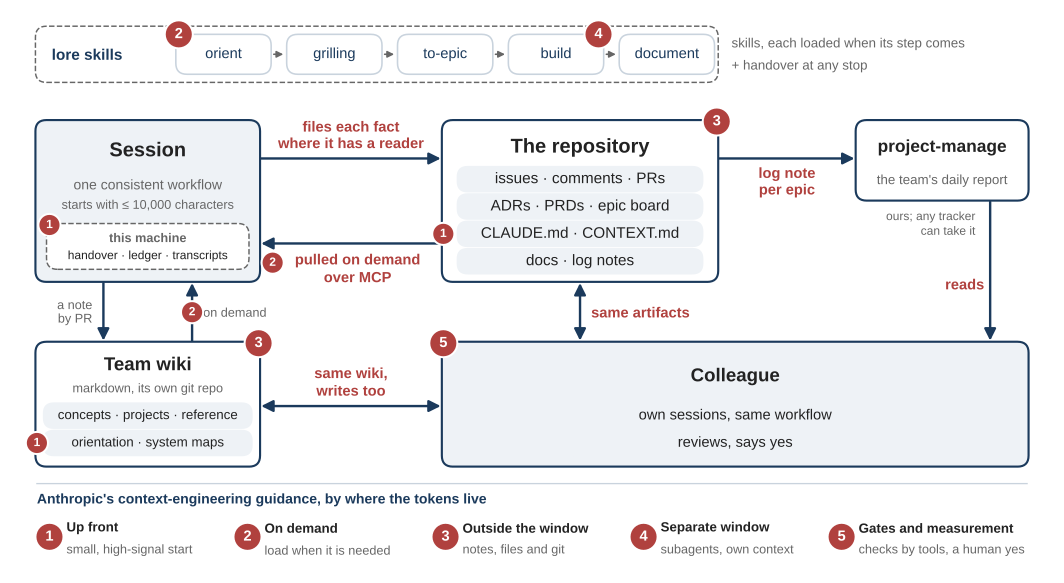
The figure is from the ADASS 2026 talk; the bullets below describe Lore today.
- Session. At SessionStart, Lore injects a small context: a status
line with the last active day, the repo's orientation note, system-map
neighbours, the index and a pointer to the handover note if one is waiting.
The index names where an agent can ask
(the route of the repo and your scopes) and what the repo holds. Each
block keeps its own budget. Everything deeper is
pulled on demand over MCP (
lore_search,lore_read,lore_context_pack, …). - This machine. Hooks register every transcript in a ledger, stamped
with repo, branch, PRs, issues, commits and files from git. No model
call is involved. Session transcripts are mirrored to the wiki's
gitignored
.transcripts/directory; handover notes and token records also stay local. - The repository. The session files each fact as the artifact that
already has a reader: an issue, a comment, a PR, an ADR or PRD,
CLAUDE.md/CONTEXT.md, docs. See file facts as artifacts. - Team wiki. A markdown wiki in its own git repo: projects, concepts,
the orientation note per repo, and system maps across repos. Notes
arrive by PR or
/lore:inbox; Lore mirrors private transcripts there but does not compose wiki notes. - Logbook. Every finish point writes a logbook entry to a configured sink: a file in the repo, or a command such as a project tracker. See use the logbook.
- Colleagues work on the same artifacts and the same wiki, with the same workflow.
One plugin: lore
This repo is a Claude Code marketplace with one plugin, lore: hooks, the
MCP server, and every skill as /lore:<name>. The planning-and-build chain:
orient → grilling → to-epic → build → document (+ handover at any stop)
build runs in three modes: loop for fast rounds with you watching,
issue for one clear issue, epic for a build order of sub-issues. tdd
is the discipline every mode follows; debug, experiment, triage and
file-issue are helpers. The build skills call the lore CLI and MCP
surface (lore codemap, lore tier resolve, lore workflow validate-build-order / create-prd). Onboard a repo with
lore setup scope --scaffold-workflow. The spawn rules the skills share live
in skills/TIER-DELEGATION.md.
The build skills:
| Skill | What it does |
|---|---|
/lore:orient |
First step of a task: homework, then reflect understanding back. A light mode ("brief me") pulls only the roadmap and the context pack, and hands one change to build. |
/lore:grilling |
Interview the user to stress-test a plan, and sharpen the domain model: CONTEXT.md terms and ADRs with Holds and Revisit if. |
/lore:to-epic |
Turn a plan into a PRD file plus an epic tracker issue with a build-order table. |
/lore:build |
Build code in three modes: loop (fast rounds, local merges, one wrap-up PR), issue (one issue, one PR), epic (a build order, teammates, review by risk level). Keeps a ledger and writes a handover section. |
/lore:tdd |
Test-driven red-green-refactor loop. |
/lore:debug |
Systematic root-cause debugging with a hard circuit breaker. |
/lore:experiment |
Run one experiment: write the question and the expected result, run it, write one lab entry with lore lab add and commit it. |
/lore:document |
Bring the Diátaxis docs in line with the code: pre-merge, catch-up, or a plan-approved consolidation of a docs tree. Marks a shipped PRD at the epic tail. |
/lore:file-issue |
Writes issue text and files it: resolve the writing rules, draft, Vale-lint, then post the issue or PR body. |
/lore:triage |
Reviews every open issue and PR of a repo against the code, gives each a verdict, and presents one filterable page for discussion. Review only until the user decides. |
The context and upkeep skills:
| Skill | What it does |
|---|---|
/lore:context |
Show what Lore injected this session. |
/lore:handover |
Part one writes a handover note for the next session. Part two writes the handover section for work that stops early, and turns follow-up work into a seed issue. |
/lore:inbox |
Route inbox files into the right wiki. |
/lore:map |
Keep the system map true across repos. |
/lore:system |
Bring every checkout of a system to its target branch. |
Install
Linux and macOS:
curl -fsSL https://raw.githubusercontent.com/buchbend/lore/main/install.sh | sh
The script installs the lore CLI with pipx, uv tool or pip --user,
then runs lore setup. Setup creates or links a wiki and installs the
Claude Code plugin, plus Cursor's MCP wiring where present. It offers a
scope for the current repo and runs the checks. Upgrade later with lore update.
By hand:
pipx install "git+https://github.com/buchbend/lore.git#egg=lore"
lore setup
The bare
pipx install lorewill not work: the name is taken on PyPI by an unrelated package.
The plugin only, from inside Claude Code (you still need the CLI):
/plugin marketplace add buchbend/lore
/plugin install lore@lore
lore setup is also the repair command. On a healthy setup it writes
nothing; lore setup --yes runs without a terminal. lore uninstall
removes everything Lore added. For an editable or offline install, see
CONTRIBUTING.md.
Configure
Vault layout. $LORE_ROOT (default ~/lore) holds wiki/ with one or
more mounted wikis, an optional inbox/, and a CLAUDE.md. Each wiki is
its own git repo, mounted as a symlink or an inline directory:
ln -s ~/git/myorg/team-knowledge ~/lore/wiki/team   # mount an existing wiki
lore wiki new research                              # or scaffold a new one
Scopes. A scope maps a folder of repos to a wiki, in
~/.config/lore/config.yml. Every repo below that folder uses the wiki.
A committed .lore.yml in a repo holds exceptions only.
lore setup scope ~/git/myorg # or: --name myorg --wiki team --remote 'github.com/myorg/*'
Sources and sinks. lore setup source adds search sources beyond the
wiki and GitHub (DokuWiki, any command). lore setup sink sets where
logbook entries go. lore config shows the resolved configuration and
where each value comes from; lore config secret stores tokens.
Guides: onboarding, route repos to a wiki, onboard a repo, keep a system map.
Daily use
| Command | What it does |
|---|---|
lore status |
Health: capture, wikis, retention, alerts. Run it first when something seems off. |
lore stats |
Token-use and systems pages in the browser. |
lore search / lore read |
Search the wiki index; composite retrieval. The same as the MCP tools. |
lore log add|flush|show |
Write, retry or show logbook entries. |
lore lab add|show |
Record or review lab-notebook entries. |
lore index |
Print the index: the route, your scopes, glossary terms, ADRs, PRDs, roadmap, neighbours and recent lab entries. |
lore roadmap add |
Add an idea to the roadmap. |
lore system status|target |
Git state of every repo in a system; its target branch. |
lore trace tokens <session> |
Token totals per skill or subagent phase. |
lore update |
Upgrade the CLI and plugins. |
Event logs live in $LORE_ROOT/.lore/spine.jsonl. See
observability and
troubleshooting.
Design principles
- Markdown and git stay authoritative. No database the vault cannot be rebuilt from.
- One home per fact. Each fact lives in the artifact that already has a reader; nothing is extracted from transcripts behind your back.
- Small context up front, the rest on demand. Bounded, deterministic context at SessionStart; the agent pulls more over MCP when it needs it. No auto-enrichment on every tool call.
- No model call in Lore. Hooks, capture and curation are deterministic. The agent in the session does the judging.
Documentation
docs/how-to/: task recipes (run an epic, use the fast path, hand over a session, run an experiment, keep a roadmap, record a decision, …).docs/explanation/: why the design is as it is.docs/architecture/: internals (CLI contract, config, ledger, state, sync, observability).docs/conventions.md: the full chain, where each fact lives, the model-tier vocabulary.
Credits
The grilling method, the shared-language glossary (CONTEXT.md), the ADR format and the
TDD skill come from Matt Pocock's
mattpocock/skills (MIT). The step from a
conversation to a PRD and issues is his idea too. The rest of lore
is our own. skills/THIRD-PARTY.md says exactly
which parts are his, what we changed, and holds his licence.
License
MIT. See LICENSE.
Lore MCP questions
Does Lore use an AI model to process information?
No, Lore itself does not call any models; the agent in the session is responsible for the judging and decision-making.