
NodeBenchAI MCPサーバー
コミット 2026年11月13日さまざまなソースからの調査結果を再利用可能なアーティファクトとして統合し、時間の経過に伴う変化を監視することで、エンティティ・インテリジェンスを提供します。
別名 HomenShum/NodeBenchAI
- スター
- 14
- ツール
- —
- ダウンロード数(30日間)
- —
- 最新バージョン
- —
- 最終コミット
- 2026年11月13日
- ライセンス
- MIT
NodeBenchAI MCPとは
NodeBenchAIはMCPサーバーです。 さまざまなソースからの調査結果を再利用可能なアーティファクトとして統合し、時間の経過に伴う変化を監視することで、エンティティ・インテリジェンスを提供します。.
プロジェクトのREADMEから生成された概要
NodeBenchAI MCP server について
NodeBenchAI は、さまざまなソースからの調査結果を再利用可能なアーティファクトに統合することで、エンティティ・インテリジェンスを提供します。これは、単なるチャットボットの回答を超えて、企業、市場、または特定の調査課題における重要な変化を長期的に監視するシステムを必要とする開発者やコーディングエージェント向けに設計されています。このプラットフォームを使用すると、調査実行結果を永続的なメモリに変換し、過去の学習に基づいて将来の結果を向上させることができます。
ユーザーは、Chat、Reports、およびアラート用の Inbox などのインターフェースを備えた Web アプリケーションを通じてシステムとやり取りできます。外部アプリケーションへの統合のために、ホストされた公開リサーチ MCP エンドポイントが提供されています。開発者は、npx nodebench-mcp、nodebench-mcp-power、または nodebench-mcp-admin といった特定の配布レーンを使用できます。システムは、匿名の公開調査と、より高い予算、チーム利用、およびプライベートなワークスペースのコンテキストを提供する認証済みセッションの両方をサポートしています。
できること
- 1調査結果をアーティファクトに統合AI エージェントが調査課題や URL を受け取り、その結果得られた統合情報を再利用可能なリサーチカードに変換できます。
- 2エンティティの変化を監視特定の企業や市場に関する重要な更新を継続的に監視するシステムを構築できます。
- 3外部アプリへの調査機能の統合開発者は、ホストされた MCP エンドポイントに独自の 에ージェントを接続することで、即時のサインアップを必要とせずに公開リサーチ機能を利用できます。
プロジェクトの README から作成されています。すべてのユースケースは、その引用と照らし合わせて確認されています。
自動チェック
実行日 2026年11月14日完全なレポート →まだ検証されていません。サーバーには80点のスコア、重大な問題がないこと、および検証に必要な十分なデータが必要です。 チェックの仕組み · 点数を上げるための改善点

- ソースリポジトリがリンクされており、アクセス可能homenshum/nodebenchai is public and reachablegithub.com/homenshum/nodebenchai ↗合格
- パッケージがこのリポジトリをソースとして指定未チェック
- ビルドの来歴 (Sigstore 証明)未チェック
- オープンソースライセンス (OSI)MITspdx.org/licenses/MIT.html ↗合格
- 過去1年以内にコミットまたはリリースありLast commit or release 2026-11-13github.com/homenshum/nodebenchai ↗合格
- OpenSSF Scorecard未チェック
- パッケージ名が有名なパッケージに酷似していない未チェック
- パッケージおよびその依存関係に重大な勧告なし未チェック
- モデルへの隠れた指示がない0 tool descriptions and the README read; no override phrases, credential paths or hidden characters合格
- 破壊的なツールがラベル付けされている未チェック
- リモートエンドポイントが MCP ハンドシェイクに応答未チェック
README
GitHubで見るNodeBench AI
Entity intelligence for any company, market, or question.
Live: nodebenchai.com
npm: npx nodebench-mcp / npx nodebench-mcp-power / npx nodebench-mcp-admin
GitHub: HomenShum/nodebench-ai
Developers and coding agents: Read docs/START_HERE.md
for the first local start and one question's runtime path. Use
docs/ONBOARDING.md for orientation and
CONTRIBUTING.md for the contribution workflow. Agents read
AGENTS.md and AGENT_COORDINATION.md
before shared-file edits. Then
.tours/ walks the same path inside the live source in VS Code
(CodeTour extension). docs/codebase/ has the stack,
structure, conventions, integrations, testing and the honest list of known
problems. docs/SIMPLIFICATION_REPORT.md
records what was measured and removed, with the command for every number.
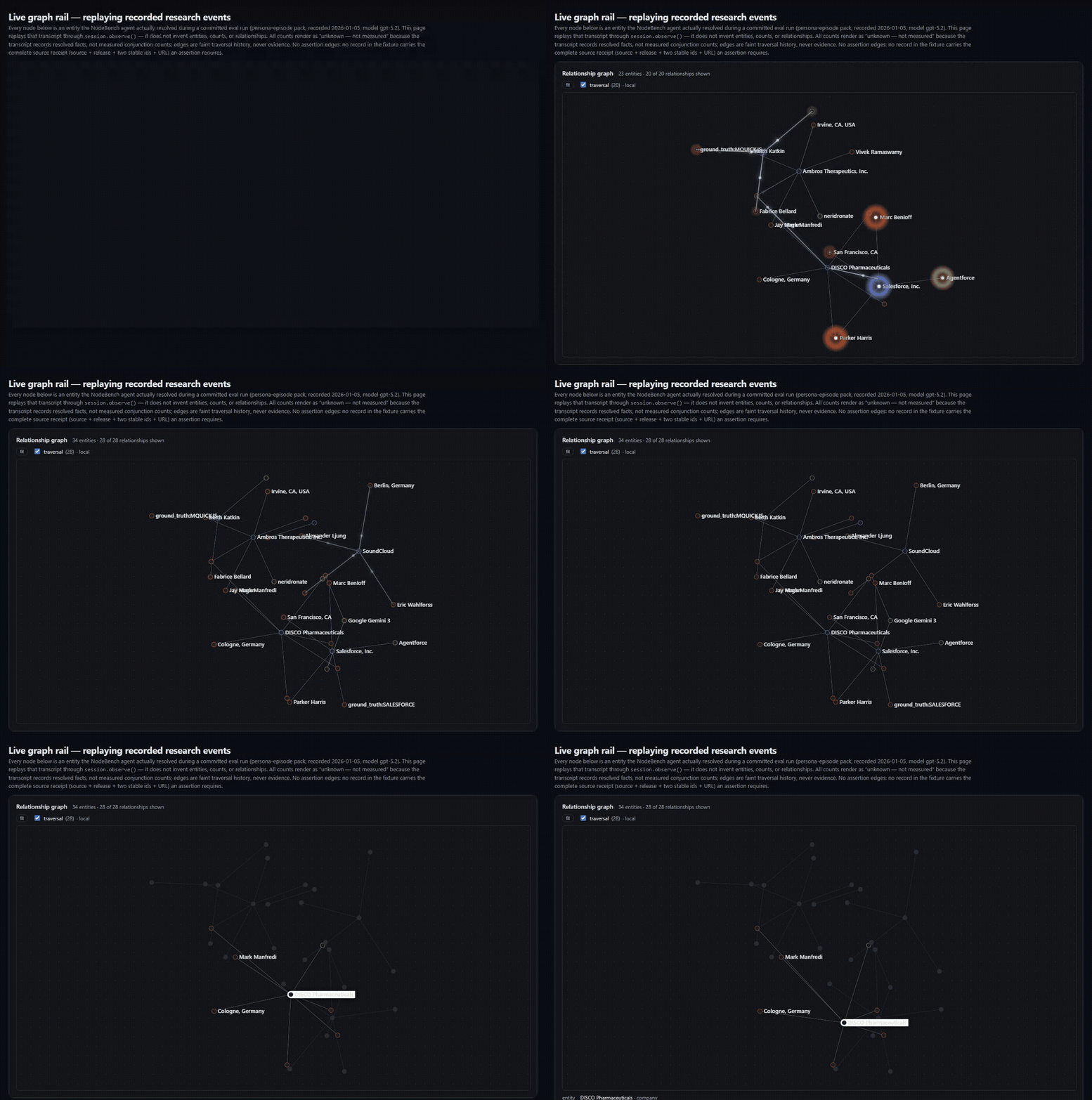
Recorded from demo/graph-rail/ replaying a committed eval transcript (persona-episode pack, 2026-01-05) through session.observe() — recorded events replayed, not re-verified; every label is a literal fixture substring, edges are traversal history, never evidence. Regenerate: node scripts/record-graph-rail-clip.mjs.
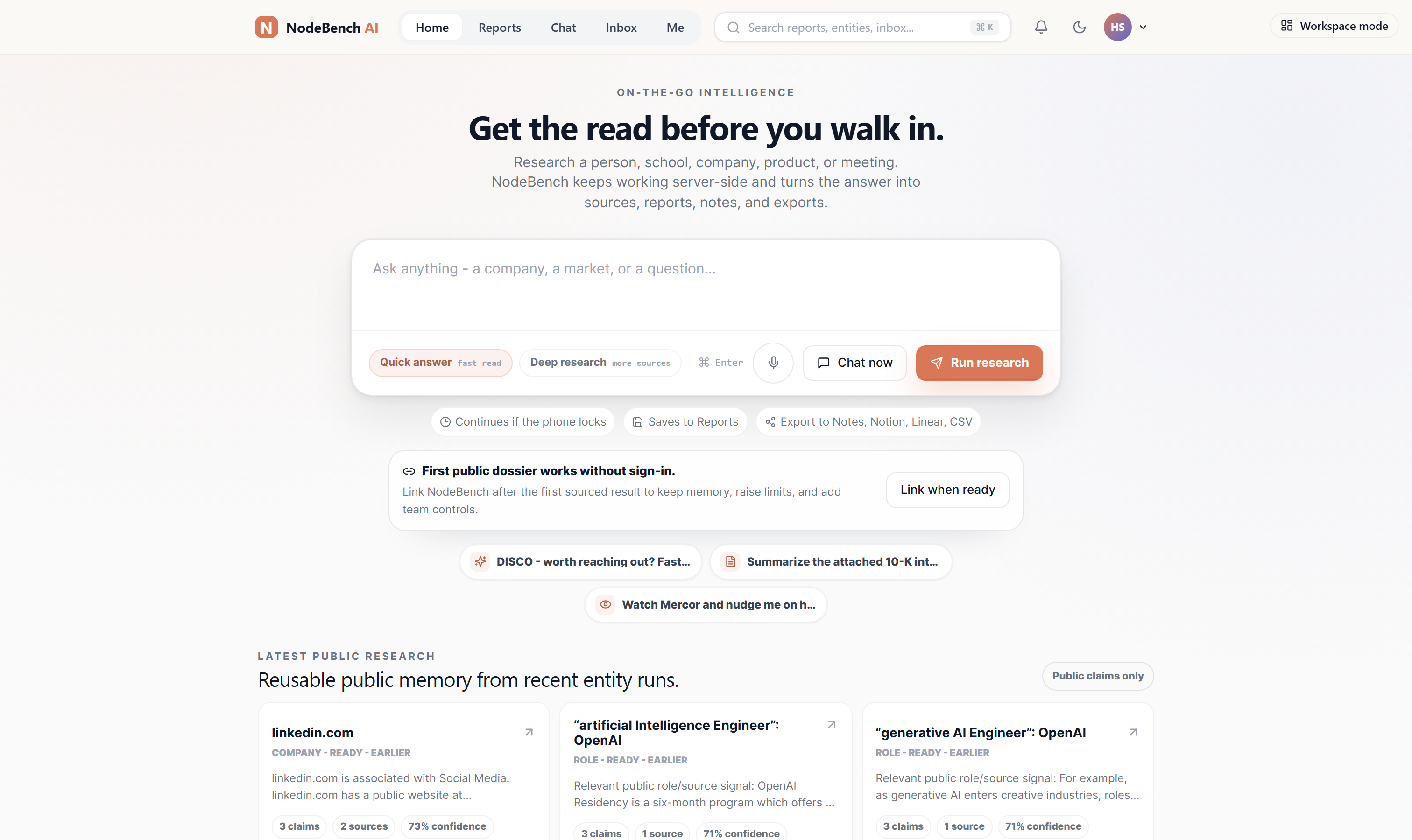
Product
NodeBench is a research and reporting product built around five user-facing surfaces:
Home= start quicklyReports= reusable memoryChat= do the workInbox= captures, nudges, alerts, automations, and unassigned reviewMe= operator context and control
Deep research opens in the separate Workspace surface at nodebench.workspace;
it is not a sixth tab in the operating app.
The core idea is simple:
users do not just need a chatbot that answers once.
They need a system that can:
- take a question, file, URL, or prior thread
- search and synthesize with sources
- turn the run into a reusable artifact
- watch for meaningful change later
- improve the next run from what it learned
Pending Release Candidate: Runtime-Grounded Control Focus
This candidate is not yet merged or deployed. It narrows the reachable product to controls backed by a real runtime capability and makes unavailable state explicit:
- Agents keeps ask, explicit swarm launch, active work, approvals, sources, traces, receipts, exports, and provenance while removing projected metrics, synthetic fallbacks, duplicate actions, and local-only controls.
- Generated code remains copyable and exportable but never executes inside the signed-in app origin. Runtime cards accept successful structured tool output, not assistant prose, guessed search fields, or incomplete/error states.
- Canonical owner-scoped streaming remains; an unreferenced bearer-stream component and HTTP route were removed instead of retained as a second path.
- Home, Reports, Chat, Inbox, and Me use live runtime data, owner-scoped where private, or honest loading, empty, not-found, and unmeasured states instead of reachable product fixtures. Desktop and mobile now share the same Inbox and Me component trees; duplicate queue/profile renders and their hard-coded plan, usage, connector, and local-draft projections were deleted.
- Pipeline launches and schedules require an authenticated server identity, while guest history, detail, bundle, stream, and evaluation reads require an anonymous-session possession credential. Browser-supplied owner keys are no longer an authority boundary, and trusted cron or MCP work stays on internal contracts.
- Authenticated launches consume durable per-owner admission: four units per ten minutes and thirty per day, with composed runs costing two units. Server input bounds and per-owner schedule caps close the remaining cost-abuse path.
- Fresh pipeline attempts and recurring schedule occurrences are isolated by durable attempt identities and execution-generation fences, so retries can resume the same attempt without stale or overlapping workers rewriting it.
- Research distinguishes sources consulted from citations actually bound in the synthesis. Missing, malformed, or unbound evidence cannot be promoted to a verified claim, and chat no longer injects citation markers into prose.
- Operator telemetry and maintenance are deferred until deliberate disclosure and require server-confirmed operator access.
- Task sessions, traces, steps, evidence, approvals, swarms, and operational history are owner-scoped. The unreachable parallel timeline, kanban, hook, and public orchestrator were removed; due diligence retains only a bounded, owner-checked internal task substrate. Unused public due-diligence, investor, demo, and evaluation entrypoints were internalized or removed, and retained job, branch, memo, and catch-path writes require the exact owner chain. Raw orchestrator writes use internal contracts, MCP document and spreadsheet operations require exact object ownership, and a TRACE completion fails closed unless its receipt persists with an exact output hash.
Release evidence is intentionally pending. The source PR must merge through the required CI gates first; a follow-up evidence-seal PR must then record the canonical squash SHA, exact-revision checks, preview assertions, production deployment revision, and direct production browser verification before this section can be described as shipped.
What Shipped
- five-surface web app across
Home,Reports,Chat,Inbox, andMe - separate deep-work Workspace shell at
nodebench.workspace - typed search and reporting pipeline
- hosted public research MCP for external apps and agents:
https://nodebench-mcp-unified.onrender.com?profile=public-research - Pi-AI pipeline lane on
Reportswith code-gen, design-gen, research, composed runs, schedules, streaming previews, eval scorecard, and MCP HTTP bridge - live SSE streaming with saved runtime state
- Convex-backed product state for sessions, reports, entities, nudges, files, and related objects
- shared-context handoff and delegation plumbing
- local and deployed server runtime for search, streaming, voice, and shared context routes
nodebench-mcp,nodebench-mcp-power, andnodebench-mcp-admindistribution lanes- builder-facing Oracle, dogfood, eval, replay, and control-plane infrastructure
Live graph rail on a LIVE Convex backend
The rail inside the product UI

The rail lives in the real product page —
apps/web/src/features/research/components/EntityGraphRail.tsx, mounted in
EntityProfilePage (/#entity/<name>, the grammar digest links emit). It is
fed by the SAME reactive queries the page already holds
(entityContexts.getEntityContext, relationshipGraph.getEntityGraph,
adaptiveEntityQueries.getAdaptiveProfile) — zero new subscriptions. Counts
stay undefined and every edge is traversal: research prose measures nothing.
Regenerate: node demo/graph-rail-live/record-product-rail.mjs (exits
nonzero if the rail is missing, stays under 4 nodes, or fails to grow after
the live write). See docs/GRAPH_INTEGRATION.md for the event taxonomy.
The standalone live viewer
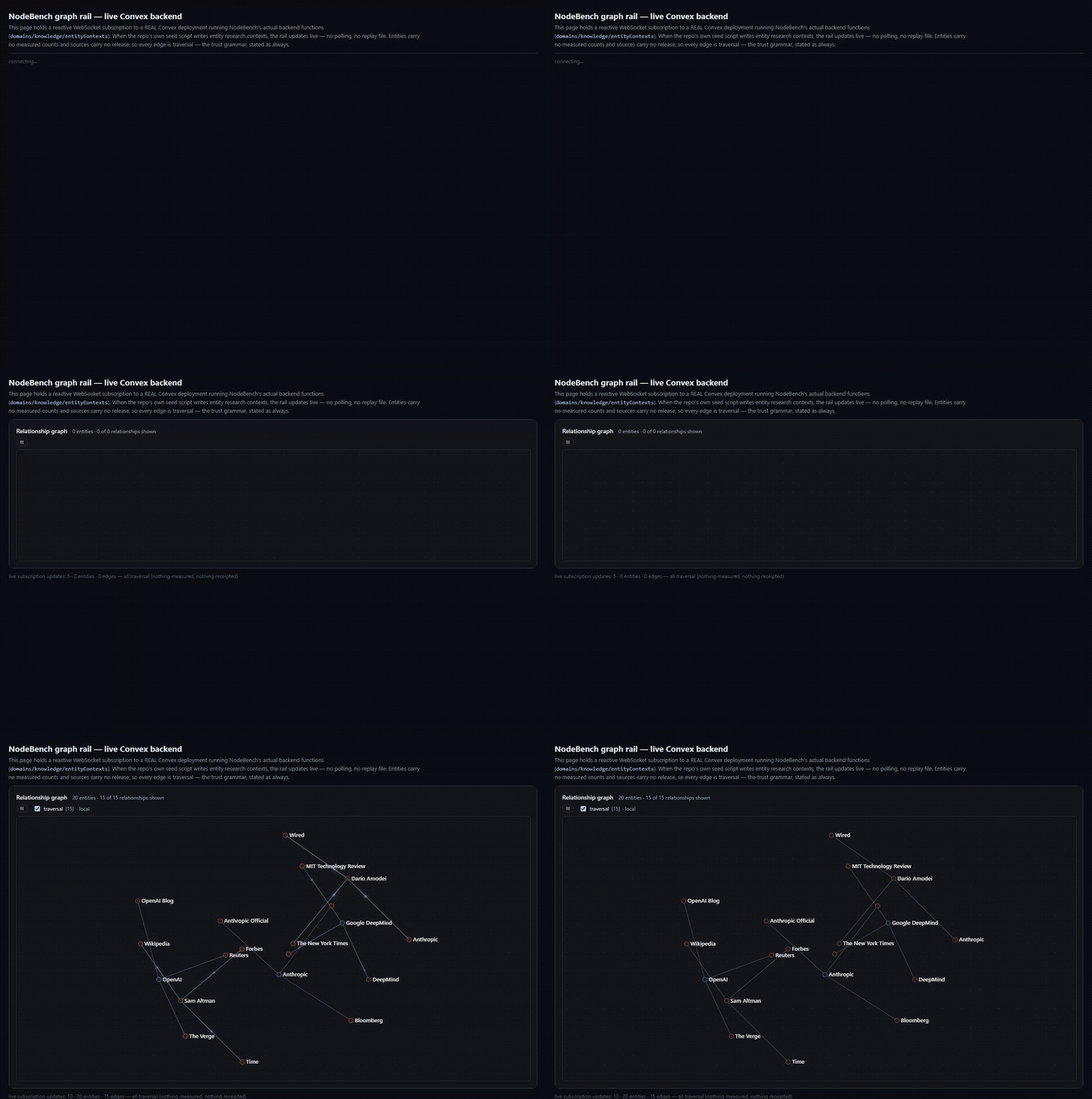
No replay file: demo/graph-rail-live/ subscribes to the real
domains/knowledge/entityContexts:getEntityContext query on an isolated dev
deployment, and the repo's own seed script writes through the real mutation
on camera. All edges traversal — research prose is not a measurement.
Regenerate: node demo/graph-rail-live/record-live.mjs <dev-deployment-url>
(see the script header for the one-time deployment setup).
Live graph rail (recorded events)
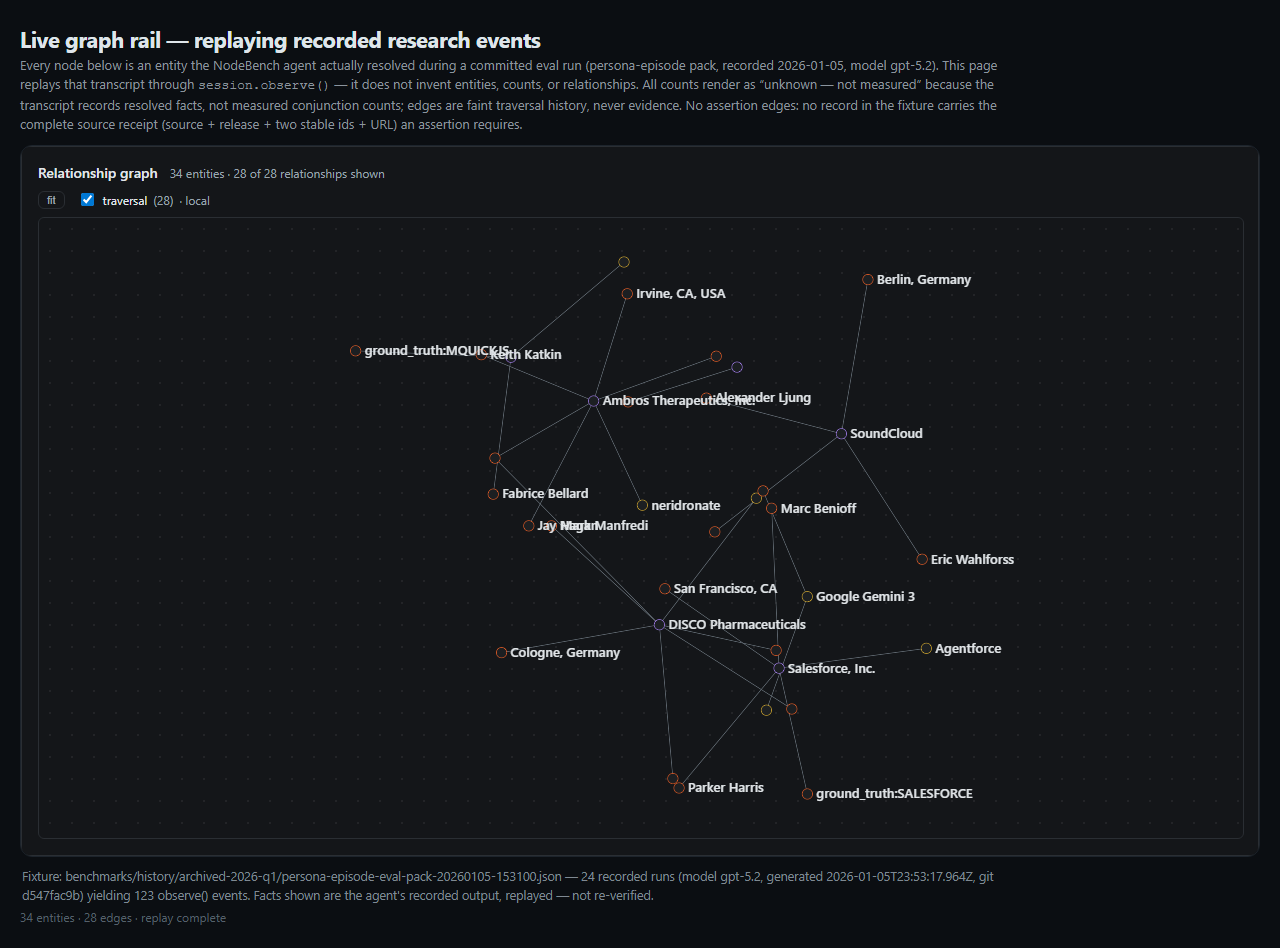
demo/graph-rail/ feeds the NodeGraph Live
renderer (vendored at vendor/nodegraph-live/, pending npm publish) with real
entity-research events from a committed eval transcript
(benchmarks/history/archived-2026-q1/persona-episode-eval-pack-20260105-153100.json)
— it is a replay of recorded events, not a live agent run: every label is a
verbatim string from that fixture, all counts render as unknown because the
transcript holds no measured pair counts, and no assertion edges are drawn
because no record carries a complete source receipt.
node scripts/capture-graph-rail.mjs regenerates the capture and exits nonzero
on an empty rail, any console error, or any rendered label that does not appear
in the fixture.
Hosted Public Research MCP
NodeBench can be used as a public research memory and tool server from any agent or app without forcing signup before the first useful result.
Use the hosted MCP endpoint:
https://nodebench-mcp-unified.onrender.com?profile=public-research
For Gmail/job-match style integrations, use the smaller profile:
https://nodebench-mcp-unified.onrender.com?profile=gmail-research
Public profiles are anonymous by default, but still metered. Responses include:
x-nodebench-request-id
x-nodebench-profile
x-nodebench-auth-mode
x-nodebench-account-key
Apps should send stable, non-sensitive client headers:
x-nodebench-client: your-app-name
x-nodebench-client-version: 1.0.0
x-nodebench-client-id: stable-install-or-workspace-id
x-nodebench-client-id lets NodeBench attribute anonymous usage and estimated
costs without requiring a NodeBench token. Do not put private email text,
resume text, API keys, or user secrets in this header.
Progressive Sign-In And Linking
The intended user flow is:
First public dossier works without signup
  -> show sources, freshness, and confidence
  -> offer "Link NodeBench" after value is visible
  -> linked users get stable history, higher budgets, team usage, webhooks,
     token management, billing controls, and reusable private workspace context
Do not block public-source research behind login. Promote sign-in when the user wants persistence, shared team memory, budget controls, private workspace linking, or API/MCP tokens.
See MCP_TOOL_PROFILES.md for the full profile list, tool catalog, account attribution, and cost tracking contract.
Product At A Glance
USER SURFACES
-------------
Home      -> start quickly
Reports   -> reusable report memory
Chat      -> answer, sources, trace, follow-ups
Inbox     -> captures, nudges, automations, alerts, unassigned items
Me        -> operator context, permissions, controls

BACKEND
-------
Convex tables and product state for sessions, reports, entities, nudges,
files, shared context, and evaluation artifacts

RUNTIME
-------
search pipeline
  -> answer packet
  -> saved report
  -> tracked entity / tracked theme / follow-up task
  -> nudge or prep brief
  -> resumed chat or reopened report

COMPOUNDING LOOP
----------------
question
  -> answer
  -> saved report
  -> watch item
  -> useful nudge
  -> better next run

DISTRIBUTION
------------
nodebenchai.com
nodebench.workspace
nodebench-mcp
nodebench-mcp-power
nodebench-mcp-admin
Event Intelligence Serving Model
Event serving extends the same budgeted search route used by the main app and MCP runtime. NodeBench treats search as a memory-building operation with a budget. For events, NodeBench checks the event corpus and workspace memory before live search, then persists useful results as entities, claims, sources, and workspace context.
ScratchNode is the lightweight live-event sidecar for this model: a disposable
room that turns public chat and sourced /ask answers into a public wiki while
keeping attendee notes private. It complements Luma, Slack, Eventbrite, and
other event surfaces instead of replacing them; the explicit handoff to
NodeBench opens https://nodebenchai.com/events/:eventSlug/private with
private-note continuation context and no URL-borne ownerKey.
The event flow is:
Before event
  -> build event corpus

During event
  -> capture messy notes instantly

After event
  -> turn captures into report, cards, follow-ups, and reusable memory
The product model is:
ScratchNode sidecar room + public event corpus + private NodeBench continuation
Event corpus and capture data stay separated:
Shared event corpus= public event info, speakers, sponsors, company pages, sessions, and public source cache.Private captures= what a user personally heard, wrote, recorded, or photographed; ScratchNode private notes never enter the public feed, public wiki, or public/askcache.Team/org memory= shared only inside the fund, company, or workspace.Event aggregate insights= opt-in or anonymized only.
During the event, most captures should hit the event corpus first and avoid paid search:
voice memo / text / screenshot
  -> captureRouter
  -> active event corpus
  -> entity and claim extraction
  -> active event session attachment
  -> budget policy
  -> ack + next action
Example mobile ack:
Saved to Ship Demo Day session
Detected 1 person | 1 company | 2 claims | 1 follow-up
Using event corpus | 0 paid calls
After the event, the report opens in nodebench.workspace:
Brief      -> post-event memo
Cards      -> people, companies, products, themes
Notebook   -> raw notes, transcripts, screenshot OCR, cleaned notes
Sources    -> field notes, public evidence, verification status
Chat       -> follow-up questions and deeper refreshes
Map        -> graph view later
The canonical spec lives in EVENT_INTELLIGENCE_SERVING_MODEL.md. The ScratchNode/NodeBench privacy boundary lives in SCRATCHNODE_NODEBENCH_BOUNDARY.md.
Why This Design
NodeBench is designed around a few product realities:
- A useful answer should not disappear after one chat turn.
- Saved work should become reusable memory, not a dead archive row.
- The product should bring the user back only when something meaningful changes.
- The system should gradually learn how the user works without forcing a heavy onboarding flow.
- Operator context should improve future runs without turning the system into corporate-speak or fake-agreeable sludge.
That drives the current design:
- answer-first execution
- advisor mode by design via dynamic routing:
- fast executive lane for routine work
- deeper advisor lane for ambiguity, planning, and harder reasoning
- similar in spirit to Claude Code's official
opusplansplit: stronger planning lane, cheaper execution lane
- saved artifacts as first-class objects
- visible sources and traceability
- a five-page loop instead of five unrelated tabs
- future
Harness v2work focused on specification, operator context, and compounding behavior
Plain English:
NodeBench should not spend the most expensive reasoning path on every request.
It should move fast by default, then go deeper when the task, evidence, or user
request justifies it.
The detailed implementation, verification, and evaluation plan for this mode lives in:
- HARNESS_V2_PROPOSAL.md (archived)
- HARNESS_V2_BUILD_PLAN.md (archived)
How The Five Pages Compound
NodeBench should not feel like five separate destinations.
The intended product behavior is:
Home
  -> start quickly

Reports
  -> turn that artifact into reusable memory

Chat
  -> do the work
  -> create the first useful artifact

Inbox
  -> triage captures, nudges, automations, alerts, and unassigned items

Me
  -> improve how the next run is handled

Workspace
  -> open deep Brief / Cards / Notebook / Sources / Chat / Map work
  -> lives at nodebench.workspace, not in the operating tab bar

Next Home or Chat run
  -> starts with more context than before
The shortest version of the compounding loop is:
question
  -> answer
  -> saved report
  -> watch item
  -> useful nudge
  -> better next run
Plain-English artifact flow:
input
  -> answer packet
  -> saved report
  -> tracked entity / tracked theme / follow-up task
  -> nudge or prep brief
  -> resumed report or resumed chat
  -> user correction or confirmation
  -> updated operator context
  -> better next run
What each page contributes:
Homestarts the run with the least friction possibleReportsturns those into a durable report the user can reopen, refresh, and reuseChatcreates the answer, sources, trace, entities, and next actionsInboxcollects nudges, captures, automations, alerts, and unassigned itemsMestores the operator context that improves the next answerWorkspaceowns recursive cards, notebook editing, source verification, and long-lived intelligence memory
Current Legacy Infrastructure
NodeBench is not starting from zero. The repo already contains a substantial legacy stack that works today.
Current legacy foundation:
- five-surface web product
- Convex-backed canonical data layer
- local and deployed server runtime
- harness v1 planning and execution path
- shared-context handoff and delegation support
- MCP distribution lanes
- builder-facing evaluation and control-plane systems
What that means:
- the problem is not missing architecture
- the problem is product behavior, workflow compression, and clearer cross-surface compounding
Roadmap
The near-term goal is:
keep the working legacy foundation
remove accidental complexity
add specification-aware operator context
ship one clear compounding workflow
Main tasks still to finish:
- make
Home -> Reports -> Chat -> Inbox -> Mebehave like one continuous workflow instead of five adjacent surfaces - turn harness v1 into the clearer v2 shape described in HARNESS_V2_PROPOSAL
- ship
Layer 0operator context so the system can learn useful workflow patterns without forcing a heavy onboarding flow - support permissioned transcript ingestion from NodeBench chats first, then
optional external logs such as Claude Code JSONL transcripts for
nodebench-mcp - add style-drift guardrails so the system learns judgment and workflow without overfitting to corporate voice, filler, or sycophancy
- add anticipatory prep behavior so the system can prepare the user before important interactions, not only answer after the fact
- make saved reports behave like reusable memory, not storage
- keep
Nudgesas an Inbox section with at least one working daily trigger - make
Meclearly improve future runs by exposing what context is being used and why - finish the
nodebench-mcpv3 cut-and-split plan so default runtime, power runtime, and admin runtime are clearly separated - instrument real latency, real cost, real artifact completion, and real reuse across both web and MCP flows
- keep README, runtime behavior, and exposed tool counts in sync so the public story matches the actual system
- keep dogfood, eval, and builder-control infrastructure as internal leverage instead of letting it leak into the main user-facing product
Quick Start
Web app
Open nodebenchai.com and start in Home.
MCP
# Claude Code
claude mcp add nodebench -- npx -y nodebench-mcp

# Claude Code power lane
claude mcp add nodebench-power -- npx -y nodebench-mcp-power

# Claude Code admin lane
claude mcp add nodebench-admin -- npx -y nodebench-mcp-admin

# Cursor
npx nodebench-mcp --preset cursor

# Generic MCP client
npx nodebench-mcp
Local development
git clone https://github.com/HomenShum/nodebench-ai.git
cd nodebench-ai
nvm use            # Node version from .nvmrc
npm install

# Frontend only. This is the honest first run: it starts, and every product
# route shows the "Convex backend not configured" card until you supply a real
# VITE_CONVEX_URL. That card is the designed state, not a failure.
npx vite --port 5173

# Production build
npm run build
npm run dev runs three processes in parallel (vite, convex dev,
and the voice worker). Two of them block on credentials — convex dev wants an
interactive Convex login and the voice worker wants .env.local — so it is not
the command to start with on a fresh clone.
cp .env.example .env.local on its own does not get you a working backend:
the file ships VITE_CONVEX_URL=https://your-project.convex.cloud, which is a
placeholder and is rejected on purpose (apps/web/src/lib/convexUrl.ts). Run
npx convex dev to provision a real deployment, then put its URL there.
Architecture
nodebenchai.com (React + Vite + Tailwind)
    |
Convex Cloud (sessions, reports, entities, nudges, files, product state)
    |
server runtime + search pipeline + SSE
    |
answer packet
    |
saved report
    |
tracked entities / watch conditions / nudges
    |
future runs with better operator context
NodeBenchAI MCPのよくある質問
NodeBenchを自作エージェントの調査ツールとして使用するにはどうすればよいですか?
ホストされている公開リサーチ MCP エンドポイントを使用することで、外部アプリやエージェントのメモリおよびツールサーバーとして NodeBench を統合できます。