
Analyzes raw DNA files locally to provide reports on haplogroups, traits, ClinVar health data, and pharmacogenomics.
別名 codebase/gnomancer
- スター
- 5
- ツール
- —
- ダウンロード数(30日間)
- 1,013
- 最新バージョン
- 0.5.2
- 最終コミット
- 2026年11月10日
- ライセンス
- MIT
gnomancer MCPとは
gnomancerはMCPサーバーです。 Analyzes raw DNA files locally to provide reports on haplogroups, traits, ClinVar health data, and pharmacogenomics.
プロジェクトのREADMEから生成された概要
gnomancer MCP server について
Analyzing raw DNA files from services like AncestryDNA, 23andMe, or MyHeritage locally is what gnomancer enables. It transforms raw genotype data into readable reports covering haplogroups, physical traits, and health information without ever uploading your genetic files to the cloud. The processing happens entirely on your own machine, ensuring privacy for your sensitive data.
Developers can connect this server to AI clients like Claude Desktop, Cursor, or LM Studio using the uvx command. Once connected, an AI assistant can query the report results or look up specific genotypes at individual sites. The server provides specialized tools for ClinVar health scans and PharmCAT pharmacogenomics, which are only fetched when requested. This setup allows you to use local models to keep all genetic insights on your hardware or use cloud assistants to generate narrative summaries from your structured results.
できること
- 1Querying specific genetic traitsAsk your AI assistant to explain what your DNA report says about your ability to process caffeine.
- 2Analyzing family relationshipsProvide multiple DNA files to determine shared segments and likely biological relationships between family members.
- 3Monitoring health data updatesAutomatically check for new ClinVar classifications to see if any previously identified variants have been reclassified.
プロジェクトの README から作成されています。すべてのユースケースは、その引用と照らし合わせて確認されています。
gnomancer MCPのインストール方法
フォーマット検証日 2026年11月10日Cursor に追加Gooseに追加Claude Codeにgnomancer MCPをインストール
$ claude mcp add gnomancer -- uvx gnomancerCursorにgnomancer MCPをインストール
~/.cursor/mcp.json
{
  "mcpServers": {
    "gnomancer": {
      "command": "uvx",
      "args": [
        "gnomancer"
      ]
    }
  }
}VS Codeにgnomancer MCPをインストール
.vscode/mcp.json
{
  "servers": {
    "gnomancer": {
      "type": "stdio",
      "command": "uvx",
      "args": [
        "gnomancer"
      ]
    }
  }
}VS Code CLIにgnomancer MCPをインストール
$ code --add-mcp '{"name":"gnomancer","type":"stdio","command":"uvx","args":["gnomancer"]}'Claude Desktopにgnomancer MCPをインストール
claude_desktop_config.json
{
  "mcpServers": {
    "gnomancer": {
      "command": "uvx",
      "args": [
        "gnomancer"
      ]
    }
  }
}Codexにgnomancer MCPをインストール
$ codex mcp add gnomancer -- uvx gnomancerCodex config.tomlにgnomancer MCPをインストール
~/.codex/config.toml
[mcp_servers.gnomancer]
command = "uvx"
args = ["gnomancer"]
Gemini CLIにgnomancer MCPをインストール
$ gemini mcp add -s user gnomancer uvx -- gnomancerGemini settings.jsonにgnomancer MCPをインストール
~/.gemini/settings.json
{
  "mcpServers": {
    "gnomancer": {
      "command": "uvx",
      "args": [
        "gnomancer"
      ]
    }
  }
}自動チェック
実行日 2026年11月13日完全なレポート →自動チェックに合格しました。これはセキュリティ監査ではありません。コードを読み、サーバーに必要最小限のアクセス権を与えてください。 チェックの仕組み

- ソースリポジトリがリンクされており、アクセス可能codebase/gnomancer is public and reachablegithub.com/codebase/gnomancer ↗合格
- パッケージがこのリポジトリをソースとして指定gnomancer names codebase/gnomancer as sourcepypi.org/project/gnomancer/ ↗合格
- ビルドの来歴 (Sigstore 証明)Sigstore attestation for gnomancerpypi.org/project/gnomancer/ ↗合格
- オープンソースライセンス (OSI)MITspdx.org/licenses/MIT.html ↗合格
- 過去1年以内にコミットまたはリリースありLast commit or release 2026-11-10github.com/codebase/gnomancer ↗合格
- OpenSSF Scorecard未チェック
- パッケージ名が有名なパッケージに酷似していないNo popular package one edit away from gnomancer合格
- パッケージおよびその依存関係に重大な勧告なし46 resolved dependencies checked; no critical advisoryosv.dev ↗合格
- モデルへの隠れた指示がない0 tool descriptions and the README read; no override phrases, credential paths or hidden characters合格
- 破壊的なツールがラベル付けされている未チェック
- リモートエンドポイントが MCP ハンドシェイクに応答未チェック
README
GitHubで見るTake the raw file you already downloaded from AncestryDNA, 23andMe, MyHeritage, FamilyTreeDNA or LivingDNA (or a VCF) and turn it into one readable report. Everything runs on your computer. Nothing is uploaded.
Quick start
pipx install gnomancer      # Python 3.10+; Java 17+ for the mtDNA haplogroup and PharmCAT steps
gnomancer ~/Downloads/AncestryDNA.zip   # first run fetches the open-source tools and references once (~250 MB)
Open AncestryDNA_analysis/REPORT.html. No Python? curl -fsSL https://gnomancer.com/install.sh | bash sets everything up (macOS and Linux; Windows via WSL).
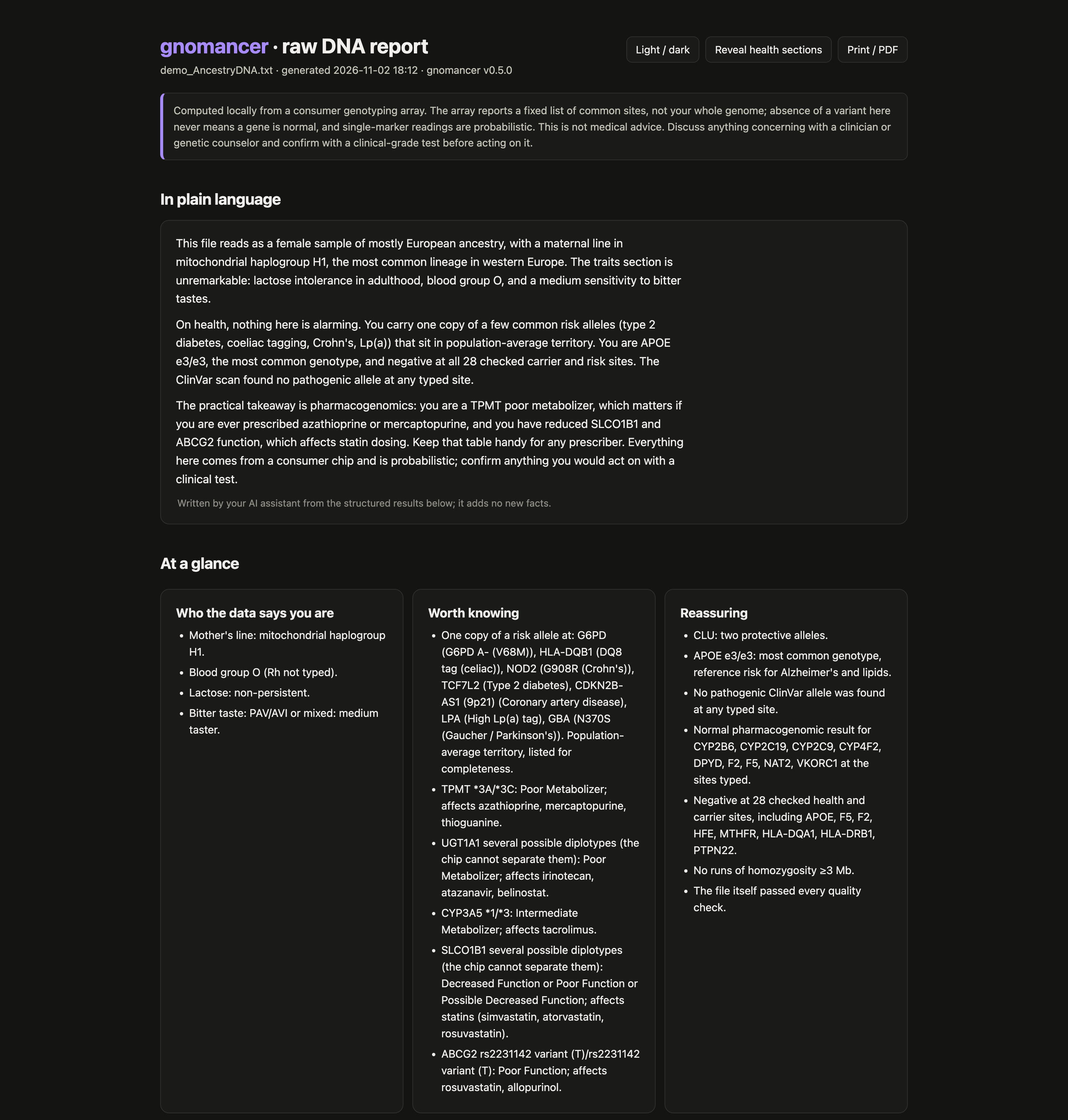
What you get
- Plain language first. An at-a-glance digest, then a narrative your own AI assistant can write from a prompt the run gives you.
- Lineages. Y haplogroup (yhaplo, plus Yleaf on current YFull/FTDNA/ISOGG trees) and mtDNA haplogroup (Haplogrep3), each with population context.
- Traits and ancestry markers. About 110 well-replicated sites: pigmentation, lactose, caffeine, bitter taste, blood group and more.
- Health, carefully. Carrier sites, common risk variants, a ClinVar scan of every typed site with plausibility scoring, and PharmCAT pharmacogenomics. All collapsed by default so nobody sees a result they didn't ask for.
- Family mode.
gnomancer family dad.zip mom.zip me.zipshows shared DNA and the likely relationship for each pair, which lines you share, and which parent each of your alleles came from. - Stays current.
gnomancer watchre-checks ClinVar each month and tells you only what was reclassified at sites you carry. - Honest limits. Every section says what the chip can and cannot tell you.
Use it from your AI assistant
gnomancer is also an MCP server. Connect it and ask "what does my report say about caffeine?"
claude mcp add gnomancer -- uvx gnomancer serve # Claude Code
Any MCP client works the same way: the command is uvx with arguments gnomancer serve. For Claude Desktop, Cursor and LM Studio (for a local model), add it to the client's mcpServers JSON:
{"mcpServers": {"gnomancer": {"command": "uvx", "args": ["gnomancer", "serve"]}}}
For Codex, add it to ~/.codex/config.toml:
[mcp_servers.gnomancer]
command = "uvx"
args = ["gnomancer", "serve"]
Tested with Claude Code and with a generic MCP client; reports from other clients are welcome.
The assistant never gets the raw file. It gets the report's results, and can look up the genotype at a single site when a question needs it; the health tables are separate tools fetched only on request. The repo also works as a Claude plugin (skills/gnomancer/SKILL.md).
Privacy
Your genotype file never leaves your machine. The only network traffic is the one-time download of public tools and references. The optional --ai flag sends the structured results (not the file) to the Anthropic API to write the narrative, and only when you ask. If you connect an AI assistant through the MCP server, it sees what it asks for: the report's results, and the genotype at any single site it looks up. With a cloud assistant those go to its provider; with a local model they stay on your machine.
Not medical advice
A genotyping array reads about 0.02% of the genome at pre-chosen sites, and its calls at rare sites are wrong often enough that a clinical lab found 40% did not confirm. gnomancer tells you what the chip says and how far to trust it. Confirm anything that matters with a clinical-grade test and a clinician or genetic counselor.
More
Discord community · CLI options · vendors and quirks · the marker panel · tools under the hood · development · MCP registry · contributing
MIT licensed. The tools it downloads keep their own licenses; see NOTICE.md for credits.
mcp-name: com.gnomancer/gnomancer
gnomancer MCPのよくある質問
gnomancer MCPをClaude Codeに追加するには
ターミナルでclaude mcp add gnomancer -- uvx gnomancerを実行します。すべてのプロジェクトで利用するには--scope userを追加します。
gnomancer MCPをCursorに追加するには
~/.cursor/mcp.jsonを開き、上記のインストールセクションに示すCursor設定を使ってmcpServersの下にサーバーを追加します。
Is my DNA data uploaded to the cloud?
No, everything runs locally on your computer and your genotype file never leaves your machine.
Which DNA services are supported?
It supports raw files from AncestryDNA, 23andMe, MyHeritage, FamilyTreeDNA, LivingDNA, or VCF files.