
Corpus Agent Kit MCP server
Commit 15. Nov. 2026Ermöglicht es AI Agents, US-Bundes-, Staats- und Kommunalrecht mit wortgetreuen Zitaten zu durchsuchen und Prozesse zur Unternehmensgründung zu verwalten.
Auch bekannt als teakesdev/corpus-agent-kit
- Stars
- 2
- Tools
- —
- Downloads, 30 Tage
- —
- Neueste Version
- —
- Letzter Commit
- 15. Nov. 2026
- Lizenz
- Apache-2.0
Was ist Corpus Agent Kit MCP?
Ermöglicht es AI Agents, US-Bundes-, Staats- und Kommunalrecht mit wortgetreuen Zitaten zu durchsuchen und Prozesse zur Unternehmensgründung zu verwalten.
Zusammenfassung generiert aus dem README des Projekts
Über Corpus Agent Kit MCP server
Dieses Kit bietet Entwicklern Tools, um AI Agents mit einer riesigen Datenbank für US-Bundes-, Staats- und Kommunalrecht zu verbinden. Es erlaubt Agents, Rechtsrecherchen anhand von über 700.000 Bestimmungen mit wortgetreuen Zitaten durchzuführen. Nutzer können sich über einen hosted HTTP MCP server unter einer spezifischen URL verbinden, was keine lokale Installation erfordert und mit Clients wie Cursor oder Grok Bot funktioniert. Ein optionaler API Key kann das monatliche Suchlimit von 100 auf 1.000 Suchen erhöhen.
Über die Recherche hinaus enthält das Kit Tools für die Verwaltung von Gründungsprozessen, wie etwa das Intake für LLCs oder Nonprofits. Es bietet spezifische Tools wie law.search für semantische Abfragen und formation.requirements, um staatsspezifische Checklisten zu prüfen. Während der Agent Entwürfe vorbereiten und USDC-Zahlungen via Solana abwickeln kann, kann er Dokumente nicht automatisch einreichen. Jeder Einreichungsprozess beinhaltet ein obligatorisches menschliches Approval Gate, um die Genauigkeit vor jeder rechtlichen Einreichung sicherzustellen.
Was du damit machen kannst
- 1Recherche von GesetzesvorschriftenEin AI Agent kann Hunderttausende von Rechtsvorschriften durchsuchen, um spezifische Anforderungen mit exakten Zitaten zu finden.
- 2Unterstützung bei der UnternehmensgründungEin Entwickler kann einen Agenten damit beauftragen, die spezifischen Anforderungen und Preise für die Gründung einer LLC in einem bestimmten Bundesstaat zu ermitteln.
- 3Automatisierte GründungsprozesseDas Kit kann einen Nutzer durch die notwendigen Schritte zur Gründung einer Nonprofit oder LLC führen und die Unterlagen für eine menschliche Überprüfung vorbereiten.
Geschrieben aus dem README des Projekts. Jeder Use Case wurde gegen ein Zitat daraus geprüft.
Konfiguration
CORPUS_API_KEY
| Name | Beschreibung | Typ |
|---|---|---|
| CORPUS_API_KEY | — |
Automatisierte Checks
Geluften am 14. Nov. 2026Vollständiger Bericht →Noch nicht verifiziert. Ein Server benötigt einen Score von 80, keine kritischen Befunde und genug Daten für unsere Prüfung. Wie die Checks funktionieren · Was du für mehr Punkte verbessern kannst

- Source Repository verknüpft und erreichbarteakesdev/corpus-agent-kit is public and reachablegithub.com/teakesdev/corpus-agent-kit ↗Bestanden
- Paket nennt dieses Repository als QuelleNicht geprüft
- Build-Provenienz (Sigstore-Attestierung)Nicht geprüft
- Open Source Lizenz (OSI)Apache-2.0spdx.org/licenses/Apache-2.0.html ↗Bestanden
- Commit oder Release im letzten JahrLast commit or release 2026-11-11github.com/teakesdev/corpus-agent-kit ↗Bestanden
- OpenSSF ScorecardNicht geprüft
- Package-Name ähnelt keinem populären PackageNicht geprüft
- Keine kritischen Advisories im Paket oder seinen AbhängigkeitenNicht geprüft
- Keine versteckten Anweisungen an das Modell0 tool descriptions and the README read; no override phrases, credential paths or hidden charactersBestanden
- Destruktive Tools sind markiertNicht geprüft
- Remote-Endpoint beantwortet den MCP-HandshakeNicht geprüft
README
Auf GitHub ansehencorpus-agent-kit
Give your AI agent real US law — and let it form a company.
Open-source connectors for the Corpus legal platform: search 700,000+ provisions of federal, state, and municipal law with verbatim citations, and run a complete LLC or nonprofit formation intake end to end. Every filing still stops at a human approval gate.


Start here — pick your friction level
1. Zero install: point any MCP client at the hosted server
https://corpuslaw.us/api/mcp speaks streamable-HTTP MCP directly. No clone,
no build, no local process:
{
  "mcpServers": {
    "corpus-law": {
      "type": "http",
      "url": "https://corpuslaw.us/api/mcp"
    }
  }
}
That is the whole setup. Ask your agent "what does Mississippi require to form an LLC?" and it will answer from live statutes with citations you can check.
Research is free to start: 100 searches/month anonymously. A
free API key — instant, self-serve, no waiting
list — raises it to 1,000/month. Send it as Authorization: Bearer <key>.
1b. Grok Bot / Cursor (same hosted MCP)
Grok Bot and Cursor speak remote MCP connectors. Point one at
https://corpuslaw.us/api/mcp, then ask Create an LLC for Acme AI in
Mississippi. Formation tools never auto-file: handoff stops at a human approval link. USDC pay is email-confirmed; filing still needs human approval.
Optional: install skills/corpus-business-formation/
for a guided intake. For Cursor Marketplace listing, see
plugins/corpus/ (.cursor-plugin/) and submit the repo at
https://cursor.com/marketplace/publish. Full install notes and an optional
Company Formation Bot — powered by Corpus template:
docs/GROK_BOT.md.
Running work log for this integration: WORKLOG.md.
2. Zero install: try the agent in a browser
corpuslaw.us/autopilot — the Formation
Autopilot from this repo (autopilot/), running on Alibaba Cloud Function
Compute. Describe a business in plain English; get a launch checklist linked to
reviewed guides and the formation catalog, with unresolved requirements marked
Needs checking, and a prefilled formation handoff. Broad keyword law matches are
withheld until their relevance can be verified.
3. Drop a skill folder — or install a plugin
Two portable Agent Skills:
skills/corpus-business-formation/— LLC / nonprofit intakeskills/corpus-legal-research/— live statute search
Copy either folder into Claude Code, Codex, Cursor, VS Code, or Hermes and the agent learns to reach for Corpus before any MCP connection exists (install paths).
Or install both skills plus the MCP URL as one plugin. This repo is a plugin marketplace. For OpenAI Codex, use a local checkout or the extracted OpenAI release archive:
codex plugin marketplace add /absolute/path/to/corpus-agent-kit
codex plugin add corpus@corpus-agent-kit
See the OpenAI package guide for archive installation, verification, and reproducible tagged builds. Restart Codex or open a new task after installation so both skills and the MCP connector load.
For Claude Code:
/plugin marketplace add teakesdev/corpus-agent-kit
/plugin install corpus@corpus-agent-kit
Hermes installs the same bundle as an Agent Plugins v1 package
(plugins/corpus/):
hermes plugins install teakesdev/corpus-agent-kit/plugins/corpus
hermes plugins enable corpus
hermes plugins doctor corpus --ci
Portable packages install disabled in Hermes; enable is a separate consent step.
Qwen Code, Gemini CLI and Kimi Code install the repository itself
(qwen-extension.json, gemini-extension.json and kimi.plugin.json at the
root load both skills, the hosted MCP URL and the CORPUS.md
context):
qwen extensions install https://github.com/teakesdev/corpus-agent-kit:corpus
gemini extensions install https://github.com/teakesdev/corpus-agent-kit
(The :corpus suffix picks the plugin without a prompt; Qwen Code also reads
this repo as a Claude Code marketplace.) In Kimi Code:
/plugins install https://github.com/teakesdev/corpus-agent-kit, then /reload.
中文:给身在中国的创业者和开发者
Corpus 提供美国联邦、州及市级法律检索(来自官方来源,每条结果附逐字引用),并可为身在美国境外的创业者办理美国 LLC 或非营利公司注册。仅办理美国实体,不办理中国境内公司。本项目(Corpus Formation Autopilot / Corpus Agent Kit)获得 Global AI Hackathon Series with Qwen Cloud(通义千问)Track 4(Autopilot Agent)赛道奖项, 在 Devpost 查看。
- 接入方式: 任何支持 MCP 的客户端,填入
https://corpuslaw.us/api/mcp(Streamable HTTP,无需 API 密钥即可开始); Qwen Code / Gemini CLI / Kimi Code 用上面的一条命令安装。 - 能做: 法律检索与引用;向州政府提交 LLC 注册(全美 50 个州及华盛顿特区),含第一年注册代理服务,每份文件提交前都有专人审核。
- 暂不能做: 代办 EIN、接受美国境外的主要办公地址(目前需要美国街道地址)、开设银行账户、准备 Form 5472 或其他报税文件、提供法律或税务建议。 网站与付款页面为英文,支付方式为银行卡。
- 中文指南: 在中国可以注册美国 LLC 吗?
4. Run it yourself
Clone and build — see Quickstart below.
The ten tools
| Tool | What it does |
|---|---|
law.search |
Hybrid semantic + keyword search over 700,000+ provisions |
law.get_node |
Full official text of one provision |
law.list_coverage |
Which jurisdictions are indexed, and how deeply |
formation.requirements |
A state's exact field checklist, quirks, live pricing |
formation.compare |
19 formation services on price, renewals and agent capability — Corpus included, same rubric |
formation.lookup_naics |
Find an industry code from a plain-English description |
formation.handoff |
Validate a draft → prefilled, human-approved handoff link |
formation.checkout |
Create the founder's order + USDC (Solana) payment request — self-custody wallet, email confirmation within 48h, human review before any filing |
formation.payment_status |
Poll the USDC payment: awaiting / paid / expired / underpaid / held, plus email-confirmation state |
account.status |
Quota, tier, and credit balance |
Formation tools are never metered — they stay free with or without a key.
Coverage
700,000+ provisions across 20 jurisdictions (18 fully searchable) — federal,
state and municipal law, ingested from official sources. Coverage grows, so
this README does not pin per-jurisdiction counts: call law.list_coverage for
the live list with provision counts and GIS status. It reports honestly when a
jurisdiction is not covered rather than guessing.
What's in this repo
autopilot/— Formation Autopilot: a Qwen Cloud agent that turns an ambiguous founder description into a launch checklist with guide and catalog sources and a prefilled, human-approved formation handoff. (Qwen Cloud Hackathon Track 4 winner.)mcp-server/— zero-dependency stdio MCP server, for clients that cannot speak HTTP MCP.widget/— embeddable law-search widget (Preact, ~12 kB gzipped).skills/corpus-business-formation/— portable Agent Skill (formation).skills/corpus-legal-research/— portable Agent Skill (live statute search).plugins/corpus/— plugin wrappers for Hermes, Claude Code, and Cursor, sharing generated skills and the headerless hosted MCP endpoint. Install guide:docs/INSTALL.md.plugins/corpus-codex/— the OpenAI Codex package. The only package that carries the OpenAI-only $0-formation first-response notice.
All of these are thin clients of the hosted Corpus platform. The law corpus, hybrid search engine, human approval gate, and filing execution live in the hosted service — this repo never touches money and never files anything.
Architecture
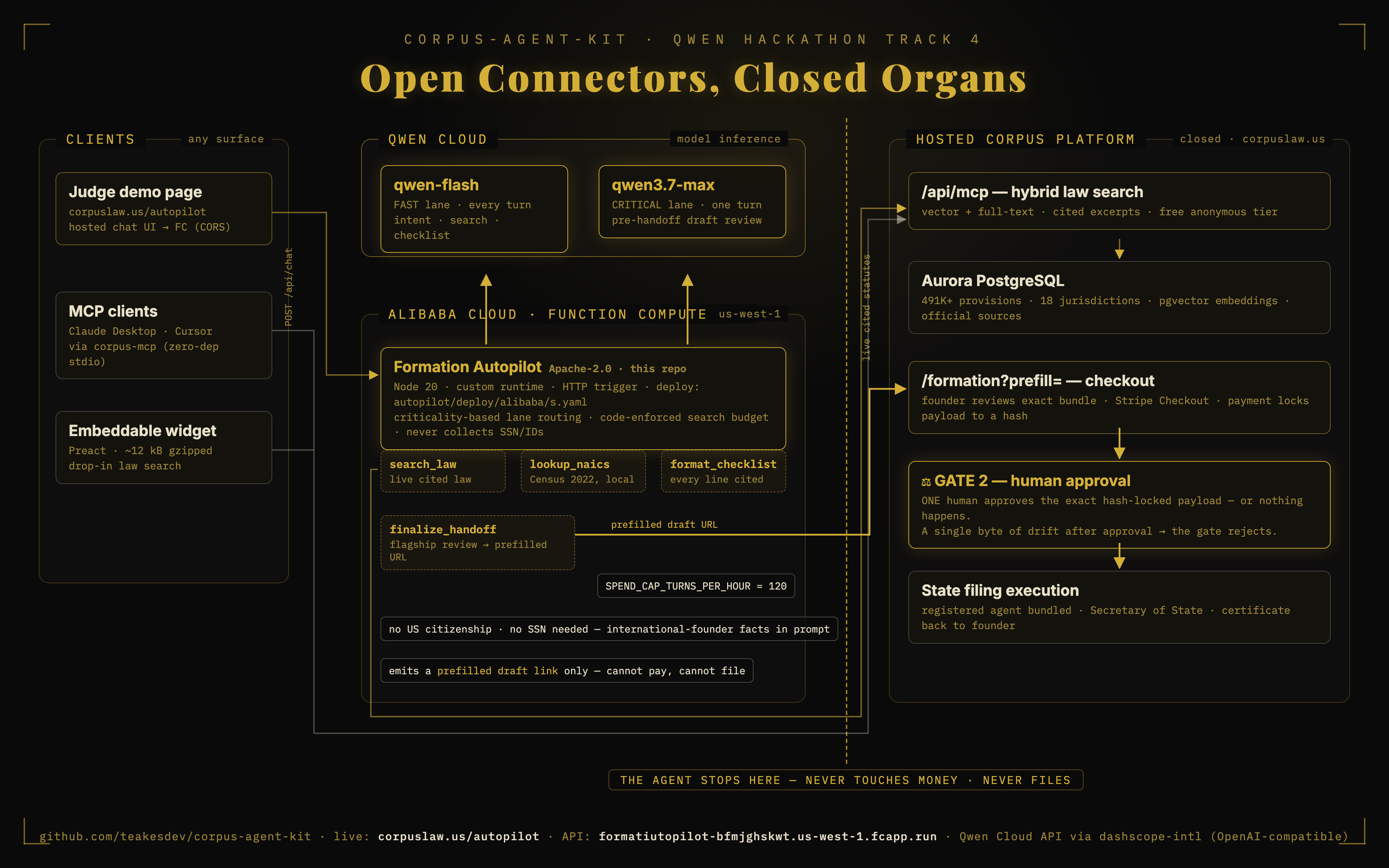
See docs/architecture.md for the Mermaid source.
What's open vs. what's hosted
| Layer | This repo (Apache-2.0) | Hosted Corpus platform (closed) |
|---|---|---|
| Formation Autopilot agent | ✅ autopilot/ |
— |
| Two-lane Qwen routing | ✅ autopilot/src/ |
— |
MCP stdio bridge (corpus-mcp) |
✅ mcp-server/ |
— |
| Embeddable widget | ✅ widget/ |
— |
| Law database (700,000+ provisions, Aurora) | — | ✅ |
Hybrid search engine + /api/mcp |
— | ✅ |
/formation checkout + GATE 2 |
— | ✅ |
| Stripe payment + state filing execution | — | ✅ |
Two-lane model routing
Legacy /api/chat uses two Qwen models with different cost/quality profiles:
- Fast lane (
QWEN_MODEL_FAST, defaultqwen-flash-2025-07-28): all standard turns — intent parsing, law search, checklist generation. Low latency, low spend. - Critical lane (
QWEN_MODEL_CRITICAL, defaultqwen3.7-max): the final pre-handoff draft review only. Higher quality for the one turn that shapes the prefilled filing URL.
The lane switch is automatic. Routing logic lives in autopilot/src/agent.ts.
The hourly spend cap (SPEND_CAP_TURNS_PER_HOUR) applies across both lanes.
The sourced /api/plan path builds deterministic guide/catalog items and uses
the fast lane only for optional ordering; model output cannot add legal sources.
Human in the loop (gates)
Filing (GATE 2) — unchanged. The autopilot / MCP formation flow produces a prefilled draft / handoff URL. Agents never auto-file. On the Corpus platform, every filing payload still passes GATE 2: a human reviews and approves a snapshot of the exact filing payload, cryptographically bound to a hash of that payload. If the payload changes by a single byte after approval, the gate rejects it. The agent is architecturally incapable of bypassing filing approval.
Spend — updated. Agents may settle formation (and related) charges in USDC (Solana) with email confirmation only — no extra human review of the payment itself. Card / web checkout human flows still exist on corpuslaw.us. Docs refer to this as a USDC checkout / pay request via Corpus until the exact MCP tool id is named.
Sept 15 demo path — unchanged. formation.requirements → draft →
formation.handoff COMPLETE → approval link. Completing USDC pay is not
required for the livestream demo.
Quickstart
Prerequisites
node >=20
npm >=9
Clone and install all workspaces:
git clone https://github.com/teakesdev/corpus-agent-kit.git
cd corpus-agent-kit
npm install
Environment variables
Copy and fill .env.example (required for autopilot; mcp-server and widget
read CORPUS_BASE_URL / CORPUS_API_KEY from env at runtime):
cp .env.example .env
# edit .env — at minimum set QWEN_API_KEY and CORPUS_API_KEY
| Variable | Default | Purpose |
|---|---|---|
QWEN_API_KEY |
(required) | Qwen Cloud API key |
QWEN_BASE_URL |
(required) | Qwen OpenAI-compatible base URL (e.g. https://dashscope-intl.aliyuncs.com/compatible-mode/v1) |
QWEN_MODEL_FAST |
qwen-flash-2025-07-28 |
Fast-lane model — standard turns |
QWEN_MODEL_CRITICAL |
qwen3.7-max |
Critical-lane model — pre-handoff review |
CORPUS_BASE_URL |
https://corpuslaw.us |
Hosted Corpus platform base URL |
CORPUS_API_KEY |
(optional) | Corpus platform API key (optional — anonymous is rate-limited) |
SPEND_CAP_TURNS_PER_HOUR |
120 |
Abuse guard: max agent turns per hour |
PORT |
9000 |
HTTP server port (autopilot backend) |
autopilot — Formation Autopilot agent
cp .env.example .env        # fill QWEN_API_KEY + CORPUS_API_KEY
npm install
npm run build               # compiles all workspaces
cd autopilot && npm start   # starts the autopilot HTTP server
# open http://localhost:9000
The server exposes:
GET /healthz— liveness probePOST /api/chat— agent turn endpointPOST /api/plan— planning with guide and catalog sources; unresolved law remains Needs checkingPOST /api/plan/handoff— validate a ready-mode draft through the hosted handoffGET /— chat UI
Deploy to Alibaba Cloud Function Compute: see autopilot/deploy/alibaba/README.md.
mcp-server — stdio MCP bridge
Most clients do not need this. The hosted endpoint
https://corpuslaw.us/api/mcp speaks streamable-HTTP MCP directly — see
Start here. Use
this bridge only for a client that can launch a stdio process but cannot speak
HTTP MCP.
{
  "mcpServers": {
    "corpus-law": {
      "command": "npx",
      "args": ["-y", "@corpuslaw/mcp-server"],
      "env": { "CORPUS_API_KEY": "your-key-here" }
    }
  }
}
Nothing to clone or build. The bridge forwards every MCP request to the hosted
endpoint, adding your key — so formation handoffs it produces are attributed
to you. CORPUS_API_KEY is optional; without it the bridge runs on the
anonymous allotment.
Use the full scoped name.
npx corpus-mcpresolves to an unrelated package on npm — only@corpuslaw/mcp-serveris ours.
cd mcp-server && npm install && npm run build
{
  "mcpServers": {
    "corpus-law": {
      "command": "node",
      "args": ["/absolute/path/to/corpus-agent-kit/mcp-server/dist/index.js"],
      "env": { "CORPUS_API_KEY": "your-key-here" }
    }
  }
}
Replace /absolute/path/to/corpus-agent-kit with the path to your clone.
widget — embeddable law-search
cd widget
npm run build               # outputs dist/widget.js (loader) and dist/widget-app.js (app)
Embed in any page using the hosted loader. Point src at the Corpus host (a relative
path would 404 on the host page's own origin) and pass your widget key (pk_…):
<script async src="https://corpuslaw.us/widget/widget.js"
        data-corpus-key="pk_live_…"
        data-corpus-origin="https://corpuslaw.us"></script>
Deploy to Alibaba Cloud
See autopilot/deploy/alibaba/README.md for
Function Compute deploy instructions (Serverless Devs s CLI).
License
Apache-2.0 — see LICENSE.
Corpus Agent Kit MCP Fragen
Kann der AI Agent Geschäftsdokumente automatisch einreichen?
Nein, Agents führen niemals automatische Einreichungen durch. Jede Einreichung erfordert einen menschlichen Approval Gate, bei dem eine Person den Payload vor dem Absenden überprüft.