
PayPilot MCP server
Commit 12. Nov. 2026Ein agentisches System, das fehlgeschlagene Abonnement-Zahlungen diagnostiziert, Retry-Strategien festlegt und Mahn-E-Mails mithilfe von deterministischen Regeln und RAG erstellt.
Auch bekannt als IvanSFlowGit/paypilot, paypilot
- Stars
- 0
- Tools
- 3
- Downloads, 30 Tage
- 310
- Neueste Version
- 0.1.1
- Letzter Commit
- 12. Nov. 2026
- Lizenz
- —
Was ist PayPilot MCP?
PayPilot ist ein MCP server. Ein agentisches System, das fehlgeschlagene Abonnement-Zahlungen diagnostiziert, Retry-Strategien festlegt und Mahn-E-Mails mithilfe von deterministischen Regeln und RAG erstellt. Er stellt 3 Tools bereit, etwa lookup_return_code, list_decisions, explain.
Zusammenfassung generiert aus dem README des Projekts
Über PayPilot MCP server
PayPilot ist ein agentisches System, das darauf ausgelegt ist, fehlgeschlagene Abonnement-Zahlungen zu verwalten, indem es deterministische Logik mit generativer KI kombiniert. Es wurde für Entwickler und Unternehmen entwickelt, die wiederkehrende Zahlungsausfälle durch automatisierte Diagnose, Retry-Planung und das Erstellen von Mahn-E-Mails handhaben müssen. Das System nutzt einen LangGraph-Agenten, um Events von Plattformen wie Stripe oder Recharge zu verarbeiten und einen Zahlungsausfall in einen strukturierten Recovery-Plan zu verwandeln.
Nutzer können dies als FastAPI-Service bereitstellen. Während die Kernlogik der Entscheidungsfindung und die Retry-Zyklen durch eine feste Regel-Tabelle gesteuert werden, um Vorhersehbarkeit zu gewährleisten, kann das System ein LLM nutzen, um personalisierte Nachrichten und Diagnosen zu entwerfen, wenn das Flag PAYPILOT_LLM_DRAFT aktiviert ist. Es benötigt einen OPENAI_API_KEY für das embedding-basierte RAG, kann aber ohne diesen auf einen lexikalischen Keyword-Retriever zurückgreifen. Um die Sicherheit zu gewährleisten, ist das System so konzipiert, dass ohne menschliche Freigabe und eine aktive Allowlist keine E-Mails versendet werden.
Was du damit machen kannst
- 1Automatisierung von Subscription-Recovery-WorkflowsEin AI-Client kann ein fehlgeschlagenes Zahlungsevent senden, um eine vollständige Recovery-Strategie inklusive Risikobewertung und Retry-Timing zu generieren.
- 2Erstellung personalisierter Mahn-E-MailsEin Entwickler kann das System nutzen, um empathische, kontextbezogene Nachrichten basierend auf einem spezifischen Dunning-Playbook zu erstellen.
- 3Analyse der finanziellen Auswirkungen von ZahlungsausfällenEin Nutzer kann Batches von fehlgeschlagenen Zahlungen verarbeiten, um den gefährdeten Gesamtumsatz und die erwarteten Recovery-Beträge zu berechnen.
- 4Integration mit Stripe WebhooksDer Server kann auf Echtzeit-Stripe-Events hören, um den Recovery-Graph automatisch auszulösen.
Geschrieben aus dem README des Projekts. Jeder Use Case wurde gegen ein Zitat daraus geprüft.
So installierst du PayPilot MCP
Formate geprüft am 10. Nov. 2026Zu Cursor hinzufügenZu Goose hinzufügenPayPilot MCP in Claude Code installieren
$ claude mcp add paypilot -- uvx paypilot-ach-returns-mcpPayPilot MCP in Cursor installieren
~/.cursor/mcp.json
{
  "mcpServers": {
    "paypilot": {
      "command": "uvx",
      "args": [
        "paypilot-ach-returns-mcp"
      ]
    }
  }
}PayPilot MCP in VS Code installieren
.vscode/mcp.json
{
  "servers": {
    "paypilot": {
      "type": "stdio",
      "command": "uvx",
      "args": [
        "paypilot-ach-returns-mcp"
      ]
    }
  }
}PayPilot MCP in VS Code CLI installieren
$ code --add-mcp '{"name":"paypilot","type":"stdio","command":"uvx","args":["paypilot-ach-returns-mcp"]}'PayPilot MCP in Claude Desktop installieren
claude_desktop_config.json
{
  "mcpServers": {
    "paypilot": {
      "command": "uvx",
      "args": [
        "paypilot-ach-returns-mcp"
      ]
    }
  }
}PayPilot MCP in Codex installieren
$ codex mcp add paypilot -- uvx paypilot-ach-returns-mcpPayPilot MCP in Codex config.toml installieren
~/.codex/config.toml
[mcp_servers.paypilot]
command = "uvx"
args = ["paypilot-ach-returns-mcp"]
PayPilot MCP in Gemini CLI installieren
$ gemini mcp add -s user paypilot uvx -- paypilot-ach-returns-mcpPayPilot MCP in Gemini settings.json installieren
~/.gemini/settings.json
{
  "mcpServers": {
    "paypilot": {
      "command": "uvx",
      "args": [
        "paypilot-ach-returns-mcp"
      ]
    }
  }
}PayPilot MCP tools 3
Erkannt aus dem READMElookup_return_codelist_decisionsexplain
| lookup_return_code | — | |
| list_decisions | — | |
| explain | — |
Konfiguration
PAYPILOT_CONTRACT_BASE_URLPAYPILOT_CONTRACT_TOKENPAYPILOT_DEMO_EMAILPAYPILOT_TENANT
| Name | Beschreibung | Typ |
|---|---|---|
| PAYPILOT_CONTRACT_BASE_URL | — | |
| PAYPILOT_CONTRACT_TOKEN | — | |
| PAYPILOT_DEMO_EMAIL | — | |
| PAYPILOT_TENANT | — |
Automatisierte Checks
Geluften am 14. Nov. 2026Vollständiger Bericht →Noch nicht verifiziert. Ein Server benötigt einen Score von 80, keine kritischen Befunde und genug Daten für unsere Prüfung. Wie die Checks funktionieren · Was du für mehr Punkte verbessern kannst

- Source Repository verknüpft und erreichbarivansflowgit/paypilot is public and reachablegithub.com/ivansflowgit/paypilot ↗Bestanden
- Paket nennt dieses Repository als Quellepaypilot-ach-returns-mcp names ivansflowgit/paypilot as sourcepypi.org/project/paypilot-ach-returns-mcp/ ↗Bestanden
- Build-Provenienz (Sigstore-Attestierung)No build attestation published for this releaseNicht geprüft
- Open Source Lizenz (OSI)No licenseBefund
- Commit oder Release im letzten JahrLast commit or release 2026-11-12github.com/ivansflowgit/paypilot ↗Bestanden
- OpenSSF ScorecardNicht geprüft
- Package-Name ähnelt keinem populären PackageNo popular package one edit away from paypilot-ach-returns-mcpBestanden
- Keine kritischen Advisories im Paket oder seinen Abhängigkeiten29 resolved dependencies checked; no critical advisoryosv.dev ↗Bestanden
- Keine versteckten Anweisungen an das ModellInstruction aimed at the model found in the description or READMEBefund
- Destruktive Tools sind markiertNo tool named like delete, drop or execBestanden
- Remote-Endpoint beantwortet den MCP-HandshakeNicht geprüft
README
Auf GitHub ansehenPayPilot
A worked example of an agent that handles money and can be told no: failed subscription payments, decided by a fixed rules table, recorded with the rule that fired, and sent only after a person approves.
Live demo -> paypilot.fly.dev - try it in the browser, no setup or API key required.



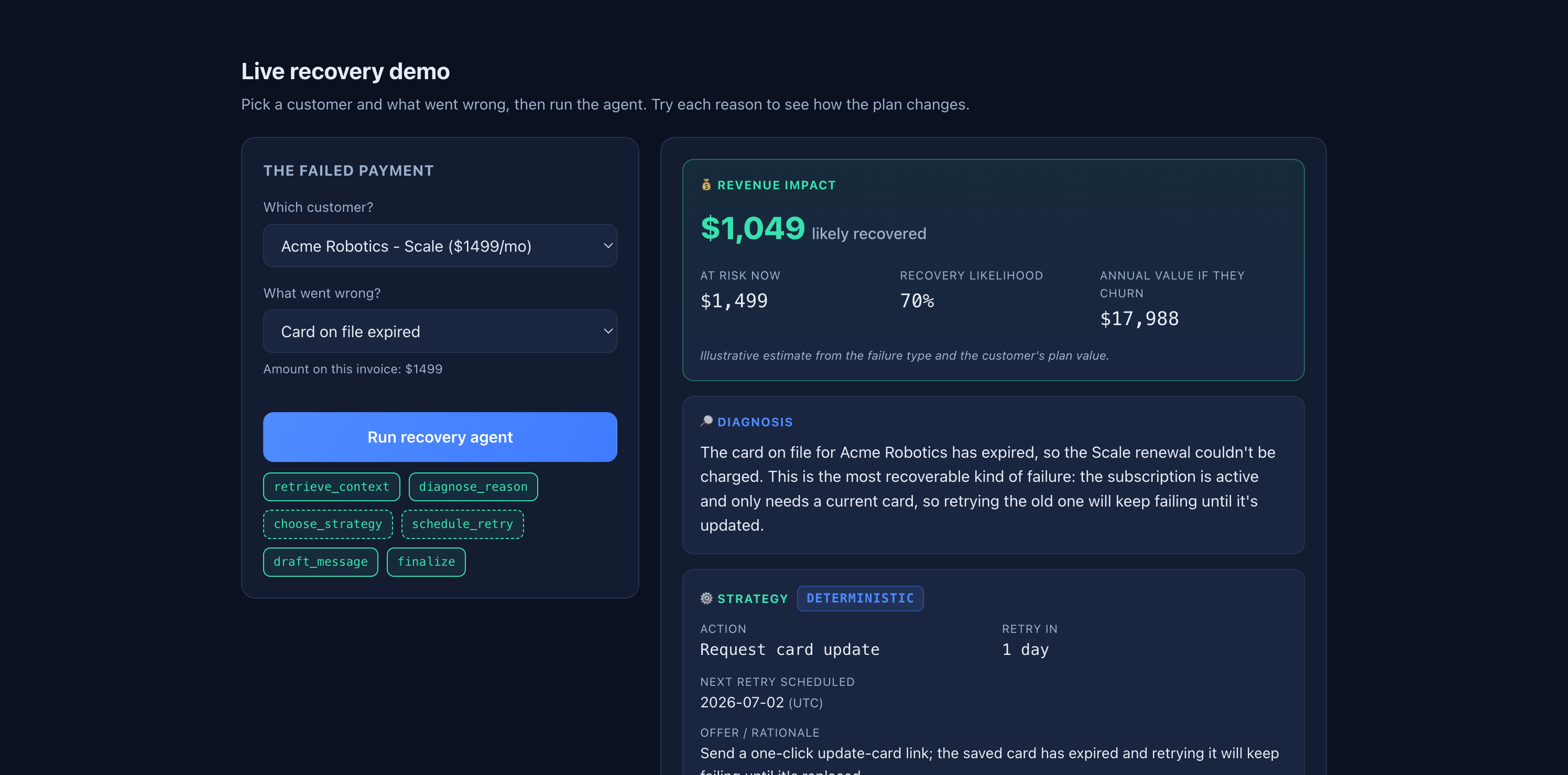
The hard part of putting a model near money is not the model. It is the part where
the agent can act and somebody has to answer for it. PayPilot is built around that
part. A failed payment arrives, a fixed rules table (app/decision.py) decides what
happens next, the model writes only the wording, every decision stores the rule that
fired, and nothing leaves without a person's approval. The recovery email is the worked
example; the refusals are the point.
When a recurring charge fails, PayPilot turns the invoice.payment_failed event into
a diagnosis, a retry strategy and a drafted dunning email in a single API call.
It's built as a small, readable LangGraph agent with retrieval-augmented generation (RAG) over a dunning playbook, exposed through a FastAPI endpoint. The whole thing runs its test suite with no API key and no network.
How it works
A failed-payment event flows through a seven-node LangGraph StateGraph. Each node
enriches a shared, typed RecoveryState and hands it to the next:
flowchart LR
    A[retrieve_context] --> R[assess_risk]
    R --> B[diagnose_reason]
    B --> C[choose_strategy]
    C --> S[schedule_retry]
    S --> D[draft_message]
    D --> E[finalize]
    E --> F([END])
| Node | What it does |
|---|---|
retrieve_context |
Loads the customer record and pulls relevant snippets from the dunning playbook via the RAG retriever. |
assess_risk |
Deterministic (no LLM): scores churn risk (low/medium/high) from the dunning attempt number and the customer's recent failure streak. |
diagnose_reason |
Committed template by default, LLM only with PAYPILOT_LLM_DRAFT=1: a 1-2 sentence, playbook-grounded diagnosis of why the payment failed, reflecting the churn risk. |
choose_strategy |
Deterministic (no LLM): maps the failure code to a fixed action + retry cadence, then tightens it when churn risk is high. Stable and unit-testable. |
schedule_retry |
Deterministic (no LLM): turns the cadence into a concrete next_retry_at UTC time, ready to hand to a scheduler. |
draft_message |
Committed template by default, LLM only with PAYPILOT_LLM_DRAFT=1: a short, warm dunning email with one clear call to action. |
finalize |
Assembles the {diagnosis, risk, strategy, schedule, message, impact} response payload. |
Why RAG?
The recovery quality depends on dunning best-practice - retry timing, tone, when to
offer a grace period. Rather than bake that into prompts, PayPilot keeps it in an
editable knowledge source (data/playbook.md) that the
retriever feeds into the diagnosis and drafting nodes.
Which retriever depends on configuration, and it is worth being precise about
this. With OPENAI_API_KEY set, app/ingest.py builds a FAISS index over the
playbook using OpenAI embeddings (k=3). With no key - which is how the public
demo runs - it falls back to a lexical keyword retriever, so no FAISS index and
no embedding call is involved in anything a visitor sees.
And the playbook only changes the output on the LLM path. On the default
zero-inference path the committed templates are rendered as-is and retrieved
context is not consulted, so editing playbook.md changes nothing until
PAYPILOT_LLM_DRAFT=1 is set. Playbook edits are input to the build-time
generation step, not to every request.
What it refuses, and what is not built
- It does not send unless sending is switched on, a person approved the message and the
recipient is on the allowlist. An empty allowlist means nobody (
app/mailer.py). - A draft carrying a link it did not sanction, or anything shaped like a secret, is
swapped for fixed copy; a send that fails the same check is refused (
app/safety.py). - It does not return a decision it could not record: no audit row, a 503 (
app/decision.py). - A code the table does not list fires a row named
default, and the decision'sgates_checkedreceipt saysfell_throughrather thanmatched.
A refusal view, in two parts. A body POST /decide refuses leaves a row in
decision_refusals: the gate that refused and a machine reason code, never the rejected
input, and the 422 carries the row's refusal_id. Every mailer and approval refusal was
already recorded as a suppressed message with a reason code, so those are not copied.
GET /refusals (admin-gated, read-only) lists both, newest first, with the gate each reason
belongs to (app/refusals.py). A test walks the mailer and approval source and fails when a
reason code the code can write has no gate, and a reason the map does not know is listed as
unclassified rather than dropped. It also lists decisions that fell through to the default
row, and drafts the output guard replaced with fixed copy. That last source is the optional
event log (PAYPILOT_AUDIT_DB_PATH), which is absent on the public deployment on purpose, so
the response carries a sources map saying which sources were read: an empty swap list with
audit_event_log: not_configured is not the same as no swaps. In multi mode that log is
platform-level and is not listed (not_tenant_scoped). In single mode the view reads decision
refusals only for the client id equal to the tenant id; a different token map client id is not
listed. The decision audit has no update or delete on the record path;
erasing a client for GDPR is a separate, named function. See docs/claims.md.
Why a deterministic strategy node?
choose_strategy is intentionally not an LLM call. Retry cadence and the chosen
action come from a fixed rules table (app/decision.py) keyed on the failure code,
which comes from Stripe, Recharge, Chargebee or Loop:
| Failure code | Retry in | Action | Tone |
|---|---|---|---|
card_expired |
~1 day | request card update | Friendly, routine |
insufficient_funds |
~3 days | wait and retry | Soft, no pressure |
generic_decline |
~2 days | retry and verify | Calm, helpful |
issuer_do_not_retry |
never | request new payment method | Plain, no blame |
card_details_invalid |
never | request card update | Plain, no blame |
direct_debit_not_retried |
never | request manual payment | Plain, no blame |
retries_exhausted |
never | request new payment method | Plain, no blame |
The LLM writes the message; the policy stays predictable.
irreversible-reach maps which model-produced values in an agent can reach an action that cannot be undone. Its PayPilot manifest marks sending an email as PayPilot's only irreversible action, with deterministic guards in front of it; remove those guards and it fails. A manifest describes code, it does not test it.
Risk-aware escalation
assess_risk reads the dunning attempt number and the customer's recent
payment history (from data/customers.json) and buckets churn risk. When it's
high - a third attempt, or a run of recent failures - choose_strategy
tightens the retry cadence and marks the strategy escalated, the diagnosis
calls out the urgency, and impact discounts the recovery odds for a customer
who keeps bouncing. So the agent reasons about history, not just the single
event in front of it.
Quickstart
# 1. Install
python -m venv .venv && source .venv/bin/activate
pip install -r requirements.txt

# 2. Configure (only needed to call the live LLM; tests don't need it)
cp .env.example .env   # then add your OPENAI_API_KEY

# 3. Run the API. PAYPILOT_TENANT=demo serves the bundled demo fixtures (data/customers.json).
PAYPILOT_TENANT=demo uvicorn app.api:app --reload
Call it
curl -s http://localhost:8000/payment-failed \
  -H 'Content-Type: application/json' \
  -d '{
        "customer_id": "cust_001",
        "amount": 1499.0,
        "currency": "usd",
        "failure_code": "card_expired",
        "attempt": 1
      }' | jq
{
  "diagnosis": "The card on file for Acme Robotics has expired, so the Scale renewal couldn't be charged; ...",
  "risk": { "attempt": 1, "prior_failures": 0, "churn_risk": "low", "escalate": false },
  "strategy": { "action": "request_card_update", "retry_in_days": 1, "offer": "...", "escalated": false },
  "schedule": { "retry_in_days": 1, "next_retry_at": "2026-07-02T09:00:00+00:00", "retry_on": "2026-07-02", "timezone": "UTC" },
  "message": "Hello Acme Robotics, we tried to renew your Scale plan but the card we have on file has expired ...",
  "impact": { "amount_at_risk": 1499.0, "currency": "USD", "recovery_likelihood": 0.7, "expected_recovered": 1049.3, "annual_value_at_risk": 17988.0, "churn_risk": "low" }
}
GET /health returns {"status": "ok"} for liveness checks. The full response
schema (typed with pydantic) is browsable at /docs.
The endpoint is rate limited per client IP, and the response payload is a typed
RecoveryResponse (diagnosis, risk, strategy, schedule, message,
impact), so the contract shows up precisely in the OpenAPI docs.
POST /payment-failed/batch runs a whole billing run (up to 50 events) in one
call and adds a portfolio aggregate - total at risk, total expected recovered,
and how many accounts are high churn risk. GET /portfolio-impact rolls that up
across the demo customers and powers the recoverable-revenue headline on the
landing page.
Speaks Stripe
Status: no client traffic reaches this deployment, so no merchant's live Stripe
delivery has either. The handler is exercised offline by tests/test_stripe.py.
POST /webhooks/stripe accepts a real Stripe invoice.payment_failed event. It
verifies the Stripe-Signature header (HMAC-SHA256) when STRIPE_WEBHOOK_SECRET
is set, acknowledges other event types with a 200 so Stripe won't retry, maps
Stripe decline codes (expired_card, insufficient_funds, ...) to PayPilot's
failure codes, and runs the recovery graph. Point a webhook (or
stripe trigger invoice.payment_failed) at it; add
metadata.paypilot_customer_id to resolve a demo customer.
Speaks Recharge
Status: this deployment carries no client traffic, so no merchant's live Recharge
delivery has reached it. The handler is exercised offline by tests/test_recharge.py.
POST /webhooks/recharge accepts Recharge charge/failed and
charge/max_retries_reached deliveries for Shopify subscription stores. It checks
X-Recharge-Hmac-Sha256 against RECHARGE_CLIENT_SECRET the way Recharge
documents it, and maps every one of Recharge's 109 published error types to a
PayPilot failure code (the full table). Recharge runs its own retries, so when it will retry, its
retry_date is reported as the schedule with source="recharge" and no customer
email is drafted (message_suppressed: "recharge_retry_scheduled"). Errors that are
not a payment problem the customer can fix (inventory, shipping, tax, test mode)
and error types PayPilot does not recognise are acknowledged and not run, so no
customer gets an email about them.
A merchant comes on in three steps. They create an API token and copy the API
Client Secret from their Recharge admin; the secret goes on the deployment as
RECHARGE_CLIENT_SECRET; then
RECHARGE_API_TOKEN=... python scripts/recharge_register_webhooks.py --apply
registers both webhooks against this deployment (dry run without --apply, and
safe to re-run).
The webhook is idempotent on the Stripe event id, so a retried delivery
replays the stored result instead of re-running the graph. POST /payment-failed
and /batch accept an optional Idempotency-Key header for the same guarantee.
Every response carries X-Process-Time and X-Request-ID headers, emits a
structured JSON access log, and 429s include Retry-After. GET /metrics (admin token required)
returns a JSON snapshot (request counts by status, average latency, recoveries
run, total expected recovered). Batches roll up per currency, so a mixed
USD/EUR/GBP billing run stays correct (aggregate.by_currency).
GET /usage (admin token, hidden from the schema) answers "has anyone outside called the
API": a tally per route and client network prefix that survives restarts, stored beside the
database on the volume. It keeps the route template, status, a coarse /24 prefix and a count;
no body, no headers, no query string, no full address, and rows are deleted after 90 days.
Pass ?exclude=<your prefixes> to remove your own traffic.
For discovery, the app also serves /robots.txt, /sitemap.xml, and an
/llms.txt summary for AI answer engines,
and the landing page ships SoftwareApplication + FAQPage JSON-LD.
The closed recovery loop
PayPilot does not stop at drafting. It records what failed, what it sent, and what happened next, so "we recovered X" is a figure you can audit rather than a claim.
invoice.payment_failed  ->  record  ->  strategy  ->  portal link  ->  email
                                                                        |
        invoice.paid / payment_succeeded  ->  recovered  <---------------+
        customer.subscription.deleted     ->  churned
Per-invoice state machine: failed -> messaged -> clicked -> recovered | churned | exhausted. Illegal moves raise rather than silently overwrite, so the
dashboard can never contradict revenue it already reported. Amounts are stored
in integer minor units with a currency code. Floats appear only at the
presentation edge, never in storage or arithmetic.
State only advances to messaged on a real send. A dry run, a suppressed
recipient or a provider failure leaves the invoice at failed, because claiming
we contacted someone we did not is exactly what this ledger exists to prevent.
An invoice we never saw fail is never counted as a recovery. Most invoices in a Stripe account are paid without ever failing, and counting those would inflate the one number the product is judged on.
Honest attribution
Some failed invoices recover on their own: Stripe retries them, and customers
fix their cards unprompted. So /report splits invoices into three arms -
treated (actually messaged), holdout (deliberately withheld) and untouched
(a dry run or suppressed send) - and reports each separately. A lift figure is
withheld until both arms reach 30 invoices, and says so rather than printing a
confident percentage from four data points.
Holdout assignment is a deterministic hash of the invoice id, stable across restarts and reproducible from invoice ids alone. It defaults to 0 percent: withholding dunning from paying customers is a decision, not a default.
A public sample of the dashboard, on a fixed cohort and labelled as sample data, is at /report/sample. The real one is admin-gated: it holds revenue data and reveals which invoices were withheld from dunning.
Watch every refusal gate fire
make refusal-walk sends seven invented requests through the real code paths (a refused
body, a fall-through, an allowlist refusal, an output-guard refusal, a swapped draft) and
two controls that must NOT appear (a matched decision and a provider failure), prints what
each did and the view GET /refusals serves, and exits non-zero if an expected row is
missing or an unexpected one is present. No key, no network, nothing leaves the machine.
tests/test_refusal_walk.py runs it in the suite. The same run is published at /refusals-sample,
rendered by scripts/render_refusals_page.py from what the walk returned, so a gate that stops
refusing makes the page stale and the build red. Every row on it is invented.
Prove it end to end
PAYPILOT_DEMO_EMAIL=you@example.com make demo-loop
Drives Stripe test mode through the whole cycle with a test clock: a subscription is created and paid, its card goes bad, a month passes, the renewal genuinely fails, the recovery runs, the card is fixed, the invoice is paid, and the dashboard is printed before and after. It refuses to run against a live key.
Zero-token architecture
The default path performs no inference at all. A dunning email for a given
failure code is the same class of output every time, so the copy is generated
once, reviewed by a human, committed as data/templates/dunning.json, and
filled deterministically at runtime. That makes what a customer reads reviewable
the way code is reviewable: it diffs, and changing it is a pull request.
An OPENAI_API_KEY alone does not enable chat inference; live drafting also
requires PAYPILOT_LLM_DRAFT=1.
One honest caveat: a key does still enable embeddings. With OPENAI_API_KEY
set, the retriever builds a FAISS index over the playbook once per process (a
lazy singleton in app/ingest.py) and then embeds the query on each request.
So the index cost is paid once, but per-request query embedding is a real, small
token cost on a path otherwise described as zero-inference.
Three CI gates keep the rest honest: a full recovery must construct no chat
model, a ChatOpenAI( call site without a written BUILD-TIME / CACHEABLE /
TRUE-RUNTIME classification fails the build, and the committed copy must cover
every failure code and contain no URL. The call-site gate matches on that
literal string, so it would not catch a different SDK or a call outside app/.
Multilingual copy, on the same seam
A locale is a dimension on the committed catalogue rather than a second system: the generator writes it, a human reviews it, the runtime fills it, and no model is called on the path. Two decisions are worth naming.
A locale is all or nothing. A half-translated catalogue is not merged key by
key with English, because that mails one customer a Spanish subject over an
English body, which reads as broken software rather than as a missing
translation. A catalogue that does not cover every kind and every failure code is
refused as a locale and English is served whole, with the reason readable per
locale (incomplete_locales()). Completeness is measured against the English
catalogue rather than a fixed list, so adding a failure code to English makes
every translation incomplete until it is translated, which is the direction that
fails safe.
The fallback is reported, not silent. render_with_locale() returns the
locale actually used, because a silent fallback is indistinguishable from a
translation that is working, and a climbing fallback count is the measurement
that says which language to translate next. A missing catalogue falls back rather
than failing closed: an English dunning email recovers money where no email
recovers none. Missing copy altogether is still fatal.
A language is never derived from the currency, and a test greps the module's own source to keep it that way. EUR spans twenty countries, USD is legal tender in Ecuador and Panama, and GBP is not a language.
State today, measured rather than implied: available_locales() returns
['en']. The machinery is complete and runnable and there is one catalogue in
it. scripts/generate_templates.py --locale translates the live English rather
than regenerating per language, so the languages cannot drift apart in meaning,
and it refuses a draft that renamed a {name}, {plan} or {business}
placeholder, since str.format would then leave a customer reading a literal
brace. Producing a reviewed Spanish catalogue is one command and a speaker's
review, not a build.
An MCP server over the decision table
An agent asks, the table decides, and the answer carries which rule fired. The
model scores, suggests and drafts; governed logic decides. app/mcp_server.py is
that sentence made callable: an MCP server whose three tools read a fixed
decision table, so the answer cannot be argued with by anything the agent read on
the way in.
Seventeen ACH return codes, five decisions. There are five answers to the one question that decides what happens next: what has to change before this debit can exist again. Nothing, the account details, their instruction, our own entry, or nothing ever will. A table with one row per code is a reference document and the registrar publishes that for free. A table with one row per decision is a rule set, and that is the part a team cannot download.
| Row | Goes again | What has to change first | A person acts first | Codes |
|---|---|---|---|---|
| 1 | yes | nothing | no | R01, R09 |
| 2 | not on this entry | account details | no | R02, R03, R04, R13, R20, R28 |
| 3 | not until they ask | their instruction | no | R08 |
| 4 | corrected only | our own entry | no | R11 |
| 5 | no | nothing will | yes | R05, R07, R10, R14, R15, R16, R29 |
It is published at paypilot.fly.dev/ach-returns
and readable in the repository at
docs/ach-return-decisions.md. Both are generated
from app/ach_return_map.py by scripts/render_ach_page.py, so neither holds the
table and neither can disagree with it.
R11 is the row worth the table. It arrives in the unauthorized family and is
still correctable, so it is the one code where the family and the decision
disagree, and the one thing here that is hard to know.
The default is visible as a default. Every code from R00 to R99 that the
table does not list lands on row 5, where nothing automatic happens, and the
answer comes back with matched set to false and a reason saying it fell through
rather than matched. It is never null and it is never row 1. A caller that cannot
tell a match from a fallback has been handed a guess dressed as an answer.
The three tools
| Tool | Answers |
|---|---|
lookup_return_code |
one code: its row, whether the entry goes again, what has to change first, the wording for the customer, and whether a named person acts first. R01 and R09 also carry the reinitiation limit (at most two times, within 180 days of the original settlement date) with its source; no other code states one |
list_decisions |
the five rows and the codes on each, so the table is legible to an agent rather than only queryable |
explain |
which row fired and why, plus what the table does and does not state about the code's family |
Nothing writes, nothing calls a model, and nothing reaches the network. That is
declared per tool as read_only_hint and open_world_hint: false rather than
promised in prose, so a client can read it off the tool list and
tests/test_mcp_server.py asserts it. The same suite runs every tool again with
socket.socket replaced by a function that raises, which is the claim measured
rather than intended.
PayPilot MCP Fragen
Wie füge ich PayPilot MCP zu Claude Code hinzu?
Führe claude mcp add paypilot -- uvx paypilot-ach-returns-mcp in deinem Terminal aus. Füge --scope user hinzu, damit der Server in jedem Projekt verfügbar ist.
Wie füge ich PayPilot MCP zu Cursor hinzu?
Öffne ~/.cursor/mcp.json und füge den Server unter mcpServers hinzu, mit der Cursor-Config aus dem Installationsabschnitt oben.
Welche Tools bietet PayPilot MCP?
Er stellt 3 Tools bereit, darunter lookup_return_code, list_decisions, explain.
Versendet PayPilot automatisch E-Mails?
Nein, es werden keine E-Mails versendet, es sei denn, der Versand wurde explizit aktiviert, eine Person hat die Nachricht genehmigt und der Empfänger befindet sich auf der Allowlist.
Wie entscheidet das System über eine Retry-Strategie?
Die Strategie wird durch eine deterministische Regel-Tabelle bestimmt, die Fehlercodes spezifischen Aktionen und Retry-Zyklen zuordnet, anstatt ein LLM für Richtlinienentscheidungen zu nutzen.
Kann es Stripe Webhooks verarbeiten?
Ja, es kann echte Stripe invoice.payment_failed Events empfangen und diese mithilfe des Stripe-Signature Headers verifizieren.
Was passiert, wenn ein Fehlercode nicht erkannt wird?
Wenn ein Code nicht in der Tabelle enthalten ist, wird eine Zeile namens default ausgeführt, und der Decision Receipt zeigt an, dass kein spezifischer Match gefunden wurde.